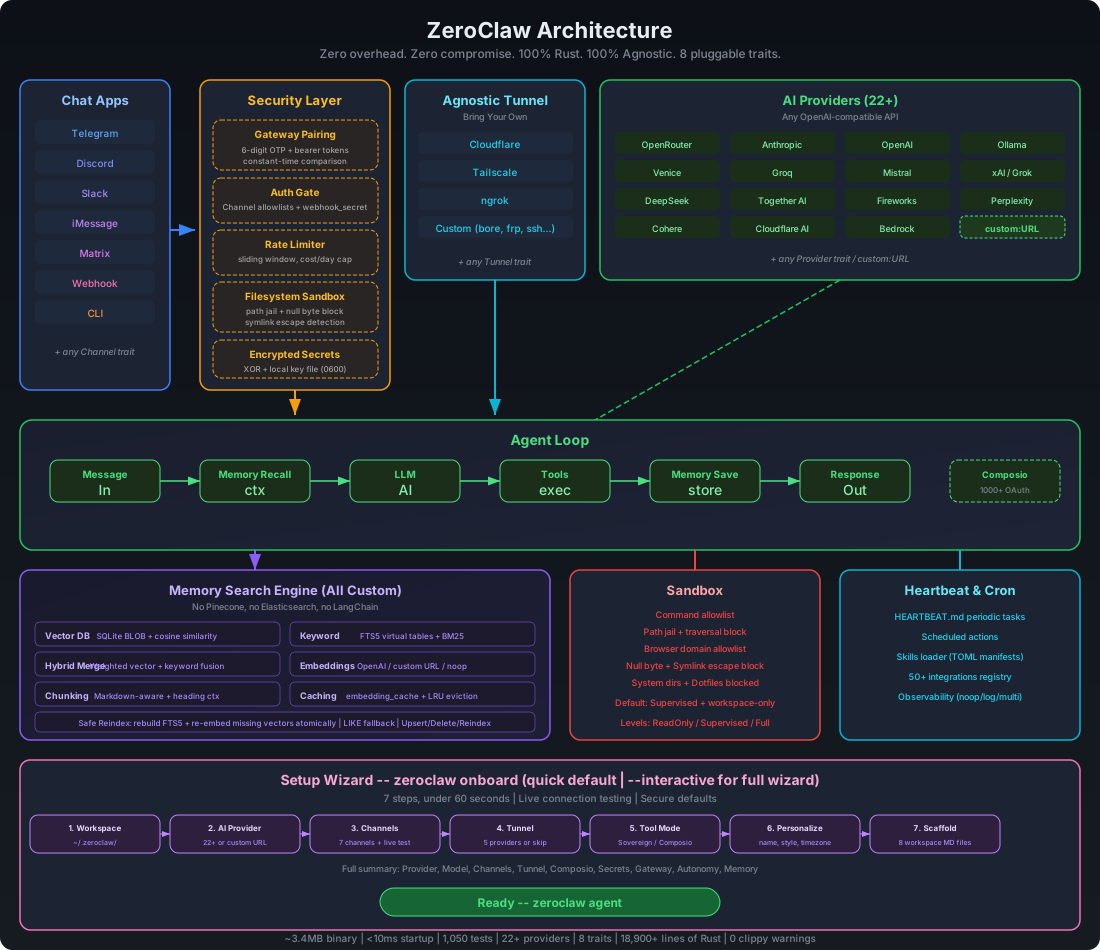
# ZeroClaw Sandboxing Strategies
> ⚠️ **Status: Proposal / Roadmap**
>
> This document describes proposed approaches and may include hypothetical commands or config.
> For current runtime behavior, see [config-reference.md](config-reference.md), [operations-runbook.md](operations-runbook.md), and [troubleshooting.md](troubleshooting.md).
## Problem
ZeroClaw currently has application-layer security (allowlists, path blocking, command injection protection) but lacks OS-level containment. If an attacker is on the allowlist, they can run any allowed command with zeroclaw's user permissions.
## Proposed Solutions
### Option 1: Firejail Integration (Recommended for Linux)
Firejail provides user-space sandboxing with minimal overhead.
```rust
// src/security/firejail.rs
use std::process::Command;
pub struct FirejailSandbox {
enabled: bool,
}
impl FirejailSandbox {
pub fn new() -> Self {
let enabled = which::which("firejail").is_ok();
Self { enabled }
}
pub fn wrap_command(&self, cmd: &mut Command) -> &mut Command {
if !self.enabled {
return cmd;
}
// Firejail wraps any command with sandboxing
let mut jail = Command::new("firejail");
jail.args([
"--private=home", // New home directory
"--private-dev", // Minimal /dev
"--nosound", // No audio
"--no3d", // No 3D acceleration
"--novideo", // No video devices
"--nowheel", // No input devices
"--notv", // No TV devices
"--noprofile", // Skip profile loading
"--quiet", // Suppress warnings
]);
// Append original command
if let Some(program) = cmd.get_program().to_str() {
jail.arg(program);
}
for arg in cmd.get_args() {
if let Some(s) = arg.to_str() {
jail.arg(s);
}
}
// Replace original command with firejail wrapper
*cmd = jail;
cmd
}
}
```
**Config option:**
```toml
[security]
enable_sandbox = true
sandbox_backend = "firejail" # or "none", "bubblewrap", "docker"
```
---
### Option 2: Bubblewrap (Portable, no root required)
Bubblewrap uses user namespaces to create containers.
```bash
# Install bubblewrap
sudo apt install bubblewrap
# Wrap command:
bwrap --ro-bind /usr /usr \
--dev /dev \
--proc /proc \
--bind /workspace /workspace \
--unshare-all \
--share-net \
--die-with-parent \
-- /bin/sh -c "command"
```
---
### Option 3: Docker-in-Docker (Heavyweight but complete isolation)
Run agent tools inside ephemeral containers.
```rust
pub struct DockerSandbox {
image: String,
}
impl DockerSandbox {
pub async fn execute(&self, command: &str, workspace: &Path) -> Result<String> {
let output = Command::new("docker")
.args([
"run", "--rm",
"--memory", "512m",
"--cpus", "1.0",
"--network", "none",
"--volume", &format!("{}:/workspace", workspace.display()),
&self.image,
"sh", "-c", command
])
.output()
.await?;
Ok(String::from_utf8_lossy(&output.stdout).to_string())
}
}
```
---
### Option 4: Landlock (Linux Kernel LSM, Rust native)
Landlock provides file system access control without containers.
```rust
use landlock::{Ruleset, AccessFS};
pub fn apply_landlock() -> Result<()> {
let ruleset = Ruleset::new()
.set_access_fs(AccessFS::read_file | AccessFS::write_file)
.add_path(Path::new("/workspace"), AccessFS::read_file | AccessFS::write_file)?
.add_path(Path::new("/tmp"), AccessFS::read_file | AccessFS::write_file)?
.restrict_self()?;
Ok(())
}
```
---
## Priority Implementation Order
| **P0** | Landlock (Linux only, native) | Low | High (filesystem) |
| **P1** | Firejail integration | Low | Very High |
| **P2** | Bubblewrap wrapper | Medium | Very High |
| **P3** | Docker sandbox mode | High | Complete |
## Config Schema Extension
```toml
[security.sandbox]
enabled = true
# Firejail-specific
[security.sandbox.firejail]
extra_args = ["--seccomp", "--caps.drop=all"]
# Landlock-specific
[security.sandbox.landlock]
readonly_paths = ["/usr", "/bin", "/lib"]
readwrite_paths = ["$HOME/workspace", "/tmp/zeroclaw"]
```
## Testing Strategy
```rust
#[cfg(test)]
mod tests {
#[test]
fn sandbox_blocks_path_traversal() {
// Try to read /etc/passwd through sandbox
let result = sandboxed_execute("cat /etc/passwd");
assert!(result.is_err());
}
#[test]
fn sandbox_allows_workspace_access() {
let result = sandboxed_execute("ls /workspace");
assert!(result.is_ok());
}
#[test]
fn sandbox_no_network_isolation() {
// Ensure network is blocked when configured
let result = sandboxed_execute("curl http://example.com");
assert!(result.is_err());
}
}
```