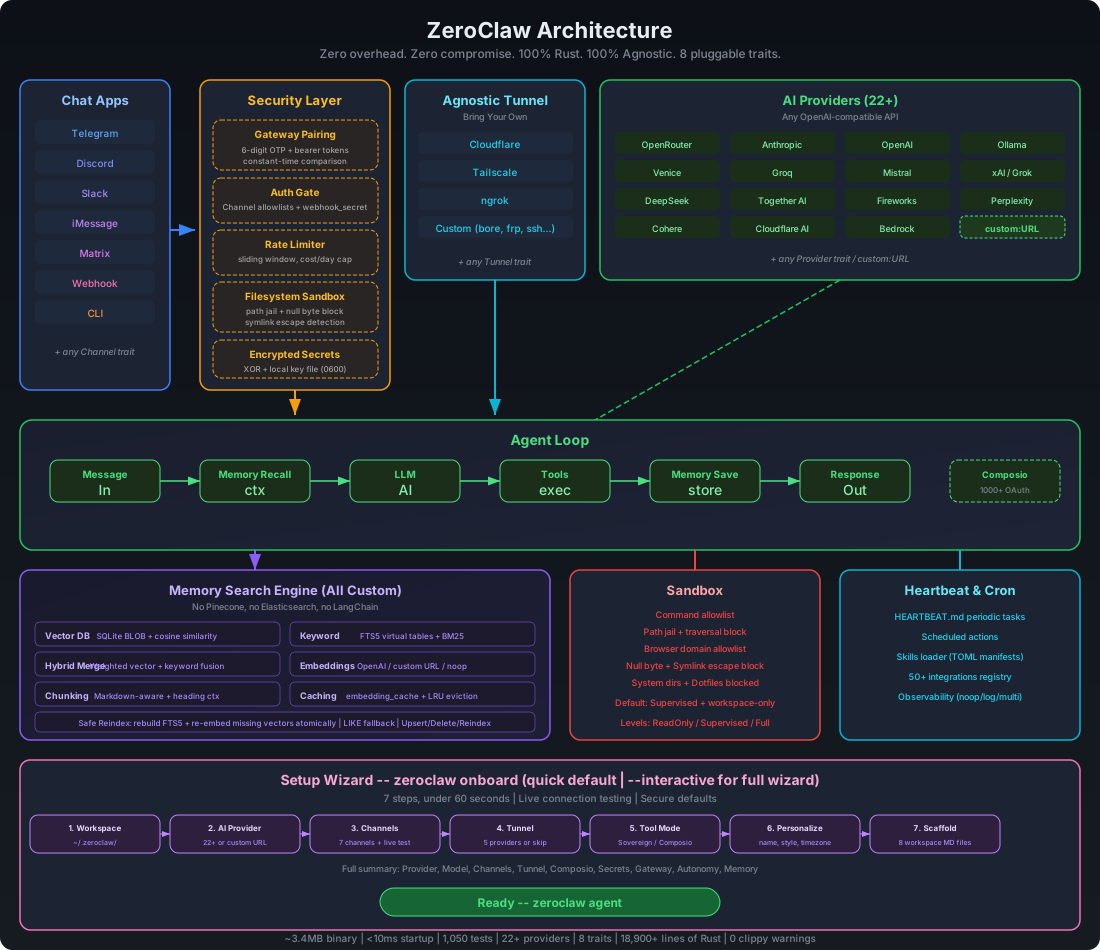
# One-Click Bootstrap
This page defines the fastest supported path to install and initialize ZeroClaw.
Last verified: **February 20, 2026**.
## Option 0: Homebrew (macOS/Linuxbrew)
```bash
brew install zeroclaw
```
## Option A (Recommended): Clone + local script
```bash
git clone https://github.com/zeroclaw-labs/zeroclaw.git
cd zeroclaw
./bootstrap.sh
```
What it does by default:
1. `cargo build --release --locked`
2. `cargo install --path . --force --locked`
### Resource preflight and pre-built flow
Source builds typically require at least:
- **2 GB RAM + swap**
- **6 GB free disk**
When resources are constrained, bootstrap now attempts a pre-built binary first.
```bash
./bootstrap.sh --prefer-prebuilt
```
To require binary-only installation and fail if no compatible release asset exists:
```bash
./bootstrap.sh --prebuilt-only
```
To bypass pre-built flow and force source compilation:
```bash
./bootstrap.sh --force-source-build
```
## Dual-mode bootstrap
Default behavior is **app-only** (build/install ZeroClaw) and expects existing Rust toolchain.
For fresh machines, enable environment bootstrap explicitly:
```bash
./bootstrap.sh --install-system-deps --install-rust
```
Notes:
- `--install-system-deps` installs compiler/build prerequisites (may require `sudo`).
- `--install-rust` installs Rust via `rustup` when missing.
- `--prefer-prebuilt` tries release binary download first, then falls back to source build.
- `--prebuilt-only` disables source fallback.
- `--force-source-build` disables pre-built flow entirely.
## Option B: Remote one-liner
```bash
For high-security environments, prefer Option A so you can review the script before execution.
Legacy compatibility:
```bash
This legacy endpoint prefers forwarding to `scripts/bootstrap.sh` and falls back to legacy source install if unavailable in that revision.
If you run Option B outside a repository checkout, the bootstrap script automatically clones a temporary workspace, builds, installs, and then cleans it up.
## Optional onboarding modes
### Containerized onboarding (Docker)
```bash
./bootstrap.sh --docker
```
This builds a local ZeroClaw image and launches onboarding inside a container while
persisting config/workspace to `./.zeroclaw-docker`.
Container CLI defaults to `docker`. If Docker CLI is unavailable and `podman` exists,
bootstrap auto-falls back to `podman`. You can also set `ZEROCLAW_CONTAINER_CLI`
explicitly (for example: `ZEROCLAW_CONTAINER_CLI=podman ./bootstrap.sh --docker`).
For Podman, bootstrap runs with `--userns keep-id` and `:Z` volume labels so
workspace/config mounts remain writable inside the container.
If you add `--skip-build`, bootstrap skips local image build. It first tries the local
Docker tag (`ZEROCLAW_DOCKER_IMAGE`, default: `zeroclaw-bootstrap:local`); if missing,
it pulls `ghcr.io/zeroclaw-labs/zeroclaw:latest` and tags it locally before running.
### Quick onboarding (non-interactive)
```bash
./bootstrap.sh --onboard --api-key "sk-..." --provider openrouter
```
Or with environment variables:
```bash
ZEROCLAW_API_KEY="sk-..." ZEROCLAW_PROVIDER="openrouter" ./bootstrap.sh --onboard
```
### Interactive onboarding
```bash
./bootstrap.sh --interactive-onboard
```
## Useful flags
- `--install-system-deps`
- `--install-rust`
- `--skip-build` (in `--docker` mode: use local image if present, otherwise pull `ghcr.io/zeroclaw-labs/zeroclaw:latest`)
- `--skip-install`
- `--provider <id>`
See all options:
```bash
./bootstrap.sh --help
```
## Related docs
- [README.md](../README.md)
- [commands-reference.md](commands-reference.md)
- [providers-reference.md](providers-reference.md)
- [channels-reference.md](channels-reference.md)