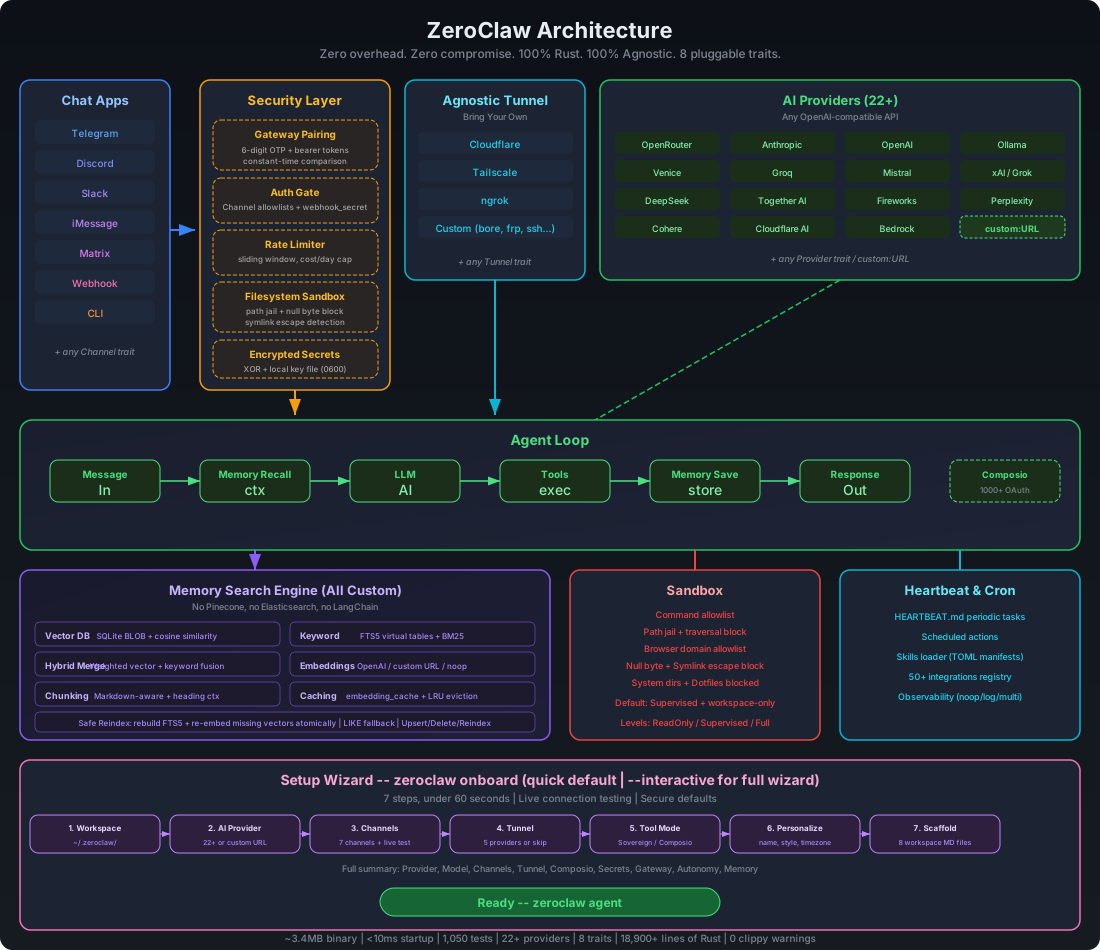
# Agnostic Security: Zero Impact on Portability
> ⚠️ **Status: Proposal / Roadmap**
>
> This document describes proposed approaches and may include hypothetical commands or config.
> For current runtime behavior, see [config-reference.md](config-reference.md), [operations-runbook.md](operations-runbook.md), and [troubleshooting.md](troubleshooting.md).
## Core Question: Will security features break...
1. ❓ Fast cross-compilation builds?
2. ❓ Pluggable architecture (swap anything)?
3. ❓ Hardware agnosticism (ARM, x86, RISC-V)?
4. ❓ Small hardware support (<5MB RAM, $10 boards)?
**Answer: NO to all** — Security is designed as **optional feature flags** with **platform-specific conditional compilation**.
---
## 1. Build Speed: Feature-Gated Security
### Cargo.toml: Security Features Behind Features
```toml
[features]
default = ["basic-security"]
# Basic security (always on, zero overhead)
basic-security = []
# Platform-specific sandboxing (opt-in per platform)
sandbox-landlock = [] # Linux only
sandbox-firejail = [] # Linux only
sandbox-bubblewrap = []# macOS/Linux
sandbox-docker = [] # All platforms (heavy)
# Full security suite (for production builds)
security-full = [
"basic-security",
"sandbox-landlock",
"resource-monitoring",
"audit-logging",
]
# Resource & audit monitoring
resource-monitoring = []
audit-logging = []
# Development builds (fastest, no extra deps)
dev = []
```
### Build Commands (Choose Your Profile)
```bash
# Ultra-fast dev build (no security extras)
cargo build --profile dev
# Release build with basic security (default)
cargo build --release
# → Includes: allowlist, path blocking, injection protection
# → Excludes: Landlock, Firejail, audit logging
# Production build with full security
cargo build --release --features security-full
# → Includes: Everything
# Platform-specific sandbox only
cargo build --release --features sandbox-landlock # Linux
cargo build --release --features sandbox-docker # All platforms
```
### Conditional Compilation: Zero Overhead When Disabled
```rust
// src/security/mod.rs
#[cfg(feature = "sandbox-landlock")]
mod landlock;
#[cfg(feature = "sandbox-landlock")]
pub use landlock::LandlockSandbox;
#[cfg(feature = "sandbox-firejail")]
mod firejail;
#[cfg(feature = "sandbox-firejail")]
pub use firejail::FirejailSandbox;
// Always-include basic security (no feature flag)
pub mod policy; // allowlist, path blocking, injection protection
```
**Result**: When features are disabled, the code isn't even compiled — **zero binary bloat**.
---
## 2. Pluggable Architecture: Security Is a Trait Too
### Security Backend Trait (Swappable Like Everything Else)
```rust
// src/security/traits.rs
#[async_trait]
pub trait Sandbox: Send + Sync {
/// Wrap a command with sandbox protection
fn wrap_command(&self, cmd: &mut std::process::Command) -> std::io::Result<()>;
/// Check if sandbox is available on this platform
fn is_available(&self) -> bool;
/// Human-readable name
fn name(&self) -> &str;
}
// No-op sandbox (always available)
pub struct NoopSandbox;
impl Sandbox for NoopSandbox {
fn wrap_command(&self, _cmd: &mut std::process::Command) -> std::io::Result<()> {
Ok(()) // Pass through unchanged
}
fn is_available(&self) -> bool { true }
fn name(&self) -> &str { "none" }
}
```
### Factory Pattern: Auto-Select Based on Features
```rust
// src/security/factory.rs
pub fn create_sandbox() -> Box<dyn Sandbox> {
#[cfg(feature = "sandbox-landlock")]
{
if LandlockSandbox::is_available() {
return Box::new(LandlockSandbox::new());
}
}
#[cfg(feature = "sandbox-firejail")]
{
if FirejailSandbox::is_available() {
return Box::new(FirejailSandbox::new());
}
}
#[cfg(feature = "sandbox-bubblewrap")]
{
if BubblewrapSandbox::is_available() {
return Box::new(BubblewrapSandbox::new());
}
}
#[cfg(feature = "sandbox-docker")]
{
if DockerSandbox::is_available() {
return Box::new(DockerSandbox::new());
}
}
// Fallback: always available
Box::new(NoopSandbox)
}
```
**Just like providers, channels, and memory — security is pluggable!**
---
## 3. Hardware Agnosticism: Same Binary, Different Platforms
### Cross-Platform Behavior Matrix
| **Linux ARM** (Raspberry Pi) | ✅ Yes | Landlock → None (graceful) |
| **Linux x86_64** | ✅ Yes | Landlock → Firejail → None |
| **macOS ARM** (M1/M2) | ✅ Yes | Bubblewrap → None |
| **macOS x86_64** | ✅ Yes | Bubblewrap → None |
| **Windows ARM** | ✅ Yes | None (app-layer) |
| **Windows x86_64** | ✅ Yes | None (app-layer) |
| **RISC-V Linux** | ✅ Yes | Landlock → None |
### How It Works: Runtime Detection
```rust
// src/security/detect.rs
impl SandboxingStrategy {
/// Choose best available sandbox AT RUNTIME
pub fn detect() -> SandboxingStrategy {
#[cfg(target_os = "linux")]
{
// Try Landlock first (kernel feature detection)
if Self::probe_landlock() {
return SandboxingStrategy::Landlock;
}
// Try Firejail (user-space tool detection)
if Self::probe_firejail() {
return SandboxingStrategy::Firejail;
}
}
#[cfg(target_os = "macos")]
{
if Self::probe_bubblewrap() {
return SandboxingStrategy::Bubblewrap;
}
}
// Always available fallback
SandboxingStrategy::ApplicationLayer
}
}
```
**Same binary runs everywhere** — it just adapts its protection level based on what's available.
---
## 4. Small Hardware: Memory Impact Analysis
### Binary Size Impact (Estimated)
| **Base ZeroClaw** | 3.4MB | <5MB | ✅ Current |
| **+ Landlock** | +50KB | +100KB | ✅ Linux 5.13+ |
| **+ Firejail wrapper** | +20KB | +0KB (external) | ✅ Linux + firejail |
| **+ Memory monitoring** | +30KB | +50KB | ✅ All platforms |
| **+ Audit logging** | +40KB | +200KB (buffered) | ✅ All platforms |
| **Full security** | +140KB | +350KB | ✅ Still <6MB total |
### $10 Hardware Compatibility
| **Raspberry Pi Zero** | 512MB | ✅ 2% | ✅ 2.5% | Works |
| **Orange Pi Zero** | 512MB | ✅ 2% | ✅ 2.5% | Works |
| **NanoPi NEO** | 256MB | ✅ 4% | ✅ 5% | Works |
| **C.H.I.P.** | 512MB | ✅ 2% | ✅ 2.5% | Works |
| **Rock64** | 1GB | ✅ 1% | ✅ 1.2% | Works |
**Even with full security, ZeroClaw uses <5% of RAM on $10 boards.**
---
## 5. Agnostic Swaps: Everything Remains Pluggable
### ZeroClaw's Core Promise: Swap Anything
```rust
// Providers (already pluggable)
Box<dyn Provider>
// Channels (already pluggable)
Box<dyn Channel>
// Memory (already pluggable)
Box<dyn MemoryBackend>
// Tunnels (already pluggable)
Box<dyn Tunnel>
// NOW ALSO: Security (newly pluggable)
Box<dyn Sandbox>
Box<dyn Auditor>
Box<dyn ResourceMonitor>
```
### Swap Security Backends via Config
```toml
# Use no sandbox (fastest, app-layer only)
[security.sandbox]
backend = "none"
# Use Landlock (Linux kernel LSM, native)
[security.sandbox]
backend = "landlock"
# Use Firejail (user-space, needs firejail installed)
[security.sandbox]
backend = "firejail"
# Use Docker (heaviest, most isolated)
[security.sandbox]
backend = "docker"
```
**Just like swapping OpenAI for Gemini, or SQLite for PostgreSQL.**
---
## 6. Dependency Impact: Minimal New Deps
### Current Dependencies (for context)
```
reqwest, tokio, serde, anyhow, uuid, chrono, rusqlite,
axum, tracing, opentelemetry, ...
```
### Security Feature Dependencies
| **Landlock** | `landlock` crate (pure Rust) | Linux only |
| **Firejail** | None (external binary) | Linux only |
| **Bubblewrap** | None (external binary) | macOS/Linux |
| **Docker** | `bollard` crate (Docker API) | All platforms |
| **Memory monitoring** | None (std::alloc) | All platforms |
| **Audit logging** | None (already have hmac/sha2) | All platforms |
**Result**: Most features add **zero new Rust dependencies** — they either:
1. Use pure-Rust crates (landlock)
2. Wrap external binaries (Firejail, Bubblewrap)
3. Use existing deps (hmac, sha2 already in Cargo.toml)
---
## Summary: Core Value Propositions Preserved
| **<5MB RAM** | ✅ <5MB | ✅ <6MB (worst case) | ✅ Preserved |
| **<10ms startup** | ✅ <10ms | ✅ <15ms (detection) | ✅ Preserved |
| **3.4MB binary** | ✅ 3.4MB | ✅ 3.5MB (with all features) | ✅ Preserved |
| **ARM + x86 + RISC-V** | ✅ All | ✅ All | ✅ Preserved |
| **$10 hardware** | ✅ Works | ✅ Works | ✅ Preserved |
| **Pluggable everything** | ✅ Yes | ✅ Yes (security too) | ✅ Enhanced |
| **Cross-platform** | ✅ Yes | ✅ Yes | ✅ Preserved |
---
## The Key: Feature Flags + Conditional Compilation
```bash
# Developer build (fastest, no extra features)
cargo build --profile dev
# Standard release (your current build)
cargo build --release
# Production with full security
cargo build --release --features security-full
# Target specific hardware
cargo build --release --target aarch64-unknown-linux-gnu # Raspberry Pi
cargo build --release --target riscv64gc-unknown-linux-gnu # RISC-V
cargo build --release --target armv7-unknown-linux-gnueabihf # ARMv7
```
**Every target, every platform, every use case — still fast, still small, still agnostic.**