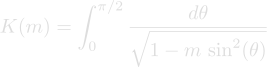
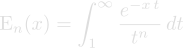
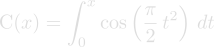
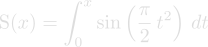
1
2
3
4
5
6
7
8
9
10
11
12
13
14
15
16
17
18
19
20
21
22
23
24
25
26
27
28
29
30
31
32
33
34
35
36
37
38
39
40
41
42
43
44
45
46
47
48
49
50
51
52
53
54
55
56
57
58
59
60
61
62
63
64
65
66
67
68
69
70
71
72
73
74
75
76
77
78
79
80
81
82
83
84
85
86
87
88
89
90
91
92
93
94
95
96
97
98
99
100
101
102
103
104
105
106
107
108
109
110
111
112
113
114
115
116
117
118
119
120
121
122
123
124
125
126
127
128
129
130
131
132
133
134
135
136
137
138
139
140
141
142
143
144
145
146
147
148
149
150
151
152
153
154
155
156
157
158
159
160
161
162
163
164
165
166
167
168
169
170
171
172
173
174
175
176
177
178
179
180
181
182
183
184
185
186
187
188
189
190
191
192
193
194
195
196
197
198
199
200
201
202
203
204
205
206
207
208
209
210
211
212
213
214
215
216
217
218
219
220
221
222
223
224
225
226
227
228
229
/*                                                     zeta.c
*
*     Riemann zeta function of two arguments
*
*
*
* SYNOPSIS:
*
* double x, q, y, zeta();
*
* y = zeta( x, q );
*
*
*
* DESCRIPTION:
*
*
*
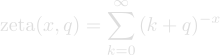
*                 inf.
*                  -        -x
*   zeta(x,q)  =   >   (k+q)
*                  -
*                 k=0
*
* where x > 1 and q is not a negative integer or zero.
* The Euler-Maclaurin summation formula is used to obtain
* the expansion
*
*                n
*                -       -x
* zeta(x,q)  =   >  (k+q)
*                -
*               k=1
*
*           1-x                 inf.  B   x(x+1)...(x+2j)
*      (n+q)           1         -     2j
*  +  ---------  -  -------  +   >    --------------------
*        x-1              x      -                   x+2j+1
*                   2(n+q)      j=1       (2j)! (n+q)
*
* where the B2j are Bernoulli numbers.  Note that (see zetac.c)
* zeta(x,1) = zetac(x) + 1.
*
*
*
* ACCURACY:
*
*
*
* REFERENCE:
*
* Gradshteyn, I. S., and I. M. Ryzhik, Tables of Integrals,
* Series, and Products, p. 1073; Academic Press, 1980.
*
*/

/*
* Cephes Math Library Release 2.0:  April, 1987
* Copyright 1984, 1987 by Stephen L. Moshier
* Direct inquiries to 30 Frost Street, Cambridge, MA 02140
*/

#![allow(clippy::excessive_precision)]

use crate::cephes64::consts::MACHEP;

/* Expansion coefficients
* for Euler-Maclaurin summation formula
* (2k)! / B2k
* where B2k are Bernoulli numbers
*/
const A: [f64; 12] = [
    12.0,
    -720.0,
    30240.0,
    -1209600.0,
    47900160.0,
    -1.8924375803183791606e9,	/*1.307674368e12/691 */
    7.47242496e10,
    -2.950130727918164224e12,	/*1.067062284288e16/3617 */
    1.1646782814350067249e14,	/*5.109094217170944e18/43867 */
    -4.5979787224074726105e15,	/*8.028576626982912e20/174611 */
    1.8152105401943546773e17,	/*1.5511210043330985984e23/854513 */
    -7.1661652561756670113e18	/*1.6938241367317436694528e27/236364091 */
];

/* 30 Nov 86 -- error in third coefficient fixed */

// $$\mathrm{zeta}(x, q) = \sum_{k = 0}^{\infty}{(k + q)^{-x}}$$
//
// $$\mathrm{zeta}(x, q) = \sum_{k = 1}^{n}{(k + q)^{-x}} +
// \frac{(n + q)^{1 - x}}{x - 1}-\frac{1}{2\,(n + q)^x} +
// \sum_{j=1}^{\infty}{\frac{B_{2j}\,x\,(x + 1)\,...\,(x + 2\,j)}
// {(2\,j)!\,(n + q)^{x + 2\,j + 1}}}$$


pub fn zeta(x: f64, q: f64) -> f64 {
    //! Riemann zeta function of two arguments
    //!
    //! ## DESCRIPTION:
    //!
    #![doc=include_str!("zeta.svg")]
    //!
    //! where x > 1 and q is not a negative integer or zero.
    //! The Euler-Maclaurin summation formula is used to obtain
    //! the expansion
    //!
    #![doc=include_str!("zeta2.svg")]
    //!
    //! where the B2j are Bernoulli numbers.  Note that (see zetac.c)
    //! zeta(x,1) = zetac(x) + 1.
    //!
    //! ## ACCURACY:
    //!
    //! ## REFERENCE:
    //!
    //! Gradshteyn, I. S., and I. M. Ryzhik, Tables of Integrals,
    //! Series, and Products, p. 1073; Academic Press, 1980.

    if x == 1.0 {
        return f64::INFINITY;
    } else if x < 1.0 {
        //sf_error("zeta", SF_ERROR_DOMAIN, NULL);
        return f64::NAN;
    } else if q <= 0.0 {
        if q == q.floor() {
            //sf_error("zeta", SF_ERROR_SINGULAR, NULL);
            return f64::INFINITY;
        } else if x != x.floor() {
            return f64::NAN; /* because q^-x not defined */
        }
    }

    /* Asymptotic expansion
    * https://dlmf.nist.gov/25.11#E43
    */
    if q > 1e8 {
        return (1.0 / (x - 1.0) + 1.0 / (2.0 * q)) * q.powf(1.0 - x);
    }

    /* Euler-Maclaurin summation formula */

    /* Permit negative q but continue sum until n+q > +9 .
    * This case should be handled by a reflection formula.
    * If q<0 and x is an integer, there is a relation to
    * the polyGamma function.
    */
    let mut s = q.powf(-x);
    let mut a = q;
    let mut i = 0;
    let mut b = 0.0;
    while (i < 9) || (a <= 9.0) {
        i += 1;
        a += 1.0;
        b = a.powf(-x);
        s += b;
        if (b / s).abs() < MACHEP {
            return s;
        }
    }

    let w = a;
    s += b * w / (x - 1.0);
    s -= 0.5 * b;
    a = 1.0;
    let mut k = 0.0;
    for a_i in &A {
        a *= x + k;
        b /= w;
        let t = a * b / a_i;
        s += t;
        if (t / s).abs() < MACHEP {
            return s;
        }
        k += 1.0;
        a *= x + k;
        b /= w;
        k += 1.0;
    }

    // TODO: Find a way to test this case
    s
}

#[cfg(test)]
mod zeta_tests {
    use super::*;

    #[test]
    fn zeta_trivials() {
        assert_eq!(zeta(1.0, 1.0), f64::INFINITY);
        assert_eq!(zeta(1.0 - 1e-10, 1.0).is_nan(), true);
        assert_eq!(zeta(3.0, 0.0), f64::INFINITY);
        assert_eq!(zeta(3.0, -10.0), f64::INFINITY);
        assert_eq!(zeta(3.1, -10.5).is_nan(), true);
    }

    #[test]
    fn zeta_large_q() {
        assert_eq!(zeta(1.5, 1.1e8), 0.00019069251828251056);
        assert_eq!(zeta(10.0, 1.1e8), 4.712195952465921e-74);
        assert_eq!(zeta(1e10, 1.1e10), 0.0);
        assert_eq!(zeta(10.0, 1.1e15), 4.712195759694296e-137);
        assert_eq!(zeta(10.0, 1.1e25), 4.712195759694275e-227);
        assert_eq!(zeta(10.0, 1.1e35), 4.7121956e-317);
    }

    #[test]
    fn zeta_neg_q() {
        assert_eq!(zeta(25.0, -0.9), 1.0000000000000055e+25);
        assert_eq!(zeta(20.0, -1.5), 2097152.0006014686);
        assert_eq!(zeta(100.0, -20.1), 9.99999999998579e+99);
        assert_eq!(zeta(10.0, -1e5 + 0.1), 9999999997.435017);
        assert_eq!(zeta(100.0, -1e5 + 0.1), 9.999999941792339e+99);
    }

    #[test]
    fn zeta_nominal() {
        assert_eq!(zeta(1.0 + 1e-15, 1e-20), 1.0000000000000511e+20);
        assert_eq!(zeta(1.001, 0.002), 1503.6909814191445);
        assert_eq!(zeta(1.0 + 1e-10, 1e-15), 1000000003453880.9);
        assert_eq!(zeta(1.01, 0.01), 205.27439873109253);
        assert_eq!(zeta(1.01, 1e5), 89.12509826963665);
        assert_eq!(zeta(1.5, 0.9e7), 0.0006666666851851857);
        assert_eq!(zeta(25.0, 0.9e7), 5.2235903489005884e-169);
        assert_eq!(zeta(25.0, 0.01), 9.999999999999995e+49);
        assert_eq!(zeta(100.0, 0.01), 9.99999999999998e+199);
    }
}