1
2
3
4
5
6
7
8
9
10
11
12
13
14
15
16
17
18
19
20
21
22
23
24
25
26
27
28
29
30
31
32
33
34
35
36
37
38
39
40
41
42
43
44
45
46
47
48
49
50
51
52
53
54
55
56
57
58
59
60
61
62
63
64
65
66
67
68
69
70
71
72
73
74
75
76
77
78
79
80
81
82
83
84
85
86
87
88
89
90
91
92
93
94
95
96
97
98
99
100
101
102
103
104
105
106
107
108
109
110
111
112
113
114
115
116
117
118
119
120
121
122
123
124
125
126
127
128
129
130
131
132
133
134
135
136
137
138
139
140
141
142
143
144
145
146
147
148
149
150
151
152
153
154
155
156
157
158
159
160
161
162
163
164
165
166
167
168
169
170
171
172
173
174
175
176
177
178
179
180
181
182
183
184
185
186
187
188
189
190
191
192
193
194
195
196
197
198
199
200
201
202
203
204
205
206
207
208
209
210
211
212
213
214
215
216
217
218
219
220
221
222
223
224
225
226
227
228
229
230
231
232
233
234
235
236
237
238
239
240
241
242
243
244
245
246
247
248
249
/*                                                     nbdtr.c
*
*     Negative binomial distribution
*
*
*
* SYNOPSIS:
*
* int k, n;
* double p, y, nbdtr();
*
* y = nbdtr( k, n, p );
*
* DESCRIPTION:
*
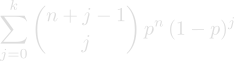
* Returns the sum of the terms 0 through k of the negative
* binomial distribution:
*
*   k
*   --  ( n+j-1 )   n      j
*   >   (       )  p  (1-p)
*   --  (   j   )
*  j=0
*
* In a sequence of Bernoulli trials, this is the probability
* that k or fewer failures precede the nth success.
*
* The terms are not computed individually; instead the incomplete
* beta integral is employed, according to the formula
*
* y = nbdtr( k, n, p ) = incbet( n, k+1, p ).
*
* The arguments must be positive, with p ranging from 0 to 1.
*
* ACCURACY:
*
* Tested at random points (a,b,p), with p between 0 and 1.
*
*               a,b                     Relative error:
* arithmetic  domain     # trials      peak         rms
*    IEEE     0,100       100000      1.7e-13     8.8e-15
* See also incbet.c.
*
*/
/*
* Cephes Math Library Release 2.3:  March, 1995
* Copyright 1984, 1987, 1995 by Stephen L. Moshier
*/

use crate::cephes64::incbet::incbet;
use crate::cephes64::incbi::incbi;

pub fn nbdtrc(k: isize, n: isize, p: f64) -> f64 {
    //! Complemented negative binomial distribution
    //!
    //! ## DESCRIPTION:
    //!
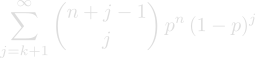
    //! Returns the sum of the terms k+1 to infinity of the negative
    //! binomial distribution:
    //!
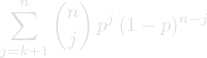
    #![doc=include_str!("nbdtrc.svg")]
    //!
    //! The terms are not computed individually; instead the incomplete
    //! beta integral is employed, according to the formula
    //!
    //! `y = nbdtrc( k, n, p ) = incbet( k+1, n, 1-p )`
    //!
    //! The arguments must be positive, with `p` ranging from 0 to 1.
    //!
    //! ## ACCURACY:
    //!
    //! Tested at random points (`a`, `b`, `p`), with `p` between 0 and 1.
    //!
    //! Relative error
    //!
    //!<table>
    //! <tr>
    //!     <th>Arithmetic</th>
    //!     <th>a, b Domain</th>
    //!     <th># Trials</th>
    //!     <th>Peak</th>
    //!     <th>RMS</th>
    //! </tr>
    //! <tr>
    //!     <td>IEEE</td>
    //!     <td>0, 100</td>
    //!     <td>100000</td>
    //!     <td>1.7e-13</td>
    //!     <td>8.8e-15</td>
    //! </tr>
    //!</table>
    //!
    //! See also [`cephes64::incbet`](crate::cephes64::incbet).

    if !(0.0..=1.0).contains(&p) || k < 0 {
        //sf_error("nbdtr", SF_ERROR_DOMAIN, NULL);
        f64::NAN
    } else {
        let dk = k + 1;
        let dn = n;
        incbet(dk as f64, dn as f64, 1.0 - p)
    }
}


pub fn nbdtr(k: isize, n: isize, p: f64) -> f64 {
    //! Negative binomial distribution
    //!
    //! ## DESCRIPTION:
    //!
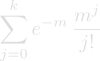
    //! Returns the sum of the terms 0 through k of the negative
    //! binomial distribution:
    //!
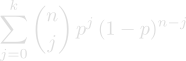
    #![doc=include_str!("nbdtr.svg")]
    //!
    //! In a sequence of Bernoulli trials, this is the probability
    //! that k or fewer failures precede the nth success.
    //!
    //! The terms are not computed individually; instead the incomplete
    //! beta integral is employed, according to the formula
    //!
    //! `y = nbdtr( k, n, p ) = incbet( n, k+1, p )`
    //!
    //! The arguments must be positive, with p ranging from 0 to 1.
    //!
    //! ## ACCURACY:
    //!
    //! Tested at random points (`a`, `b`, `p`), with `p` between 0 and 1.
    //!
    //! Relative error
    //!
    //!<table>
    //! <tr>
    //!     <th>Arithmetic</th>
    //!     <th>a, b Domain</th>
    //!     <th># Trials</th>
    //!     <th>Peak</th>
    //!     <th>RMS</th>
    //! </tr>
    //! <tr>
    //!     <td>IEEE</td>
    //!     <td>0, 100</td>
    //!     <td>100000</td>
    //!     <td>1.7e-13</td>
    //!     <td>8.8e-15</td>
    //! </tr>
    //!</table>
    //!
    //! See also [`cephes64::incbet`](crate::cephes64::incbet).

    if !(0.0..=1.0).contains(&p) || k < 0 {
        //sf_error("nbdtr", SF_ERROR_DOMAIN, NULL);
        f64::NAN
    } else {
        let dk = k + 1;
        let dn = n;
        incbet(dn as f64, dk as f64, p)
    }
}


pub fn nbdtri(k: isize, n: isize, p: f64) -> f64 {
    //! Functional inverse of negative binomial distribution
    //!
    //! ## DESCRIPTION:
    //!
    //! Finds the argument `p` such that `nbdtr(k,n,p)` is equal to `y`.
    //!
    //! ## ACCURACY:
    //!
    //! Tested at random points (`a`, `b`, `y`), with `y` between 0 and 1.
    //!
    //! Relative error:
    //!
    //!<table>
    //! <tr>
    //!     <th>Arithmetic</th>
    //!     <th>a, b Domain</th>
    //!     <th># Trials</th>
    //!     <th>Peak</th>
    //!     <th>RMS</th>
    //! </tr>
    //! <tr>
    //!     <td>IEEE</td>
    //!     <td>0, 100</td>
    //!     <td>100000</td>
    //!     <td>1.5e-14</td>
    //!     <td>8.5e-16</td>
    //! </tr>
    //!</table>
    //!
    //! See also [`cephes64::incbi`](crate::cephes64::incbi).

    if !(0.0..=1.0).contains(&p) || k < 0 {
        //sf_error("nbdtri", SF_ERROR_DOMAIN, NULL);
        f64::NAN
    } else {
        let dk = k + 1;
        let dn = n;
        incbi(dn as f64, dk as f64, p)
    }
}

// Very few tests due to simplicity of implementation
#[cfg(test)]
mod nbdtr_tests {
    use super::*;

    #[test]
    fn nbdtr_trivials() {
        assert_eq!(nbdtrc(-1, 10, 0.5).is_nan(), true);
        assert_eq!(nbdtrc(1, 10, -1e-15).is_nan(), true);
        assert_eq!(nbdtrc(1, 10, 1.0 + 1e-15).is_nan(), true);

        assert_eq!(nbdtr(-1, 10, 0.5).is_nan(), true);
        assert_eq!(nbdtr(1, 10, -1e-15).is_nan(), true);
        assert_eq!(nbdtr(1, 10, 1.0 + 1e-15).is_nan(), true);

        assert_eq!(nbdtri(-1, 10, 0.5).is_nan(), true);
        assert_eq!(nbdtri(1, 10, -1e-15).is_nan(), true);
        assert_eq!(nbdtri(1, 10, 1.0 + 1e-15).is_nan(), true);
    }

    #[test]
    fn nbdtr_tests() {
        assert_eq!(nbdtrc(5, 10, 0.5), 0.8491210937499999);
        assert_eq!(nbdtrc(5, 10, 0.9), 0.0022496700850479973);
        assert_eq!(nbdtrc(15, 10, 0.5), 0.11476147174835194);
        assert_eq!(nbdtrc(15, 15, 0.1), 0.9999999644052073);
        assert_eq!(nbdtrc(15, 10, 0.0), 1.0);
        assert_eq!(nbdtrc(15, 10, 1.0), 0.0);

        assert_eq!(nbdtr(5, 10, 0.5), 0.15087890625000008);
        assert_eq!(nbdtr(5, 10, 0.9), 0.997750329914952);
        assert_eq!(nbdtr(15, 10, 0.5), 0.8852385282516481);
        assert_eq!(nbdtr(15, 15, 0.1), 3.559479269444176e-08);
        assert_eq!(nbdtr(15, 10, 0.0), 0.0);
        assert_eq!(nbdtr(15, 10, 1.0), 1.0);

        assert_eq!(nbdtri(5, 10, 0.5), 0.6303295486548143);
        assert_eq!(nbdtri(5, 10, 0.9), 0.7744087263163602);
        assert_eq!(nbdtri(15, 10, 0.5), 0.3816135642524775);
        assert_eq!(nbdtri(15, 15, 0.1), 0.36969603948477525);
        assert_eq!(nbdtri(15, 10, 0.0), 0.0);
        assert_eq!(nbdtri(15, 10, 1.0), 1.0);
    }
}