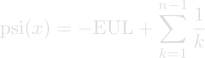
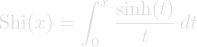
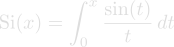
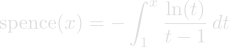
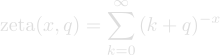
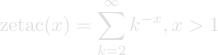
1
2
3
4
5
6
7
8
9
10
11
12
13
14
15
16
17
18
19
20
21
22
23
24
25
26
27
28
29
30
31
32
33
34
35
36
37
38
39
40
41
42
43
44
45
46
47
48
49
50
51
52
53
54
55
56
57
58
59
60
61
62
63
64
65
66
67
68
69
70
71
72
73
74
75
76
77
78
79
80
81
82
83
84
85
86
87
88
89
90
91
92
93
94
95
96
97
98
99
100
101
102
103
104
105
106
107
108
109
110
111
112
113
114
115
116
117
118
119
120
121
122
123
124
125
126
127
128
129
130
131
132
133
134
135
136
137
138
139
140
141
142
143
144
145
146
147
148
149
150
151
152
153
154
155
156
157
158
159
160
161
162
163
164
165
166
167
168
169
170
171
172
173
174
175
176
177
178
179
180
181
182
183
184
185
186
187
188
189
190
191
192
193
194
195
196
197
198
199
200
201
/*
* Cephes Math Library Release 2.2:  January, 1991
* Copyright 1984, 1991 by Stephen L. Moshier
* Direct inquiries to 30 Frost Street, Cambridge, MA 02140
*/

#![allow(clippy::excessive_precision)]

use crate::utils::frexp;

const CBRT2: f64 = 1.2599210498948731647672;
const CBRT4: f64 = 1.5874010519681994747517;
const CBRT2I: f64 = 0.79370052598409973737585;
const CBRT4I: f64 = 0.62996052494743658238361;

pub fn scalbn(x: f64, mut n: i32) -> f64 {
    let x1p1023 = f64::from_bits(0x7fe0000000000000); // 0x1p1023 === 2 ^ 1023
    let x1p53 = f64::from_bits(0x4340000000000000); // 0x1p53 === 2 ^ 53
    let x1p_1022 = f64::from_bits(0x0010000000000000); // 0x1p-1022 === 2 ^ (-1022)

    let mut y = x;

    if n > 1023 {
        y *= x1p1023;
        n -= 1023;
        if n > 1023 {
            y *= x1p1023;
            n -= 1023;
            if n > 1023 {
                n = 1023;
            }
        }
    } else if n < -1022 {
        /* make sure final n < -53 to avoid double
        rounding in the subnormal range */
        y *= x1p_1022 * x1p53;
        n += 1022 - 53;
        if n < -1022 {
            y *= x1p_1022 * x1p53;
            n += 1022 - 53;
            if n < -1022 {
                n = -1022;
            }
        }
    }
    y * f64::from_bits(((0x3ff + n) as u64) << 52)
}

pub fn ldexp(x: f64, n: i32) -> f64 {
    scalbn(x, n)
}

pub fn cbrt(x: f64) -> f64
{
    //! Cube root
    //!
    //! ## DESCRIPTION:
    //!
    //! Returns the cube root of the argument, which may be negative.
    //!
    //! Range reduction involves determining the power of 2 of
    //! the argument.  A polynomial of degree 2 applied to the
    //! mantissa, and multiplication by the cube root of 1, 2, or 4
    //! approximates the root to within about 0.1%.  Then Newton's
    //! iteration is used three times to converge to an accurate
    //! result.
    //!
    //! ## ACCURACY:
    //!
    //! Relative error:
    //!
    //!<table>
    //! <tr>
    //!     <th>Arithmetic</th>
    //!     <th>Domain</th>
    //!     <th># Trials</th>
    //!     <th>Peak</th>
    //!     <th>RMS</th>
    //! </tr>
    //! <tr>
    //!     <td>IEEE</td>
    //!     <td>0, 1e308</td>
    //!     <td>30000</td>
    //!     <td>1.5e-16</td>
    //!     <td>5.0e-17</td>
    //! </tr>
    //!</table>

    if x.is_infinite() {
        return x;
    }
    if x == 0.0 {
        return x;
    }
    let (sign, x) = if x > 0.0 {
        (1, x)
    } else {
        (-1, -x)
    };

    let z = x;
    /* extract power of 2, leaving
    * mantissa between 0.5 and 1
    */
    let (x, mut e) = frexp(x);

    /* Approximate cube root of number between .5 and 1,
    * peak relative error = 9.2e-6
    */
    let mut x = (((-1.3466110473359520655053e-1 * x
    + 5.4664601366395524503440e-1) * x
    - 9.5438224771509446525043e-1) * x
    + 1.1399983354717293273738e0) * x + 4.0238979564544752126924e-1;

    /* exponent divided by 3 */
    if e >= 0 {
        let mut rem = e;
        e /= 3;
        rem -= 3 * e;
        if rem == 1 {
            x *= CBRT2;
        }else if rem == 2 {
            x *= CBRT4;
        }
    }


        /* argument less than 1 */

    else {
        e = -e;
        let mut rem = e;
        e /= 3;
        rem -= 3 * e;
        if rem == 1 {
            x *= CBRT2I;
        } else if rem == 2 {
            x *= CBRT4I;
        }
        e = -e;
    }

    /* multiply by power of 2 */
    x = ldexp(x, e);

    /* Newton iteration */
    x -= (x - (z / (x * x))) * 0.33333333333333333333;
    x -= (x - (z / (x * x))) * 0.33333333333333333333;

    if sign < 0 {
        -x
    } else {
        x
    }
}

#[cfg(test)]
mod cbrt_tests {
    use super::*;

    #[test]
    fn cbrt_trivials() {
        assert_eq!(cbrt(f64::INFINITY), f64::INFINITY);
        assert_eq!(cbrt(-f64::INFINITY), -f64::INFINITY);
        assert_eq!(cbrt(f64::NAN).is_nan(), true);
        assert_eq!(cbrt(1.0), 1.0);
        assert_eq!(cbrt(0.0), 0.0);
    }

    #[test]
    fn cbrt_e_neg() {
        assert_eq!(cbrt(0.5), 0.7937005259840997);
        assert_eq!(cbrt(0.421875), 0.75);
        assert_eq!(cbrt(0.008), 0.2);
        assert_eq!(cbrt(0.001), 0.1);
        assert_eq!(cbrt(1e-18), 1e-6);
        assert_eq!(cbrt(1e-300), 1e-100);

        assert_eq!(cbrt(-0.5), -0.7937005259840997);
        assert_eq!(cbrt(-0.421875), -0.75);
        assert_eq!(cbrt(-0.008), -0.2);
        assert_eq!(cbrt(-0.001), -0.1);
        assert_eq!(cbrt(-1e-18), -1e-6);
        assert_eq!(cbrt(-1e-300), -1e-100);
    }

    #[test]
    fn cbrt_e_pos() {
        assert_eq!(cbrt(8.0), 2.0);
        assert_eq!(cbrt(100.0), 4.641588833612778);
        assert_eq!(cbrt(3375.0), 15.0);
        assert_eq!(cbrt(1e18), 1e6);
        assert_eq!(cbrt(1e300), 1e100);

        assert_eq!(cbrt(-8.0), -2.0);
        assert_eq!(cbrt(-100.0), -4.641588833612778);
        assert_eq!(cbrt(-3375.0), -15.0);
        assert_eq!(cbrt(-1e18), -1e6);
        assert_eq!(cbrt(-1e300), -1e100);
    }
}