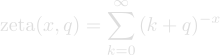
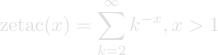
#![allow(clippy::excessive_precision)]
use super::consts::{M_PI, M_PI_2, MACHEP};
use super::ellpk::ellpk;
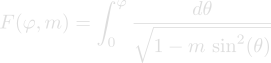
pub fn ellik(phi: f64, m: f64) -> f64
{
#![doc=include_str!("ellik.svg")]
if phi.is_nan() || m.is_nan() {
return f64::NAN;
}
if m > 1.0 {
return f64::NAN;
}
if phi.is_infinite() || m.is_infinite()
{
if m.is_infinite() && !phi.is_infinite() {
return 0.0;
}
else if phi.is_infinite() && !m.is_infinite() {
return phi;
}
else {
return f64::NAN;
}
}
if m == 0.0 {
return phi;
}
let a = 1.0 - m;
if a == 0.0 {
if phi.abs() >= M_PI_2 {
return f64::INFINITY;
}
return phi.tan().asinh();
}
let mut phi = phi;
let mut npio2 = (phi / M_PI_2).floor();
if npio2.abs() % 2.0 == 1.0 {
npio2 += 1.0;
}
let mut k = if npio2 != 0.0 {
phi -= npio2 * M_PI_2;
ellpk(a)
}
else {
0.0
};
let sign = if phi < 0.0 {
phi = -phi;
-1
}
else {
0
};
let mut temp = if a > 1.0 {
ellik_neg_m(phi, m)
} else {
let mut b = a.sqrt();
let mut t = phi.tan();
if t.abs() > 10.0 {
let e = 1.0 / (b * t);
if e.abs() < 10.0 {
let e = e.atan();
if npio2 == 0.0 {
k = ellpk(a);
}
let mut temp2 = k - ellik(e, m);
if sign < 0 {
temp2 = -temp2;
}
temp2 += npio2 * k;
return temp2;
}
}
let mut a = 1.0;
let mut c = m.sqrt();
let mut d = 1;
let mut mod_ = 0;
while (c / a).abs() > MACHEP {
let temp2 = b / a;
phi = phi + (t * temp2).atan() + (mod_ as f64) * M_PI;
let denom = 1.0 - temp2 * t * t;
if denom.abs() > 10.0 * MACHEP {
t = t * (1.0 + temp2) / denom;
mod_ = ((phi + M_PI_2) / M_PI) as isize;
}
else {
t = phi.tan();
mod_ = ((phi - t.atan())/M_PI).floor() as isize;
}
c = (a - b) / 2.0;
let temp2 = (a * b).sqrt();
a = (a + b) / 2.0;
b = temp2;
d += d;
}
(t.atan() + (mod_ as f64) * M_PI) / (d as f64 * a)
};
if sign < 0 {
temp = -temp;
}
temp + npio2 * k
}
fn max3(a: f64, b: f64, c: f64) -> f64 {
a.max(b.max(c))
}
fn ellik_neg_m(phi: f64, m: f64) -> f64
{
let mut n: isize = 0;
let mpp = (m*phi)*phi;
if -mpp < 1e-6 && phi < -m {
return phi + (-mpp*phi*phi/30.0 + 3.0*mpp*mpp/40.0 + mpp/6.0)*phi;
}
if -mpp > 4e7 {
let sm = (-m).sqrt();
let sp = phi.sin();
let cp = phi.cos();
let a = (4.0 * sp * sm / (1.0 + cp)).ln();
let b = -(1.0 + cp/sp/sp - a) / 4.0 / m;
return (a + b) / sm;
}
let (scale, x, y, z) = if phi > 1e-153 && m > -1e305 {
let s = phi.sin();
let csc2 = 1.0 / (s*s);
(1.0, 1.0 / (phi.tan() * phi.tan()), csc2 - m, csc2)
}
else {
(phi, 1.0, 1.0 - m*phi*phi, 1.0)
};
if x == y && x == z {
return scale / x.sqrt();
}
let a0 = (x + y + z) / 3.0;
let mut a = a0;
let mut x1 = x;
let mut y1 = y;
let mut z1 = z;
let mut q = 400.0 * max3((a0-x).abs(), (a0-y).abs(), (a0-z).abs());
while q > a.abs() && n <= 100 {
let sx = x1.sqrt();
let sy = y1.sqrt();
let sz = z1.sqrt();
let lam = sx*sy + sx*sz + sy*sz;
x1 = (x1 + lam) / 4.0;
y1 = (y1 + lam) / 4.0;
z1 = (z1 + lam) / 4.0;
a = (x1 + y1 + z1) / 3.0;
n += 1;
q /= 4.0;
}
let x = (a0 - x) / a / ((1 << (2 * n)) as f64);
let y = (a0 - y) / a / ((1 << (2 * n)) as f64);
let z = -(x + y);
let e2 = x*y - z*z;
let e3 = x*y*z;
scale * (1.0 - e2/10.0 + e3/14.0 + e2*e2/24.0 - 3.0*e2*e3/44.0) / a.sqrt()
}
#[cfg(test)]
mod tests {
use super::*;
#[test]
fn ellik_trivials() {
assert_eq!(ellik(f64::NAN, 0.5).is_nan(), true);
assert_eq!(ellik(0.0, f64::NAN).is_nan(), true);
assert_eq!(ellik(0.0, 1.0 + 1e-10).is_nan(), true);
assert_eq!(ellik(0.0, 10.0).is_nan(), true);
assert_eq!(ellik(0.0, f64::INFINITY).is_nan(), true);
assert_eq!(ellik(f64::INFINITY, -f64::INFINITY).is_nan(), true);
assert_eq!(ellik(0.5, -f64::INFINITY), 0.0);
assert_eq!(ellik(f64::INFINITY, 0.5), f64::INFINITY);
assert_eq!(ellik(-f64::INFINITY, 0.5), -f64::INFINITY);
assert_eq!(ellik(0.0, 0.0), 0.0);
assert_eq!(ellik(10.0, 0.0), 10.0);
assert_eq!(ellik(-10.0, 0.0), -10.0);
assert_eq!(ellik(M_PI_2 + 1e-20, 1.0), f64::INFINITY);
assert_eq!(ellik(-M_PI_2 - 1e-20, 1.0), f64::INFINITY);
}
#[test]
fn ellik_m_1() {
assert_eq!(ellik(0.0, 1.0), 0.0);
assert_eq!(ellik(1e-10, 1.0), 1e-10);
assert_eq!(ellik(0.1, 1.0), 0.10016708454748019);
assert_eq!(ellik(1.0, 1.0), 1.2261911708835171);
assert_eq!(ellik(M_PI_2 - 0.1, 1.0), 2.9948984537675716);
assert_eq!(ellik(M_PI_2 - 1e-10, 1.0), 23.718997415436874);
assert_eq!(ellik(M_PI_2 - 1e-15, 1.0), 35.07367669831271);
assert_eq!(ellik(-1e-10, 1.0), -1e-10);
assert_eq!(ellik(-0.1, 1.0), -0.10016708454748019);
assert_eq!(ellik(-1.0, 1.0), -1.2261911708835171);
assert_eq!(ellik(-M_PI_2 + 0.1, 1.0), -2.9948984537675716);
assert_eq!(ellik(-M_PI_2 + 1e-10, 1.0), -23.718997415436874);
assert_eq!(ellik(-M_PI_2 + 1e-15, 1.0), -35.07367669831271);
}
#[test]
fn ellik_m_neg() {
assert_eq!(ellik(0.0, -0.1), 0.0);
assert_eq!(ellik(1e-10, -0.1), 1e-10);
assert_eq!(ellik(0.1, -0.1), 0.0999833740948805);
assert_eq!(ellik(1.0, -0.1), 0.9868118487668738);
assert_eq!(ellik(10.0, -0.1), 9.773849855431353);
assert_eq!(ellik(1e10, -0.1), 9763155117.895386);
assert_eq!(ellik(1e20, -0.1), 9.763155117905381e+19);
assert_eq!(ellik(-1e-10, -0.1), -1e-10);
assert_eq!(ellik(-0.1, -0.1), -0.0999833740948805);
assert_eq!(ellik(-1.0, -0.1), -0.9868118487668738);
assert_eq!(ellik(-10.0, -0.1), -9.773849855431353);
assert_eq!(ellik(-1e10, -0.1), -9763155117.895386);
assert_eq!(ellik(-1e20, -0.1), -9.763155117905381e+19);
assert_eq!(ellik(1e-10, -1.0), 1e-10);
assert_eq!(ellik(0.1, -1.0), 0.09983440838641279);
assert_eq!(ellik(1.0, -1.0), 0.8963937894628946);
assert_eq!(ellik(10.0, -1.0), 8.415142198945016);
assert_eq!(ellik(1e10, -1.0), 8346268416.675423);
assert_eq!(ellik(1e20, -1.0), 8.346268416740732e+19);
assert_eq!(ellik(-1e-10, -1.0), -1e-10);
assert_eq!(ellik(-0.1, -1.0), -0.09983440838641279);
assert_eq!(ellik(-1.0, -1.0), -0.8963937894628946);
assert_eq!(ellik(-10.0, -1.0), -8.415142198945016);
assert_eq!(ellik(-1e10, -1.0), -8346268416.675423);
assert_eq!(ellik(-1e20, -1.0), -8.346268416740732e+19);
}
#[test]
fn ellik_nominal() {
assert_eq!(ellik(M_PI, 1e-20), 3.141592653589793);
assert_eq!(ellik(100.0, 1e-10), 100.00000000251092);
assert_eq!(ellik(-10.0, 1e-5), -10.000023858951376);
assert_eq!(ellik(0.1351, 0.1), 0.1351409811799065);
assert_eq!(ellik(-0.1351, 0.1), -0.1351409811799065);
assert_eq!(ellik(-M_PI, 0.5), -3.7081493546027438);
assert_eq!(ellik(-100.0, 0.9), -164.44309769019648);
assert_eq!(ellik(30.0 * M_PI + 0.1, 1.0 - 1e-10), 774.0533541855924);
assert_eq!(ellik(-30.0 * M_PI + 0.1, 1.0 - 1e-15), -1119.2647743528726);
assert_eq!(ellik(-M_PI_2, 0.9), -2.5780921133481733);
assert_eq!(ellik(-3.0 * M_PI_2 - 0.05, 1e-10), -4.762388980504998);
assert_eq!(ellik(31.0 * M_PI_2, 1e-20), 48.69468613064179);
assert_eq!(ellik(15.0 * M_PI_2 + 0.05, 1.0 - 1e-10), 202.69884547978893);
assert_eq!(ellik(-15.0 * M_PI_2, 1.0 - 1e-16), -296.3204195149779);
assert_eq!(ellik(M_PI_2, 0.1), 1.6124413487202192);
assert_eq!(ellik(M_PI_2 - 0.01, 0.1), 1.601900442706069);
assert_eq!(ellik(M_PI_2 + 0.01, 0.1), 1.6229822547343693);
}
}