pub struct GameBoard { /* private fields */ }Expand description
Parsed game board for some Tessellation.
Encapsulates game board as 2D matrix of TileKind.
- coordinate system origin
(0, 0)is at the top left of board Xaxis points from left to rightYaxis points from top to down
GameBoard is end result of parsing and editing game puzzles. As such it is not optimized data
structure playing the game, implementing game engines or game solvers. GameBoard is meant to
be used only as input for these uses and will have to be converted into more suitable data
structure.
GameBoard doesn’t place any restrictions on it’s width, height or on number of pushers, boxes
and goals. When implementing game engines or game solvers, you’ll want to validate parsed
GameBoard against concrete engine or solver requirements.
BoxID, GoalID, PusherID and
PlusID ** do restrict** numeric IDs that they can represent. Having
GameBoard with more pushers, boxes or goals than these can represent is possible, but you will
not be able to represent ids of it’s pieces. Again and by design, there is no mechanism in
GameBoard to prevent this situation.
GameBoard supports Index and IndexMut for (x, y), Point2D and linear usize.
GameBoard supports iter() yielding row-major ((x, y), TileKind) pairs.
Depending on Tessellation, a board position has related TileShape that
can be calculated via
Tessellation::tile_shape_from_pos(x, y) or via
Point2D::tile_shape(tessellation)
§Examples
use sokoban_elements::*;

let board_text = [
    "    #####",
    "    #   #",
    "    #$  #",
    "  ###  $##",
    "  #  $ $ #",
    "### # ## #   ######",
    "#   # ## #####  ..#",
    "# $  $          ..#",
    "##### ### #@##  ..#",
    "    #     #########",
    "    #######",
]
.join("\n");

let mut board = GameBoard::parsed(&board_text, Tessellation::Sokoban)?;

assert_eq!(board.width(), 19);
assert_eq!(board.height(), 11);

// tiles are read by (x, y)...
assert_eq!(board[(4, 0)], TileKind::Wall);

// ... or by linear board position: y * width + x
let position: usize = 4;
assert_eq!(board[position], TileKind::Wall);

// short rows are padded with floor tiles
assert_eq!(board[(18, 0)], TileKind::Floor);

// tiles are writable
board[(4, 0)] = TileKind::Floor;
assert_eq!(board[(4, 0)], TileKind::Floor);

// iteration is row major over ((x, y), tile) pairs
assert_eq!(board.iter().count(), board.width() * board.height());
assert_eq!(board.iter().next(), Some(((0, 0), TileKind::Floor)));
§Board size
Board data is always width-normalized: all rows have exactly width()
tiles. Rows shorter than board width are padded with
TileKind::Floor. Parsing, resizing, rotation and mirroring ensure
that this always holds. Index<(usize, usize)> and Index<Point2D> would’ve panicked for
perfectly valid board coordinates, if the rows were ragged. Index<usize> wouldn’t even panic -
in case of ragged rows it would silently return wrong board tile.
A board with no columns and or no rows is empty: width() is zero if and
only if height() is zero. Constructing or editing a board in a way that
would leave it with rows of zero length silently produces the empty board instead. There is no
error for this.
These rules is what makes indexing board position well defined.
Resizing edits one edge at a time, so callers control operation order. Additions to a non-empty
board apply count exactly, and methods return how many lines were applied.
Removals saturate. remove_rows(Top, 42) on a 11-row board removes 11, it is not an error.
In that case we’d removed all the rows from the board, so there are no columns left either.
The result of chaining board edge edits depends on order of calls. Any individual step may collapse the board to size zero (because removals saturate).
Once edge editing empties a board, the one-edge-at-a-time methods cannot grow it back: there are
no rows to add columns to, and rows added to a board with no columns are of zero length, which
is the empty board again. Use grow() for that.
Top and Left resizing shifts existing content. To compensate what would otherwise be a break
in tile geometry, GameBoard adds or removes one padding line in perpendicular axis. This means
that Top and Left resizing may have side effect of changing both board dimensions. This
depends on concrete Tessellation:
add_rows(Top, 1)on aTriobanorOctobanboard also adds a left column;add_columns(Left,1)also adds a top row.Hexobanneeds it on oddTopcounts when the retained board spans both row parities. Even counts need nothing
Bottom and Right resizing never adds perpendicular padding.
Each resizing count is one batched shift. Adding two Top rows to Trioban adds no padding,
while two separate one-row calls each add a column.
If you need to tighten the resulting board after this padding, call
trim() explicitly.
§Transformations
rotate() applies one tessellation-specific step; see
Tessellation::rotation_step_degrees(). A transform may add one row or column because its
result must be re-anchored with a rigid motion of the tiling; integer translation periods are
exposed by Tessellation::translation_period(). A full turn likewise takes four steps for
Sokoban and Octoban, and six for Hexoban and Trioban. Rotation keeps its complete bounding box;
call trim() separately when a tight board is wanted.
Mirroring twice restores the original content, but may retain padding added by re-anchoring.
§Normalization and enclosing
grow() and enclose() are the two resizing
methods that are not per-edge, because neither takes an edge to work on: grow() is told a
size, and enclose() derives the edges it must grow from where the play area reaches.
enclose() walls the play area in, so it is the operation that makes a
board “closed”.
normalize() does not produce a closed board. A play area that
reaches the board edge is confined by the edge, not by a wall, and no wall is invented for it.
§Edits invalidate emergent types and properties
Editing, resizing, mirroring and rotation invalidates everything keyed to position:
BoxID,GoalID, andPusherIDare reassigned by scanning the edited board in row-major orderSokobanPlusis keyed to those IDs and is silently invalidated.SavedGamemoves are directional and no longer describe the transformed board. In particular, Trioban direction changes depend on each triangle’s orientation and cannot be repaired by substituting direction characters.- Zobrist hashes of boards (game engine feature) are position-keyed and do not survive editing.
Invalidation is natural consequences of how all of above types are defined: they need a stable
board configuration to make any sense. Important thing to have in mind when editing the board:
finish the design before assigning ie. Sokoban+ to it.
§Serde
With the serde feature, GameBoard is a two field map of the printed board and the
Tessellation needed to parse it back:
{ "tessellation": "Sokoban", "board": "#####\n#@$.#\n#####" }Deserialization goes through parsed(), so a document can never produce
a board that violates the width-normalization invariant. Unknown fields are rejected. The board
text is accepted in any form parsed() accepts, run-length encoding
included, but is always written out uncompressed with visible floors.
use sokoban_elements::*;

#[rustfmt::skip]
let board_text = [
    "#####",
    "#@$.#",
    "#####",
]
.join("\n");

let board = GameBoard::parsed(&board_text, Tessellation::Sokoban)?;

let json = serde_json::to_string(&board)?;
assert_eq!(serde_json::from_str::<GameBoard>(&json)?, board);Implementations§
Source§impl GameBoard
impl GameBoard
Sourcepub fn new(width: usize, height: usize, tessellation: Tessellation) -> Self
pub fn new(width: usize, height: usize, tessellation: Tessellation) -> Self
Constructs blank board of given size, all of it’s tiles being
TileKind::Floor.
A board with no columns is the empty board: if either width or height is zero, both
width() and height() of constructed board
are zero.
§Examples
use sokoban_elements::*;

let board = GameBoard::new(0, 5, Tessellation::Sokoban);

assert_eq!(board.width(), 0);
assert_eq!(board.height(), 0);pub fn tessellation(&self) -> Tessellation
Sourcepub fn parsed(
printed_board: &str,
tessellation: Tessellation,
) -> Result<Self, BoardSyntaxError>
pub fn parsed( printed_board: &str, tessellation: Tessellation, ) -> Result<Self, BoardSyntaxError>
Parses board string in context of given Tessellation.
§Examples
Constructing GameBoard from text:
use sokoban_elements::*;

let board_text = [
    "    #####",
    "    #   #",
    "    #$  #",
    "  ###  $##",
    "  #  $ $ #",
    "### # ## #   ######",
    "#   # ## #####  ..#",
    "# $  $          ..#",
    "##### ### #@##  ..#",
    "    #     #########",
    "    #######",
]
.join("\n");

let board = GameBoard::parsed(&board_text, Tessellation::Sokoban)?;§Grammar
Game board strings use following characters:
| tile | char |
|---|---|
| Wall | ‘#’ |
| Pusher | ‘p’, ‘@’, ‘m’ |
| Pusher on goal | ‘P’, ‘+’, ‘M’ |
| Box | ‘b’, ‘$’ |
| Goal | ‘.’ , ‘o’ |
| Floor | ’ ’, ‘-’, ‘_’ |
Game board strings mostly follow SokobanYASC specification:
::::::::::::::::::::::::::: Board ::::::::::::::::::::::::::
::                                                        ::
:: Remarks:                                               ::
::                                                        ::
::   The first and the last non-empty square in each row  ::
::   must be a wall or a box on a goal. An empty interior ::
::   row is written with at least one "-" or "_".         ::
::                                                        ::
::   Boards may be run-length encoded (RLE), e.g.,        ::
::   "###----p.#" may be encoded as "3#4-p.#", and        ::
::   "#-#-#-##-#-#-#" may be encoded as "2(3(#-)#)".      ::
::   A row cannot be split over multiple lines.           ::
::                                                        ::
::   Rows may be combined on a single line by using "|"   ::
::   as a row separator, e.g., "--3#|3#-#|#pb.#|5#".      ::
::   A "|" at the end of a line is optional and may be    ::
::   omitted.                                             ::
Sourcepub fn parsed_from_tiles(
data: &[TileKind],
width: usize,
height: usize,
tessellation: Tessellation,
) -> Result<Self, BoardSyntaxError>
pub fn parsed_from_tiles( data: &[TileKind], width: usize, height: usize, tessellation: Tessellation, ) -> Result<Self, BoardSyntaxError>
Constructs board from row major slice of TileKind.
A board with no columns is the empty board: if either width or height is zero, data
must be empty and constructed board is the empty board.
§Errors
InputSizeNotMatchedByDeclaredSize
when length of data is not exactly width * height. Sizes too large to be represented
are reported the same way.
pub fn printed(&self, visible_floor: bool) -> String
Sourcepub fn width(&self) -> usize
pub fn width(&self) -> usize
Number of board columns.
Returns 0 for empty board. Board width and height() are either
both zero or both greater than zero.
Sourcepub fn height(&self) -> usize
pub fn height(&self) -> usize
Number of board rows.
Returns 0 for empty board. Board height and width() are either
both zero or both greater than zero.
pub fn size(&self) -> Size2D
pub fn pushers_count(&self) -> usize
pub fn boxes_count(&self) -> usize
pub fn goals_count(&self) -> usize
pub fn is_blank(&self) -> bool
Sourcepub fn pushers(&self) -> Result<Vec<Pusher>, BoardSyntaxError>
pub fn pushers(&self) -> Result<Vec<Pusher>, BoardSyntaxError>
All Pusher pieces on this board, in row major order.
PusherID of each piece is assigned by scanning board top to bottom and
each row left to right, starting from 0. See PusherID docs.
Tile with pusher standing on goal
(TileKind::PusherOnGoal) yields both a Pusher here
and a Goal in goals().
§Errors
TooManyPushers when board has more pushers
than PusherID can represent.
§Examples
use sokoban_elements::*;

#[rustfmt::skip]
let board_text = [
    "#####",
    "#@$.#",
    "#####",
]
.join("\n");

let board = GameBoard::parsed(&board_text, Tessellation::Sokoban)?;

let pushers = board.pushers()?;

assert_eq!(pushers.len(), board.pushers_count());
assert_eq!(pushers[0].id, PusherID::from(0_u8));
assert_eq!((pushers[0].x, pushers[0].y), (1, 1));Sourcepub fn boxes(
&self,
sokoban_plus: Option<&SokobanPlus>,
) -> Result<Vec<Boxbox>, BoardSyntaxError>
pub fn boxes( &self, sokoban_plus: Option<&SokobanPlus>, ) -> Result<Vec<Boxbox>, BoardSyntaxError>
All Boxbox pieces on this board, in row major order.
BoxID of each piece is assigned by scanning board top to bottom and each
row left to right, starting from 0. See BoxID docs.
Tile with box standing on goal (TileKind::BoxOnGoal) yields
both a Boxbox here and a Goal in goals().
Sokoban+ ID of each piece is looked up in sokoban_plus by assigned
BoxID. Without sokoban_plus, no box gets Sokoban+ ID. See
SokobanPlus.
§Errors
TooManyBoxes when board has more boxes than
BoxID can represent.
§Examples
use sokoban_elements::*;

#[rustfmt::skip]
let board_text = [
    "#####",
    "#@$*#",
    "#####",
]
.join("\n");

let board = GameBoard::parsed(&board_text, Tessellation::Sokoban)?;

let boxes = board.boxes(None)?;

assert_eq!(boxes.len(), board.boxes_count());
assert_eq!(boxes[0].id, BoxID::from(0_u8));
assert_eq!((boxes[0].x, boxes[0].y), (2, 1));
assert_eq!(boxes[0].plus_id, None);

// box standing on goal is both a box and a goal
assert_eq!((boxes[1].x, boxes[1].y), (3, 1));
assert_eq!(board.goals(None)?.len(), 1);
Reading Sokoban+ IDs:
use sokoban_elements::*;

#[rustfmt::skip]
let board_text = [
    "#####",
    "#@$*#",
    "#####",
]
.join("\n");

let board = GameBoard::parsed(&board_text, Tessellation::Sokoban)?;
let sokoban_plus = SokobanPlus::parsed("0 42", "42 0")?;

let boxes = board.boxes(Some(&sokoban_plus))?;

assert_eq!(boxes[0].plus_id, None);
assert_eq!(boxes[1].plus_id, Some(PlusID::new(42)?));Sourcepub fn goals(
&self,
sokoban_plus: Option<&SokobanPlus>,
) -> Result<Vec<Goal>, BoardSyntaxError>
pub fn goals( &self, sokoban_plus: Option<&SokobanPlus>, ) -> Result<Vec<Goal>, BoardSyntaxError>
All Goal pieces on this board, in row major order.
GoalID of each piece is assigned by scanning board top to bottom and each
row left to right, starting from 0. See GoalID docs.
Tiles with box or pusher standing on goal
(TileKind::BoxOnGoal,
TileKind::PusherOnGoal) yield a Goal here in addition
to the piece standing on it.
Sokoban+ ID of each piece is looked up in sokoban_plus by assigned
GoalID. Without sokoban_plus, no goal gets Sokoban+ ID. See
SokobanPlus.
§Errors
TooManyGoals when board has more goals than
GoalID can represent.
§Examples
use sokoban_elements::*;

#[rustfmt::skip]
let board_text = [
    "#####",
    "#+$.#",
    "#####",
]
.join("\n");

let board = GameBoard::parsed(&board_text, Tessellation::Sokoban)?;

let goals = board.goals(None)?;

assert_eq!(goals.len(), board.goals_count());

// pusher standing on goal is both a pusher and a goal
assert_eq!(goals[0].id, GoalID::from(0_u8));
assert_eq!((goals[0].x, goals[0].y), (1, 1));
assert_eq!((goals[1].x, goals[1].y), (3, 1));Sourcepub fn iter(&self) -> GameBoardIter<'_> ⓘ
pub fn iter(&self) -> GameBoardIter<'_> ⓘ
Row major iterator over ((x, y), tile) pairs of this board.
§Examples
use sokoban_elements::*;

let board = GameBoard::new(3, 2, Tessellation::Sokoban);

let positions: Vec<(usize, usize)> = board.iter().map(|(position, _)| position).collect();

assert_eq!(positions, vec![(0, 0), (1, 0), (2, 0), (0, 1), (1, 1), (2, 1)]);Sourcepub fn mirror(&mut self, axis: MirrorAxis)
pub fn mirror(&mut self, axis: MirrorAxis)
Mirrors the board across axis as a rigid motion of its tessellation.
MirrorAxis::Horizontal exchanges the top and bottom edges;
MirrorAxis::Vertical exchanges the left and right edges. Re-anchoring may add one row or
column to keep tile geometry intact.
§Examples
use sokoban_elements::*;

let mut board = GameBoard::parsed("@$.", Tessellation::Sokoban)?;
board.mirror(MirrorAxis::Vertical);
assert_eq!(board.printed(false), ".$@");Sourcepub fn rotate(&mut self, rotation: Rotation)
pub fn rotate(&mut self, rotation: Rotation)
Rotates the board by one natural step of its tessellation.
The step is 90 degrees for Sokoban and Octoban, and 60 degrees for Hexoban and Trioban;
see Tessellation::rotation_step_degrees(). Rotation keeps the complete rotated bounding
box and does not trim floor-only edges.
§Examples
use sokoban_elements::*;

#[rustfmt::skip]
let board_text = [
    "@",
    "$",
    ".",
]
.join("\n");
let mut board = GameBoard::parsed(&board_text, Tessellation::Sokoban)?;
board.rotate(Rotation::Clockwise);
assert_eq!(board.printed(false), ".$@");Sourcepub fn grow(&mut self, width: NonZeroU16, height: NonZeroU16)
pub fn grow(&mut self, width: NonZeroU16, height: NonZeroU16)
Grows the board to at least width columns and height rows, filling with
TileKind::Floor.
Each axis is grown independently to the larger of its current and its wanted size, so a board is never shrunk: an axis already at or past its wanted size is left alone, and a call asking for no growth on either axis is a no-op.
Growth is added to the Bottom and Right edges only. Existing tiles therefore keep their
(x, y), and no perpendicular padding line is ever added, whatever the
Tessellation.
This is also the way back from the empty board, which the one-edge-at-a-time methods cannot grow.
§Examples
use std::num::NonZeroU16;

use sokoban_elements::*;

let mut board = GameBoard::new(3, 2, Tessellation::Sokoban);

board.grow(NonZeroU16::try_from(5)?, NonZeroU16::try_from(1)?);

// width grew, height was already past the wanted one and stayed
assert_eq!(board.width(), 5);
assert_eq!(board.height(), 2);

// editing can empty a board, and growing is the way back
board.remove_columns(VerticalEdge::Left, 42);
assert_eq!(board.size(), Size2D::new(0, 0));

board.grow(NonZeroU16::try_from(4)?, NonZeroU16::try_from(3)?);
assert_eq!(board.size(), Size2D::new(4, 3));Sourcepub fn add_rows(&mut self, edge: HorizontalEdge, count: usize) -> usize
pub fn add_rows(&mut self, edge: HorizontalEdge, count: usize) -> usize
Adds count rows of TileKind::Floor to given board edge.
Returns count when the board is non-empty. A Top addition may also add one left padding
column to preserve tile geometry.
Does nothing to the empty board: a board with no columns can only grow rows of zero length,
and a board with no columns is the empty board. Grow the empty board with
grow() instead.
§Examples
use sokoban_elements::*;

let mut board = GameBoard::new(3, 2, Tessellation::Sokoban);

board.add_rows(HorizontalEdge::Top, 2);

assert_eq!(board.width(), 3);
assert_eq!(board.height(), 4);Sourcepub fn remove_rows(&mut self, edge: HorizontalEdge, count: usize) -> usize
pub fn remove_rows(&mut self, edge: HorizontalEdge, count: usize) -> usize
Removes up to count rows from given board edge and returns the number removed.
Removal saturates at the board height. A Top removal that retains rows may also add one left padding column to preserve tile geometry.
§Examples
use sokoban_elements::*;

let mut board = GameBoard::new(3, 2, Tessellation::Sokoban);

board.remove_rows(HorizontalEdge::Bottom, 1);
assert_eq!(board.height(), 1);

// removing more rows than there are empties the board
board.remove_rows(HorizontalEdge::Bottom, 42);
assert_eq!(board.width(), 0);
assert_eq!(board.height(), 0);Sourcepub fn add_columns(&mut self, edge: VerticalEdge, count: usize) -> usize
pub fn add_columns(&mut self, edge: VerticalEdge, count: usize) -> usize
Adds count columns of TileKind::Floor to given board edge.
Returns count when the board is non-empty. An odd Left addition on Trioban or Octoban also
adds one top padding row to preserve tile geometry.
Does nothing to the empty board, which has no rows to add columns to. Grow the empty board
with grow() instead.
§Examples
use sokoban_elements::*;

let mut board = GameBoard::new(3, 2, Tessellation::Sokoban);

board.add_columns(VerticalEdge::Right, 4);

assert_eq!(board.width(), 7);
assert_eq!(board.height(), 2);Sourcepub fn remove_columns(&mut self, edge: VerticalEdge, count: usize) -> usize
pub fn remove_columns(&mut self, edge: VerticalEdge, count: usize) -> usize
Removes up to count columns from given board edge and returns the number removed.
Removal saturates at the board width. An odd Left removal that retains columns on Trioban or Octoban also adds one top padding row to preserve tile geometry. Removing all columns also removes the rows, because a board with no columns is the empty board.
§Examples
use sokoban_elements::*;

let mut board = GameBoard::new(3, 2, Tessellation::Sokoban);

board.remove_columns(VerticalEdge::Left, 1);
assert_eq!(board.width(), 2);

board.remove_columns(VerticalEdge::Left, 2);
assert_eq!(board.width(), 0);
assert_eq!(board.height(), 0);Sourcepub fn trim(&mut self)
pub fn trim(&mut self)
Removes “outer” floor-only rows and columns in one geometry-preserving crop.
A tile is retained when it is not empty floor - walls, boxes, goals and pushers all count, so a goal-only or pusher-only edge line survives trimming.
The result is the smallest rigidly anchored rectangle. It may retain one padding row or column when the tight rectangle would change tile geometry.
Trimming leaves the empty board exactly when there is nothing to retain,
which is what is_blank() reports.
Sourcepub fn enclose(&mut self) -> Result<(), BoardSyntaxError>
pub fn enclose(&mut self) -> Result<(), BoardSyntaxError>
Surrounds the play area with walls, growing the board where there is no room for them.
StaticBoardAnalysis::flood_fill() stops at
walls and at the board edge, so the play area is always confined by the two together.
A board is “closed” exactly when the edge is not doing any of that work, which is what
StaticBoardAnalysis::is_playable_area_confined()
reports and what this method establishes. There is no need to reconstruct anything inward:
every on-board position next to the play area and not in it is already a wall, because that
is why the flood stopped there.
One row or column is added to each edge the play area reaches, and then every empty
floor tile on the resulting outer edge becomes a
Wall. Edges are grown Bottom, Right, Top, Left, because only Top
and Left shift content and may add a perpendicular padding line. Those padding lines are
floor too, so walling the outer edge afterwards seals them without tracking where they
landed.
Nothing is overwritten but floor, so no piece, goal or wall is ever lost. Two consequences:
- Dead floor on an edge that was not grown becomes wall as well. It lies outside the play area, so the puzzle is unchanged, and it only happens on a board that was leaking somewhere - an already closed board is left exactly as it is, which makes this method idempotent.
- The result is not tightened. Follow with
trim()ornormalize()when a tight board is wanted.
A board with no Pusher has no play area to enclose and is left untouched, as is the
empty board.
§Examples
use sokoban_elements::*;

// The pusher can walk off the top of this board, so the top is not a wall's job yet.
#[rustfmt::skip]
let board_text = [
    "#-@-#",
    "#####",
]
.join("\n");

let mut board = GameBoard::parsed(&board_text, Tessellation::Sokoban)?;
board.enclose()?;

#[rustfmt::skip]
let enclosed = [
    "#####",
    "#-@-#",
    "#####",
]
.join("\n");

assert_eq!(board.printed(true), enclosed);

// Enclosing an already closed board changes nothing.
board.enclose()?;
assert_eq!(board.printed(true), enclosed);Sourcepub fn normalize(&mut self) -> Result<(), BoardSyntaxError>
pub fn normalize(&mut self) -> Result<(), BoardSyntaxError>
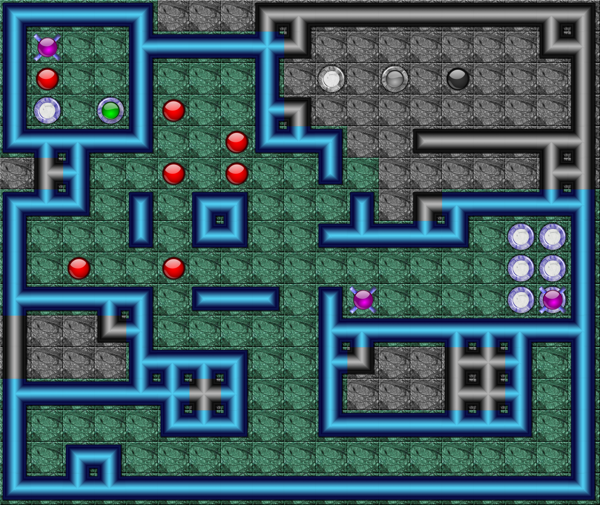
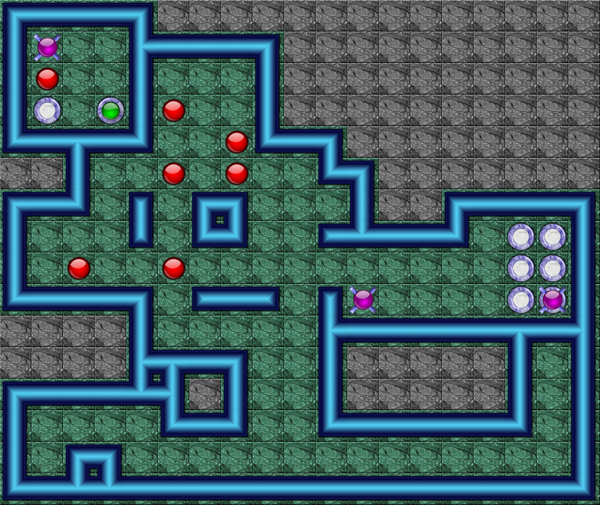
All non-playable tiles are replaced by floors and missing walls around play area are reconstructed.
The reconstructed board is cropped once using the same smallest rigid anchor as
trim(). The crop is the bounding box of everything this method keeps: the
play area plus the reconstructed walls confining it.
This does not make a board closed. A play area that reaches the board edge is confined
there by the edge itself rather than by a wall, and those edge tiles are kept as they are -
no wall is invented around them. enclose() is the operation that makes
room and walls them, and the two compose: board.enclose()?; board.normalize()?;.
A board with no Pusher has no play area to normalize around, and is left untouched.
becomes
§Todo
Following is the stuff that SokobanYASC does, see what we can implement too
- fill jagged (i.e., “stair-case” like) wall edges
- remove redundant walls and floors,
- remove unused boxes and goals
- change immovable boxes on non goal squares to walls
- change immovable boxes on goal squares to walls
- fill unnecessary illegal box squares
Trait Implementations§
Source§impl<'de> Deserialize<'de> for GameBoard
impl<'de> Deserialize<'de> for GameBoard
Source§fn deserialize<D: Deserializer<'de>>(deserializer: D) -> Result<Self, D::Error>
fn deserialize<D: Deserializer<'de>>(deserializer: D) -> Result<Self, D::Error>
impl Eq for GameBoard
Source§impl<'a> IntoIterator for &'a GameBoard
impl<'a> IntoIterator for &'a GameBoard
impl StructuralPartialEq for GameBoard
Auto Trait Implementations§
impl Freeze for GameBoard
impl RefUnwindSafe for GameBoard
impl Send for GameBoard
impl Sync for GameBoard
impl Unpin for GameBoard
impl UnsafeUnpin for GameBoard
impl UnwindSafe for GameBoard
Blanket Implementations§
Source§impl<T> BorrowMut<T> for Twhere
T: ?Sized,
impl<T> BorrowMut<T> for Twhere
T: ?Sized,
Source§fn borrow_mut(&mut self) -> &mut T
fn borrow_mut(&mut self) -> &mut T
impl<ST, DT> CastableFrom<ST, Initialized, Initialized> for DT
impl<ST, DT> CastableFrom<ST, Uninit, Uninit> for DT
Source§impl<T> CloneToUninit for Twhere
T: Clone,
impl<T> CloneToUninit for Twhere
T: Clone,
impl<T> DeserializeOwned for Twhere
T: for<'de> Deserialize<'de>,
Source§impl<Q, K> Equivalent<K> for Q
impl<Q, K> Equivalent<K> for Q
Source§fn equivalent(&self, key: &K) -> bool
fn equivalent(&self, key: &K) -> bool
key and return true if they are equal.Source§impl<T> FmtForward for T
impl<T> FmtForward for T
Source§fn fmt_binary(self) -> FmtBinary<Self>where
Self: Binary,
fn fmt_binary(self) -> FmtBinary<Self>where
Self: Binary,
self to use its Binary implementation when Debug-formatted.Source§fn fmt_display(self) -> FmtDisplay<Self>where
Self: Display,
fn fmt_display(self) -> FmtDisplay<Self>where
Self: Display,
self to use its Display implementation when
Debug-formatted.Source§fn fmt_lower_exp(self) -> FmtLowerExp<Self>where
Self: LowerExp,
fn fmt_lower_exp(self) -> FmtLowerExp<Self>where
Self: LowerExp,
self to use its LowerExp implementation when
Debug-formatted.Source§fn fmt_lower_hex(self) -> FmtLowerHex<Self>where
Self: LowerHex,
fn fmt_lower_hex(self) -> FmtLowerHex<Self>where
Self: LowerHex,
self to use its LowerHex implementation when
Debug-formatted.Source§fn fmt_octal(self) -> FmtOctal<Self>where
Self: Octal,
fn fmt_octal(self) -> FmtOctal<Self>where
Self: Octal,
self to use its Octal implementation when Debug-formatted.Source§fn fmt_pointer(self) -> FmtPointer<Self>where
Self: Pointer,
fn fmt_pointer(self) -> FmtPointer<Self>where
Self: Pointer,
self to use its Pointer implementation when
Debug-formatted.Source§fn fmt_upper_exp(self) -> FmtUpperExp<Self>where
Self: UpperExp,
fn fmt_upper_exp(self) -> FmtUpperExp<Self>where
Self: UpperExp,
self to use its UpperExp implementation when
Debug-formatted.Source§fn fmt_upper_hex(self) -> FmtUpperHex<Self>where
Self: UpperHex,
fn fmt_upper_hex(self) -> FmtUpperHex<Self>where
Self: UpperHex,
self to use its UpperHex implementation when
Debug-formatted.Source§impl<T> IntoEither for T
impl<T> IntoEither for T
Source§fn into_either(self, into_left: bool) -> Either<Self, Self> ⓘ
fn into_either(self, into_left: bool) -> Either<Self, Self> ⓘ
self into a Left variant of Either<Self, Self>
if into_left is true.
Converts self into a Right variant of Either<Self, Self>
otherwise. Read moreSource§fn into_either_with<F>(self, into_left: F) -> Either<Self, Self> ⓘ
fn into_either_with<F>(self, into_left: F) -> Either<Self, Self> ⓘ
self into a Left variant of Either<Self, Self>
if into_left(&self) returns true.
Converts self into a Right variant of Either<Self, Self>
otherwise. Read moreSource§impl<T> Pipe for Twhere
T: ?Sized,
impl<T> Pipe for Twhere
T: ?Sized,
Source§fn pipe<R>(self, func: impl FnOnce(Self) -> R) -> Rwhere
Self: Sized,
fn pipe<R>(self, func: impl FnOnce(Self) -> R) -> Rwhere
Self: Sized,
Source§fn pipe_ref<'a, R>(&'a self, func: impl FnOnce(&'a Self) -> R) -> Rwhere
R: 'a,
fn pipe_ref<'a, R>(&'a self, func: impl FnOnce(&'a Self) -> R) -> Rwhere
R: 'a,
self and passes that borrow into the pipe function. Read moreSource§fn pipe_ref_mut<'a, R>(&'a mut self, func: impl FnOnce(&'a mut Self) -> R) -> Rwhere
R: 'a,
fn pipe_ref_mut<'a, R>(&'a mut self, func: impl FnOnce(&'a mut Self) -> R) -> Rwhere
R: 'a,
self and passes that borrow into the pipe function. Read moreSource§fn pipe_borrow<'a, B, R>(&'a self, func: impl FnOnce(&'a B) -> R) -> R
fn pipe_borrow<'a, B, R>(&'a self, func: impl FnOnce(&'a B) -> R) -> R
Source§fn pipe_borrow_mut<'a, B, R>(
&'a mut self,
func: impl FnOnce(&'a mut B) -> R,
) -> R
fn pipe_borrow_mut<'a, B, R>( &'a mut self, func: impl FnOnce(&'a mut B) -> R, ) -> R
Source§fn pipe_as_ref<'a, U, R>(&'a self, func: impl FnOnce(&'a U) -> R) -> R
fn pipe_as_ref<'a, U, R>(&'a self, func: impl FnOnce(&'a U) -> R) -> R
self, then passes self.as_ref() into the pipe function.Source§fn pipe_as_mut<'a, U, R>(&'a mut self, func: impl FnOnce(&'a mut U) -> R) -> R
fn pipe_as_mut<'a, U, R>(&'a mut self, func: impl FnOnce(&'a mut U) -> R) -> R
self, then passes self.as_mut() into the pipe
function.Source§fn pipe_deref<'a, T, R>(&'a self, func: impl FnOnce(&'a T) -> R) -> R
fn pipe_deref<'a, T, R>(&'a self, func: impl FnOnce(&'a T) -> R) -> R
self, then passes self.deref() into the pipe function.impl<T> Read<Exclusive, BecauseExclusive> for Twhere
T: ?Sized,
Source§impl<T> Tap for T
impl<T> Tap for T
Source§fn tap_borrow<B>(self, func: impl FnOnce(&B)) -> Self
fn tap_borrow<B>(self, func: impl FnOnce(&B)) -> Self
Borrow<B> of a value. Read moreSource§fn tap_borrow_mut<B>(self, func: impl FnOnce(&mut B)) -> Self
fn tap_borrow_mut<B>(self, func: impl FnOnce(&mut B)) -> Self
BorrowMut<B> of a value. Read moreSource§fn tap_ref<R>(self, func: impl FnOnce(&R)) -> Self
fn tap_ref<R>(self, func: impl FnOnce(&R)) -> Self
AsRef<R> view of a value. Read moreSource§fn tap_ref_mut<R>(self, func: impl FnOnce(&mut R)) -> Self
fn tap_ref_mut<R>(self, func: impl FnOnce(&mut R)) -> Self
AsMut<R> view of a value. Read moreSource§fn tap_deref<T>(self, func: impl FnOnce(&T)) -> Self
fn tap_deref<T>(self, func: impl FnOnce(&T)) -> Self
Deref::Target of a value. Read moreSource§fn tap_deref_mut<T>(self, func: impl FnOnce(&mut T)) -> Self
fn tap_deref_mut<T>(self, func: impl FnOnce(&mut T)) -> Self
Deref::Target of a value. Read moreSource§fn tap_dbg(self, func: impl FnOnce(&Self)) -> Self
fn tap_dbg(self, func: impl FnOnce(&Self)) -> Self
.tap() only in debug builds, and is erased in release builds.Source§fn tap_mut_dbg(self, func: impl FnOnce(&mut Self)) -> Self
fn tap_mut_dbg(self, func: impl FnOnce(&mut Self)) -> Self
.tap_mut() only in debug builds, and is erased in release
builds.Source§fn tap_borrow_dbg<B>(self, func: impl FnOnce(&B)) -> Self
fn tap_borrow_dbg<B>(self, func: impl FnOnce(&B)) -> Self
.tap_borrow() only in debug builds, and is erased in release
builds.Source§fn tap_borrow_mut_dbg<B>(self, func: impl FnOnce(&mut B)) -> Self
fn tap_borrow_mut_dbg<B>(self, func: impl FnOnce(&mut B)) -> Self
.tap_borrow_mut() only in debug builds, and is erased in release
builds.Source§fn tap_ref_dbg<R>(self, func: impl FnOnce(&R)) -> Self
fn tap_ref_dbg<R>(self, func: impl FnOnce(&R)) -> Self
.tap_ref() only in debug builds, and is erased in release
builds.Source§fn tap_ref_mut_dbg<R>(self, func: impl FnOnce(&mut R)) -> Self
fn tap_ref_mut_dbg<R>(self, func: impl FnOnce(&mut R)) -> Self
.tap_ref_mut() only in debug builds, and is erased in release
builds.Source§fn tap_deref_dbg<T>(self, func: impl FnOnce(&T)) -> Self
fn tap_deref_dbg<T>(self, func: impl FnOnce(&T)) -> Self
.tap_deref() only in debug builds, and is erased in release
builds.