
Torudo

A terminal-based todo.txt viewer and manager written in Rust with TUI interface.
Features
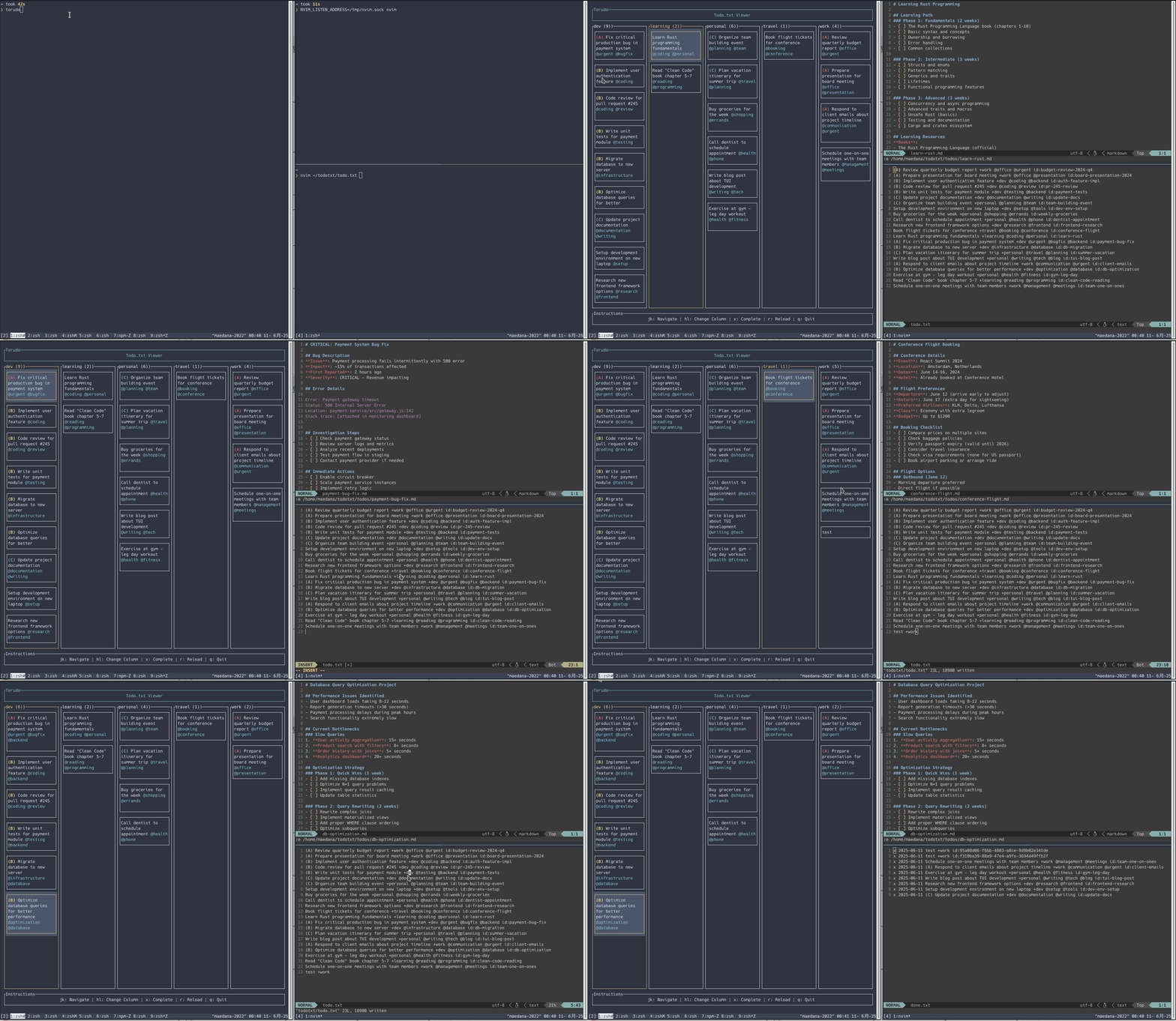
- Project-based column view with priority sorting
- GTD modes (Inbox, Todo, Waiting, Ref, Someday) switchable with
Tab/Shift+Tab - External capture via
torudo inbox add "..."— add items to the inbox from scripts, launchers, or editor bindings without the TUI running - Vim integration and real-time file watching
- URL detection (🔗) and browser open (
o) - Self-update via GitHub Releases (
torudo update) - crmux / Claude Code integration
Demo
Installation
Quick install
|
From crates.io
Build from source
Configuration
Command Line Options
--todotxt-dir <PATH>: Directory containing your todo.txt file (default:~/todotxt, fallback:TODOTXT_DIRenv var)--nvim-listen <PATH>: Neovim socket path set bynvim --listen(default:/tmp/nvim.sock, fallback:NVIM_LISTEN_ADDRESSenv var)
Usage
First Time Setup
When you run Torudo for the first time, it will check for the required directory and files:
- If
~/todotxtdirectory doesn't exist, it will ask permission to create it - If
todo.txtdoesn't exist, it will ask permission to create an empty file - If you decline either creation, the application will exit
This ensures you have control over where your todo files are stored.
Basic Usage
# Run torudo (looks for todo.txt in $TODOTXT_DIR or ~/todotxt)
# Specify todotxt directory
# Run with debug mode for detailed logging
# Specify Neovim socket path
Capturing to Inbox from Outside the TUI
The torudo inbox add subcommand appends a new item to inbox.txt without requiring the TUI to be running. It is meant for quick capture from launchers, shell scripts, editor keybindings, or anywhere you don't want to open the full UI.
# Capture a new task into the inbox
# Pipe the output through jq to grab the generated id
|
# Preserve an explicit id (otherwise a UUID is generated)
The command prints the added item as JSON in the same format as torudo current. When a TUI session is running, the file watcher picks up the change and the Inbox tab updates automatically.
Updating
# Check for updates
# Update to latest version
# Force re-download
Keyboard Controls
Press ? in the TUI or run torudo -h to see all keyboard shortcuts.
Todo.txt Format
Torudo supports the standard todo.txt format:
(A) Call Mom +family @phone
x 2024-01-15 2024-01-10 (B) Review quarterly report +work @office
(C) Buy groceries +personal @errands
Learn Rust programming +learning @coding id:abc123
Features supported:
- Priority levels:
(A),(B),(C) - Completion status:
xprefix with completion date - Creation date:
YYYY-MM-DDformat - Projects:
+project_name - Contexts:
@context_name - Unique IDs:
id:unique_identifier(automatically added if missing) - Key/value tags:
key:valuepairs (e.g.t:2026-05-30,due:2026-06-01) are parsed into a dedicated field; URLs in the description are not misdetected as tags
Todo Sorting
Todos are automatically sorted within each project column using the following priority:
- Priority level: (A) items first, then (B), then (C)
- File line number: Within the same priority level, todos maintain their original file order
This ensures high-priority items are always visible at the top while preserving your intended ordering for items of the same priority.
Display Features
Dynamic Text Wrapping: Todo titles and descriptions automatically wrap to multiple lines based on the terminal width. This ensures that long todo items are fully visible without truncation, making it easy to read comprehensive task descriptions.
Smart Height Calculation: Each todo item's display height is calculated dynamically based on its content length, with a reasonable maximum to prevent excessive screen usage.
Threshold dates (t:YYYY-MM-DD): Items with a future threshold date are sorted to the bottom of their project column and rendered dimmed, matching topydo semantics — they become active on the threshold date. Useful as a GTD tickler.
Overdue highlighting (due:YYYY-MM-DD): Items whose due date has arrived (today >= due) are rendered with a red border. Border color precedence: selected (yellow) > overdue (red) > dimmed (gray) > normal.
Vim Integration
If you have Neovim running with a socket, Torudo can automatically open todo detail files when navigating. Each todo item can have an associated markdown file in $TODOTXT_DIR/todos/{id}.md.
Todo Detail Frontmatter
Todo detail files (todos/{id}.md) support YAML frontmatter with a cwd field to specify the working directory for clp/cli claude launch:
cwd: /home/user/src/my-project
The cwd field is required for clp/cli — an error is shown if it is not set.
File Structure
Torudo keeps one todo.txt-format file per GTD mode plus a done.txt archive. Each file holds plain todo.txt lines; todos/{id}.md holds optional long-form detail for individual items.
~/todotxt/
├── inbox.txt         # Inbox — capture target (also `torudo inbox add`)
├── todo.txt          # Todo / Next actions (the only mode where `x` completes)
├── waiting.txt       # Waiting for
├── ref.txt           # Reference material
├── someday.txt       # Someday / maybe
├── done.txt          # Archive of items completed from todo.txt
└── todos/            # Individual todo detail files
    ├── abc123.md
    └── def456.md
Only todo.txt is created at first launch; the other mode files are created lazily the first time something lands in them (e.g. via the s send-to prefix or torudo inbox add). Completing an item with x works only in Todo mode; to complete an item from another mode, send it to Todo first with st.
If you prefer the classic todo.txt / done.txt workflow, just stay in Todo mode and ignore the other tabs — none of the GTD mode files are created until you write to them, and every existing key (x, hjkl, o, …) behaves exactly as before. GTD is opt-in, not required.
Development
Running in Development
# With debug mode
Running Tests
Code Quality
Roadmap
Ideas that are on the table but not yet implemented. Order does not imply priority.
- Show PR status for todos linked to a git working tree (new frontmatter field pointing at the working tree path)
torudo w syncsubcommand: when invoked from inside a git working tree, automatically fill the currently selected todo's frontmatter with that path (no more hand-editing)
License
This project is licensed under the MIT License - see the LICENSE file for details.
Contributing
- Fork the repository
- Create a feature branch
- Make your changes
- Run tests and linting
- Submit a pull request