# rustify-ml
> **Auto-accelerate Python ML hotspots with Rust.** Profile → Identify → Generate → Build — drop-in PyO3 extensions with no manual rewrite.
> **20x faster `running_mean`. 15x faster `convolve1d`. 12x faster BPE tokenizer. Zero manual Rust.**
Install: `cargo install rustify-ml` (from crates.io) — also `pip install maturin` for builds.
[](https://github.com/homezloco/rustify-ml/actions)
[](https://crates.io/crates/rustify-ml)
[](LICENSE)
---
## What It Does
`rustify-ml` is a CLI tool that:
1. **Profiles** your Python file using `cProfile` (no elevated privileges required)
2. **Identifies** CPU hotspots above a configurable threshold
3. **Generates** safe Rust + PyO3 stubs with length-check guards and type inference
4. **Builds** an installable Python extension via `maturin develop --release`
**Bridge:** Python (cProfile) → hotspot selection → Rust codegen (PyO3) → maturin wheel → editable install → parity tests + benchmarks. No manual glue required.
Typical speedups: **5–100x** on pure-Python loops (tokenizers, matrix ops, image preprocessing, data pipelines).
---
## Quick Start
```bash
# Install dependencies
pip install maturin
cargo install rustify-ml # once published on crates.io
cargo install --path rustify-ml # or: cargo build --release
# Accelerate a Python file (dry-run: generate code, skip build)
rustify-ml accelerate --file examples/euclidean.py --output dist --threshold 0 --dry-run
# Full run: profile → generate → build extension
rustify-ml accelerate --file examples/euclidean.py --output dist --threshold 10
# Install and use the generated extension
cd dist/rustify_ml_ext && maturin develop --release
python -c "from rustify_ml_ext import euclidean; print(euclidean([0.0,3.0,4.0],[0.0,0.0,0.0]))"
# → 5.0
# Validate parity + speedups
python -X utf8 tests/test_all_fixtures.py --with-rust
python benches/compare.py --with-rust
```
---
## CLI Reference
```
rustify-ml accelerate [OPTIONS]
Input (one required):
--file <PATH> Python file to profile and accelerate
--snippet Read Python code from stdin
--git <URL> Git repo URL to clone and analyze
--git-path <PATH> Path within the git repo (required with --git)
Profiler:
--threshold <FLOAT> Minimum hotspot % to target [default: 10.0]
Tip: set to 0.0 to include all defined functions (parsed from the source)
--iterations <N> Profiler loop count for better sampling [default: 100]
--list-targets Profile only: print hotspot table and exit (no codegen)
--function <NAME> Skip profiler, target a specific function by name
Generation:
--output <DIR> Output directory for generated extension [default: dist]
--ml-mode Enable ML-focused heuristics (numpy → PyReadonlyArray1)
--dry-run Generate code without building (inspect before install)
--benchmark After building, run Python timing harness + speedup table
--no-regen Skip code regeneration; only rebuild the existing extension
Logging:
-v / -vv Increase verbosity (debug / trace)
```
### New in latest build
| `--list-targets` | Profile only, print ranked hotspot table, exit — no code generated |
| `--function <name>` | Skip profiler entirely, target one function by name (100% weight) |
| `--iterations <n>` | Control how many times the profiler loops the script (default: 100) |
| `--ml-mode` | Detect numpy imports → use `PyReadonlyArray1<f64>` + add numpy dep to Cargo.toml |
| `--threshold 0` | Force inclusion of all defined functions (parser-based), even if profiler reports 0% |
| `--no-regen` | Skip code regeneration; only rebuild the existing `dist/rustify_ml_ext` (prevents overwriting manual edits) |
### BPE Tokenizer Demo
One of the best targets for rustify-ml is the BPE (Byte-Pair Encoding) encode loop — the same algorithm used by tiktoken (OpenAI) and HuggingFace tokenizers. The inner merge pass is O(n²) in Python and translates cleanly to Rust `Vec<usize>` + `while` loops:
```bash
# Profile and generate Rust stubs for the BPE tokenizer
cargo run -- accelerate \
--file examples/bpe_tokenizer.py \
--function count_pairs \
--output dist \
--dry-run
# Or let the profiler find hotspots automatically
cargo run -- accelerate \
--file examples/bpe_tokenizer.py \
--threshold 5 \
--output dist \
--benchmark
```
**Latest benchmark snapshot** (WSL, CPython 3.12, `python benches/compare.py --with-rust`):
```
euclidean (n=1000) | 55.8 | 20.8 | 2.7x
dot_product (n=1000) | 45.8 | 19.4 | 2.4x
normalize_pixels (n=1000) | 53.2 | 25.1 | 2.1x
running_mean (n=500, w=10) | 376.9 | 18.7 | 20.2x
count_pairs (n=500) | 88.3 | 61.5 | 1.4x
bpe_encode (len=100) | 11.1 | 0.9 | 12.3x
standard_scale (n=1000) | 55.1 | 27.2 | 2.0x
min_max_scale (n=1000) | 60.6 | 28.6 | 2.1x
l2_normalize (n=1000) | 95.5 | 29.4 | 3.2x
convolve1d (n=1000, k=5) | 329.8 | 21.0 | 15.7x
moving_average (n=1000, w=10) | 471.5 | 30.8 | 15.3x
diff (n=1000) | 58.5 | 16.1 | 3.6x
cumsum (n=1000) | 40.0 | 27.3 | 1.5x
```
After `maturin develop --release`, re-run `python benches/compare.py --with-rust` to refresh numbers for your machine.
## Examples
```bash
# Snippet from stdin
echo "def dot(a, b):\n return sum(x*y for x,y in zip(a,b))" | \
rustify-ml accelerate --snippet --output dist --dry-run
# Git repo (shallow clone, analyze one file)
rustify-ml accelerate \
--git https://github.com/huggingface/transformers \
--git-path examples/slow_preproc.py \
--output dist --threshold 5
# ML mode (numpy/torch type hints in generated stubs)
rustify-ml accelerate --file examples/image_preprocess.py --ml-mode --output dist --dry-run
```
### Timing Demo (euclidean)
Baseline vs Rust extension on WSL, CPython 3.12, Ryzen 7:
| euclidean | n=1_000 | 55.8 | 20.8 | 2.7x |
Reproduce:
```bash
python -X utf8 benches/compare.py --function euclidean --with-rust
```
### ML-mode benchmarks (numpy arrays)
`--ml-mode` is optimized for numeric array inputs (numpy). Use it when your hotspots already operate on `np.ndarray` or can be cheaply converted to arrays. Example (image preprocessing):
```bash
python -X utf8 benches/compare.py --function normalize_pixels --with-rust --ml-mode
```
Sample (WSL, CPython 3.12, numpy arrays):
| normalize_pixels | n=1_000 | 53.2 | 25.1 | 2.1x |
| convolve1d | n=1_000, k=5 | 329.8 | 21.0 | 15.7x |
| running_mean | n=500, w=10 | 376.9 | 18.7 | 20.2x |
Best practices: keep data as `np.ndarray` before calling Rust, avoid per-call Python↔Rust conversions, and rerun `benches/compare.py --with-rust --ml-mode` on your hardware to refresh numbers.
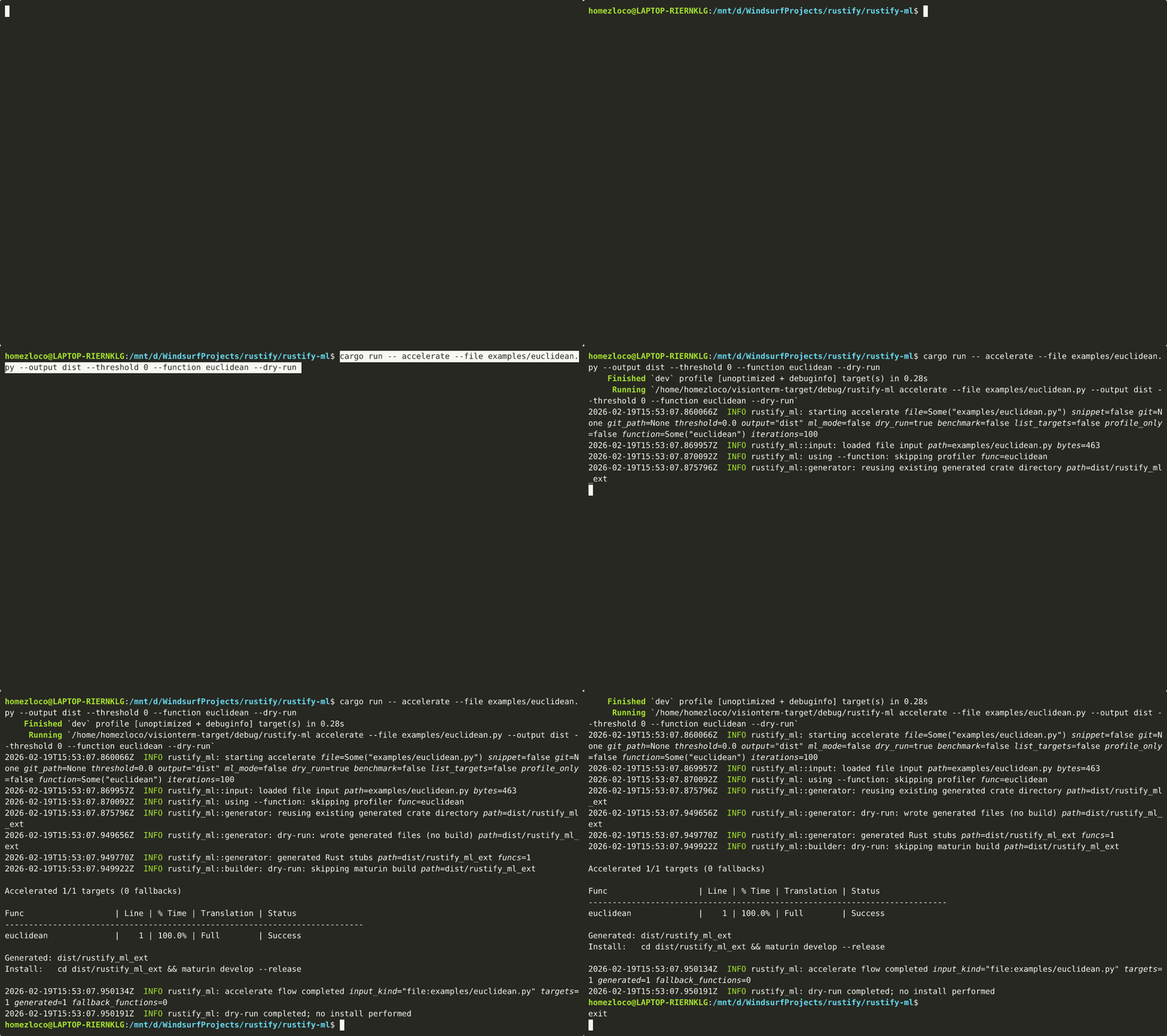
### CLI Output (screenshot)
### Using `rustify-stdlib` directly
```bash
pip install maturin
pip install rustify-stdlib # once published
python - <<'PY'
import rustify_stdlib as rs
print(rs.euclidean([0.0,3.0,4.0],[0.0,0.0,0.0]))
print(rs.dot_product([1.0,2.0],[3.0,4.0]))
PY
```
---
## Example Output
After running `accelerate`, rustify-ml prints a summary table to stdout:
```
Accelerated 3/4 targets (1 fallback)
euclidean | 1 | 42.1% | Full | Success
dot_product | 18 | 31.8% | Full | Success
matmul | 7 | 20.4% | Partial | Fallback (nested loop)
normalize_pixels | 24 | 5.7% | Full | Success
Generated: dist/rustify_ml_ext/
Install: cd dist/rustify_ml_ext && maturin develop --release
```
---
## Translation Patterns
| `for i in range(len(x)):` | `for i in 0..x.len() {` | ✅ Done |
| `total += a * b` | `total += a * b;` | ✅ Done |
| `return x ** 0.5` | `return (x).powf(0.5);` | ✅ Done |
| `a[i] - b[i]` | `a[i] - b[i]` | ✅ Done |
| `total = 0.0` | `let mut total: f64 = 0.0;` | ✅ Done |
| `result[i] = val` | `result[i] = val;` | ✅ Done |
| `result = [0.0] * n` | `let mut result = vec![0.0f64; n];` | ✅ Done |
| `range(a, b)` | `a..b` | ✅ Done |
| `for i in range(n): for j...` | nested for loops | ✅ Done |
| `[f(x) for x in xs]` | `xs.iter().map(f).collect()` | ✅ Done |
| `np.array` params | `PyReadonlyArray1<f64>` (via `--ml-mode`) | ✅ Done |
**Untranslatable** (warns + skips): `eval()`, `exec()`, `getattr()`, `async def`, class self mutation
---
## Generated Code Example
For `examples/euclidean.py`:
```python
def euclidean(p1, p2):
total = 0.0
for i in range(len(p1)):
diff = p1[i] - p2[i]
total += diff * diff
return total ** 0.5
```
rustify-ml generates:
```rust
use pyo3::prelude::*;
#[pyfunction]
/// Auto-generated from Python hotspot `euclidean` at line 1 (100.00%): 100% hotspot
pub fn euclidean(py: Python, p1: Vec<f64>, p2: Vec<f64>) -> PyResult<f64> {
let _ = py;
if p1.len() != p2.len() {
return Err(pyo3::exceptions::PyValueError::new_err("length mismatch"));
}
let mut total = 0.0f64;
for i in 0..p1.len() {
// ...
total += diff * diff;
}
Ok((total).powf(0.5))
}
```
---
## Timing Demo
Run the built-in benchmark after building the extension:
```bash
# Build the extension, then benchmark euclidean distance
rustify-ml accelerate --file examples/euclidean.py --output dist --threshold 0 --benchmark
# Or manually after maturin develop:
cd dist/rustify_ml_ext && maturin develop --release && cd ../..
rustify-ml accelerate --file examples/euclidean.py --output dist --threshold 0 --benchmark
```
Expected output (from `benches/compare.py --with-rust`):
```
================================================================================
rustify-ml benchmark results
================================================================================
running_mean (n=500, w=10) | 376.9 | 18.7 | 20.2x
convolve1d (n=1000, k=5) | 329.8 | 21.0 | 15.7x
moving_average (n=1000, w=10) | 471.5 | 30.8 | 15.3x
bpe_encode (len=100) | 11.1 | 0.9 | 12.3x
euclidean (n=1000) | 55.8 | 20.8 | 2.7x
================================================================================
```
> Numbers measured on WSL, CPython 3.12. Actual speedup depends on Python version, CPU, and input size.
> Loop-heavy functions (sliding window, convolution, tokenizers) see the largest gains.
---
## Example Files
| `examples/euclidean.py` | Euclidean distance | `range(len(x))`, `**`, accumulator |
| `examples/matrix_ops.py` | Matrix multiply + dot product | nested loops, subscript assign |
| `examples/image_preprocess.py` | Pixel normalize + gamma | `[0.0] * n`, subscript assign |
| `examples/bpe_tokenizer.py` | BPE encode (tiktoken-style) | while loop, HashMap merge rank |
| `examples/slow_tokenizer.py` | BPE-style tokenizer fixture | while loop, dict lookup |
| `examples/data_pipeline.py` | CSV parse + running mean | string ops, sliding window |
| `examples/signal_processing.py` | convolve1d, moving_average, diff, cumsum | nested loops, 1D signal ops |
| `examples/sklearn_scaler.py` | standard_scale, min_max_scale, l2_normalize | element-wise Vec ops |
---
## Architecture
```
CLI args (Clap)
→ input::load_input() # File | stdin snippet | git2 clone
→ profiler::profile_input() # cProfile subprocess; python3→python fallback
→ analyzer::select_targets() # Threshold filter; ml_mode tagging
→ generator::generate() # AST walk; Rust codegen; len-check guards
→ builder::build_extension() # cargo check (fast-fail) → maturin develop
→ print_summary() # ASCII table to stdout
```
**Modules:**
| `input.rs` | Load Python from file, stdin, or git repo |
| `profiler.rs` | Run cProfile via Python subprocess; parse hotspots |
| `analyzer.rs` | Filter hotspots by threshold; apply ML heuristics |
| `generator.rs` | Walk Python AST; emit Rust + PyO3 stubs |
| `builder.rs` | `cargo check` generated crate; spawn `maturin develop` |
| `utils.rs` | Shared types; ASCII summary table |
---
## Development
### Prerequisites
- Rust 1.75+ stable (`rustup update stable`)
- Python 3.10+ on PATH (`python3` or `python`)
- `pip install maturin`
### Build & Test
```bash
# From rustify-ml/ directory (or use WSL on Windows)
cargo fmt && cargo check
cargo test
cargo clippy -- -D warnings
```
### Run CLI in dev mode
```bash
# Dry-run: generate code, inspect, no build
cargo run -- accelerate --file examples/euclidean.py --output dist --threshold 0 --dry-run
# Full run (requires maturin)
cargo run -- accelerate --file examples/euclidean.py --output dist --threshold 0
# Verbose output
cargo run -- accelerate --file examples/euclidean.py --output dist -vv --dry-run
```
### Windows Note
The project builds and tests in **WSL** (Windows Subsystem for Linux). Running `cargo test` directly in Windows CMD requires Visual Studio Build Tools (`link.exe`). Use WSL for development:
```bash
cd /mnt/d/WindsurfProjects/rustify/rustify-ml
cargo fmt && cargo check
cargo test
```
---
## Roadmap
See [plan.md](plan.md) for the full prioritized task list. High-level:
1. ✅ **Core pipeline** — profile → analyze → generate → build
2. ✅ **Translation coverage** — assign init, subscript assign, list init, range forms, nested for loops
3. ✅ **While loop translation** — `while changed:`, `while i < len(x):` → Rust while
4. ✅ **Safety** — length-check guards, cargo check on generated crate
5. ✅ **Profiler robustness** — python3/python fallback, version pre-flight, stdlib filter
6. ✅ **CLI polish** — `--list-targets`, `--function`, `--iterations`, `--benchmark`
7. ✅ **ndarray feature** — `--ml-mode` + numpy import → `PyReadonlyArray1<f64>` params
8. ✅ **BPE tokenizer fixture** — `examples/bpe_tokenizer.py` + integration tests
9. ✅ **Benchmark script** — `benches/compare.py` (Python baseline + `--with-rust` mode)
10. ✅ **List comprehension** — `[f(x) for x in xs]` → `xs.iter().map(f).collect()`
11. ✅ **Criterion benchmarks** — `benches/speedup.rs` with Criterion (html reports; euclidean/dot_product/moving_average)
12. 📋 **v0.1.0 release** — crates.io publish, CHANGELOG, GitHub release (see CHANGELOG.md)
---
## License
MIT — see [LICENSE](LICENSE)
> ⚠️ **Generated code requires review.** rustify-ml emits Rust stubs as a starting point. Always review generated `lib.rs` before deploying, especially for fallback-translated functions (marked with `// fallback: echo input`).
