# Dynamic Children
Learn the different ways to add children to containers, from static to fully reactive with automatic resource cleanup.
## The Model
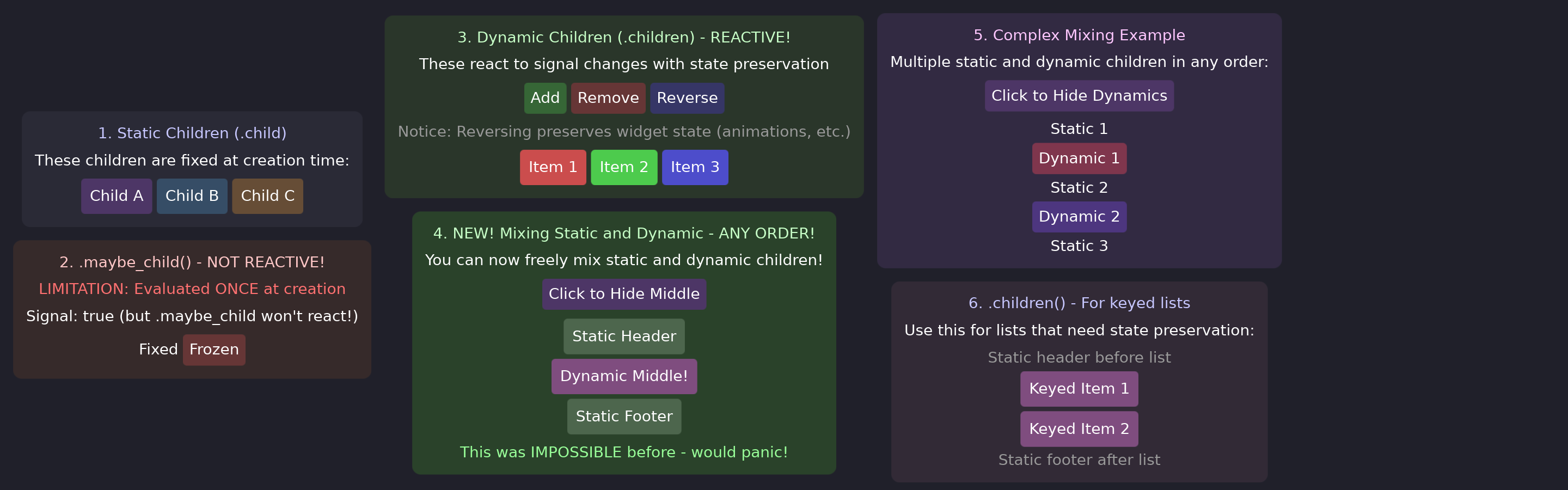
Children come in four forms — two static, two reactive, plus a keyed variant
for lists:
```rust
# extern crate guido;
# use guido::prelude::*;
# fn build_menu(_entries: Vec<Entry>) -> Container { container() }
# fn menu_widget() -> Container { container() }
# fn build_rows(_items: Vec<Item>) -> Vec<Container> { Vec::new() }
# #[derive(Clone)]
# struct Entry { id: u32 }
# #[derive(Clone, PartialEq)]
# struct Item { id: u32, label: String }
# fn row(_item: Item) -> Container { container() }
# fn main() {
# let entries = create_signal(vec![Entry { id: 1 }]);
# let items = create_signal(vec![Item { id: 1, label: String::from("one") }]);
container()
.child(text("Hello")) // static single
.child(move || build_menu(entries.get())) // reactive single
.children([text("A"), text("B")]) // static list
.children(move || build_rows(items.get())) // reactive list
.children(keyed(move || items.get(), |i| i.id, row)) // reactive keyed list
# ;
# }
```
The rule is the one from SolidJS and Leptos: **a value is static, a closure
is reactive**. A reactive closure re-runs when a signal it reads changes,
and its result **replaces** the previous widget — always. There is no key
comparison and no silently discarded rebuild.
Tracking is per segment: each closure re-runs only when *its own* signals
change, never because a sibling changed.
## Reactive Single Child
```rust
# extern crate guido;
# use guido::prelude::*;
# fn build_menu(_entries: Vec<Entry>) -> Container { container() }
# fn menu_widget() -> Container { container() }
# #[derive(Clone)]
# struct Entry;
# fn main() {
# let menu_entries = create_signal(Vec::<Entry>::new());
# #[derive(Clone)]
# struct Window;
# struct State { active_window: RwSignal<Option<Window>> }
# fn title_widget(_w: Window) -> Container { container() }
# let state = State { active_window: create_signal(None) };
// Content rebuilt when the data changes
container().child(move || build_menu(menu_entries.get()));
// Presence: Option shows/hides — None removes the child
container().child(move || {
state.active_window.get().map(|w| title_widget(w))
})
# ;
# }
```
Because widget properties are themselves lazy closures (a `text(move || ...)`
tracks its signal at paint time, not at construction), the reads tracked by a
child closure are naturally the **structural** ones: the closure re-runs
exactly when the shape of the content must change, while property-level
updates keep flowing through the widgets without any rebuild.
### Controlling granularity with memos
A closure re-runs whenever a tracked signal *changes value*. If your content
depends on a reduction of the data (a count, a filtered subset), read a memo
instead of the raw signal — memos notify only when the computed value
actually changes:
```rust
# extern crate guido;
# use guido::prelude::*;
# #[derive(Clone, PartialEq)]
# struct Item { id: u32, label: String }
# fn main() {
# let items = create_signal(vec![Item { id: 1, label: String::from("one") }]);
let count = create_memo(move || items.with(|l| l.len()));
// Rebuilt only when the count changes, not on every list edit
# }
```
## Reactive Lists
The unkeyed closure form replaces **all rows** when it re-runs:
```rust
# extern crate guido;
# use guido::prelude::*;
# #[derive(Clone, PartialEq)]
# struct Item { id: u32, label: String }
# fn row_widget(_item: &Item) -> Container { container() }
# fn main() {
# let items = create_signal(vec![Item { id: 1, label: String::from("one") }]);
container().children(move || {
items.with(|list| {
list.iter().map(|item| row_widget(item)).collect::<Vec<_>>()
})
})
# ;
# }
```
Rows have no identity across runs: inner state (hover, animations, local
signals) does not survive a re-run. That is fine for simple rows; for rows
that carry state, use `keyed()`:
```rust
# extern crate guido;
# use guido::prelude::*;
# fn item_widget(_item: Item) -> Container { container() }
# #[derive(Clone, PartialEq)]
# struct Item { id: u32, label: String }
# fn main() {
# let items = create_signal(vec![Item { id: 1, label: String::from("one") }]);
container().children(keyed(
move || items.get(), // tracked; items: Clone + PartialEq
|item| item.id, // stable identity (survives reorders)
|item| item_widget(item),
))
# ;
# }
```
Per item, identity (`key`) and content (`PartialEq`) are diffed separately:
- **new key** → the builder runs
- **known key, item unchanged** → the existing widget is kept, including
across reorders (state and animations persist)
- **known key, item changed** → only that row is rebuilt
- **key gone** → the widget is dropped with owner cleanup
Keys must be unique and stable — never use the index:
```rust
# extern crate guido;
# use guido::prelude::*;
# #[derive(Clone)]
# struct Row { id: u32, name: String }
# impl PartialEq for Row { fn eq(&self, other: &Self) -> bool { self.id == other.id } }
# fn build(_row: Row) -> Container { container() }
# fn build_at(_row: (usize, Row)) -> Container { container() }
# fn main() {
# let data = create_signal(Vec::<Row>::new());
keyed(move || data.get(), |item| item.id, build); // Good: stable identity
keyed(move || data.get(), |item| item.name.clone(), build); // Good: any Hash + Eq key
keyed(move || data.get().into_iter().enumerate(), |(index, _)| *index, build_at) // Bad: reorder loses state
# ;
# }
```
The key is anything `Hash + Eq + Clone`, and rows are indexed by the key itself
rather than by a hash of it, so two distinct keys are never reconciled as one.
The item type chooses the update granularity: fields included in the item
trigger a row rebuild when they change; fields left out can be read via
signals inside the row for in-place updates.
## Automatic Ownership & Cleanup
Reactive closures and keyed builders run inside an **owner scope**: signals
and effects created there are automatically owned and cleaned up when the
child is removed or rebuilt.
```rust,ignore
# // not compiled: `log` is the caller's crate, not one the book is
# // compiled against.
fn item_widget(item: Item) -> impl Widget {
// This signal is OWNED by this row
let clicks = create_signal(0);
// Register cleanup for non-reactive resources
on_cleanup(move || {
log::info!("Item {} removed", item.id);
});
container()
.padding(8.0)
.when_hovered(|s| s.lighter(0.1))
.on_click(move || clicks.update(|c| *c += 1))
.child(text(move || format!("{} (clicks: {})", item.name, clicks.get())))
}
container().children(keyed(move || items.get(), |i| i.id, item_widget))
```
When a child is removed or rebuilt:
1. The widget is dropped
2. `on_cleanup` callbacks run
3. Effects are disposed
4. Signals are disposed
State that must survive a rebuild belongs in signals created *outside* the
closure.
## Complete Example
```rust
# extern crate guido;
# use guido::prelude::*;
# fn item_widget(item: Item) -> impl Widget {
# container().child(text(move || item.name.clone()))
# }
#[derive(Clone, PartialEq)]
struct Item {
id: u64,
name: String,
}
fn dynamic_list_demo() -> impl Widget {
let items = create_signal(vec![
Item { id: 1, name: "First".into() },
Item { id: 2, name: "Second".into() },
Item { id: 3, name: "Third".into() },
]);
let next_id = create_signal(4u64);
container()
.padding(16.0)
.layout(Flex::column().spacing(12.0))
.child(
container()
.layout(Flex::row().spacing(8.0))
.children([
button("Add", move || {
let id = next_id.get();
next_id.set(id + 1);
items.update(|list| {
list.push(Item { id, name: format!("Item {}", id) });
});
}),
button("Remove Last", move || {
items.update(|list| { list.pop(); });
}),
button("Reverse", move || {
items.update(|list| { list.reverse(); });
}),
])
)
.child(
container()
.layout(Flex::column().spacing(4.0))
.children(keyed(move || items.get(), |i| i.id, item_widget))
)
}
fn button(label: &str, on_click: impl Fn() + 'static) -> Container {
container()
.padding(8.0)
.background(Color::rgb(0.3, 0.3, 0.4))
.corners(4.0)
.when_hovered(|s| s.lighter(0.1))
.when_pressed(|s| s.ripple())
.on_click(on_click)
.child(container().child(text(label).color(Color::WHITE)))
}
# fn main() {}
```
## Mixing Static and Dynamic
Combine static and dynamic children freely, in any order:
```rust
# extern crate guido;
# use guido::prelude::*;
# fn warning_banner() -> Container { container() }
# fn item_view(_item: Item) -> Container { container() }
# #[derive(Clone, PartialEq)]
# struct Item { id: u32, label: String }
# fn main() {
# let items = create_signal(vec![Item { id: 1, label: String::from("one") }]);
# let warning = create_signal(false);
container()
.layout(Flex::column().spacing(8.0))
// Static header
.child(container().child(text("Items:").font_size(18.0).color(Color::WHITE)))
// Reactive middle
.child(move || warning.get().then(|| warning_banner()))
// Reactive keyed list
.children(keyed(move || items.get(), |i| i.id, item_view))
// Static footer
.child(container().child(text("End of list").color(Color::rgb(0.6, 0.6, 0.7))))
# ;
# }
```
## API Reference
```rust,ignore
# // not compiled: a signature listing — these declarations have no bodies.
impl Container {
// A widget value, or a reactive closure returning a widget / Option<widget>
pub fn child<M>(self, child: impl IntoChild<M>) -> Self;
// An iterator of widgets, a reactive closure returning one,
// keyed(data, key, build), or the ChildrenSource a component was handed
pub fn children<M>(self, children: impl IntoChildren<M>) -> Self;
}
// Reactive keyed children list: tracked data, key-based identity,
// untracked per-item builder with content diffing.
pub fn keyed<T, I, K, W>(
data: impl Fn() -> I + 'static,
key: impl Fn(&T) -> K + 'static,
build: impl Fn(T) -> W + 'static,
) -> KeyedChildren<T, I, K, W>
where
T: Clone + PartialEq + 'static,
I: IntoIterator<Item = T>,
K: Hash + Eq + Clone + 'static,
W: Widget + 'static;
// Cleanup registration (use inside reactive closures and builders)
pub fn on_cleanup(f: impl FnOnce() + 'static);
```