pub struct Grid { /* private fields */ }Expand description
A view that arranges content in rows and columns.
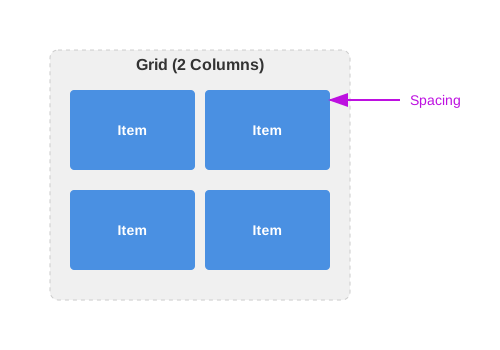
Use a Grid to create a two-dimensional layout. You define the number of columns,
and the grid automatically arranges your content into rows.
ⓘ
grid(2, [
    row((text("A1"), text("A2"))),
    row((text("B1"), text("B2"))),
])
Customize spacing and alignment:
ⓘ
Grid::new(3, rows)
    .spacing(16.0)
    .alignment(Alignment::Leading)
The grid sizes columns equally based on available width, and row heights are determined by the tallest item in each row.
Implementations§
Source§impl Grid
impl Grid
Sourcepub fn new(columns: usize, rows: impl IntoIterator<Item = GridRow>) -> Self
pub fn new(columns: usize, rows: impl IntoIterator<Item = GridRow>) -> Self
Creates a new Grid.
columns: The number of columns in the grid. Must be greater than 0.rows: A tuple ofGridRowviews.
§Panics
Panics if columns is 0.
Trait Implementations§
Auto Trait Implementations§
impl Freeze for Grid
impl !RefUnwindSafe for Grid
impl !Send for Grid
impl !Sync for Grid
impl Unpin for Grid
impl !UnwindSafe for Grid
Blanket Implementations§
§impl<T> BorrowMut<T> for Twhere
T: ?Sized,
impl<T> BorrowMut<T> for Twhere
T: ?Sized,
§fn borrow_mut(&mut self) -> &mut T
fn borrow_mut(&mut self) -> &mut T
Mutably borrows from an owned value. Read more