Grid

Struct Grid 

Source
pub struct Grid { /* private fields */ }
Expand description

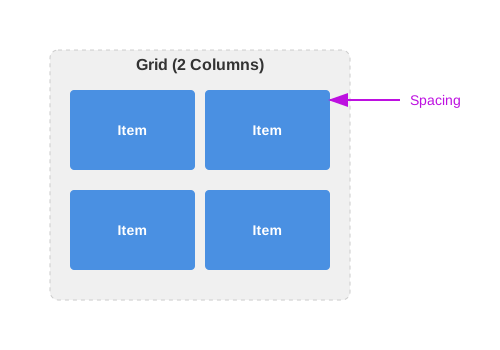
A view that arranges content in rows and columns.
Grid

Use a Grid to create a two-dimensional layout. You define the number of columns, and the grid automatically arranges your content into rows.

grid(2, [
    row((text("A1"), text("A2"))),
    row((text("B1"), text("B2"))),
])

Customize spacing and alignment:

Grid::new(3, rows)
    .spacing(16.0)
    .alignment(Alignment::Leading)

The grid sizes columns equally based on available width, and row heights are determined by the tallest item in each row.

Implementations§

Source§

impl Grid

Source

pub fn new(columns: usize, rows: impl IntoIterator<Item = GridRow>) -> Self

Creates a new Grid.

  • columns: The number of columns in the grid. Must be greater than 0.
  • rows: A tuple of GridRow views.
§Panics

Panics if columns is 0.

Source

pub const fn spacing(self, spacing: f32) -> Self

Sets the horizontal and vertical spacing for the grid.

Source

pub const fn alignment(self, alignment: Alignment) -> Self

Sets the alignment for children within their cells.

Trait Implementations§

Source§

impl Debug for Grid

Source§

fn fmt(&self, f: &mut Formatter<'_>) -> Result

Formats the value using the given formatter. Read more
Source§

impl View for Grid

Source§

fn body(self, _env: &Environment) -> impl View

Build this view and return the content. Read more

Auto Trait Implementations§

§

impl Freeze for Grid

§

impl !RefUnwindSafe for Grid

§

impl !Send for Grid

§

impl !Sync for Grid

§

impl Unpin for Grid

§

impl !UnwindSafe for Grid

Blanket Implementations§

§

impl<T> Any for T
where T: 'static + ?Sized,

§

fn type_id(&self) -> TypeId

Gets the TypeId of self. Read more
§

impl<T> Borrow<T> for T
where T: ?Sized,

§

fn borrow(&self) -> &T

Immutably borrows from an owned value. Read more
§

impl<T> BorrowMut<T> for T
where T: ?Sized,

§

fn borrow_mut(&mut self) -> &mut T

Mutably borrows from an owned value. Read more
§

impl<T> From<T> for T

§

fn from(t: T) -> T

Returns the argument unchanged.

Source§

impl<T> IdentifiableExt for T

Source§

fn use_id<F, Id>(self, f: F) -> UseId<Self, F>
where F: Fn(&Self) -> Id, Id: Ord + Hash,

Wraps the value in a UseId with the provided identification function.
Source§

fn self_id(self) -> SelfId<Self>

Wraps the value in a SelfId, making the value serve as its own identifier.
§

impl<T, U> Into<U> for T
where U: From<T>,

§

fn into(self) -> U

Calls U::from(self).

That is, this conversion is whatever the implementation of From<T> for U chooses to do.

Source§

impl<V> IntoView for V
where V: View,

Source§

type Output = V

The resulting View type after conversion.
Source§

fn into_view(self, _env: &Environment) -> <V as IntoView>::Output

Converts the implementing type into a View. Read more
§

impl<T, U> TryFrom<U> for T
where U: Into<T>,

§

type Error = Infallible

The type returned in the event of a conversion error.
§

fn try_from(value: U) -> Result<T, <T as TryFrom<U>>::Error>

Performs the conversion.
§

impl<T, U> TryInto<U> for T
where U: TryFrom<T>,

§

type Error = <U as TryFrom<T>>::Error

The type returned in the event of a conversion error.
§

fn try_into(self) -> Result<U, <U as TryFrom<T>>::Error>

Performs the conversion.