pub struct Cycle { /* private fields */ }Expand description
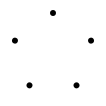
A cycle of connected edges
The end of each edge in the cycle must connect to the beginning of the next edge. The end of the last edge must connect to the beginning of the first one.
Implementations
sourceimpl Cycle
impl Cycle
sourcepub fn build(surface: Surface) -> CycleBuilder
pub fn build(surface: Surface) -> CycleBuilder
Build a cycle using CycleBuilder
sourcepub fn with_edges(self, edges: impl IntoIterator<Item = Edge>) -> Self
pub fn with_edges(self, edges: impl IntoIterator<Item = Edge>) -> Self
Add edges to the cycle
Consumes the cycle and returns the updated instance.
sourcepub fn into_edges(self) -> impl Iterator<Item = Edge>
pub fn into_edges(self) -> impl Iterator<Item = Edge>
Consume the cycle and return its edges
Trait Implementations
sourceimpl Approx for Cycle
impl Approx for Cycle
type Approximation = CycleApprox
type Approximation = CycleApprox
The approximation of the object
sourcefn approx(&self, tolerance: Tolerance) -> Self::Approximation
fn approx(&self, tolerance: Tolerance) -> Self::Approximation
Approximate the object Read more
sourceimpl<'r> ObjectIters<'r> for Cycle
impl<'r> ObjectIters<'r> for Cycle
sourcefn referenced_objects(&'r self) -> Vec<&'r dyn ObjectIters<'_>>
fn referenced_objects(&'r self) -> Vec<&'r dyn ObjectIters<'_>>
Return all objects that this one references
sourcefn cycle_iter(&'r self) -> Iter<&'r Cycle>ⓘNotable traits for Iter<T>impl<T> Iterator for Iter<T> type Item = T;
fn cycle_iter(&'r self) -> Iter<&'r Cycle>ⓘNotable traits for Iter<T>impl<T> Iterator for Iter<T> type Item = T;
Iterate over all cycles
sourcefn curve_iter(&'r self) -> Iter<&'r Curve>ⓘNotable traits for Iter<T>impl<T> Iterator for Iter<T> type Item = T;
fn curve_iter(&'r self) -> Iter<&'r Curve>ⓘNotable traits for Iter<T>impl<T> Iterator for Iter<T> type Item = T;
Iterate over all curves
sourcefn edge_iter(&'r self) -> Iter<&'r Edge>ⓘNotable traits for Iter<T>impl<T> Iterator for Iter<T> type Item = T;
fn edge_iter(&'r self) -> Iter<&'r Edge>ⓘNotable traits for Iter<T>impl<T> Iterator for Iter<T> type Item = T;
Iterate over all edges
sourcefn face_iter(&'r self) -> Iter<&'r Face>ⓘNotable traits for Iter<T>impl<T> Iterator for Iter<T> type Item = T;
fn face_iter(&'r self) -> Iter<&'r Face>ⓘNotable traits for Iter<T>impl<T> Iterator for Iter<T> type Item = T;
Iterate over all faces
sourcefn global_curve_iter(&'r self) -> Iter<&'r GlobalCurve>ⓘNotable traits for Iter<T>impl<T> Iterator for Iter<T> type Item = T;
fn global_curve_iter(&'r self) -> Iter<&'r GlobalCurve>ⓘNotable traits for Iter<T>impl<T> Iterator for Iter<T> type Item = T;
Iterate over all global curves
sourcefn global_vertex_iter(&'r self) -> Iter<&'r GlobalVertex>ⓘNotable traits for Iter<T>impl<T> Iterator for Iter<T> type Item = T;
fn global_vertex_iter(&'r self) -> Iter<&'r GlobalVertex>ⓘNotable traits for Iter<T>impl<T> Iterator for Iter<T> type Item = T;
Iterate over all global vertices
sourcefn shell_iter(&'r self) -> Iter<&'r Shell>ⓘNotable traits for Iter<T>impl<T> Iterator for Iter<T> type Item = T;
fn shell_iter(&'r self) -> Iter<&'r Shell>ⓘNotable traits for Iter<T>impl<T> Iterator for Iter<T> type Item = T;
Iterate over all shells
sourcefn sketch_iter(&'r self) -> Iter<&'r Sketch>ⓘNotable traits for Iter<T>impl<T> Iterator for Iter<T> type Item = T;
fn sketch_iter(&'r self) -> Iter<&'r Sketch>ⓘNotable traits for Iter<T>impl<T> Iterator for Iter<T> type Item = T;
Iterate over all sketches
sourcefn solid_iter(&'r self) -> Iter<&'r Solid>ⓘNotable traits for Iter<T>impl<T> Iterator for Iter<T> type Item = T;
fn solid_iter(&'r self) -> Iter<&'r Solid>ⓘNotable traits for Iter<T>impl<T> Iterator for Iter<T> type Item = T;
Iterate over all solids
sourceimpl Ord for Cycle
impl Ord for Cycle
1.21.0 · sourcefn max(self, other: Self) -> Self
fn max(self, other: Self) -> Self
Compares and returns the maximum of two values. Read more
1.21.0 · sourcefn min(self, other: Self) -> Self
fn min(self, other: Self) -> Self
Compares and returns the minimum of two values. Read more
1.50.0 · sourcefn clamp(self, min: Self, max: Self) -> Self where
Self: PartialOrd<Self>,
fn clamp(self, min: Self, max: Self) -> Self where
Self: PartialOrd<Self>,
Restrict a value to a certain interval. Read more
sourceimpl PartialEq<Cycle> for Cycle
impl PartialEq<Cycle> for Cycle
sourceimpl PartialOrd<Cycle> for Cycle
impl PartialOrd<Cycle> for Cycle
sourcefn partial_cmp(&self, other: &Cycle) -> Option<Ordering>
fn partial_cmp(&self, other: &Cycle) -> Option<Ordering>
This method returns an ordering between self and other values if one exists. Read more
1.0.0 · sourcefn lt(&self, other: &Rhs) -> bool
fn lt(&self, other: &Rhs) -> bool
This method tests less than (for self and other) and is used by the < operator. Read more
1.0.0 · sourcefn le(&self, other: &Rhs) -> bool
fn le(&self, other: &Rhs) -> bool
This method tests less than or equal to (for self and other) and is used by the <=
operator. Read more
sourceimpl TransformObject for Cycle
impl TransformObject for Cycle
impl Eq for Cycle
impl StructuralEq for Cycle
impl StructuralPartialEq for Cycle
Auto Trait Implementations
impl RefUnwindSafe for Cycle
impl Send for Cycle
impl Sync for Cycle
impl Unpin for Cycle
impl UnwindSafe for Cycle
Blanket Implementations
sourceimpl<T> BorrowMut<T> for T where
T: ?Sized,
impl<T> BorrowMut<T> for T where
T: ?Sized,
const: unstable · sourcefn borrow_mut(&mut self) -> &mut T
fn borrow_mut(&mut self) -> &mut T
Mutably borrows from an owned value. Read more
impl<T> Downcast for T where
T: Any,
impl<T> Downcast for T where
T: Any,
fn into_any(self: Box<T, Global>) -> Box<dyn Any + 'static, Global>
fn into_any(self: Box<T, Global>) -> Box<dyn Any + 'static, Global>
Convert Box<dyn Trait> (where Trait: Downcast) to Box<dyn Any>. Box<dyn Any> can
then be further downcast into Box<ConcreteType> where ConcreteType implements Trait. Read more
fn into_any_rc(self: Rc<T>) -> Rc<dyn Any + 'static>
fn into_any_rc(self: Rc<T>) -> Rc<dyn Any + 'static>
Convert Rc<Trait> (where Trait: Downcast) to Rc<Any>. Rc<Any> can then be
further downcast into Rc<ConcreteType> where ConcreteType implements Trait. Read more
fn as_any(&self) -> &(dyn Any + 'static)
fn as_any(&self) -> &(dyn Any + 'static)
Convert &Trait (where Trait: Downcast) to &Any. This is needed since Rust cannot
generate &Any’s vtable from &Trait’s. Read more
fn as_any_mut(&mut self) -> &mut (dyn Any + 'static)
fn as_any_mut(&mut self) -> &mut (dyn Any + 'static)
Convert &mut Trait (where Trait: Downcast) to &Any. This is needed since Rust cannot
generate &mut Any’s vtable from &mut Trait’s. Read more
impl<SS, SP> SupersetOf<SS> for SP where
SS: SubsetOf<SP>,
impl<SS, SP> SupersetOf<SS> for SP where
SS: SubsetOf<SP>,
fn to_subset(&self) -> Option<SS>
fn to_subset(&self) -> Option<SS>
The inverse inclusion map: attempts to construct self from the equivalent element of its
superset. Read more
fn is_in_subset(&self) -> bool
fn is_in_subset(&self) -> bool
Checks if self is actually part of its subset T (and can be converted to it).
fn to_subset_unchecked(&self) -> SS
fn to_subset_unchecked(&self) -> SS
Use with care! Same as self.to_subset but without any property checks. Always succeeds.
fn from_subset(element: &SS) -> SP
fn from_subset(element: &SS) -> SP
The inclusion map: converts self to the equivalent element of its superset.