1
2
3
4
5
6
7
8
9
10
11
12
13
14
15
16
17
18
19
20
21
22
23
24
25
26
27
28
29
30
31
32
33
34
35
36
37
38
39
40
41
42
43
44
45
46
47
48
49
50
51
52
53
54
55
56
57
58
59
60
61
62
63
64
65
66
67
68
69
70
71
72
73
74
75
76
77
78
79
80
81
82
83
84
85
86
87
88
89
90
91
92
93
94
95
96
97
98
99
100
101
102
103
104
105
106
107
108
109
110
111
112
113
114
115
116
117
118
119
120
121
122
123
124
125
126
127
128
129
130
131
132
133
134
135
136
137
138
139
140
141
142
143
144
145
146
147
148
149
150
151
152
153
154
155
156
157
158
159
160
161
162
163
164
165
166
167
168
169
170
171
172
173
174
175
176
177
178
179
180
181
182
183
184
185
186
187
188
189
190
191
192
193
194
195
196
197
198
199
200
201
202
203
204
205
206
207
208
209
210
211
212
213
214
215
216
217
218
219
220
221
222
223
224
225
226
227
228
229
230
231
232
233
234
235
236
237
238
239
240
241
242
243
244
245
246
247
248
249
250
251
252
253
254
255
256
257
258
259
260
261
262
263
264
265
266
267
268
269
270
271
272
273
274
275
276
277
278
279
280
281
282
283
284
285
286
287
288
289
290
291
292
293
294
295
296
297
298
299
300
301
302
303
304
305
306
307
308
309
310
311
312
313
314
315
316
317
318
319
320
321
322
323
324
325
326
327
328
329
330
331
332
333
334
335
336
337
338
339
340
341
342
343
344
345
346
347
348
349
350
351
352
353
354
355
356
357
358
359
360
361
362
363
364
365
366
367
368
369
370
371
372
373
374
375
376
377
378
379
380
381
382
383
384
385
386
387
388
389
390
391
392
//! # Message Routing in WAMP[](#message-routing-in-wamp "Permalink to this headline")
//!
//! - [Loosely coupled](#loosely-coupled)
//! - [Component based](#component-based)
//! - [Real-time](#real-time)
//! - [Language independent](#language-independent)
//! - [Network spanning](#network-spanning)
//!
//!
//! ---
//!
//! WAMP provides [Unified Application Routing](#unified-application-routing) in an open [WebSocket protocol](#websocket-protocol)
//! that works with [different](#different) languages.
//!
//! Using WAMP you can build distributed systems out of application components which are **loosely coupled**
//! and communicate in (soft) **real-time**.
//!
//! At its core, WAMP offers two communication patterns for application components to talk to each other:
//!
//! - [Publish & Subscribe](https://wamp-proto.org/faq.html#pubsub) (PubSub)
//! - [Remote Procedure Calls](https://wamp-proto.org/faq.html#rpc) (RPC)
//!
//! We think applications often have a natural [need for both forms of communication](https://wamp-proto.org/faq.html#why_rpc_and_pubsub)
//! and shouldn’t be required to use different protocols/means for those. Which is why WAMP provides both.
//!
//! WAMP is easy to use, simple to implement and based on modern Web standards: WebSocket, JSON and URIs.
//!
//! While WAMP isn’t exactly rocket science, we believe it’s good engineering and a major step forward in practice
//! that allows developers to create more powerful applications with less complexity and in less time.
//!
//! ## [Loosely coupled](#id6)[](#loosely-coupled "Permalink to this headline")
//!
//! WAMP provides what we call **unified Application Routing** for application communication:
//!
//! - routing of events in the Publish & Subscriber pattern and
//! - routing of calls in the Remote Procedure Call pattern
//!
//! between applications components in *one* protocol.
//!
//! Unified routing is probably best explained by contrasting it with legacy approaches.
//!
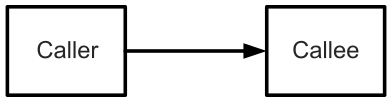
//! Lets take the old “client-server” world. In the client-server model, a remote procedure call goes
//! directly from the *Caller* to the *Callee*:
//!
//! 
//!
//! Remote procedure calls in the **Client-Server** model[](#id1 "Permalink to this image")
//!
//! In the client-server model, a *Caller* needs to have knowledge about where the *Callee* resides and how to reach it.
//! This introduces a strong coupling between *Caller* and *Callee*. Which is bad, because applications can quickly
//! become complex and unmaintainable. We explain how WAMP fixes that in a minute.
//!
//! The problems coming from strong coupling between application components were long recognized and this (besides other requirements)
//! lead to the publish-subscribe model.
//!
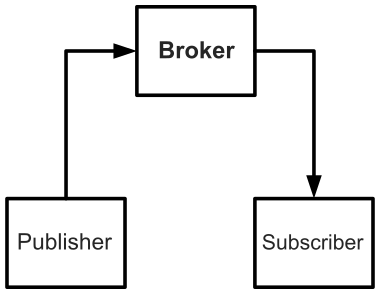
//! In the publish-subscribe model a *Publisher* submits information to an abstract “topic”, and *Subscribers* only receive
//! information indirectly by announcing their interest on a respective “topic”. Both do not know about each other.
//! They are decoupled via the “topic” and via an intermediary usually called *Broker*:
//!
//! 
//!
//! A Broker decouples *Publishers* and *Subscribers*[](#id2 "Permalink to this image")
//!
//! A *Broker* keeps a book of subscriptions: who is currently subscribed on which topic. When a *Publisher* publishes
//! some information (“event”) to a topic, the *Broker* will look up who is currently subscribed on that topic:
//! determine the set of *Subscribers* on the topic published to. And then forward the information (“event”) to all those *Subscribers*.
//!
//! The act of determining receivers of information (independently of the information submitted) and forwarding
//! the information to receivers is called *routing*.
//!
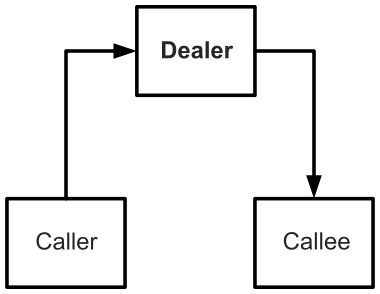
//! Now, WAMP translates the benefits of loose coupling to RPC. Different from the client-server model, WAMP also
//! decouples *Callers* and *Callees* by introducing an intermediary - the *Dealer*:
//!
//! 
//!
//! Remote procedure calls in the **Dealer** model[](#id3 "Permalink to this image")
//!
//! Similar to a *Broker’s* role with PubSub, the *Dealer* is responsible for routing a call originating
//! from the *Caller* to the *Callee* and route back results or errors vice-versa. Both do not know about each other:
//! where the peer resides and how to reach it. This knowledge is encapsulated in the *Dealer*
//!
//! With WAMP, a *Callee* registers a procedure at a *Dealer* under an abstract name: a URI identifying the procedure.
//! When a *Caller* wants to call a remote procedure, it talks to the *Dealer* and only provides the URI of the procedure
//! to be called plus any call arguments. The *Dealer* will look up the procedure to be invoked in his book of registered procedures.
//! The information from the book includes *where* the *Callee* implementing the procedure resides, and how to reach it.
//!
//! In effect, *Callers* and *Callees* are decoupled, and applications can use RPC and still benefit from loose coupling.
//!
//! ## [Component based](#id7)[](#component-based "Permalink to this headline")
//!
//! **Brokers, Dealers and Routers**
//!
//! What if you combine a Broker (for Publish & Subscribe) and a Dealer (for routed Remote Procedure Calls)?
//!
//! When you combine a *Broker* and a *Dealer* you get what WAMP calls a *Router*:
//!
//! 
//!
//! A **Router** combines a Broker and a Dealer[](#id4 "Permalink to this image")
//!
//! A *Router* is capable of routing both calls and events, and hence can support flexible, decoupled architectures
//! that use both RPC and PubSub. We think this is new. And a good thing.
//!
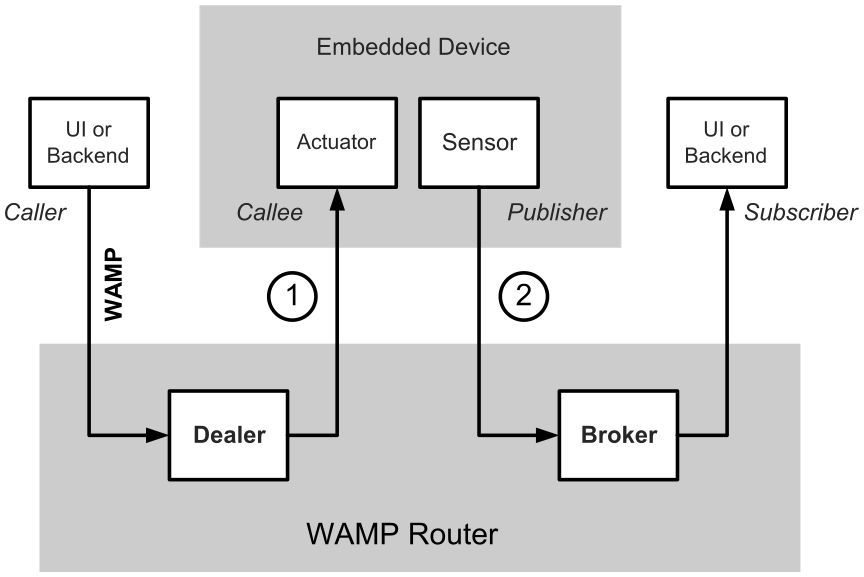
//! Here is an example. Imagine you have a small embedded device like an Arduino Yun with sensors (like a temperature sensor)
//! and actuators (like a light or motor) connected. And you want to integrate the device into an overall system with user
//! facing frontend to control the actuators, and continuously process sensor values in a backend component.
//!
//! Using WAMP, you can have a browser-based UI, the embedded device and your backend talk to each other in real-time:
//!
//! 
//!
//! WAMP in an IoT application[](#id5 "Permalink to this image")
//!
//! Switching on a light on the device from the browser-based UI is naturally done by calling a remote procedure on the device (1).
//! And the sensor values generated by the device continuously are naturally transmitted to the backend
//! component (and possibly others) via publish & subscribe (2).
//!
//! > “Moving onto the part of Internet of Things, we integrated a sensor (light sensor) and an actuator (light switch/dimmer)
//! > into a web application. The major feature of the sensor (sending data) and that of the actuator (commanding and configuration)
//! > perfectly match the messaging patterns, Pub/Sub and RPC, which WAMP provides.”
//!
//! From [Web Technologies for the Internet of Things](https://into.aalto.fi/download/attachments/12324178/Huang_Fuguo_thesis_2.pdf),
//! Master thesis, July 2013, Huang F.
//!
//! **So here you have it: one protocol fulfilling “all” application communication needs.**
//!
//! ## [Real-time](#id8)[](#real-time "Permalink to this headline")
//!
//! [WebSocket](http://crossbario.com/blog/Websocket-Why-What-Can-I-Use-It/) is a new Web protocol that overcomes limitations
//! of HTTP when bidirectional, real-time communication is required.
//!
//! WebSocket is specified as an [IETF standard](http://tools.ietf.org/html/rfc6455) and built into [modern browsers](https://caniuse.com/#search=websocket).
//!
//! When designing WAMP, we recognized early on that WebSocket would be the ideal basis for WAMP as it provides bidirectional
//! real-time messaging that is compatible with the Web and browsers. Not only that - we can run WebSocket with non-browser environments as well.
//!
//! However, as such, WebSocket it is quite low-level and only provides raw messaging. This is where WAMP enters.
//! WAMP adds the higher level messaging patterns of RPC and PubSub to WebSocket.
//!
//! Technically, WAMP is an [officially registered](http://www.iana.org/assignments/websocket/websocket.xml#subprotocol-name)
//! **WebSocket subprotocol** (runs on top of WebSocket) that uses [JSON](http://www.json.org/) as message serialization format.
//!
//! While WAMP-over-WebSocket with JSON serialization is the preferred transport for WAMP, the protocol can also run with
//! [MsgPack](http://msgpack.org/) as serialization, run over raw-TCP or generally any message based, bidirectional, reliable transport.
//!
//! **Hence: WAMP runs on the Web and anywhere else.**
//!
//! ## [Language independent](#id9)[](#language-independent "Permalink to this headline")
//!
//! WAMP was designed with first-class support for [different languages](https://wamp-proto.org/implementations.html)
//! in mind (*). Nothing in WAMP is specific to a single programming language. As soon as a programming language has a WAMP implementation,
//! it can talk to application components written *in any other language* with WAMP support. Transparently.
//!
//! > WAMP has facilities for first-class support of many common and less common language features. E.g. WAMP can transmit both positional
//! > and keyword based call arguments, so that languages which natively support keyword arguments in functions (e.g. Python) can be naturally mapped.
//! > WAMP even supports multi-positional and keywords based **return** values for calls. E.g. the PostgreSQL pgPL/SQL or Oracle PL/SQL languages support this.
//! > Means that most PL/SQL functions can be naturally exposed via WAMP.
//!
//! The ability to create a system from application components written in different languages is a big advantage. You can write your frontend
//! in JavaScript to run in the browser, but still write backend components in Python or Java. If you recognize a performance bottleneck in a component,
//! you can rewrite that component in a faster language - without changing a single line of code in other components.
//!
//! All developers in your team can become productive, since they are not tied to a “least common denominator”, but can write components in the
//! language they prefer, or which is ideal for the specific components at hand. Need some fancy numerical code which is only available in C++ and
//! needs to run with maximum performance? No problem. Have the functionality isolated in an application component written in C++, and integrate this
//! with components written in your “standard” language.
//!
//! **What this means is: plug-and-play your app components - no matter what language.**
use ;
use ;
use ;
use ;
use crate;
use ID;
use send_message;
use SubscriptionPatternNode;
use RegistrationPatternNode;
/// Represents WAMP Router
/// Represents WAMP Router connection information
static WAMP_JSON: &str = "wamp.2.json";
static WAMP_MSGPACK: &str = "wamp.2.msgpack";
unsafe