
velesdb-memory





-e8702a)
The explainable, local-first memory engine for AI agents — as a single MCP
server. Give your coding agent durable memory that never leaves your machine:
it remembers decisions, recalls them semantically, and — the differentiator —
connects them so it can answer why a decision was made, not just retrieve
look-alike text. That auditable why() recall trail is the kind of
traceability the EU AI Act
(enforceable from Aug 2026) asks of AI systems; running fully local, it helps
meet those data-residency and explainability expectations rather than claiming
certified compliance.
Release 0.9.2 — agent-ergonomics cycle over the 0.9.1 memory server: ids now survive float-lossy JSON clients end-to-end (
id_strdecimal-string twins on every id-bearing response, string ids accepted on input, surrounding whitespace tolerated),get_infodocuments all three tool families, newlist_working_contextsandsuggest_budgettools,compile_contextgainswarnings[]andpolicy.slim_response; published to the registries by thevelesdb-memory-v0.9.2tag, so the links below may briefly lag right after merge.velesdb-memoryships on crates.io and on the official MCP registry (io.github.cyberlife-coder/velesdb-memory, with 5 prebuilt.mcpbbundles: macOS arm64/x64, Linux arm64/x64, Windows x64). Bindings: Node@wiscale/velesdb-memory-node0.9.2 and Python invelesdb3.12.0 (memory API only — the context compiler is merged ondevelopbut the published 3.12.0 wheel predates it; it ships with the next PyPI release, until then Python agents reach it through the MCP server).cargo install velesdb-memoryinstalls the latest published release.
Bring your own reranker (Rust):
compile_context_rerankedhands the full fused candidate pool (vector + graph, pre-cutoff) to any [Reranker] you inject — a cross-encoder, an LLM judge — and its ordering decides which memories get compiled in. Never a default, and deliberately not on the wire: the shippedDeterministicRerankeris lexical, and a lexical second stage demotes exactly the zero-vocabulary-overlap evidence the graph walk rescues (both behaviours pinned by tests).recall_fused_rerankedis the same seam for plain recall.
Built on VelesDB's in-core Agent Memory SDK, which fuses three engines behind its memory tools:
| Tool | What it does | Engines |
|---|---|---|
remember |
store a fact, optionally linked + tagged with metadata, with an optional expiry (ttl_seconds) |
Vector + Graph + ColumnStore |
recall |
semantic retrieval, optional exact-match metadata filter | Vector + ColumnStore |
relate |
create a typed edge between two memories | Graph |
recall_fused |
recall with graph-aware re-ranking (vector + typed links fused) | Vector + Graph |
recall_where |
recall filtered by typed column predicates (ranges, comparisons) | Vector + ColumnStore |
forget |
delete a memory | — |
why |
recall a decision + its connected subgraph (multi-hop) | Vector + Graph + ColumnStore |
feedback |
reinforce a recalled fact (useful/noise) — recall re-ranks by this learned confidence, so the memory improves with use without retraining |
Vector |
remember_extracted |
extract facts from raw text + auto-build the graph (opt-in backend) | Vector + Graph |
why is the wedge: it surfaces related memories (the PR, the ticket, the
benchmark) reachable through typed links even when they share no words with
your question — exactly what a pure vector search is blind to.
By design the server exposes memory semantics only — never raw database
capabilities (query, create_collection, upsert, traverse). See
License.
See it (offline, one command)
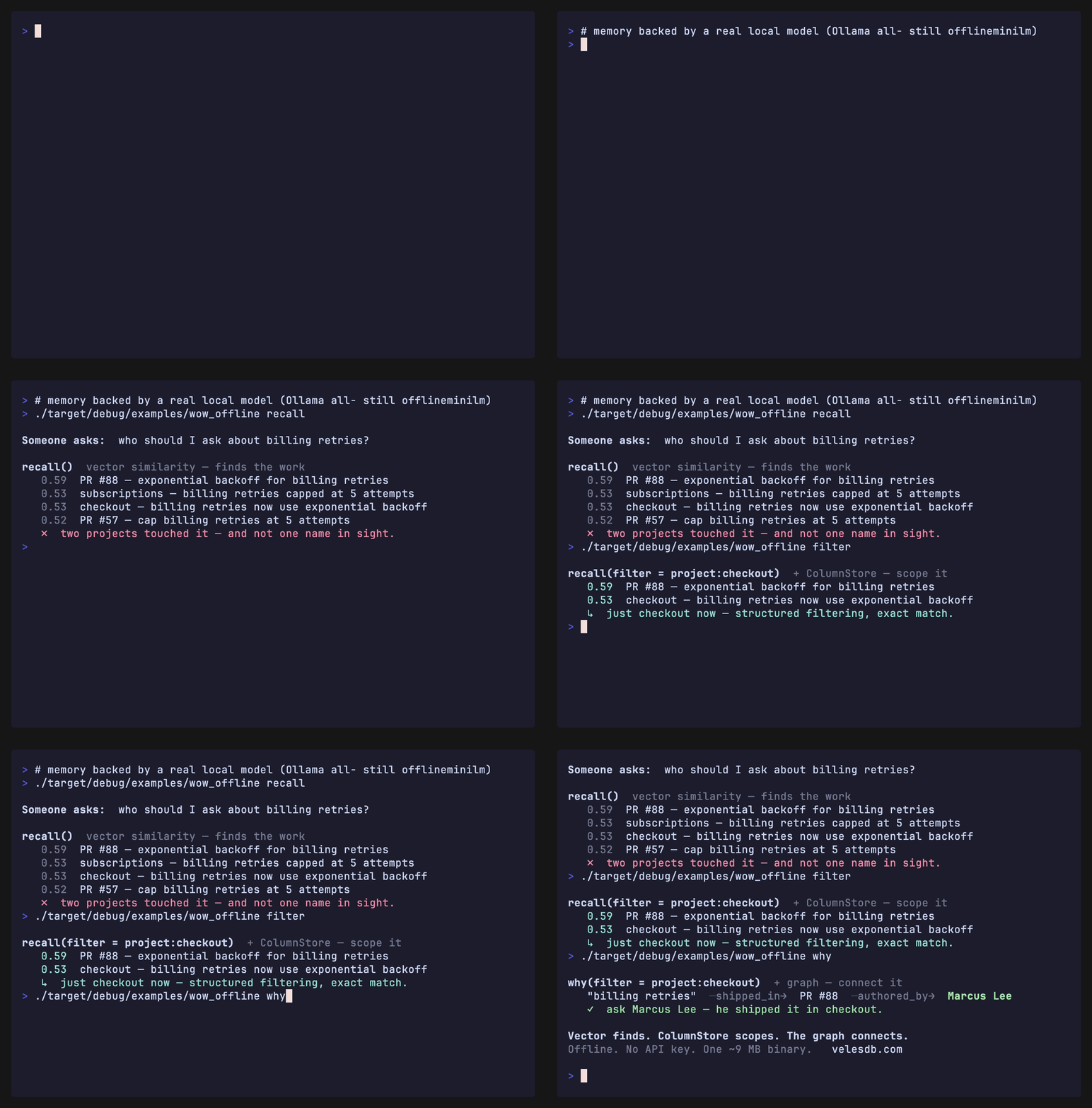
recall("why we chose parking_lot")   [vector similarity only]
   0.47  we chose parking_lot to avoid lock poisoning after a panic
   0.18  PR #42 swaps the std Mutex for parking_lot
   └─ EPIC-317 is nowhere here — it shares no words with the question.

why("why we chose parking_lot")      [vector seed + graph traversal]
   hop 0  we chose parking_lot ...
   hop 1  PR #42 ...
   hop 2  EPIC-317: intermittent CI hang under load
   └─ the graph reached the very ticket the decision fixed.
A vector search ranks by resemblance; the ticket shares no words with the
question, so a pure similarity search is blind to it. why() follows the typed
links and reaches it. That gap is the product.
Four runnable demos of the wedge
Each is a real run that shows what plain recall misses and why() recovers:
| Demo | What it shows |
|---|---|
why_across_sessions.py |
the reason survives a process restart — recall of the top 5 of 16 memories stays blind, why() reaches it |
why_magic_constant.py |
why a magic constant has its value — a business reason that shares no words with the code |
memory_builds_its_own_graph.py |
paste raw prose → a local model auto-wires the graph (no relate()), why() walks it to the root cause |
why_magic_constant.mjs (Node) |
the same engine and wedge in the @wiscale/velesdb-memory-node binding |
Not a weak-embedder trick. In each retrieval demo, recall stays blind to the reason even under a real semantic embedder (
ollama/all-minilm), not just the offlinehashdefault — the reason is connected by a decision, not by surface similarity, which is exactly what a vector store cannot follow.
How it compares — and who it's for
velesdb-memory is embedded memory, not a cloud memory service. The
difference isn't a benchmark bar chart — it's three things no competitor
counters: an evidence trail you can audit (why() shows which facts an
answer came from), zero AI calls to store a memory (the incumbents run 2–3
AI-model calls per save — by default, paid cloud calls), and published
retrieval numbers — we measure, with no AI grader in the loop, how often the
memory finds the right information; to our knowledge, nobody else in this
market publishes that at all:
| velesdb-memory | Mem0 | Zep / Graphiti | |
|---|---|---|---|
| What it is | one embedded binary (vector + graph + column engines) | coordinator over separate services (Qdrant + Postgres) | coordinator, graph-centric (needs Neo4j/FalkorDB) |
| AI calls to store a memory | zero required (optional extraction runs on your local model) | AI-model calls on every write (cloud by default) | AI-model calls on every write (cloud by default) |
| Runs | 100% local / offline | self-host still needs an AI service in the write path | Zep's self-hosted edition was discontinued; Graphiti needs a graph database + an AI service |
| Explains its answers | yes — why() returns the evidence trail |
no — returns an answer only | no — returns an answer only |
| Publishes retrieval accuracy | yes — +7.2pts multi-hop, +9.7pts time-scoped, no AI grader | no | no |
| Time-related questions on LoCoMo | 55–61% on a fully local model — floor = without the optional scaffold (method + stats) | 55.5% base / 58.1% graph-enhanced "Mem0g" (its own best score), both on cloud AI (own paper) | 49.3% on cloud AI — as measured in Mem0's evaluation, which Zep disputes |
Why no single "overall score" comparison row? Because overall scores from
different labs can't be fairly compared: the same product's score can swing
~21 points between two test setups, and vendor headlines often diverge widely
from what other labs measure. Our fully-local 56% aggregate comes with the
full method and statistics disclosed, and instead of a bar chart we publish
the complete sourced landscape — who measured what, with which AI models, and
which figures are disputed: BENCHMARK.md.
Choose velesdb-memory when local-first is a requirement, not a preference:
- Regulated / sovereign data (health, legal, finance, defense) — context can't transit a third-party LLM API;
why()gives both data residency and an auditable recall trail. - Air-gapped / on-prem / edge — a self-contained binary against a local model is the only shape that deploys with no outbound internet.
- Cost-sensitive, high-volume agents — running extraction + recall on a local stack removes the per-token cloud bill.
If you're cloud-native and want the largest community, Mem0 is the default reach. If your
data can't leave the box — or you need to audit why it recalled something — this is the
one that fits. (Deeper positioning: POSITIONING.md.)
Benchmark
cargo run --release -p velesdb-memory --example bench_multihop isolates the
graph's contribution — 24 decision → PR → problem chains, the same embedder
throughout, only the graph toggled. Each question ("why did we adopt <tech>")
has a 1-hop answer (the decision, shares words) and a 2-hop answer (the original
problem, shares none):
| embedder | direct recall | multi-hop, vector-only | multi-hop, vector + graph |
|---|---|---|---|
hash (deterministic) |
100% | 0% | 100% |
real model (Ollama all-minilm) |
100% | 33% | 100% |
Read it this way: the direct control confirms the vector engine is healthy (100% — it aces look-alike retrieval). On multi-hop, a real semantic embedder still recovers only a third of the answers (the problem shares no words with the question); the graph recovers all of them — +67 pp with a real model (structurally +100 pp with the deterministic one). Run the real one yourself:
&&
VELESDB_MEMORY_EMBEDDER=ollama \
Engine isolation, and extraction.
bench_multihopmeasures the engine's contribution on controlled data with the graph pre-wired, so the numbers reflect retrieval, not an LLM. For end-to-end extraction (turning raw text into the graph automatically), the server ships an opt-in layer — theremember_extractedtool /MemoryService::remember_extracted, backed by the dependency-freeExtractortrait (bring your own LLM) or the built-inOllamaExtractorbehind--features extract. The apples-to-apples comparison on the real LoCoMo dataset lives inexamples/locomo/: it builds a fact↔entity graph from the conversations and scores the graph's QA contribution with a hybrid LLM-judge + deterministic metric. The core stays bring-your-own-links; extraction is a commodity on top.
On public benchmarks — each engine, measured
The controlled demo above proves the idea; these run the same engines on
public, third-party datasets with generation-free metrics (pure retrieval
recall — no LLM in the scoring loop, so the number is the memory, not a model).
Each engine is isolated against a pure-vector baseline. Full method, tables and
honest limits in BENCHMARK.md and POSITIONING.md;
every figure reproduces from the bundled examples.
| Engine | Public benchmark | What it measures | Vector → fused |
|---|---|---|---|
Graph (why() BFS) |
HotpotQA (3 000 dev, distractor) | retrieving both bridge facts of a multi-hop question | +7.2pp both-facts on bridge questions (+5.6pp all types) |
| Graph — replicated | 2WikiMultiHopQA (1 000 dev) | supporting-fact recall, second independently built dataset | +2.6 to +3.1pp on its three bridged types (+2.1pp overall) |
ColumnStore (recall_where) |
TimeQA (real Wikipedia bios) | time-scoped recall a year-range filter can do and cosine can't | +9.7pp gold-sentence recall |
| Tri-engine (compound) | synthetic, multi-hop and time-scoped | do the engines stack? | +29pp together — more than the sum of each alone |
Read it straight: the graph helps exactly where a second hop is required — and the lift survives moving to a different multi-hop dataset (more modest there, +2.1pp overall, stated as measured — not a one-dataset fluke). The ColumnStore wins where the answer hinges on a number cosine cannot rank. And on a task that needs both, they compound rather than merely coexist. A pure vector store / RAG orchestrator has none of these — it ranks by similarity and stops.
Install
One command (recommended, with a Rust toolchain present):
# → installs the `velesdb-memory` MCP server binary onto your PATH
The binary is tiny, zero-dependency, and fully offline. It speaks MCP over stdio, so client and server run on the same machine and the memory never leaves it.
From the workspace (for hacking on the server itself):
In an MCP client (no Rust toolchain needed): velesdb-memory is listed on the official MCP registry as
io.github.cyberlife-coder/velesdb-memory. Registry-aware clients can install it straight from the per-platform.mcpbbundles attached to each GitHub release. Acurl | sh/ Homebrew installer is a tracked follow-up; with a Rust toolchain,cargo install velesdb-memoryis the supported one-liner.
Configure your client
All clients use the same stdio shape — point command at the built binary.
cargo install velesdb-memory puts it at ~/.cargo/bin/velesdb-memory
(or the path of your local build, target/release/velesdb-memory).
JSON/TOML configs spawn the binary without a shell, so ~ is not
expanded there — use an absolute path (shown below as
/home/you/.cargo/bin/velesdb-memory; adjust to your home directory).
Claude Code
Cursor — ~/.cursor/mcp.json (global) or .cursor/mcp.json (per project)
Cline — cline_mcp_settings.json — same mcpServers block as Cursor.
Zed — settings.json
Codex CLI — codex mcp add, or a [mcp_servers.*] table in ~/.codex/config.toml
# equivalent ~/.codex/config.toml entry
[]
= "/home/you/.cargo/bin/velesdb-memory"
= []
= { = "/home/you/.velesdb-memory" }
opencode — opencode.json (per project) or ~/.config/opencode/opencode.json (global)
Teach your agent the flow (skill)
Wiring the MCP server gives your agent the tools; it doesn't tell it when to
use them — and the differentiator (why) only pays off if the agent builds the
graph as it works. Ship it the flow with the bundled agent skill:
# Claude Code / opencode: copy the skill into your skills directory
skill/velesdb-memory/SKILL.md teaches the agent
the loop — recall before acting → remember decisions with metadata and links →
relate facts as relationships appear → why to explain → feedback to reinforce —
with concrete scenarios (incident→decision→"why?", onboarding, cross-session
continuity). Without it, an agent will call recall at best and never build the
graph that makes why shine.
A second bundled skill, velesdb-context-optimizer, teaches the compiler
workflow below (when/what to compress, how to read risk). Install it the
same way:
skills/velesdb-context-optimizer/SKILL.md
— see The context compiler tools below.
No repo clone needed: every GitHub Release
attaches velesdb-skills.tar.gz — both skills, one folder per skill at the
archive root — so a one-liner installs them straight from the release:
|
Skills teach an agent what to do; they don't make it remember to do it.
integrations/agent-hooks/
closes that gap for Claude Code with real SessionStart/Stop/PreCompact
hooks that nudge load_working_context/save_working_context automatically
— install once globally (~/.claude/hooks/) to get continuous memory
across every project, or per-project if you'd rather vendor the scripts into
one repo. Codex CLI has no hook mechanism yet; the same directory documents
an AGENTS.md-based convention for it.
Using the tools
Once configured, your agent discovers the tools automatically (via MCP
tools/list). Each takes JSON and returns JSON:
// remember — store a fact; returns a stable, content-derived id
//            (re-remembering identical text is idempotent — same id, updated in place)
remember { "fact": "we chose parking_lot to avoid lock poisoning",
           "metadata": { "project": "checkout" },                  // optional → enables filtering
           "links":   [ { "target": 1234, "relation": "decided_in" } ],  // optional typed edges
           "ttl_seconds": 604800 }                                 // optional → expires in 7 days
→ { "id": 9876543210 }

// relate — add a typed edge between two existing memories
relate { "from": 9876543210, "to": 1234, "relation": "depends_on" }
→ { "edge_id": 42 }

// recall — semantic search; optional exact-match metadata filter (ColumnStore)
recall { "query": "billing retries", "limit": 5, "filter": { "project": "checkout" } }
→ { "memories": [ { "id": 9876543210, "score": 0.59, "content": "…" }, … ] }

// why — the differentiator: best match + its connected subgraph (multi-hop)
why { "decision": "why did we choose parking_lot", "max_hops": 2,
      "filter": { "project": "checkout" } }
→ { "nodes": [ { "id": …, "content": "…", "hop": 0 }, … ],
    "edges": [ { "from": …, "to": …, "relation": "decided_in" }, … ] }

// forget — delete a memory by id
forget { "id": 9876543210 } → { "id": 9876543210, "found": true }

// remember_extracted — extract facts from raw text and auto-wire the graph
//   (opt-in: needs a server built with --features extract + VELESDB_MEMORY_EXTRACTOR)
remember_extracted { "text": "Met Dana at the Rust meetup; she now leads the parser rewrite." }
→ { "ids": [ 11122233, 44455566 ] }   // stored facts; topics become shared graph hubs
limit defaults to 10 (capped at 1000); max_hops defaults to 2 (capped at 10);
links, metadata, and filter are optional.
The context compiler tools
Compiler surfaces today: MCP server and Rust ship the full tool set
(compile_context, retrieve_context_source, context_savings,
save_working_context, load_working_context, explain_compilation;
compile_context_reranked is Rust-only). Node
(@wiscale/velesdb-memory-node) has compileContext, retrieveContextSource,
save/loadWorkingContext, and feedback, but not yet context_savings or
explain_compilation. Python (from velesdb import MemoryService) has
compile_context, retrieve_context_source, context_savings,
save/load_working_context, and feedback merged on develop (no
explain_compilation yet) — but the published PyPI wheel predates all of
it; until the next PyPI release, Python agents reach the compiler through
the MCP server. Any MCP-speaking client gets the full surface regardless of
language.
Why: agents spend most of their tokens re-reading redundant context.
compile_context compresses it deterministically — no LLM, no cloud, no
API key: same request, byte-identical output. What must survive verbatim
does (code fences, URLs, numbers/dates/ids, negative constraints, anything
marked {"verbatim": true}); duplicates drop; repeated log lines collapse
with counts (ERROR timeout (x50)); over-budget content becomes a
recoverable ctx://source/ handle instead of a silent loss; and every
fragment gets one auditable decision (stable rule id, reason, relevance,
risk). Guarantees, per compilation:
- Budget: the assembled content never exceeds
token_budget. - Provenance:
sources+ per-decisioncontent_hashidentify the exact bytes;retrieval_handleslist what was externalized. - Nothing critical silently lost: losing preserve-classified content
raises the compilation's
riskto"high"— check it before use.
How it works

Not a transparent proxy. compile_context only touches what your agent
explicitly hands it as fragments — logs, retrieved docs, conversation
history you choose to route through the call. It never sees or compresses
the harness's system prompt or tool-call schemas; those stay outside the
compiler entirely. Knowing when and what to route through it is the
velesdb-context-optimizer
skill's job, not the compiler's — the compiler just compresses what it's
given, deterministically.
No automatic repo indexing. Nothing enters recallable memory — what
recall / why / memory_scope can surface — unless you call remember /
relate / remember_extracted explicitly. Compilation does write two things
to the local store under VELESDB_MEMORY_PATH (default ~/.velesdb-memory):
all fragment sources are cached locally (content-addressed — not just the
over-budget ones) so every ctx://source/ handle stays recoverable via
retrieve_context_source, and context_savings records aggregate stats
(tokens in/out/saved) per project. Both stay on disk — local-first, nothing
is ever sent off the machine.

// compile_context — minimal call: query + token_budget + fragments
compile_context { "query": "state of the canary deploy",
                  "token_budget": 500,
                  "fragments": [
                    { "content": "The canary is green: 2% traffic, zero errors in the last 10 minutes." },
                    { "content": "Rollback runbook: kubectl rollout undo deployment/canary." } ] }
→ { "content": "…both fragments packed…", "decisions": […2 entries, "action": "preserve"…],
    "insights": { "tokens_in": 44, "tokens_out": 45, "tokens_saved": 0 }, "risk": "low" }
Add memory_scope, project, and metadata: {"cache": true} once you need
stored-memory recall or provider prompt-cache alignment — the full request:
// compile_context — deterministic compression under a token budget
compile_context { "query": "state of the canary deploy",
                  "token_budget": 4000,
                  "project": "veles",
                  "memory_scope": { "k": 5 },                 // optional: pull relevant memories in
                  "fragments": [
                    { "content": "You are the deploy assistant.", "metadata": { "cache": true } },
                    { "content": "<600 lines of CI logs>", "kind": "log" },
                    { "content": "Never restart the primary during a rebalance." } ] }
→ { "content": "…", "sections": […], "decisions": […], "sources": […],
    "retrieval_handles": […], "insights": { "tokens_in": 2244, "tokens_out": 545,
    "tokens_saved": 1699, … }, "risk": "low" }

// retrieve_context_source — what was externalized is recoverable, byte for byte
retrieve_context_source { "handle": "ctx://source/1234567890" }
→ { "handle": "ctx://source/1234567890", "content": "…original bytes…" }

// explain_compilation — "why was this fragment dropped/shortened?" (stateless:
//   compilation is deterministic, so the request is re-compiled)
explain_compilation { "request": { …same request… }, "fragment_id": 1234567890 }
→ { "action": "drop", "rule_id": "drop.duplicate", "reason": "…", "risk": "low", … }

// explain_compilation — byte-identical fragments share a content-addressed
//   fragment_id, so a plain fragment_id lookup always resolves to the
//   deduplication survivor. Pass fragment_index (0-based position in
//   request.fragments) to target one specific fragment instead:
explain_compilation { "request": { …fragments: [a, a]… }, "fragment_id": 1234567890,
                       "fragment_index": 1 }
→ { "action": "drop", "rule_id": "drop.duplicate", … }   // the SECOND "a", not the survivor

// context_savings — aggregate recorded savings, optionally per project
context_savings { "project": "veles" }
→ { "events": 12, "tokens_in": …, "tokens_saved": …, "truncated": false }
JS clients talking raw MCP (no Node binding): watch
fragment_id/content_hash/memory_idprecision. Every id in acompile_contextorexplain_compilationresponse is au64. The@wiscale/velesdb-memory-nodebinding always crosses ids as decimal strings, so it is unaffected — but a plain MCP client speaking JSON straight over stdio/SSE (no binding in between) gets a JSON number, andJSON.parsein JS represents that as an IEEE-754 double: ids above2^53 − 1(9007199254740991) silently lose precision. Set"policy": { "ids_as_strings": true }on the request to opt every id field of that response into decimal-string form instead (same rewrite the Node binding applies internally, reused — not reimplemented). Defaultfalse: existing clients keep today's numeric response unless they opt in.fragments[].idon the way IN already accepts either a JSON number or a decimal string, so a caller can resubmit an id it received stringified without converting it back.
Preservation rules (stable ids, first match wins): preserve.marked_verbatim,
cache.stable_prefix (cache-marked fragments form a stable prefix for
provider prompt caching), preserve.code_fence,
preserve.negative_constraint, abstract.log_dedup,
preserve.exact_values, preserve.url, preserve.default; the budget layer
adds budget.externalize and dedup adds drop.duplicate /
drop.near_duplicate. First-match-wins also means media.atomic is checked
before cache.stable_prefix: a media fragment marked metadata: {"cache": true} still classifies media.atomic and packs in the Body section, never
the Cache prefix — the cache flag is ignored on media fragments.
insights.tokens_saved is a local estimate, calibrated against a real
BPE (cl100k) to deliberately over-count every measured content class
(+9.6 %…+63.8 %, per-class figures in the table below) — not the provider's
count, not billed tokens, not cache reads.
The reproducible benchmark (examples/context_savings)
measures 82.5 % real (cl100k) token savings on a committed 12-turn agent-session benchmark (sub-ms stateless compiles), 75–82 % estimated savings on its static corpus in ~2 ms compile, and — with memory_scope's fused HNSW + graph-walk recall over relate-linked fact chains — 9/9 answer facts surfaced vs 3/9 for vector-only recall on the committed tri-engine benchmark
latency. The committed
cache_prefix
harness measures the cache: true prefix's byte stability directly: across
10 consecutive compiles with changing volatile content, the cache section is
a byte-identical 100 % stable prefix on all 9 consecutive turn pairs
(reproducible: two full 10-turn runs, byte-identical). Known limitation:
that measurement holds the query fixed across turns; the cache prefix is
byte-stable only at a fixed query today — when two same-priority
cache-marked fragments compete under a budget too tight for both, a query
change can reorder them (relevance is one of the packing tie-breakers), so
a caller who marks more than one fragment cacheable and expects a
query-agnostic prefix should keep the budget generous enough for all of
them, or track
issue #1455 for
the fix. That tri-engine path — the one memory_scope drives inside compile_context — looks like this:

The velesdb-context-optimizer
skill teaches an agent the full workflow — including when not to compress.
Measured on a real coding session
Your AI coding assistant re-sends everything it has seen on every single message — old screenshots, logs it already read, files it re-opened. VelesDB compiles that context first: same information, fewer tokens (what LLM providers bill you for), so each message costs less and your session lasts longer before hitting the context limit.
To measure that, a committed benchmark replays a realistic multi-turn coding
session — screenshots, CI logs, documents the assistant reads again, code
files re-opened after edits — two ways: once sending everything raw, once
compiled through compile_context. Everything is counted with cl100k (a
real tokenizer — the same counting the API does) and the API's own
image-pricing formula. Every run is deterministic and was reproduced twice,
byte-identical:

| Scenario | Without VelesDB | With VelesDB | Saved |
|---|---|---|---|
| A balanced bug-fix session (14 turns) | 84,334 tokens | 69,843 tokens | 17.2 % — duplicates and outdated screenshots only; nothing unique removed |
| The same session with a hard 8,000-token window | 84,334 tokens | 67,194 tokens | 20.3 % — the extra points come from content set aside (retrievable on demand — never deleted), not from more duplicates |
| A long session where you keep iterating (36 turns) | 449,836 tokens | 310,850 tokens | 30.9 % — savings compound as the session grows |
| With the memory features turned on (14 turns) | 84,334 tokens | 68,839 tokens | 18.4 % — reference docs stored once, recalled per turn, out-of-the-box settings |

The long session also answers the endurance question: over the full measured session (feature-building included) the raw context grows ~555 tokens per message versus ~333 compiled — 1.7× more headroom (how many more turns fit in one session before the context limit forces a summarize-and-restart), and up to 6.6× in the verification/wrap-up phase, where most turns are re-reads. Projections always use the full-session rate:

Reproduce any of these in one command, no key and no network needed
(node examples/real-session-benchmark/offline.mjs, long-session.mjs,
memory-enabled.mjs). An opt-in billed mode measures the same session
against real provider usage — through your own Claude Code CLI account with
zero configuration, or an API key — and additionally grades real generated
answers in both arms against a committed fact checklist, so a token saving
that costs answer quality is reported, never hidden. Full protocol,
attribution details, and caveats →
examples/real-session-benchmark/
(repo root — commands above run from a repo checkout).
Exact token estimators
The default HeuristicEstimator
is a deterministic, dependency-free char-class approximation, calibrated to
always over-count a real BPE (never under, so packing never silently
overflows a provider's window) — measured margins from +9.6 % (CJK) to
+63.8 % (English prose) on the committed
exact_estimator
harness (numbers below are from its own runs, reproducible: two runs, byte-
and figure-identical). For an id-dense corpus against a tight budget, or
whenever you need the provider's real count instead of a safe
over-approximation, inject a model-exact
TokenEstimator
via ContextCompiler::with_estimator — the trait is two methods, one of
them defaulted:
use TokenEstimator;
/// OpenAI cl100k, via any tiktoken-style encoder you already depend on
/// (not a VelesDB dependency — bring your own, e.g. `tiktoken-rs`).
;
// with_estimator takes a boxed trait object (DynTokenEstimator):
let compiler = new
.with_estimator;
Anthropic does not publish a tokenizer, so there is no exact-count
equivalent to plug in the same way; the closest honest option is to price
and pack against a cl100k estimator (Claude's real count runs close to it
for prose/code) or to keep the default heuristic's safe over-count, which
never claims to be exact. Injecting a custom estimator only changes
estimate()'s output — the pipeline (chunk → classify → dedup → score → pack → assemble) and its determinism guarantee are unaffected either way.
Measured on the harness's per-category corpus (two runs, identical):
| Category | Default estimate | Real (cl100k) | Error | Direction |
|---|---|---|---|---|
| English prose | 77 | 47 | +63.8 % | over (safe) |
| French prose | 90 | 59 | +52.5 % | over (safe) |
| Repetitive logs | 730 | 479 | +52.4 % | over (safe) |
| Rust code | 64 | 49 | +30.6 % | over (safe) |
| Digit-dense ids/dates | 89 | 68 | +30.9 % | over (safe) |
| Markdown | 78 | 69 | +13.0 % | over (safe) |
| JSON | 50 | 44 | +13.6 % | over (safe) |
| URLs | 57 | 51 | +11.8 % | over (safe) |
| CJK | 80 | 73 | +9.6 % | over (safe) |
Audit mode: a dry-run importance report
compile_context has no separate "audit" flag — pass a budget large enough
that nothing gets dropped, abstracted, or externalized (the request's own
hard ceiling, MAX_TOKEN_BUDGET = 10,000,000 tokens, always qualifies), and
the response is the audit: every fragment gets a full
ContextDecision
(rule id, relevance in [0, 1], reason, content hash) with risk: "low"
(nothing critical was lost — a dry run should never itself lose anything).
Sort decisions by relevance descending client-side for an at-a-glance
importance report of what the compiler would prioritize under a tighter
budget, without actually dropping anything:
compile_context { "query": "state of the canary deploy",
                   "token_budget": 10000000,               // MAX_TOKEN_BUDGET: dry-run, nothing lost
                   "fragments": [ /* … */ ] }
→ { "risk": "low", "decisions": [ /* one per fragment, every action + relevance + reason */ ], … }
Normalizing timestamped logs
By default, abstract.log_dedup collapses only byte-identical repeated
lines — real logs are usually timestamped, so a burst of otherwise-identical
lines survives as distinct entries and the fragment falls through to
whichever rule matches its literal bytes instead (see the skill's
"Timestamped logs" note). Set policy.normalize_log_timestamps: true to
opt in to a deterministic, fixed-pattern mask applied before grouping,
for kind: "log" fragments only:
- a leading timestamp — ISO-8601 (
2026-07-18T10:23:45.123Z,2026-07-18T10:23:45+02:00) or the space/comma log4j variant (2026-07-18 10:23:45,123), or syslog (Jul 18 10:23:45); - one or more immediately-following bracketed hex/decimal counters
(
[a1b2c3],[1234]) — a bracket whose content is not purely hex/decimal ([ERROR],[shard-3]) is left alone, so level tags and named ids never match.
Only the grouping key changes — the emitted line is still the first
occurrence's exact bytes, so nothing is rewritten into the output. The
patterns are fixed in the compiler (never a caller-supplied regex), so the
same request keeps producing the same collapse. When normalization actually
merged lines that would otherwise have stayed distinct, the fragment's
decision.reason says so ("… — timestamps normalized before collapsing"),
so an audit trail always shows why a log collapsed the way it did. Off by
default: it changes what "duplicate" means for logs, so existing callers
keep byte-exact grouping unless they opt in.
Media fragments
A fragment may carry an inline image alongside its text: set
media: {"mime": "image/png", "bytes_b64": "<base64>"} on a
ContextFragment; content stays the caption (often empty for a bare
screenshot).
- Atomic packing: a media fragment is never chunked — it packs whole under the budget or not at all, so an image can never be cut mid-stream.
- Token cost from the image itself, not its base64 text: PNG/JPEG
dimensions are sniffed from the header (
ceil(width * height / 750), a published Claude image-token constant); an unsupported mime or an unreadable header falls back to a safe over-count of the base64 text. - Dedup on raw bytes: two fragments with byte-identical decoded media are deduplicated regardless of their caption text (screenshots are often captionless, so caption-text dedup would false-positive on "" == ""). Media is never near-duplicated.
- Capped at 4 MiB of base64 (
limits::MAX_MEDIA_BYTES, ≈3 MiB decoded), independent of the text-content cap; malformed base64 is rejected at validation. - Real retrieval, through the memory bridge. A media fragment that does
not fit the budget externalizes exactly like text:
decision.action == "retrieve",rule_id == "budget.externalize", and actx://source/handle. A media handle is content-addressed on the raw decoded bytes (the same identity dedup uses), never the caption — two different images always get two distinct, independently resolving handles even when both captions are blank (the common case), and byte-identical images share one handle.MemoryService::compile_context(withpolicy.store_sources, the default) persists the fragment's base64 payload alongside its caption —MemoryService::retrieve_context_source(handle)returns{content, media?},mediapresent whenever the original fragment carried one. Media is embedded with a deterministic placeholder vector derived from its raw bytes' hash, never through the text embedder: resolution is by content-addressed hash only, never by vector search. The bareContextCompiler(no memory) still just mints the handle, exactly as it does for text — it never knows or cares whether a resolver is attached. - Screenshot supersession. Fragments that share
media,kind: "screenshot", and the samemetadata.targetvalue form a succession series: only the LAST one in the request (input order — never a clock) stays inline; every earlier one is reclassifiedretrieve.screenshot_supersededand externalized behind a resolvable handle, regardless of budget — a stale screenshot never competes with the current one for space.metadata.targetshould identify the subject being screenshotted (a URL, a test name, a UI element id — the caller's choice); a screenshot with nometadata.targetis never superseded, since there is no evidence it succeeds anything. Opt out per request withpolicy.disabled_rules: ["retrieve.screenshot_superseded"]. - Every surface carries media: the MCP tools (
compile_context/retrieve_context_source, schemas included —fragments[].mediaand the optionalmediaon the retrieve result are both advertised, not just accepted), the Python binding, the Node binding (compileContext/retrieveContextSource, same{handle, content, media?}shape as the MCP tool — see the Node README), and WASM'scompileContext(media fragments compile, dedup, and cost correctly on the in-memoryWasmStore;retrieveContextSourceis not yet exposed on the WASM binding, so resolving a media handle back to bytes within a wasm session is Node/Python/MCP-only for now).
Minimal end-to-end example, over the MCP tools (the exact calls
examples/context_savings/real_measures/mcp_e2e.py makes against a real
velesdb-memory server over stdio):
=
=
= # too big for budget=1, externalized
=
assert == # byte-identical round trip
Source TTL & disk growth
policy.source_ttl_seconds (None by default) controls how long a
compiled fragment's cached original — the bytes behind its
ctx://source/<hash> handle — stays retrievable. Default is permanent:
every distinct fragment compiled through the memory bridge is kept until
explicitly forgotten, on purpose — a compiler that silently expired sources
would make retrieve_context_source unreliable exactly when an audit needs
it most (auditability over disk thrift). Set a TTL (seconds) when you
compile high-volume, low-value volatile content (e.g. per-turn logs in a
long-running agent) and do not need those sources recoverable past a
bounded window; policy.event_ttl_seconds applies the same trade-off to
context_savings' aggregated compilation events.
Disk growth: with the default permanent TTL, every distinct fragment's
source accumulates under VELESDB_MEMORY_PATH (default
~/.velesdb-memory) for as long as the process compiles new content — by
design, since sources are what makes retrieval and audit trustworthy. To
reclaim space:
- set
source_ttl_seconds/event_ttl_secondsgoing forward so new compilations self-expire; - or purge the whole store manually: stop every process using it, then
delete the store directory at
VELESDB_MEMORY_PATH(the same manual purge documented above forremember-stored facts) — there is no selective "purge sources older than N days" command today, only whole- store deletion or per-factforget.
Usage-driven importance: RL confidence + recency in the same ranking
memory_scope selection composes one more engine pair: the learned RL
confidence that feedback trains, and a batch-relative recency term.
policy.importance drives the blend; per pulled memory the ranking key is
score = fused_norm + confidence·(rl_confidence − 0.5)·2 + recency·recency_norm
"policy": { "importance": {
  "confidence": 0.2,          // default; 0.0 switches the term off
  "recency": 0.1,             // default; inert without recency_field
  "recency_field": "day"      // optional caller metadata key; no default
} }
- Selection is untouched. The blend re-ranks only the pool the fused vector+graph similarity already selected — confidence is not relevance, so an over-reinforced but off-topic fact can never buy its way in (pinned by an adversarial test).
- Recency contract (strict).
recency_field: nulldisables the term — no implicit default key exists. When set, it must name a numeric caller metadata field on one monotone scale per batch (e.g.YYYYMMDDintegers as in dated recall, or an epoch); the scale is documented, not verified. Values are min-max normalised within the pulled batch: the newest reads1.0, the oldest0.0, a memory without the key contributes0(never penalised), and a degenerate batch (max == min) contributes0for all. The compile pipeline never reads a clock — recency is relative to the batch, so compilation stays byte-deterministic. - Compat. Both weights at
0.0reproduce the 0.8.0 output byte for byte (golden-pinned); requests withoutimportanceparse unchanged. Behavioral change on upgrade: the defaults are active, so with an untouched policy RL-reinforced memories rank higher out of the box — zero the weights to restore the exact 0.8.0 ordering. - Weight range. Recommended
[0, 1]for both weights. Out-of-range values are accepted verbatim, never clamped: a negative weight inverts its term (e.g. demote reinforced facts), a weight above1lets the term dominate similarity; only the recorded decisionrelevanceis clamped into[0, 1]. - Explainable. Every pulled memory's decision
reasonventilates all four signals, e.g. (from the committed tri-engine benchmark):pulled from memory 1444253315203703248 (vector 0.00, graph 1.00, confidence 1.00, recency 0.00)— a fact invisible to vector search, rescued by the graph walk, promoted by learned confidence. - Reranker seam. The blend also composes with
compile_context_reranked(Rust-only seam for a semantic cross-encoder or LLM judge): the reranker picks and orders the pool, then the same importance blend re-ranks inside it — one coherent, auditable ranking across HNSW seed, graph reach, fusion, reranker, confidence, and recency.
The committed tri_engine_rescue
harness measures the synergy end-to-end: with zero weights the wordy
similar-only fact precedes the real fix (0.8.0 behaviour); with
confidence: 0.8, the fact the team reinforced via feedback and that
only the typed-edge walk reaches leads the compiled context — identical
across two runs.
IDs & linking. remember returns a stable id derived from the fact's
content. Pass it to relate / forget, or as a links[].target on a later
remember — that is how the graph gets built, and what why traverses.
A natural agent pattern. At the end of a task, remember the decision with
metadata (project, author, status) and a link to the PR or ticket. Days
later, why("…") recovers not just the decision but the PR, ticket, and
benchmark linked to it — where recall alone returns only look-alike text.
Forgetting & expiry. Facts are permanent by default. Delete one explicitly
with forget { "id": … }. To make a fact self-expire, pass ttl_seconds to
remember (a durable TTL persisted with the fact, so it survives a restart;
expired facts stop being recalled). Set VELESDB_MEMORY_DEFAULT_TTL (seconds) to
apply a default expiry to every fact that doesn't set its own. To wipe everything,
delete the store directory at VELESDB_MEMORY_PATH.
Embedding the library directly? The same wedge is available without the MCP server: as a Rust API (
MemoryService::remember/recall/relate/forget/why, see the rustdoc on docs.rs), in Python (from velesdb import MemoryService), and in Node.js (npm install @wiscale/velesdb-memory-node).
Embedding backend
remember / relate / why / forget behave the same regardless of the
embedder — the graph is what makes why shine. Only recall's semantic
quality (and why's seed match) depend on it.
VELESDB_MEMORY_EMBEDDER |
Recall quality | Footprint | Needs |
|---|---|---|---|
hash (default) |
keyword-ish, deterministic | tiny, fully offline, zero-dep | nothing |
ollama |
real semantic | tiny binary + your local model | a running Ollama; build --features ollama |
The default keeps the single tiny offline binary promise intact. For real
semantic recall, build with the ollama feature and point it at a local model
— the model runs in your own Ollama, so memory still never leaves the machine:
VELESDB_MEMORY_EMBEDDER=ollama \
VELESDB_MEMORY_OLLAMA_MODEL=all-minilm \
Env vars: VELESDB_MEMORY_OLLAMA_URL (default http://localhost:11434),
VELESDB_MEMORY_OLLAMA_MODEL (default all-minilm). The embedding dimension is
probed from the model, so a store is fixed to one embedder — don't switch
embedders on an existing store.
Auto-extraction backend (opt-in)
By default the graph is bring-your-own-links: you wire edges with relate
or links. The remember_extracted tool turns that into a commodity — a local
LLM reads raw text and the server stores its facts + auto-builds the fact↔topic
graph. It is off by default (it pulls an HTTP dependency), so the standard
binary stays tiny and offline:
VELESDB_MEMORY_EXTRACTOR=ollama \
VELESDB_MEMORY_EXTRACTOR_MODEL=qwen3.6:35b-mlx \
Env vars: VELESDB_MEMORY_EXTRACTOR (ollama to enable), VELESDB_MEMORY_EXTRACTOR_URL
(default http://localhost:11434), VELESDB_MEMORY_EXTRACTOR_MODEL (required, a
generative model). Without a backend the tool returns a clear "not configured"
error. To plug a different model, implement the dependency-free Extractor
trait and pass it to MemoryService::remember_extracted from Rust.
License
The distributed binary embeds velesdb-core and is therefore governed by the
VelesDB Core License 1.0 (source-available): redistribution must keep the
license and notices, with velesdb.com attribution for
public apps. The wrapper source in this crate is intentionally readable and
forkable.
By design, this server exposes memory semantics only —
remember/recall/relate/forget/why, which return results. It never exposes
raw database capabilities (query, create_collection, upsert, traverse).
Run locally over stdio, you operate the software for yourself: this is the
license's expressly-permitted embedded, local-first use — not a hosted
service to third parties.
License FAQ
Is this open source? It is source-available: the full source is readable, modifiable, and redistributable under the VelesDB Core License 1.0 (a derivative of the Elastic License 2.0). It is not an OSI-approved license.
Can I use it at work / in a commercial product? Yes. Running the server
locally, or embedding the library inside your own application where your users
only ever receive results (a memory, a why() subgraph), is expressly permitted
— the license's embedded, local-first use clause.
What's actually forbidden? Re-hosting VelesDB as a multi-tenant service
where third parties drive the database (run arbitrary queries, manage
collections/indexes/graph nodes). This server makes that impossible by design:
it exposes memory semantics only (remember/recall/relate/forget/why),
never raw query / create_collection / upsert / traverse.
Why this license? So that you can embed agent memory locally and freely, while a third party cannot turn our engine into a memory-as-a-service and resell it. The moat protects the project, not your usage.
What do I owe when I redistribute? Keep the LICENSE file and copyright notices, and add a velesdb.com attribution in any public app that ships the binary. Internal, dev, and test use need no attribution.
Full terms and the canonical FAQ: LICENSE. Questions: contact@wiscale.fr.