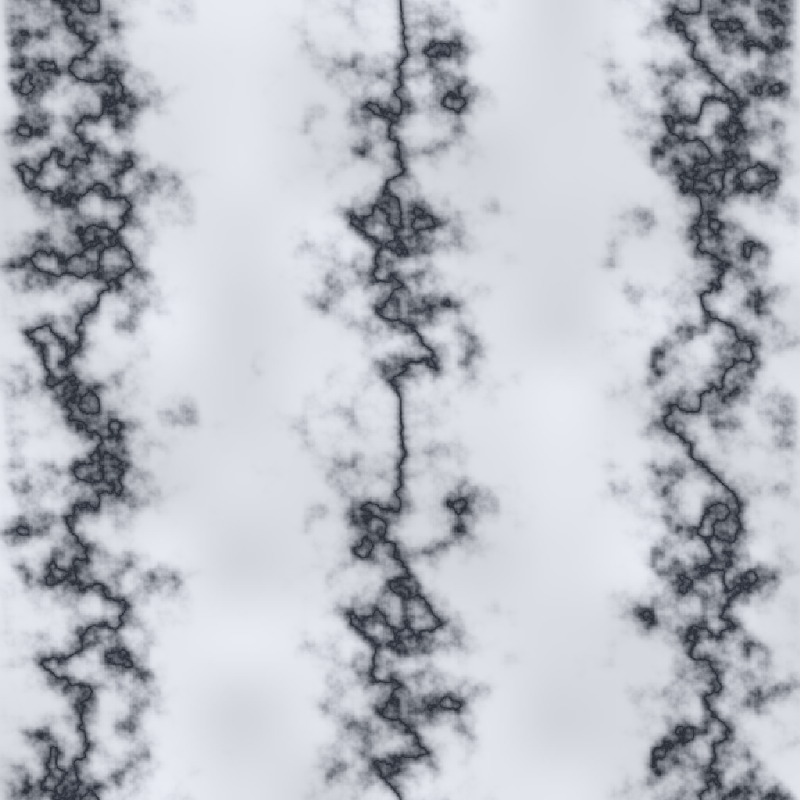
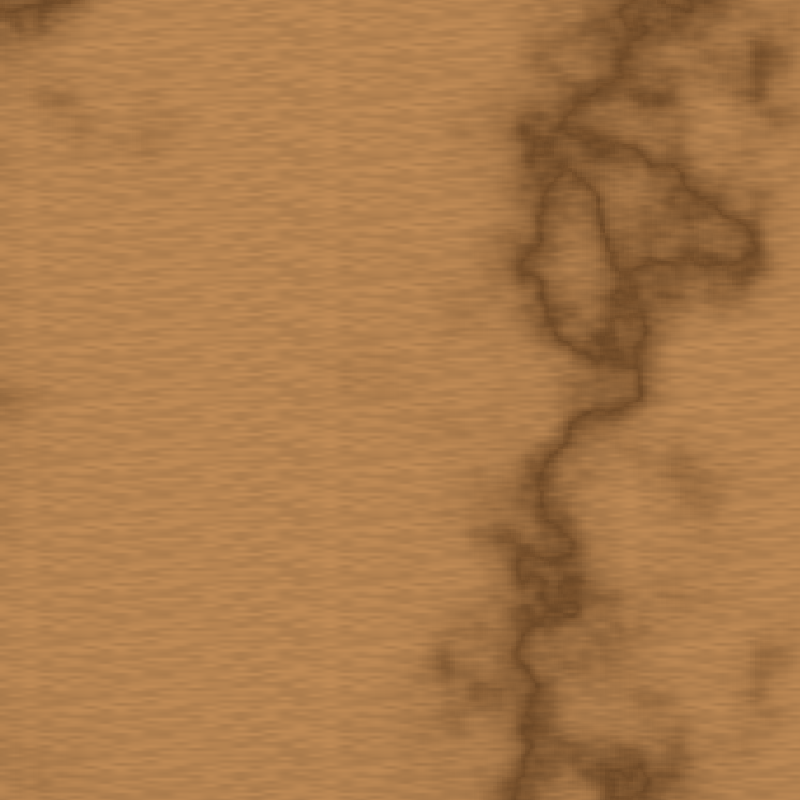
// Tileable wood ring

fn pdelta(a, c) { fract(a - c + 0.5) - 0.5; }  // [-0.5, 0.5)

// Wood (tileable)
fn shade() {
    let t = time * 0.1;

    // base uv in [0,1), ensure wrapped
    let uv0 = fract(uv);

    // torus-distance radius around center
    let cx = 0.5; let cy = 0.5;
    let dx = pdelta(uv0.x, cx);
    let dy = pdelta(uv0.y, cy);
    let r  = length(vec2(dx, dy));

    // small, tileable turbulence (wrap inputs + integer scales)
    let w1 = sample(fract(uv0 * 2.0 + vec2(t, 0.0)), "fbm_perlin"); // tiles (×2)
    let w2 = sample(fract(uv0 * 4.0 + vec2(0.0, t)), "fbm_perlin"); // tiles (×4)
    let turb = (0.6 * w1 + 0.4 * w2) - 0.5;  // zero-mean

    // ring phase; keep warp small to avoid marble look
    let ring_freq = 14.0;      // try integers
    let ring_warp = 0.05;      // small
    let phase = r + ring_warp * turb;

    // thin rings
    let waves = sin(phase * ring_freq * 6.2831853); // use 2π if you like continuous control
    let rings_mask = pow(1.0 - abs(waves), 6.0);

    // fine longitudinal grain (also tiled)
    let grain_uv = fract(vec2(uv0.x * 8.0, uv0.y * 64.0)); // integer scales
    let g = sample(grain_uv + vec2(0.0, fract(t)), "value");
    let grain = (g - 0.5) * 2.0;

    // colors
    let base_light = vec3(0.72, 0.52, 0.32);
    let base_dark  = vec3(0.45, 0.30, 0.16);
    color = mix(base_light, base_dark, rings_mask);
    color *= (1.0 + 0.05 * grain);

    roughness = 0.6;
}