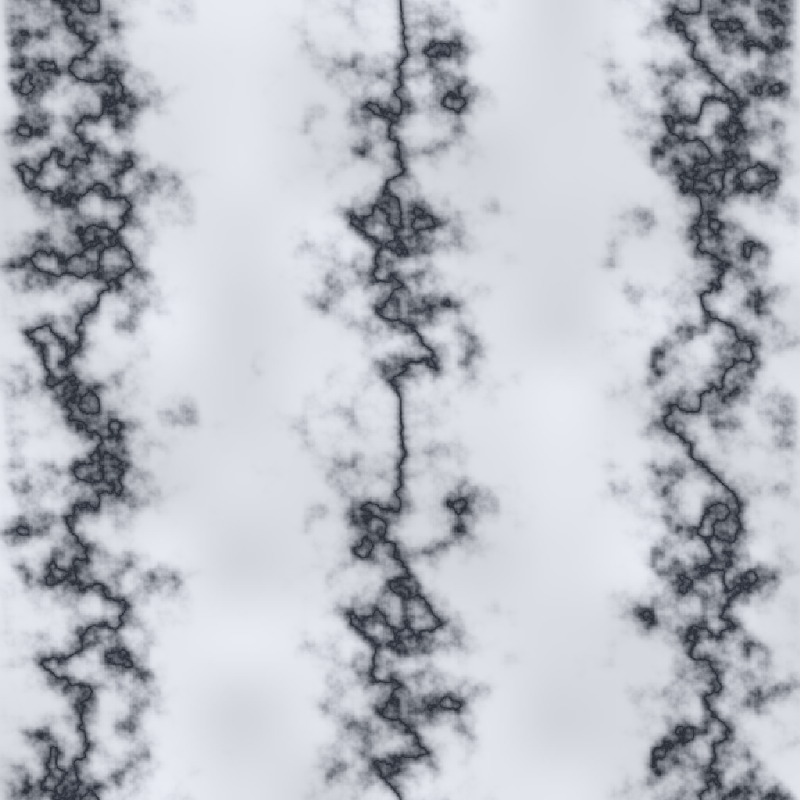
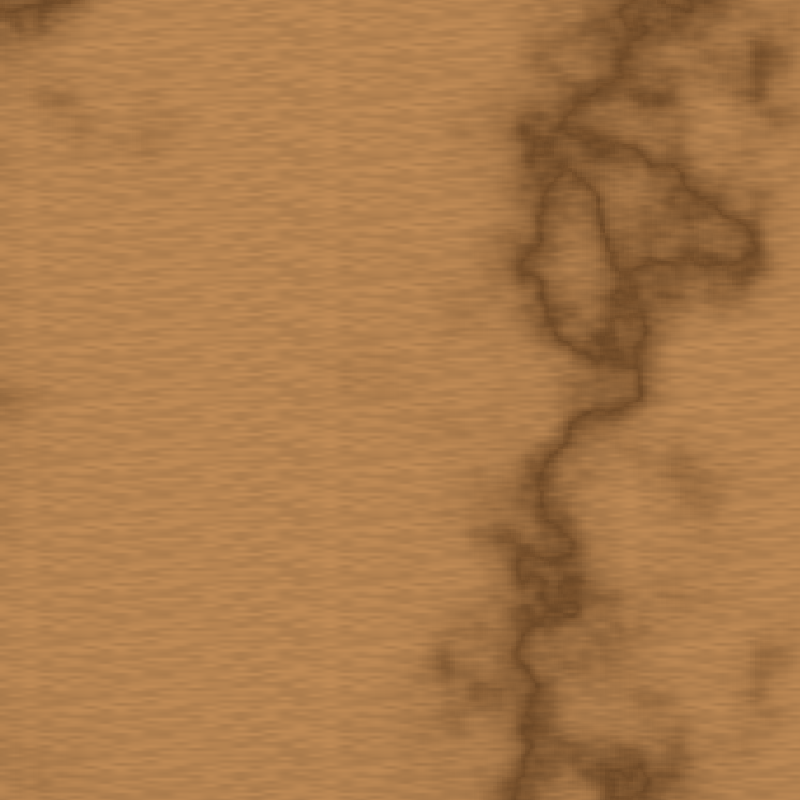
// Wood
fn shade() {
    // Procedural wood: concentric growth rings warped by turbulence + fine grain.
    // Only the .x channel of textures is used (value channel).
    let t = time * 0.0;

    // Move and scale domain; center the rings roughly in the middle of each face.
    let uv2 = uv / 3.0 - vec2(1.5);

    // fBm turbulence (zero-mean) to warp the rings
    let n1 = sample(uv2 + vec2(t, 0.0), "fbm_perlin");   // [0,1]
    let n2 = sample(uv2 * 2.0 + vec2(0.0, t*0.7), "fbm_perlin");
    let turb = 0.65 * n1 + 0.35 * n2;                       // [0,1]
    let turb_zm = (turb - 0.5) * 2.0;                       // [-1,1]

    // Radial distance from center (log cross-section look)
    let r = length(uv2);

    // Warp rings by turbulence (phase modulation)
    let ring_freq = 10.0;            // number of rings
    let ring_warp = 0.22;            // strength of warp
    let rings = r + ring_warp * turb_zm;
    let waves = sin(rings * ring_freq);

    // Map sine to ring mask; sharpen valleys to make rings thinner
    let rings_mask = pow(1.0 - abs(waves), 3.0);

    // Fine longitudinal grain: high-frequency value noise stretched along X
    let grain_uv = vec2(uv2.x * 8.0, uv2.y * 40.0);
    let g = sample(grain_uv + vec2(0.0, t*0.5), "value");
    let grain = (g - 0.5) * 2.0;     // zero-mean

    // Base wood hues
    let base_light = vec3(0.72, 0.52, 0.32);
    let base_dark  = vec3(0.45, 0.30, 0.16);

    // Mix light/dark by ring mask
    color = mix(base_light, base_dark, rings_mask);

    // Apply subtle anisotropic grain as a multiplicative zero-mean factor
    color *= (1.0 + 0.06 * grain);

    // Optional pore streaks (cathedrals): directional bands along Y with slight turbulence
    let band = uv2.y + 0.15 * turb_zm;
    let cathedral = pow(1.0 - abs(sin(band * 6.0)), 4.0);
    color = mix(color, color * 0.9, cathedral * 0.2);

    // Roughness varies: pores are rougher, rings smoother
    roughness = 0.6 + cathedral * 0.3;

    // 16 Colors
    //let color_steps = 16.0;
    //color = floor(color * color_steps) / color_steps;
}