1
2
3
4
5
6
7
8
9
10
11
12
13
14
15
16
17
18
19
20
21
22
23
24
25
26
27
28
29
30
31
32
33
34
35
36
37
38
39
40
41
42
43
44
45
46
47
48
49
50
51
52
53
54
55
56
57
58
59
60
61
62
63
64
65
66
67
68
69
70
71
72
73
74
75
76
77
78
79
80
81
82
83
84
85
86
87
88
89
90
91
92
93
94
95
96
97
98
99
100
101
102
103
104
105
106
107
108
109
110
111
112
113
114
115
116
117
118
119
120
121
122
123
124
125
126
127
128
129
130
131
132
133
134
135
136
137
138
139
140
141
142
143
144
145
146
147
148
149
150
151
152
153
154
155
156
157
158
159
160
161
162
163
164
165
166
167
168
169
170
171
172
173
174
175
176
177
178
179
180
181
182
183
184
185
186
187
188
189
190
191
192
193
194
195
196
197
198
199
200
201
202
203
204
205
206
207
208
209
210
211
212
213
214
215
216
217
218
219
220
221
222
223
224
225
226
227
228
229
230
231
232
233
234
235
236
237
238
239
240
241
242
243
244
245
246
247
248
249
250
251
252
253
254
255
256
257
258
259
260
261
262
263
264
265
266
267
268
269
270
271
272
273
274
275
276
277
278
279
280
281
282
283
284
285
286
287
288
289
290
291
292
293
//! [`triplot`](Axes::triplot) and [`tripcolor`](Axes::tripcolor): plots over an
//! unstructured triangulation.
//!
//! The caller supplies the vertex coordinates (`x`, `y`) and a connectivity
//! list `triangles`, where each `[a, b, c]` names the three vertex indices of
//! one triangle. [`triplot`](Axes::triplot) draws the mesh as a wireframe of
//! [`Line2D`] triangle outlines; [`tripcolor`](Axes::tripcolor) fills each
//! triangle with a flat [`Patch`] color obtained by averaging the three
//! vertices' scalar values and mapping that through a [`LinearNorm`] and the
//! `viridis` colormap. Both fold into autoscaling via
//! [`data_limits`](Axes::data_limits).
//!
//! Triangles whose indices fall outside `x`/`y` are skipped (never panic), and
//! mismatched `x`/`y` lengths or empty input draw nothing.
use crate::artist::{Line2D, Patch};
use crate::core::color::{LinearNorm, Normalize, colormap};
use crate::figure::Axes;
/// Yield each triangle whose three indices are all in range `0..n`, skipping
/// any that reference a vertex beyond the supplied coordinates.
fn valid_triangles(triangles: &[[usize; 3]], n: usize) -> impl Iterator<Item = &[usize; 3]> {
triangles.iter().filter(move |t| t.iter().all(|&i| i < n))
}
impl Axes {
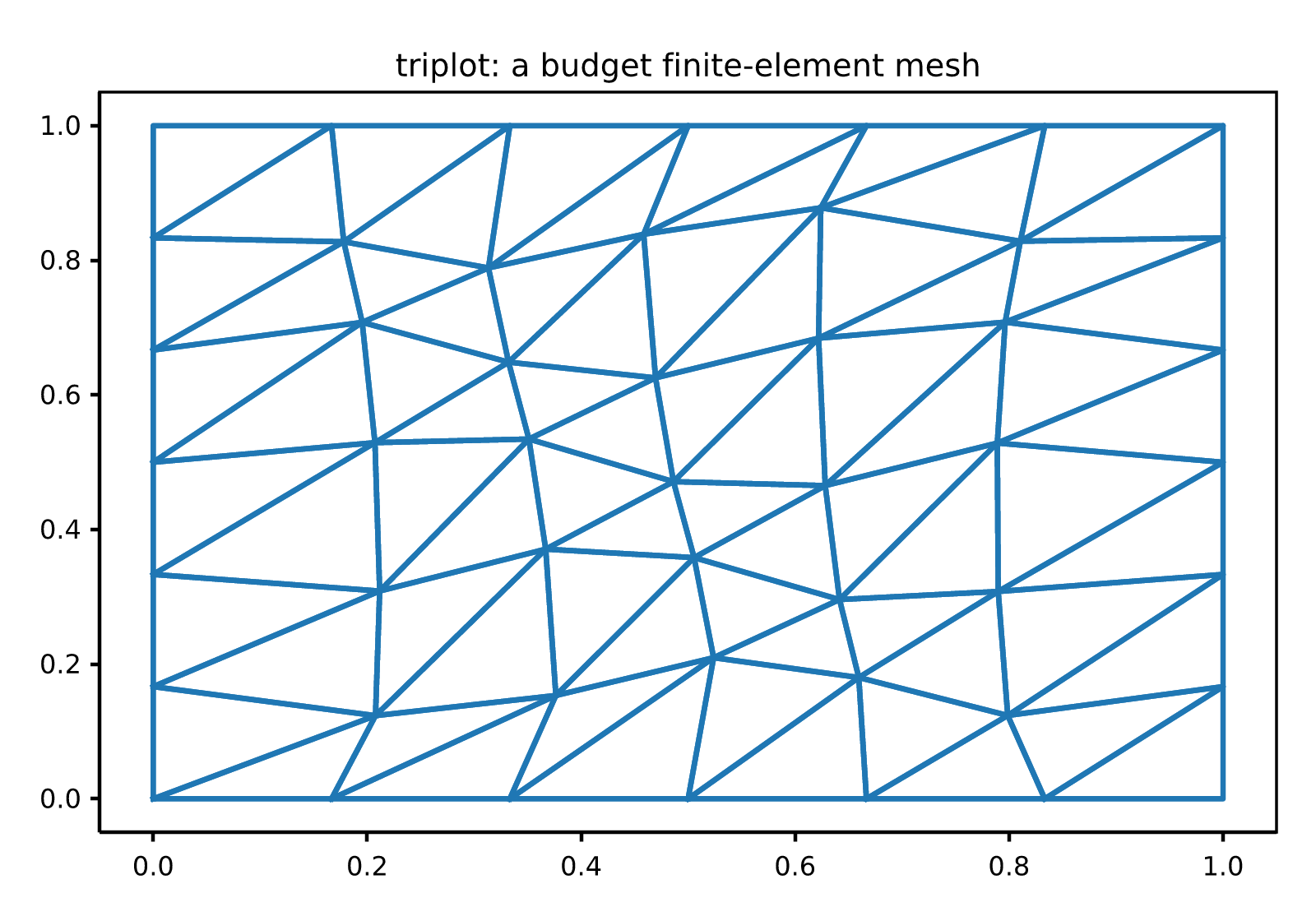
/// Draw the triangulation `(x, y, triangles)` as a wireframe.
///
/// Each entry of `triangles` is `[a, b, c]`, the three vertex indices of one
/// triangle into `x`/`y`. For every triangle a closed [`Line2D`] outline
/// `v0 -> v1 -> v2 -> v0` is drawn; all outlines share a single color (the
/// next property-cycle color). Edges shared by two triangles are drawn twice,
/// which matches a simple triplot.
///
/// Triangles with an out-of-range index are skipped (never panic). If
/// `x.len() != y.len()` or either is empty, nothing is drawn. The data limits
/// expand to cover every referenced vertex. Returns `&mut Self`.
///
/// 
///
/// ```
/// use rizzma::core::Bbox;
/// use rizzma::figure::Axes;
///
/// let mut ax = Axes::new(Bbox::from_extents(0.0, 0.0, 1.0, 1.0));
/// // A unit square split into two triangles.
/// let x = [0.0, 1.0, 1.0, 0.0];
/// let y = [0.0, 0.0, 1.0, 1.0];
/// ax.triplot(&x, &y, &[[0, 1, 2], [0, 2, 3]]);
/// let limits = ax.data_limits().expect("triplot contributes data limits");
/// assert_eq!((limits.xmin(), limits.xmax()), (0.0, 1.0));
/// assert_eq!((limits.ymin(), limits.ymax()), (0.0, 1.0));
/// ```
pub fn triplot(&mut self, x: &[f64], y: &[f64], triangles: &[[usize; 3]]) -> &mut Self {
if x.is_empty() || x.len() != y.len() {
return self;
}
let n = x.len();
let mut any = false;
let (mut xmin, mut xmax) = (f64::INFINITY, f64::NEG_INFINITY);
let (mut ymin, mut ymax) = (f64::INFINITY, f64::NEG_INFINITY);
let color = self.next_cycle_color();
for t in valid_triangles(triangles, n) {
let [a, b, c] = *t;
let xs = vec![x[a], x[b], x[c], x[a]];
let ys = vec![y[a], y[b], y[c], y[a]];
for &i in &[a, b, c] {
xmin = xmin.min(x[i]);
xmax = xmax.max(x[i]);
ymin = ymin.min(y[i]);
ymax = ymax.max(y[i]);
any = true;
}
self.add_line(Line2D::new(xs, ys).with_color(color));
}
if any {
self.include_data_bbox(xmin, ymin, xmax, ymax);
}
self
}
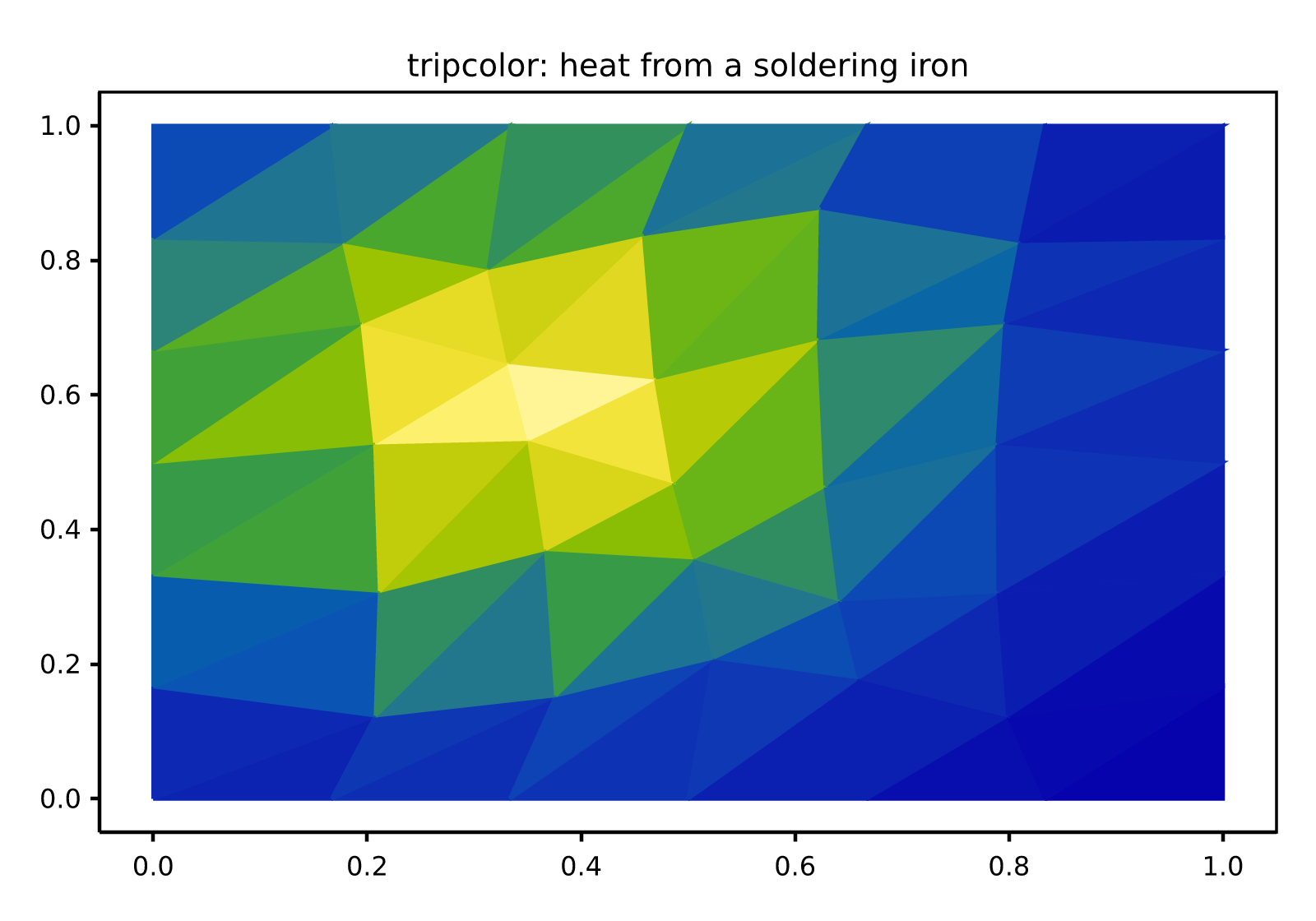
/// Fill each triangle of `(x, y, triangles)` with a flat color derived from
/// the per-vertex scalar field `values`.
///
/// `values` is per-vertex (`values.len()` must equal `x.len()`). For each
/// triangle the three vertices' values are averaged, normalized through a
/// [`LinearNorm`] over `[min(values), max(values)]`, and mapped through the
/// `viridis` colormap to a single face color. Each triangle is drawn as a
/// filled [`Patch`] whose edge matches its face, so adjacent triangles tile
/// without visible seams.
///
/// Triangles with an out-of-range index are skipped (never panic). If
/// `values.len() != x.len()`, `x.len() != y.len()`, or input is empty,
/// nothing is drawn. The data limits expand to cover every referenced
/// vertex. Returns `&mut Self`.
///
/// 
///
/// ```
/// use rizzma::core::Bbox;
/// use rizzma::figure::Axes;
///
/// let mut ax = Axes::new(Bbox::from_extents(0.0, 0.0, 1.0, 1.0));
/// let x = [0.0, 1.0, 1.0, 0.0];
/// let y = [0.0, 0.0, 1.0, 1.0];
/// // Color by a smooth field value = x + y.
/// let values = [0.0, 1.0, 2.0, 1.0];
/// ax.tripcolor(&x, &y, &[[0, 1, 2], [0, 2, 3]], &values);
/// assert!(ax.data_limits().is_some());
/// ```
pub fn tripcolor(
&mut self,
x: &[f64],
y: &[f64],
triangles: &[[usize; 3]],
values: &[f64],
) -> &mut Self {
if x.is_empty() || x.len() != y.len() || values.len() != x.len() {
return self;
}
let n = x.len();
// Normalize over the full finite value range; guard a degenerate range.
let mut vmin = f64::INFINITY;
let mut vmax = f64::NEG_INFINITY;
for &v in values {
if v.is_finite() {
vmin = vmin.min(v);
vmax = vmax.max(v);
}
}
if vmin > vmax {
vmin = 0.0;
vmax = 1.0;
}
let norm = LinearNorm::new(vmin, vmax);
let cmap = colormap("viridis").expect("viridis is built in");
let mut any = false;
let (mut xmin, mut xmax) = (f64::INFINITY, f64::NEG_INFINITY);
let (mut ymin, mut ymax) = (f64::INFINITY, f64::NEG_INFINITY);
for t in valid_triangles(triangles, n) {
let [a, b, c] = *t;
let avg = (values[a] + values[b] + values[c]) / 3.0;
let color = cmap.sample(norm.normalize(avg));
for &i in &[a, b, c] {
xmin = xmin.min(x[i]);
xmax = xmax.max(x[i]);
ymin = ymin.min(y[i]);
ymax = ymax.max(y[i]);
any = true;
}
let tri = Patch::polygon(&[[x[a], y[a]], [x[b], y[b]], [x[c], y[c]]])
.facecolor(Some(color))
.edgecolor(Some(color));
self.add_patch(tri);
}
if any {
self.include_data_bbox(xmin, ymin, xmax, ymax);
}
self
}
}
#[cfg(test)]
mod tests {
use crate::artist::Artist;
use crate::core::color::{Colormap, Rgba, viridis};
use crate::core::{Affine2D, Bbox, Path};
use crate::figure::Axes;
/// A [`Renderer`] that records the fill color of each `draw_path` call.
#[derive(Default)]
struct ColorRecorder {
fills: Vec<Option<Rgba>>,
}
impl crate::render::Renderer for ColorRecorder {
fn draw_path(
&mut self,
_gc: &crate::render::GraphicsContext,
_path: &Path,
_transform: &Affine2D,
fill: Option<Rgba>,
) {
self.fills.push(fill);
}
fn canvas_size(&self) -> (f64, f64) {
(100.0, 100.0)
}
}
/// The single fill color a patch emits when drawn.
fn patch_fill(patch: &crate::artist::Patch) -> Option<Rgba> {
let mut rec = ColorRecorder::default();
patch.draw(&mut rec, &Affine2D::identity());
rec.fills.first().copied().flatten()
}
/// A unit square split into two triangles, shared diagonal 0->2.
fn square() -> ([f64; 4], [f64; 4], [[usize; 3]; 2]) {
let x = [0.0, 1.0, 1.0, 0.0];
let y = [0.0, 0.0, 1.0, 1.0];
(x, y, [[0, 1, 2], [0, 2, 3]])
}
#[test]
fn triplot_emits_one_line_per_triangle() {
let mut ax = Axes::new(Bbox::from_extents(0.0, 0.0, 1.0, 1.0));
let (x, y, tris) = square();
ax.triplot(&x, &y, &tris);
assert_eq!(ax.lines.len(), 2);
// Each outline is a closed 4-point polyline.
assert_eq!(ax.lines[0].points().len(), 4);
}
#[test]
fn triplot_data_limits_cover_vertices() {
let mut ax = Axes::new(Bbox::from_extents(0.0, 0.0, 1.0, 1.0));
let (x, y, tris) = square();
ax.triplot(&x, &y, &tris);
let limits = ax.data_limits().expect("triplot contributes data limits");
assert_eq!((limits.xmin(), limits.xmax()), (0.0, 1.0));
assert_eq!((limits.ymin(), limits.ymax()), (0.0, 1.0));
}
#[test]
fn tripcolor_emits_one_patch_per_triangle() {
let mut ax = Axes::new(Bbox::from_extents(0.0, 0.0, 1.0, 1.0));
let (x, y, tris) = square();
let values = [0.0, 1.0, 2.0, 1.0];
ax.tripcolor(&x, &y, &tris, &values);
assert_eq!(ax.patches.len(), 2);
}
#[test]
fn tripcolor_colors_span_the_value_range() {
// Two well-separated triangles: one entirely at the min value, one at
// the max, so their averaged colors are the viridis endpoints.
let x = [0.0, 1.0, 0.0, 2.0, 3.0, 2.0];
let y = [0.0, 0.0, 1.0, 0.0, 0.0, 1.0];
let values = [0.0, 0.0, 0.0, 1.0, 1.0, 1.0];
let tris = [[0, 1, 2], [3, 4, 5]];
let mut ax = Axes::new(Bbox::from_extents(0.0, 0.0, 1.0, 1.0));
ax.tripcolor(&x, &y, &tris, &values);
let cm = viridis();
let lo = cm.sample(0.0);
let hi = cm.sample(1.0);
assert_eq!(patch_fill(&ax.patches[0]), Some(lo));
assert_eq!(patch_fill(&ax.patches[1]), Some(hi));
assert_ne!(patch_fill(&ax.patches[0]), patch_fill(&ax.patches[1]));
}
#[test]
fn out_of_range_triangle_is_skipped() {
let mut ax = Axes::new(Bbox::from_extents(0.0, 0.0, 1.0, 1.0));
let (x, y, _) = square();
// Second triangle references vertex 9, which does not exist.
let tris = [[0, 1, 2], [0, 2, 9]];
ax.triplot(&x, &y, &tris);
assert_eq!(ax.lines.len(), 1);
}
#[test]
fn tripcolor_mismatched_values_draws_nothing() {
let mut ax = Axes::new(Bbox::from_extents(0.0, 0.0, 1.0, 1.0));
let (x, y, tris) = square();
// Only three values for four vertices.
ax.tripcolor(&x, &y, &tris, &[0.0, 1.0, 2.0]);
assert!(ax.patches.is_empty());
assert!(ax.data_limits().is_none());
}
#[test]
fn empty_input_draws_nothing() {
let mut ax = Axes::new(Bbox::from_extents(0.0, 0.0, 1.0, 1.0));
ax.triplot(&[], &[], &[]);
ax.tripcolor(&[], &[], &[], &[]);
assert!(ax.lines.is_empty());
assert!(ax.patches.is_empty());
assert!(ax.data_limits().is_none());
}
}