[](https://nixos.org/manual/nix/stable/command-ref/new-cli/nix3-flake.html)
[](https://nixos.org)
# randpaper
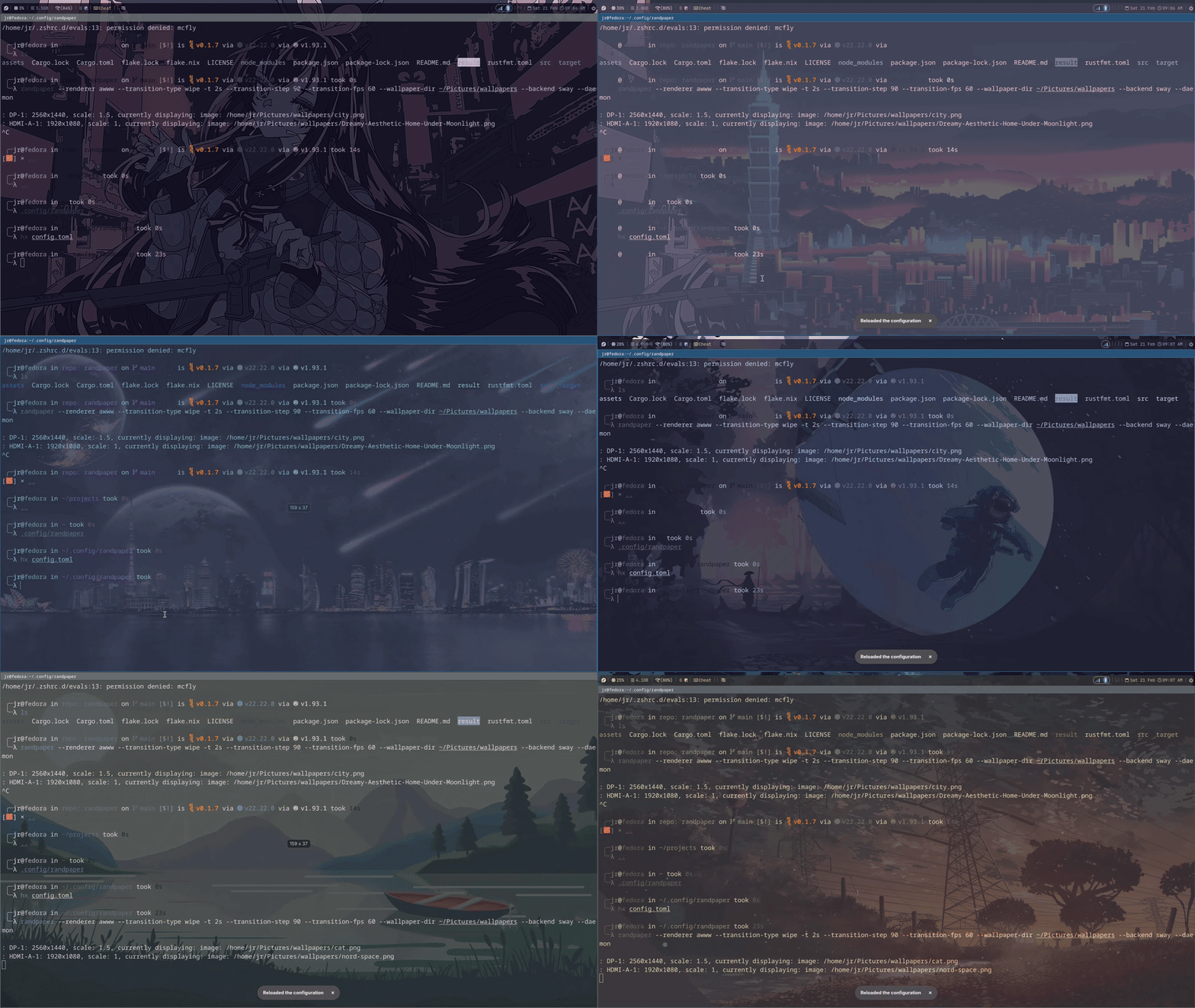
Fast per-monitor wallpaper rotation + optional theme syncing for Wayland
(Sway/Hyprland/MangoWM).
`randpaper` caches your wallpaper list once, picks random images per output, and
can optionally generate theme files (terminals + Waybar) from the current
wallpaper.
# 🚀 Features
- ⚡ **Performance**: Written in Rust using `tokio`. Scans your image directory
once into memory (caching paths) to prevent disk I/O spikes, even with massive
wallpaper collections.
- 🎨 **Dynamic Theming**: Automatically extracts dominant colors from the
current wallpaper and generates config files for **Ghostty**, **Kitty**, and
**Foot**, keeping your terminal in sync with your desktop.
- **Waybar Theming**: Generates CSS variables based on the image palette.
> [!NOTE]
> Waybar theming: Colors update on the next Waybar restart. Live reload
> (`SIGUSR2`) causes all windows to briefly reflow due to Waybar unmapping its
> layer surface. (Disabled by default now)
- 🖥️ **Multi-Monitor**: Assigns a unique random image to every active output
simultaneously.
- 🔄 **Dual Operating Modes**: Run as a background daemon with automatic
cycling, or use one-shot mode for manual wallpaper changes.
- 🛠️ **Modular Backends**: Works seamlessly with **Sway** ,**Hyprland**, and
**MangoWM**)) (via Sway IPC , `hyprctl`, or `mmsg`) and supports both
`swaybg`, `awww`, and `native` renderers.
- Support for both `awww` and `swww` for compatibility.
---
## 🛠 Installation
**Prerequisites**
`swaybg` or (`awww` / `swww`) are no longer required, if you want a simple
renderer that's built in, try `native`.
If you want slick animations and more, choose `awww`.
```bash
# From source
cargo install --git https://github.com/saylesss88/randpaper
# crates.io
cargo install randpaper
```
After `randpaper` and `awww` are installed, you can ensure that it automatically
detects your monitors and see which transition you like with commands like:
If you're on atomic fedora, it is required to install `libxkbcommon-devel`.
```bash
rpm-ostree install libxkbcommon-devel
```
```bash
# Use fade transitions
randpaper --renderer awww --transition-type fade --transition-step 90 --transition-fps 60 --wallpaper-dir ~/Pictures/wallpapers
# Use wipe transitions for hyprland
randpaper --renderer awww --transition-type wipe --transition-step 90 --transition-fps 60 --wallpaper-dir ~/Pictures/wallpapers --backend hyprland
# Use wipe transitions for mango
randpaper --renderer awww --transition-type wipe --transition-step 90 --transition-fps 60 --wallpaper-dir ~/Pictures/wallpapers --backend mango
```
Once you find what you like, either add an `exec` to the chosen command, or
throw the options in a `config.toml` and simplify the `exec` greatly.
> [!NOTE]
> It’s safe to use `exec_always` with `randpaper --daemon`; extra
> starts exit cleanly if an instance is already running. (Same with from the
> CLI)
---
## Native Renderer
randpaper includes a built-in Wayland wallpaper renderer written in Rust using
`smithay-client-toolkit` and `wayland-client` (no `swww` or `swaybg` required).
It creates a `zwlr_layer_shell_v1` surface at the background layer and renders
directly via shared memory (`wl_shm`), one surface per monitor.
> [!NOTE]
> The native renderer is a WIP. It's functional but bare bones, no transitions,
> no animation. Use `--renderer native` to opt in.
## 📚️ Configuration (Optional)
Config file (XDG):
- `~/.config/randpaper/config.toml`
Example:
```toml
wallpaper_dir = "/home/user/Pictures/wallpapers"
time = "30m" # used only in daemon mode
# The following only work with awww/swww
transition_type = "wipe"
transition_step = 90
transition_fps = 60
# outputs = ["DP-1", "HDMI-A-1"]
```
Precedence:
- CLI args override `config.toml`.
---
## Usage
**Command flag table**
| `[DIR]` | Directory containing images | `.` |
| `-t, --time` | Time between changes(e.g., 15m, 1h) | NA |
| `--daemon` | Activate daemon-mode, `--time` also required | NA |
| `-w, --wallpaper-dir` | Directory containing wallpaper images | `.` |
| `--config` | Directory containing `config.toml` | NA |
| `-b, --backend` | Detection backend: `sway` or `hyprland` | `sway` |
| `-o, --outputs` | Specific outputs to target (Sway only) | Auto-discover |
| `-r, --renderer` | Renderer tool: `swaybg` or `awww` | `swaybg` |
| `--transition-type` | swww transition: `fade`, `wipe`, `outer` | `simple` |
| `-s, --transition-step` | swww transition step (0-100) | `90` |
| `-f, --transition-fps` | swww target frame rate for transitions | `30` |
- `--transition-type`: Choose between (`simple`, `fade`, `wipe`, `outer`,
`inner`, `random`)
> [!NOTE]
> All transition options are ignored when using `--renderer swaybg` and
> `--renderer native`
---
### One-shot (default)
Applies a wallpaper + updates themes once, then exits.
```sh
# Runs with settings from `config.toml`
randpaper
# Without using the `config.toml` any command without both `--daemon` & `--time` set
# are one-shot commands
randpaper --backend hyprland --renderer swaybg --wallpaper-dir ~/Pictures/wallpapers
# or
randpaper --daemon -t 1m -b sway -r awww --transition-type wipe
```
Recommended one-shot keybinds:
**Sway**
```text
bindsym $mod+Shift+n exec randpaper
```
**Hyprland**
```text
bind = $mainMod SHIFT, N, exec, randpaper
```
**MangoWM**
```text
bind=SUPER+SHIFT,N,spawn,randpaper
```
> [!NOTE]
> For this to work, you need to add `randpaper` and `awww`'s PATHS to MangoWM's
> startup environment. (i.e., add environment variables).
>
> - `mango/env.conf`
>
> ```text
> # ~/.config/mango/env.conf
> env=PATH,/home/jr/.local/bin:/home/jr/.cargo/bin:/usr/local/bin:/usr/bin:/bin
> ```
>
> - Make sure to source it, in your main config add: `source=./env.conf`
---
### Daemon mode (`--daemon`)
Runs continuously and rotates wallpapers on a timer.
**Daemon mode Requirements**:
- `--daemon` must be provided.
- `time` must be set (via `config.toml` or `--time`).
Recommended autostart:
**Sway**
```text
# With `config.toml`
exec randpaper -w ~/Pictures/wallpapers -t 5m -r awww --daemon
```
**Hyprland**
```text
exec-once = randpaper --daemon
```
**MangoWM**
Add the following to your `mango/autostart.sh`:
```text
randpaper --daemon 2>&1 &
```
On standard filesystem hierarchy systems you can also force the daemon to cycle
without spawning a separate process (there's a guard preventing this anyways):
```bash
pkill -USR1 randpaper
```
> [!NOTE]
> Using `pkill` can be hit or miss. Try the new IPC when using the
> daemon.
## Randpaper IPC
## IPC
`randpaper` exposes a Unix socket for runtime control via the `randpaper_ipc`
crate. The socket is created at
`$XDG_RUNTIME_DIR/randpaper/randpaper-<session>.sock` on daemon startup.
Commands are sent via `randpaper` subcommands:
| `randpaper next` | Cycle to the next wallpaper immediately |
| `randpaper pause` | Pause automatic cycling |
| `randpaper resume` | Resume automatic cycling |
| `randpaper status` | Print current daemon state |
The socket is cleaned up and re-created on each daemon start, so stale sockets
from a previous session are handled automatically.
> [!IMPORTANT]
> On sway, use this exec command to prevent multiple daemon instances and
> ensure `SWAYSOCK` is available at startup:
> ```
> exec pgrep -x randpaper || SWAYSOCK=$(ls /run/user/1000/sway-ipc.*.sock 2>/dev/null | head -1) randpaper --daemon
> ```
> The `SWAYSOCK` assignment is necessary because the environment variable
> may not be inherited when launched from the sway config.
---
## 🎨 Automatic Terminal Theming
> Now with much more readable themes!!
- WIP, this works best without `zsh-syntax-highlighting`.
`randpaper` automatically extracts a 16-color palette from your wallpaper and
generates theme files in `~/.config/randpaper/themes/`.
To use them, add the include line to your terminal config:
**Ghostty**
File: `~/.config/ghostty/config`
```text
config-file = ~/.config/randpaper/themes/ghostty.config
```
**Foot**
File: `~/.config/foot/foot.ini` (Place near end of file)
```text
[main]
include=~/.config/randpaper/themes/foot.ini
```
**Kitty**
File: `~/.config/kitty/kitty.conf`
```text
allow_remote_control yes
listen_on unix:/tmp/mykitty
include ~/.config/randpaper/themes/kitty.conf
```
Add a keybind to your Sway or Hyprland config to start kitty with remote control
enabled (Sway example):
```conf
$mod+Shift+t exec kitty -o allow_remote_control=yes --listen-on unix:/tmp/mykitty
```
**Live-Reload of Terminal Themes**
- **Ghostty**: live reload works with either "cycle" keybind (i.e., theme
updates immediately with either `pkill -USR1 randpaper` from either a keybind
or the command line or a keybind set to
`exec randpaper ~/Pictures/wallpapers`)(Tested on Fedora with Sway, expect
different behavior on NixOS)
- **Kitty**: live reloads work with the one-shot keybind if you follow the steps
above.
- **Foot**: the theme file is updated, but existing windows may not live-reload
reliably; close and reopen the terminal to pick up the new theme. (Work in
Progress)
---
## Waybar
<details>
<summary> ✔️ Waybar </summary>
To use `randpaper` with a `waybar` setup, ensure you call the daemon via
`exec waybar` in your Sway or Hyprland config.
(Sway Example `~/.config/sway/config`):
```config
exec randpaper --time 15m --wallpaper-dir ~/Pictures/wallpapers --daemon
bar {
swaybar_command waybar
}
# ---snip---
```
`randpaper` automatically generates a Waybar CSS color file from the current
wallpaper palette and writes it to:
- `~/.config/randpaper/themes/waybar.css`
This file only defines color variables (it doesn't change your bar by itself).
To use it, you import it from your Waybar `style.css` and then reference the
variables in your existing rules.
The theme will be applied on the next Waybar restart.
Example of the generated `waybar.css` file:
```css
/* auto-generated by randpaper */
@define-color rp_bg #1c1c24;
@define-color rp_fg #e4dcd4;
@define-color rp_accent #f394a4;
@define-color rp_warn #201c24;
@define-color rp_ok #201c24;
@define-color rp_border #f394a4;
@define-color rp_muted #1c1c24;
```
1. Import the generated file
At the very top of your Waybar `style.css` (Change `YOUR_USER` to your
username):
```css
@import "/home/YOUR_USER/.config/randpaper/themes/waybar.css";
```
2. Use the variables in your CSS
Replace hard-coded colors with variables like `@rp_bg`, `@rp_fg`, `@rp_accent`,
etc.
Example:
```css
window#waybar {
background-color: alpha(@rp_bg, 0.8);
color: @rp_fg;
}
#workspaces button.focused {
background-color: @rp_bg;
color: @rp_accent;
}
```
- [Full `style.css` Example](https://github.com/saylesss88/.dotfiles/blob/main/waybar/.config/waybar/style.css)
Obviously, the more hard-coded colors you replace with the dynamically generated
CSS variables the more noticeable it will be.
> [!NOTE]
> Just adding the `@import` at the top makes the variables available, you need
> to reference them for the changes to be applied.
- On NixOS, after cycling with one-shot run `pkill -USR2 waybar` to apply the
new theme. (Causes a flicker)
</details>
## NixOS
<details>
<summary> ✔️ NixOS </summary>
Add as a flake input:
```nix
inputs = {
randpaper.url = "github:saylesss88/randpaper";
};
```
Install in `environment.systemPackages` or `home.packages`:
```nix
environment.systemPackages = {
inputs.randpaper.packages.${pkgs.stdenv.hostPlatform.system}.default
};
```
- Pass `inputs` through `specialArgs` in your `flake.nix`
And add an `exec` for either hyprland or sway, only for `randpaper`:
Hyprland Example:
```nix
wayland.windowManager.hyprland = {
settings = {
exec-once = [
# Standard Usage
"randpaper --time 15m /home/your-user/Pictures/wallpapers --backend hyprland --renderer swww"
# UWSM Usage w/ swaybg
"uwsm app -- randpaper --time 15m /home/your-user/Pictures/wallpapers --backend hyprland --renderer swaybg"
];
};
}
```
Sway Example:
```nix
wayland.windowManager.sway = {
extraConfig = ''
# Default backend is Sway
exec randpaper --time 30m /home/your-user/wallpapers
'';
};
```
> Note: `randpaper` manages the renderer process for you. You do not need
> separate `exec-once = swaybg ...` or `exec-once = swww ...` lines in your
> config.
### Using the `config.toml` on NixOS
To use the config file on NixOS you can do something like this:
```nix
home.file = {
".config/randpaper/config.toml".text = ''
# ~/.config/randpaper/config.toml
time = "10m"
renderer = "awww"
backend = "hyprland"
wallpaper_dir = "/home/user/Pictures/Wallpapers"
'';
};
```
And now your `exec` can be simplified to:
```nix
exec-once = [
"randpaper --daemon"
];
```
### Terminal & Waybar Theming on NixOS
**GhosTTY**
```nix
# home.nix or ghostty.nix
programs.ghostty = {
enable = true;
settings = {
# The '?' makes the include optional/non-blocking
"config-file" = "?~/.config/randpaper/themes/ghostty.config";
};
};
```
- On boot up, the generated theme will be applied.
- Run the cycle command then type `pkill -USR2 ghostty` to apply the theme
instantly.
**Kitty (Recommended on NixOS)**
```nix
programs.kitty = {
extraConfig = ''
allow_remote_control yes
listen_on unix:/tmp/mykitty
include ~/.config/randpaper/themes/kitty.conf
'';
};
```
Add this keybind:
```nix
"$mod,T,exec,kitty -o allow_remote_control=yes --listen-on unix:/tmp/mykitty"
# One-Shot for Hyprland
"$mod SHIFT,N,exec, randpaper --backend hyprland /home/Your-User/Pictures/wallpapers"
```
Now running the above one-shot command will dynamically reload the kitty theme
and apply it automatically.
### Waybar on NixOS
- [NixOS Waybar Example](https://github.com/saylesss88/flake/blob/main/home/hypr/waybar.nix)
</details>
## ⚙️ How it Works
1. **Startup**: Caches all valid image paths (`jpg`, `png`, `bmp`, `webp`) from
the target directory into memory.
2 **Loop**(daemon mode): Every interval (e.g., 30m):
- Queries active monitors via IPC.
- Picks a random image for the primary monitor and extracts its color palette.
- Generates theme files and triggers terminal reloads.
- Spawns a non-blocking background process (`swaybg` daemon or `awww` client) to
update the display.
- Sleeps efficiently until the next cycle.
3. One-Shot (no `--time` or `--daemon`): Picks wallpaper, updates themes, exits
immediately.
---
## License
- [Apache License 2.0](https://github.com/saylesss88/randpaper/blob/main/LICENSE)