
RadBeeper
A GQ GMC-320 Plus Geiger-Muller counter on the desk, read from Alpine Linux — and from Copal, its distillation.
MIT · 0.5.0 · cargo install radbeeper · one dependency, and it is libc
vonglurt.github.io/radbeeper — this page, the lab reports, and a live counter's report built from the logs in this repository.
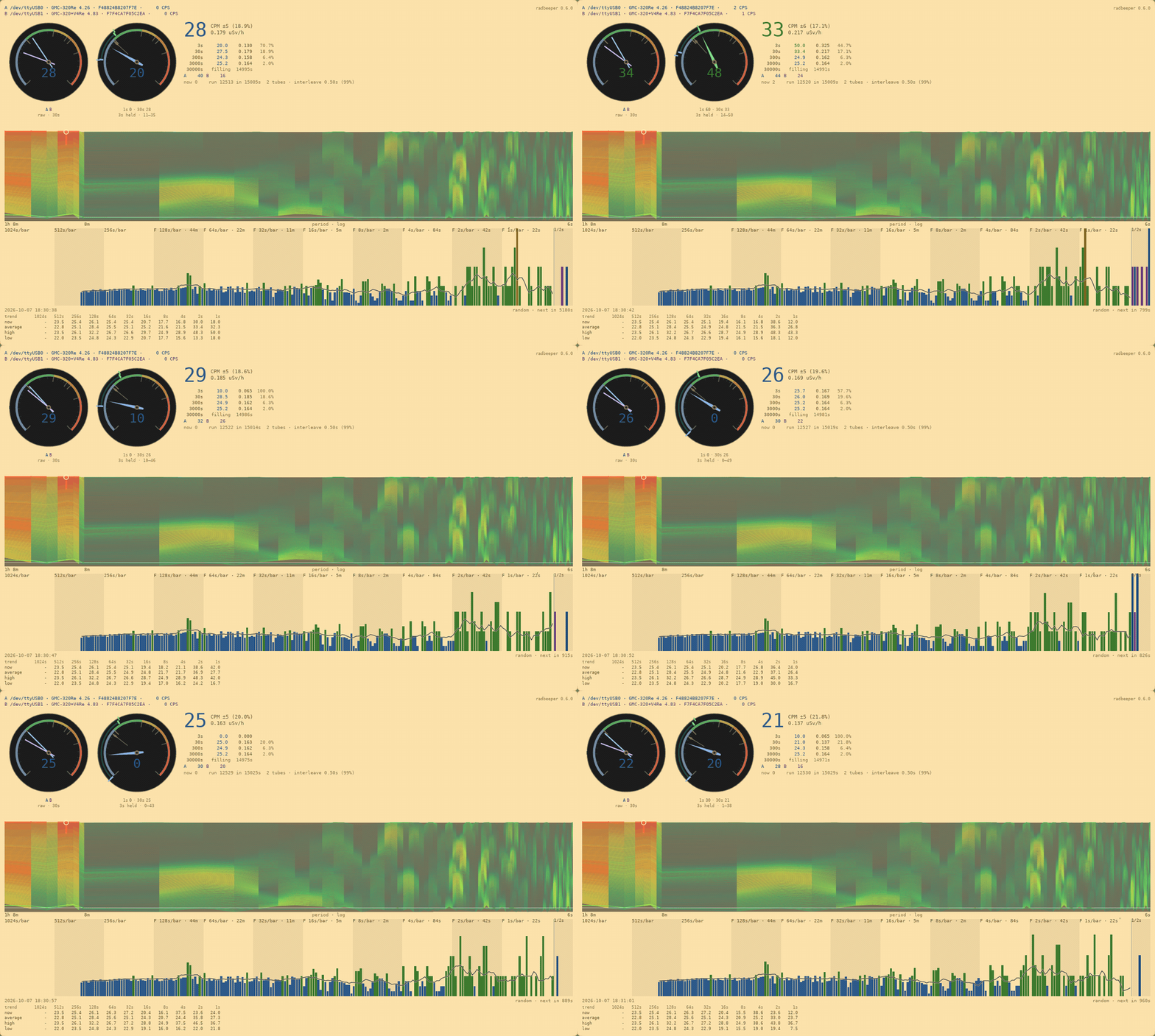
Twenty-four seconds of two counters, in real time, attached to radbeeper service daemon. GUI visuals like analogue dial meters, five averaging windows with the precision of each, a strip of counts that compresses as it ages, three spectra of FFT.
Plug a counter into a machine running Alpine — including a VM with the counter passed through, which is what these logs were taken on — switch it on, and RadBeeper finds it, shows what it is counting, pulls the history it recorded while nobody was watching, and builds a web page out of the result.
Fast track
With the counter plugged in and switched on:
That is the whole of it. The dialout line above is not optional: the serial
node is root:dialout and RadBeeper does not want root.
Only one program can hold the port — but only one needs to. The process that
has it serves what it reads on a socket beside the log, and watch asks that
socket before it asks /dev: with the boot service logging, the monitor attaches
to it and the port is never touched. Nothing has to be stopped, and the log does
not skip a second while you watch. With no service running, the monitor takes the
port itself and serves it in turn, so the second window attaches to the first.
No counter yet? tests/fake_gmc.py puts a synthetic counter on a
pseudo-terminal — a real Poisson background, because decay is a Poisson process —
and exercises the serial path as well as the display:
python3 tests/fake_gmc.py --cpm 400, then radbeeper -d /dev/pts/N watch.
What you need
A GQ GMC-320 Plus, plugged into USB. There is no substitute for it in software: RadBeeper reads a real tube over a real serial port, and every number on the screen comes off the wire.
| The counter | A GQ GMC-320 Plus. A GMC-300 works — RadBeeper tries its 57600 baud as well as the 320's 115200 — and a 500 or 600 will be found and read, but its tube is not an M4011, so give it --cpm-per-usvh (see the tube factor). |
| The cable | The USB cable that came with it. It is easy to grab a charge-only cable by mistake: one that carries no data leaves you with nothing plugged in as far as Linux is concerned. |
| The counter, switched on | The USB-serial chip inside is powered by the counter, not by the bus. A 320 that is off, or flat, enumerates as nothing. |
A kernel with ch341 |
The 320 Plus presents as a CH340 USB-serial device. linux-lts and linux-rpi carry the driver; Alpine's linux-virt does not. |
Membership of dialout |
The serial node is root:dialout and RadBeeper does not want root. |
Plug it in, and Linux should say so:
| The kernel is the thing that catches people. These logs were taken from a 320
Plus shared into a VM, and the counter cannot tell the difference — but pass the
device through to a guest running linux-virt and it will never appear, however
correct the pass-through is:
$ lsusb
Bus 003 Device 002: ID 1a86:7523  USB2.0-Serial      # the counter is right there

$ ls /dev/ttyUSB*
ls: cannot access '/dev/ttyUSB*': No such file or directory
doas apk add linux-lts, reboot into it, and the same device enumerates as
/dev/ttyUSB0. This is the trap Copal avoids by installing linux-lts
rather than the virt kernel a VM image would otherwise default to.
If /dev/ttyUSB0 still is not there,
Troubleshooting names the four things it can be, and
they have four different fixes.
Install
A static binary off the releases page needs no toolchain at all, which is the
point on a Pi. From a clone, make install is cargo install --path ..
The window is a separate crate on purpose — RadBeeper has one dependency and
it is libc; Iced brings several hundred, which is the right price for a
GPU-accelerated window and the wrong price to put on cargo install radbeeper:
Find the counter
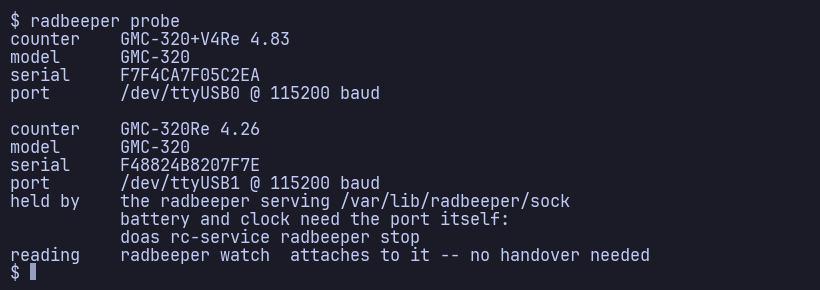
If it finds nothing, the message says which of four things went wrong, because they have four different fixes — see Troubleshooting.
radbeeper clock says how far the counter's own clock has drifted from this
machine's, and --set corrects it. It matters for the
backfill: the timestamps
in the counter's flash are its own.
Watch it
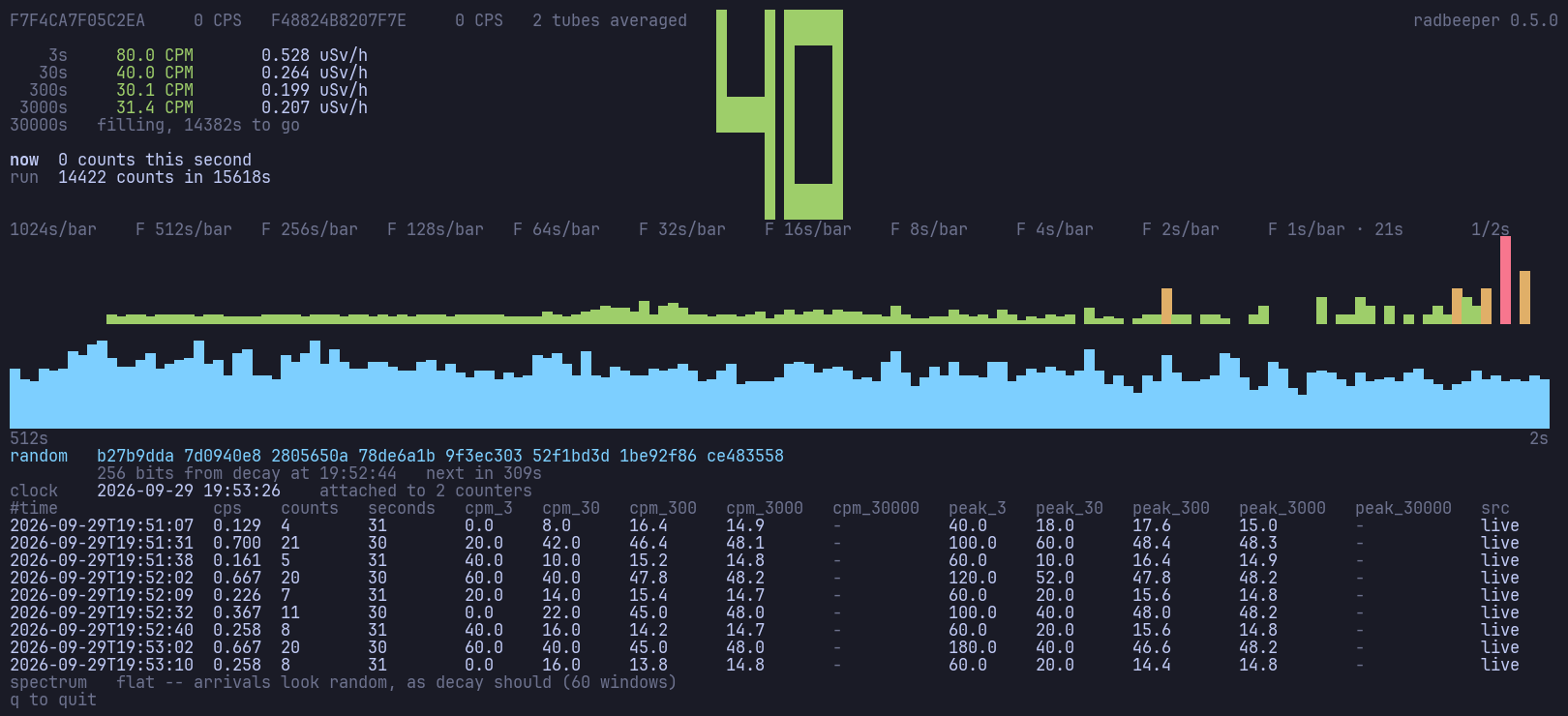
The monitor is also the logger. Only one program can hold the counter's port,
so the log used to have a hole exactly where somebody was watching. Now watch
does what the service does, with a screen on top: it reads the counter's history
on connect and fills the log's gaps, writes a row every thirty seconds through
the same code the service uses, appends every random line, and writes
index.html beside the log. --no-log turns all of that off.
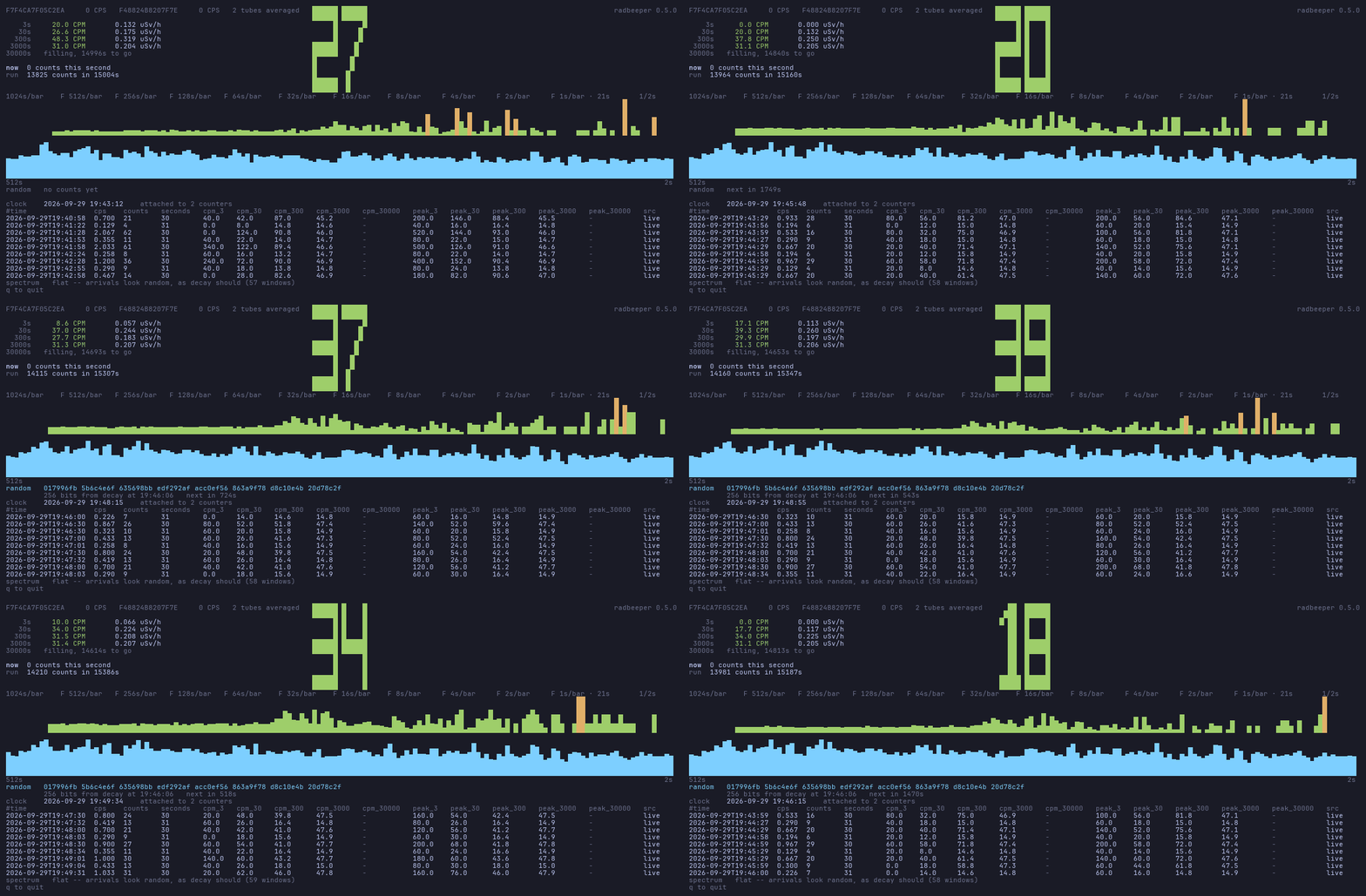
Ten minutes of it, three ways: the first five minutes at a hundred times speed, the hundred seconds after them at ten, and the second the random pool delivered its first line.
| The number, big | The 30-second CPM in block digits. 3 s is too jumpy to read as a headline and 300 s too slow to react to anything you are doing with your hands. |
| Five averages | 3 s to see a source come and go under your hand, 30 s to read the room, 300 s for a number worth writing down, 3000 s for what the background here actually is, and 30000 s — a working day. The counter's own reading is one rolling 60-second count: one number, one time constant, one question answered. |
| The counts, compressing as they age | A second a bar at the right, and each panel to its left holds twice as long in a bar. Ten minutes of history in one row of a terminal, at one-second resolution where it matters. |
| The spectrum | Three windows at once, looking for anything arriving on a schedule. Flat is the good answer — decay is Poisson, and a Poisson process has a flat power spectrum. A peak means something periodic is contaminating the arrivals. |
| The random line | 256 bits of hex out of decay timing, the moment the pool has measured enough min-entropy to justify them. |
| The log, scrolling | The rows as they go to disk, so what is on screen is what is in the file. |
--line prints one line a second for a pipe instead of drawing a screen.
The window
An instrument cluster: a round dial per counter with a 270-degree sweep on a fixed logarithmic scale, the bands painted on the face at the same thresholds everything else uses, and the reading in digits on the black face under the needle. Beside it the five averaging windows, each with the precision of its own figure. Then the cascade, the spectrum overlay, the emission and its countdown, and the log rows as the server wrote them.
It opens no serial port — it cannot, it has no code for one — which is exactly what makes it safe to open and close all day while the logging carries on underneath.
The two meters
They answer different questions and neither answers the other.
| RAW | A needle per counter, each in that counter's colour. A tube that has wandered off is a needle that has wandered off. This is do they agree? |
| COLLECTED | One needle, carrying three time constants at once. This is what is the room doing? |
They share a scale, because two dials that don't cannot be compared — which is the only reason to draw them side by side.
A dial can show more than one answer at a time and a number cannot. The collected face carries the three seconds its needle points at, the half minute the chrome pointer sits at, and — as two arcs outside the bands — where the needle has been over the last half minute and minute. The gap between needle and pointer is the trend.
The needle has mass: it leans out fast and settles back slower, the way every moving-coil meter does mechanically. Without it the needle teleports once a second and the eye cannot follow which way it went.
The scale does not move
Three decades, 3 → 3000 CPM, and it is the same three every time you look.
The range used to be picked from a list to suit the current reading, which meant
a value sitting near a boundary flipped the whole face back and forth several
times a minute — every band and every tick jumping with it. A fixed scale cannot
do that, and a logarithmic one is the right fixed scale here because the
quantity is: background is tens of counts a minute, a source is thousands, and
on a linear face the only reading anybody ever takes sits in the bottom tenth.
The decades land on the numbers the bands are named after — 3 at the bottom stop, 30 a third of the way round, 300 at two thirds, 3000 at full — with the 2..9 of each decade ticked between them and a heavy mark at every band floor.
The bands, named
A reading is not "above 240" — it is a warning. The names are printed under the cluster in their own colours, and the floor of each is a mark on the face:
| sweep | ||
|---|---|---|
| attenuated — under 3 CPM | 0% | not a clean room: a tube shielded, unplugged or dying |
| nominal — 30 | 33% | ordinary background |
| advisory — 120 | 53% | worth knowing about, not worth acting on |
| warning — 240 | 63% | |
| deadly — 600 | 77% |
The floor of nominal is 30 and not 0, deliberately. Natural background does not go below a few counts a minute, so a counter reading under 30 is reporting itself rather than the room — which is why that band is cold blue and not green, and why the dial's bottom stop is 3 rather than nothing.
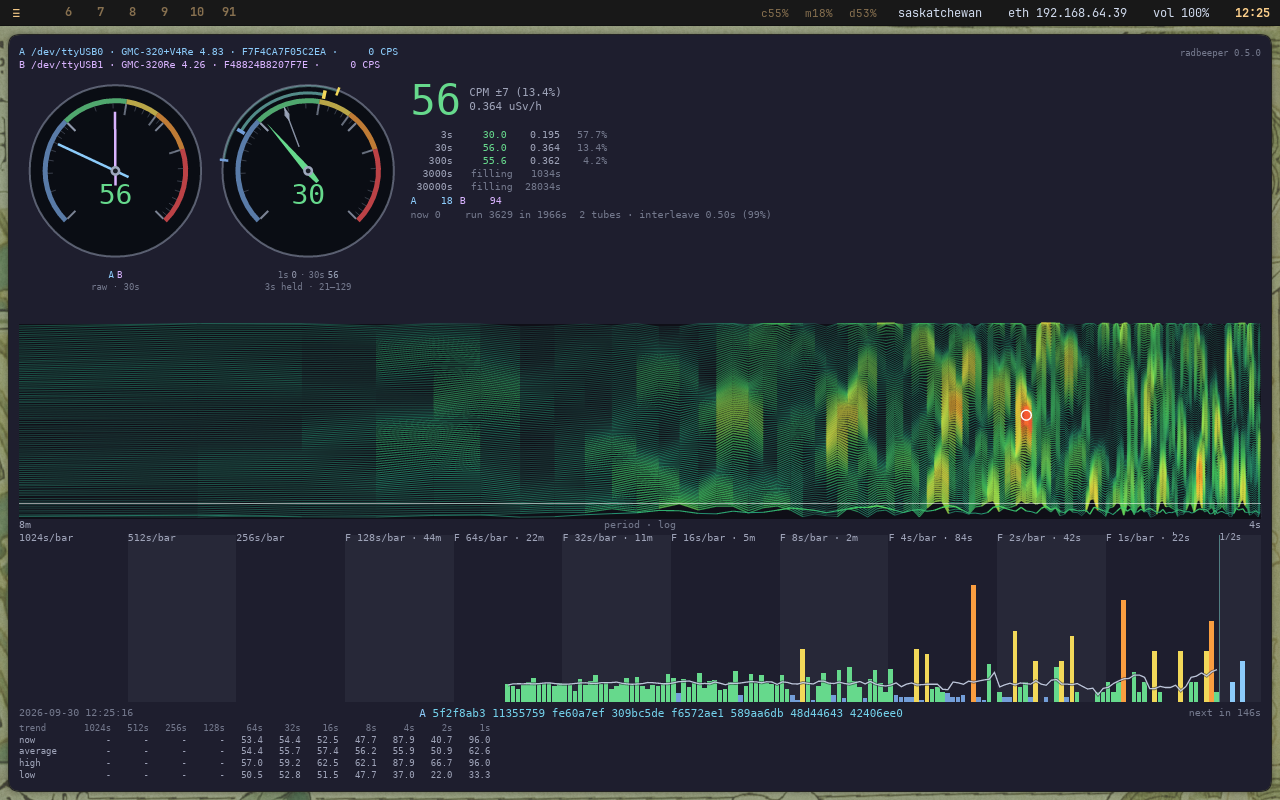
Both themes, and it follows yours
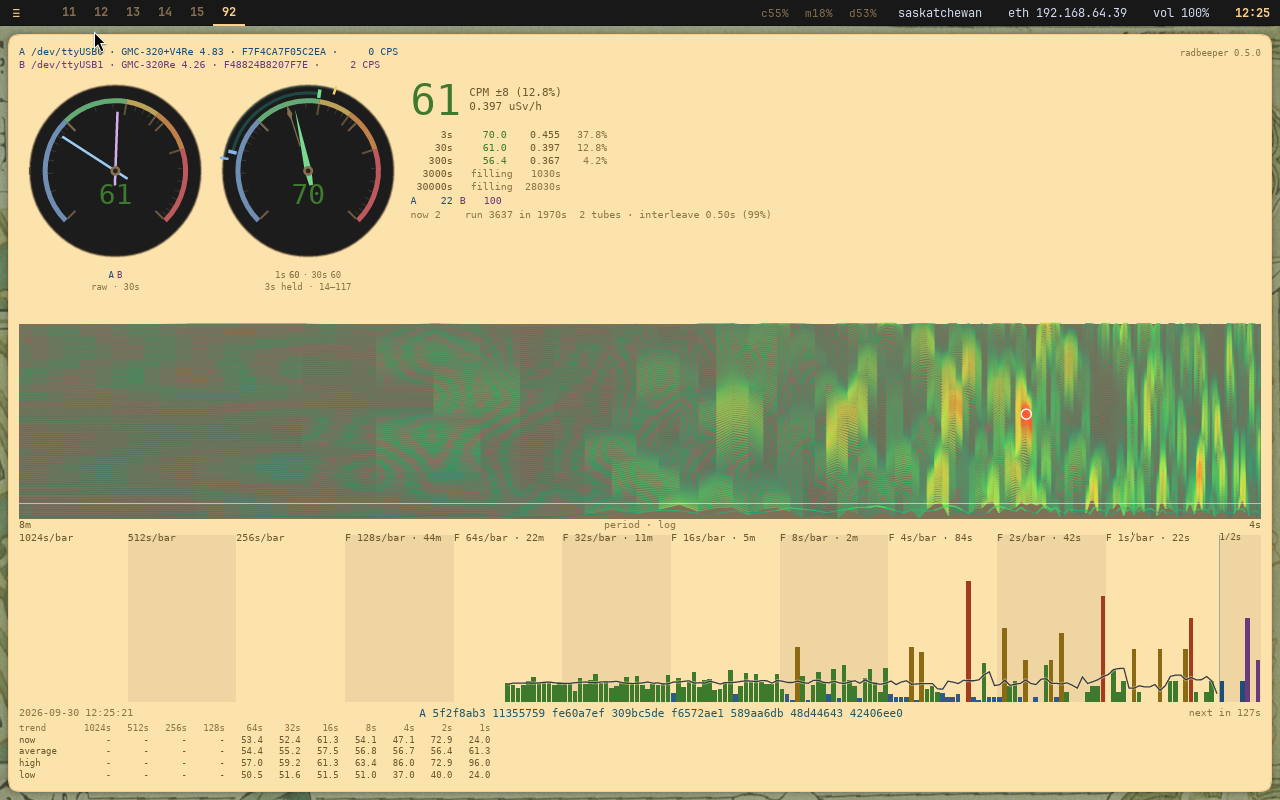
Copal writes down which theme is on, so the window asks rather than guesses.
--theme dark, --theme antiquity or --theme auto (the default) override it.
The dial faces stay dark in both. Antiquity's own note about itself is that it is dark chrome around light paper, and a black-faced gauge on paper is what the instruments this borrows from actually look like.
It fits what the compositor gives it
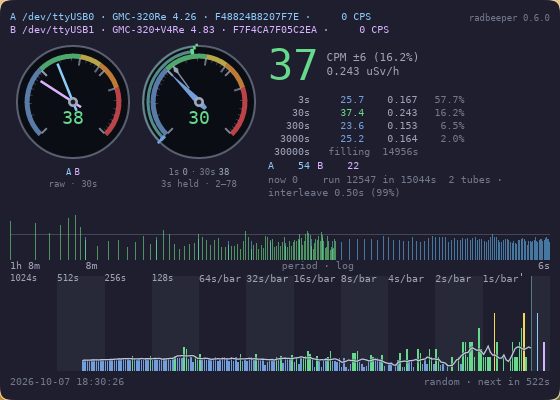
A tiling compositor hands this window whatever is left once every other window has had its share. The charts are the instrument, so they are the last thing to go, not the first: the log table goes first, then the spectrum's axis. The dials, the numbers and the two charts keep their shape all the way down — and grow into the glass when there is more of it.
radbeeper hotplug opens the window when it is installed and a terminal running
watch when it is not.
Two counters
Plug in a second GMC and radbeeper service reads both. No flag is needed,
and it does not have to be restarted for one: once a log cycle the service looks
for a counter that was not there before and adopts it on the spot — its own
backfill, its own log, its own entropy pool, and a line on the wire telling every
attached window.
Two tubes watching one room are two measurements of one number. They do not double the dose — what doubles is the evidence:
| Each keeps its own log | Separate files, keyed by serial. They are separate instruments and the record has to say which said what; a row that averaged two of them would be a reading neither took. |
| The displays average them | Every combined figure is the mean across the tubes: the same number one tube would report, measured from twice the arrivals. |
| The precision is what improves | Poisson error is 1/sqrt(N), so twice the counts is a factor of root two better. The window prints it: 452 CPM +-21 (4.7%). |
| The cascade grows one more tier | Counters on their own clocks interleave, so the strip ends in a tier of arrival rather than of time — 1/2 of a second with two tubes, 1/9 with nine — drawn in each tube's own colour. |
| And a merged record is kept | cpm-merged-YYYY-MM.tsv, beside the per-counter files: the raw arrivals, the rate of the room, and the interleave. See the log. |
The interleave is measured, not assumed. Two counters only sharpen time if
they disagree about when a second starts, and neither clock can be steered, so
the window reports the offset it actually sees: 2 tubes · interleave 0.50s (100%). Near zero is two tubes firing together — still twice the counts and
still the better precision, but no extra resolution in time, and the display says
so rather than claiming a half-second bar it has not earned.
Log it to disk
One row every 30 seconds into a dated file per counter. watch writes the same
rows while it is open, so it does not matter which of the two has the port.
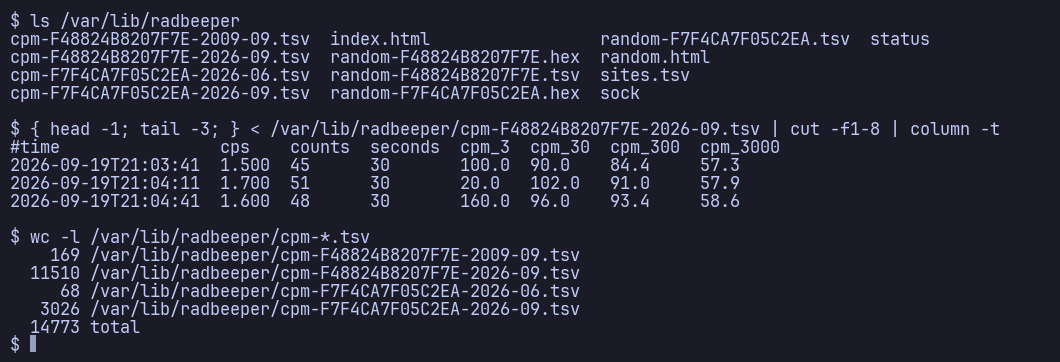
Tabs are invisible and that matters here, because an empty field is not a zero — it is a window that was not full yet. The peaks are the point: a row carrying only the averages as they stood at the instant it was written would miss a source that came and went between two rows, which is the one event actually worth having a log for.
Files rotate by month and by counter (cpm-<serial>-YYYY-MM.tsv), which needs no
cron entry and nothing that renames a file while a service is appending to it.
State lives in /var/lib/radbeeper when that is writable — not /var/log,
because on Alpine desktops that is commonly a tmpfs and every reboot emptied
it. A measurement record is state, not a log to rotate away.
The log is the full column-by-column account, including the merged record two or more counters produce, the backfill, and where a counter has been.
Random numbers out of decay
The moment a nucleus decays is not determined by anything, which makes a counter the textbook hardware entropy source.
b17c9c60 d5deeb7b 4b102dfc bec14efc b523818b 18d3ada0 582bd912 e61ff856

  256 bits, min-entropy 258 measured, from 448 seconds at 0.68 counts/s
  440 bits is what a Poisson model would have claimed for the same 448 seconds
  spectrum flat -- the source looks like decay
That second line is the point: the bits are measured, not modelled, and on this tube the textbook model was measurably wrong — it claimed 1.15 bits a second where the samples support 0.62. A line therefore arrives about half as often as it used to, and the number on it is one the data will support.
The counts behind every line are written beside it, so anyone can recompute it and check it was not invented:
Every emission also keeps its raw material. The .tsv clamps each second to
one hex digit — enough to recompute the key, not enough to say what the tube did
— so the seconds are written unclamped to a .bin beside it, one byte each,
with the gaps where the counter was away. A four-hundred-second frame is about
450 bytes, and each one recomputes the key written inside it. --no-frames
turns it off.
Treat this as a good physical entropy source, not a certified one. It has not been through a statistical test battery, and 256 bits of accounted min-entropy is a claim about the model of the source, not a proof about the output.
Random numbers out of decay is the full account: the three ways this is normally done wrong, the measurement that replaced the model, and what the serial link's one-second resolution costs.
Publish it
One self-contained page: summary cards, a log-scale plot of counts per minute by
the hour, a by-day table, the latest rows, and — with two or more counters —
whether they agree. No JavaScript, no web fonts, no CDN; the chart is SVG the
program draws itself. watch writes it by itself after its backfill, every hour
and on quit, so a monitor left open keeps it current.
random.html is written beside it whenever there are emissions to account for.
It is the one claim on the front page a reader cannot check by looking, so the
audit gets its own page.
To put it on the web: fork this repository, copy your cpm-*.tsv,
random-*.tsv and sites.tsv into logs/, and push. A GitHub Action rebuilds
the site and commits it back, with nothing to install in the workflow — your
counter's report lands at /monitor.html, and / is this page, rendered.
Running it covers the boot service, one log directory two programs can both write, and publishing in more detail.
Commands
probe |
find the counter and say what it is |
watch |
the monitor, logging while it is open; --no-log to only watch |
clock |
how far the counter's clock is out; --set corrects it |
cpm |
one 30-second average, for a script. Takes 30 s, and says so |
service |
monitor and log every counter found; dormant when there is nothing to read |
hotplug |
sit in the session, open the monitor on plug-in |
backfill |
fill the log's gaps from the counter's flash |
random |
256 bits from decay timing, with the accounting for it |
random --frames F |
the raw seconds behind those lines, and whether they still recompute |
recompute |
fill long-window columns in existing logs from their own counts |
site |
where a counter is, and where it has been |
export |
build index.html and random.html from the logs |
pages |
build the landing page and the lab reports from the documents |
log info / log pull |
how much history the flash holds, and download it |
Options: --source sim, --sim-cpm, --seed, --spans 3,30,300,
--cpm-per-usvh, --log-every, --duration, --clock-offset,
--backfill-bytes, --max-gap, --entropy-bits, --device, --baud,
--no-log, --no-backfill, --no-export, --no-frames, --entropy-bits.
Further reading
The lab reports. Each is the why behind one part of the program — written up properly, with the arithmetic, the failures that shaped it, and the prior art.
| The log | every column, the merged record two counters produce, the backfill, and where a counter has been |
| The stream | why an exclusive lock on a port is not an exclusive claim on the counter; the protocol, what a second tube buys, and the window's layout |
| The cascade strip | chained dyadic time compression: its invariants, its arithmetic, the prior art from RRDtool to exponential histograms, and what to call it |
| The spectrum | why flat is the good answer, how windows are accumulated, and why a peak is not called on sigma alone |
| Random numbers out of decay | where the bits come from, three ways this is normally done wrong, and why the model was replaced by a measurement |
| Running it | the boot service, one log directory two programs can both write, and publishing without a build step |
| The native build | the Rust crate, what is ported and what is not, and how it is held to the reference implementation |
| Reference | the tube factor, the counter's protocol, what it costs to run, the tests, and how the screenshots are made |
| Troubleshooting | the four things it can be when probe finds nothing, and the four different fixes |
| Prior art | what else reads these counters, and what this does differently |
| Security | what is in scope, what is not, and how the supply chain is kept small |
| A signed chain of custody | the four links from a commit on a Copal VM to a crate on crates.io, the three defects found building them, and what the arrangement does not establish |
| The monthly record | how a record that never stops growing is published anyway: dated by construction, chained between months, and identified by a coordinate no finer than you asked for |
| Archive | the long-form README this replaced, kept as it stood at 0.3.1 |