
proteinogenic 
Chemical structure generation for protein sequences as SMILES string.







🔌 Usage
This crate builds on top of purr, a crate providing
primitives for reading and writing SMILES.
Use the AminoAcid enum to encode the sequence residues, and build a SMILES
string with proteinogenic::smiles:
extern crate proteinogenic;
let sequence = "KGILGKLGVVQAGVDFVSGVWAGIKQSAKDHPNA";
let residues = sequence.chars
.map;
let s = smiles;
This SMILES string can then be given in conjunction with cheminformatics toolkits, for instance using OpenBabel to generate a PNG figure:
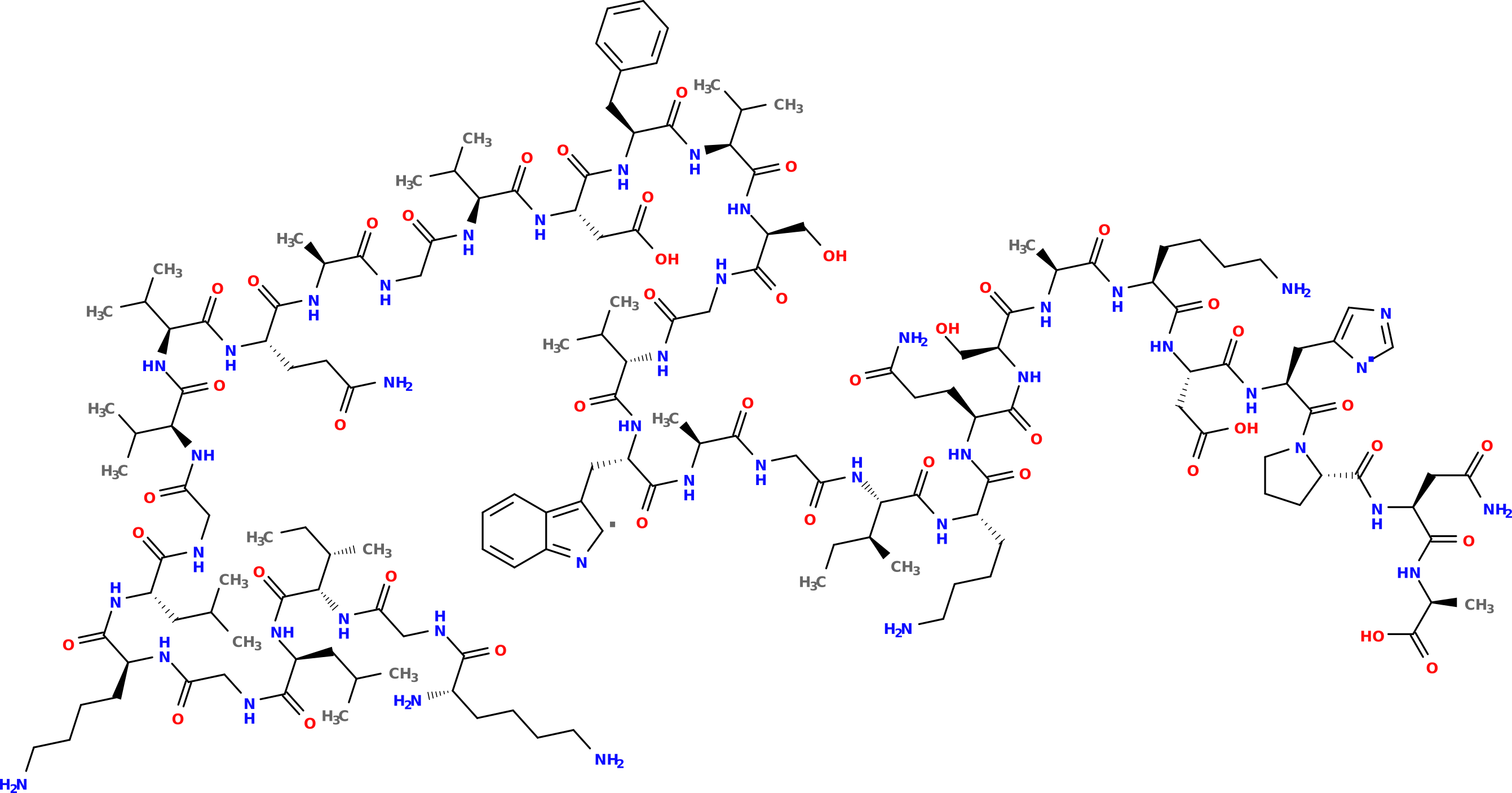
Note that proteinogenic is not limited to building a SMILES string; it can
actually use any purr::walk::Follower
implementor to generate an in-memory representation of a protein formula. If
your code is already compatible with purr, then you'll be able to use
protein sequences quite easily.
extern crate proteinogenic;
extern crate purr;
let sequence = "KGILGKLGVVQAGVDFVSGVWAGIKQSAKDHPNA";
let residues = sequence.chars
.map;
let mut builder = new;
visit;
builder.build
.expect;
The API is not yet stable, and may change to follow changes introduced by
purr or to improve the interface ergonomics.
💭 Feedback
⚠️ Issue Tracker
Found a bug ? Have an enhancement request ? Head over to the GitHub issue tracker if you need to report or ask something. If you are filing in on a bug, please include as much information as you can about the issue, and try to recreate the same bug in a simple, easily reproducible situation.
📋 Changelog
This project adheres to Semantic Versioning and provides a changelog in the Keep a Changelog format.
🔍 See Also
If you're a bioinformatician and a Rustacean, you may be interested in these other libraries:
uniprot.rs: Rust data structures for the UniProtKB databases.obofoundry.rs: Rust data structures for the OBO Foundry.fastobo: Rust parser and abstract syntax tree for Open Biomedical Ontologies.pubchem.rs: Rust data structures and API client for the PubChem API.
📜 License
This library is provided under the open-source MIT license.
This project was developed by Martin Larralde during his PhD project at the European Molecular Biology Laboratory in the Zeller team.