
peekme
Peek me. Pick me. Select text in Codex CLI or Claude Code output, press Alt+P (Option+P on a Mac), and a short explanation opens right next to that text, inside the terminal. The other lines move to make room, like Peek in VS Code. Esc closes it and the screen is exactly as before.
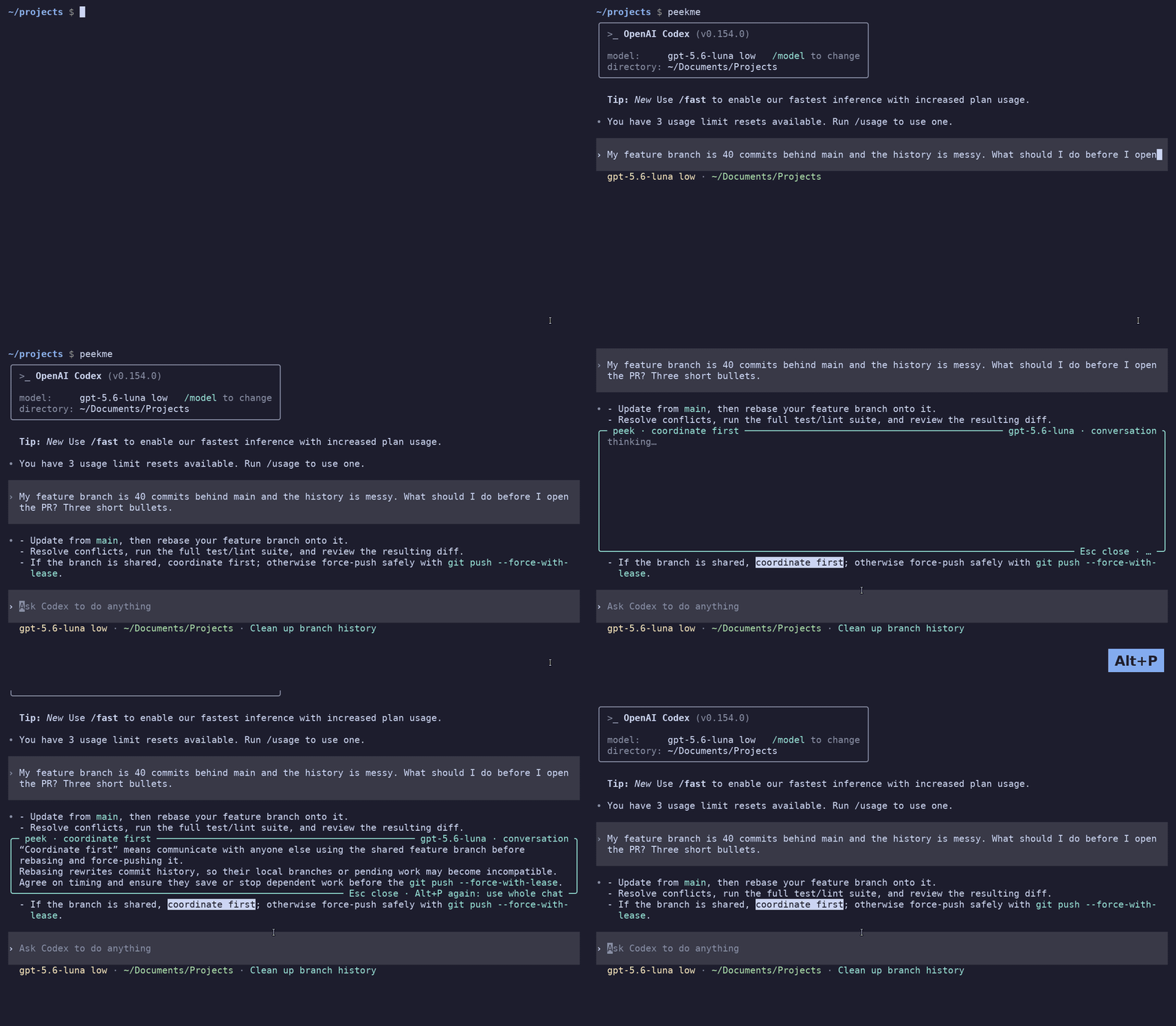
The explanation comes from a small, fast model and it knows the conversation. If you select "its split panes" in an answer that recommends Kitty, it tells you it is about Kitty.
Status: 0.2.2. Tested on Linux with X11 and bash, with Codex 0.157 and Claude Code 2.1.283.
Install
You need Codex CLI or Claude Code (logged in). Both is fine too. Then install peekme in one of
these ways and run peekme install:
npm i -g peekme                               # you have npm already if you installed an agent with it
brew install gregorybolshakov/tap/peekme      # Homebrew, on macOS or Linux
cargo install peekme                          # builds it with Rust
peekme install
npm 12 may say that it skipped an install script of peekme. That is fine: peekme then downloads its binary the first time it runs.
Without npm, Homebrew or Rust, the script from the
latest release puts peekme in
~/.local/bin:
curl --proto '=https' --tlsv1.2 -LsSf https://github.com/GregoryBolshakov/peekme/releases/latest/download/peekme-installer.sh | sh
Ready binaries are there too, for Linux and macOS on x86_64 and ARM. macOS is not tested yet.
After this, codex and claude open with peekme in every new terminal. You keep typing
codex or claude, and your aliases and scripts that call them keep working. peekme install
adds a short, marked block to your ~/.bashrc or ~/.zshrc (for fish, a file in
~/.config/fish/conf.d). If you install one of the agents later, it gets peekme too.
peekme doctor      # check the setup, and see what is in the way if something is
peekme uninstall   # remove the block, your files are as before
command codex      # run plain Codex once
command claude     # run plain Claude Code once
The first time you run peekme on its own, it asks if it should do peekme install for you.
Upgrading from 0.1: run peekme install once more, so that claude gets peekme too.
Use
Start Codex or Claude Code as always. Select text with the mouse as you normally do, then press
Alt+P. When the agent draws full screen (Codex since 0.157, Claude Code with
"tui": "fullscreen"), it makes the selection itself, and peekme uses that selection.
| Key | When | What it does |
|---|---|---|
| Alt+P (Mac: Option+P) | any time | explain the selected text |
| Alt+P again | box is open, same selection | explain again using the whole conversation |
| PgUp / PgDn, mouse wheel | box is open | scroll a long explanation |
| Esc | box is open | close the box |
| typing | box is open | goes to the agent's input line, the box stays open |
| Enter | box is open | sends your message and closes the box |
On a Mac
Option+P works as it is, with no terminal setting. A Mac terminal sends Option+P as the
character π, and peekme takes that as the shortcut, the same way Claude Code does. So while
peekme runs, Option+P does not type π. Pasting π still works. If your terminal is set to use
Option as Meta, Option+P works too.
When the agent draws full screen, peekme gets the selection from the agent. Otherwise (Claude Code's classic screen) it reads the clipboard: iTerm2 copies a selection there by itself, in Terminal press Cmd+C after you select.
In Claude Code, Alt+P opens the model picker. With peekme it explains the selection instead.
/model still opens the model picker.
No API key is needed. peekme asks the agent's own CLI, with your existing login:
- Codex: its
app-server, on a temporary thread that is not saved. Since Codex 0.157 a shared Codex server runs in the background, and peekme uses it, so it adds only a few MB of memory. Without that server it starts its owncodex app-server, which takes about 250 MB. - Claude Code:
claude -pon Haiku, without tools and without saving the session, so nothing appears in/resume. After the first explanation oneclaude -pwaits in the background for the next one, so it starts in about half a second. It takes about 210 MB.
It does use your plan, a little for each explanation. Nothing starts before the first Alt+P.
Only the interactive screen gets peekme: codex, codex "prompt", codex resume,
codex fork, and claude, claude "prompt", claude --resume, claude -c. Commands like
codex exec, codex mcp, claude -p or claude mcp, and anything with output going to a pipe
or a file, run the agent directly.
How it works
The agent runs in a pseudo-terminal. Its output goes to your terminal unchanged, and the same
bytes also go to a terminal emulator in memory (alacritty_terminal). So peekme always knows
what is on your screen.
On Alt+P it takes the selection and finds it on the screen:
- Codex full screen: the text Codex highlighted.
- Claude Code full screen: Claude copies the selection with an OSC 52 escape sequence when you release the mouse. peekme reads the text from that sequence as it passes through, and knows where the drag ended. This also works over SSH.
- Otherwise: your terminal's mouse selection (the X11 PRIMARY selection).
Then it redraws only the rows next to the selection, with the box between them. Nothing is cleared and there is no switch to another screen, so there is no flicker. The agent's input line and status line under the box keep updating, so you can type while you read. Other output that arrives while the box is open is kept aside.
On Esc it draws those rows again from a copy taken when the box opened. After that it sends the kept output, so the terminal ends in the same state as if the box never existed. Tests check this cell by cell on real Codex and Claude Code output.
What the model gets
A few words alone are not enough ("Desktop app", which one?). The whole chat is too much and too slow. So the model gets small parts, each with a size limit:
- One line saying which agent this is and in which directory. This is enough for text from the agent itself, like the startup tips.
- The text around the selection, with the selection marked in place like
⟦this⟧. peekme finds it in the conversation by searching for the selection together with the words next to it on screen. This way it finds the right place when the same words appear many times. If the text is not in the conversation, it uses the screen. - Your request that this text answers, and one line for each of your earlier requests.
- The first places in the conversation where the same words were used before.
The conversation comes from Codex's app-server, or from Claude Code's session transcript in
~/.claude/projects (peekme knows which one, because Claude registers its process id).
Usually this is 1 to 7 KB of text. When it is not enough, press Alt+P again and the model gets the whole conversation. A long chat can be 5 to 30 times bigger than a normal explanation, so above about 40k tokens peekme shows the size first and sends it only when you press Alt+P once more.
Settings
| Variable | Meaning |
|---|---|
PEEKME_MODEL |
model for Codex explanations. Default is the model your account lists as fast |
PEEKME_CODEX_BIN |
codex binary to use for explanations. Default is codex |
PEEKME_OWN_SERVER |
set to 1 to start peekme's own codex app-server instead of using the shared one |
PEEKME_CLAUDE_MODEL |
model for Claude Code explanations. Default is haiku |
PEEKME_CLAUDE_BIN |
claude binary to use for explanations. Default is claude |
PEEKME_SELECTION |
use this text instead of the mouse selection, for testing |
How codex and claude get peekme
peekme install does two things:
- It defines shell functions
codexandclaudein your shell setup. A function wins over anything on PATH, so it keeps working when nvm, mise, Homebrew or an agent's installer change PATH later. Aliases that callcodexorclaudego through it too. - It puts
codexandclaudelinks to peekme in~/.local/share/peekme/binat the front of PATH, so scripts that run them also get peekme. If some tool puts its own directory in front of it later, only scripts lose peekme, andpeekme doctortells you which directory it is.
Both find the real agent on PATH themselves, so updating the agent changes nothing. If you
remove peekme, the functions fall back to plain codex and claude.
To use peekme with another program, run peekme -- COMMAND.
Limits
- Only text that is on screen now. Text that scrolled up into the terminal history can't be selected yet.
- In full screen mode selection works anywhere, also over SSH, because peekme reads the selection from the agent. Otherwise peekme needs the terminal's selection, which it reads on Linux with X11 only. On Wayland it works through XWayland, and on macOS it reads the clipboard (see On a Mac).
- Claude Code full screen: if
copyOnSelectis off, Claude does not report the selection. Then only a Shift+drag selection works (read from X11 PRIMARY). - An explanation takes about 1 to 2 seconds to start arriving.
peekme installis tested with bash. zsh uses the same block and should work the same way, but it is not tested yet. The fish setup is not tested either.
Development
cargo test
cargo clippy --all-targets
cargo run --example vtdump -- capture.bin 120 40 [offset]
cargo run --example peek_text -- "<screen text>" "<selection>" [--deep] [--claude [--pid PID]]
python3 spikes/capture.py out.bin 120 40 "<script>" -- peekme claude
python3 spikes/flicker_test.py
python3 spikes/explain_probe.py
vtdump replays a captured byte stream and prints the screen. peek_text runs one explanation
without a terminal and prints the exact prompt. capture.py runs a command in a pseudo-terminal,
sends keys and mouse events from a script and saves everything it prints. flicker_test.py
shows if your terminal flickers when a program switches screens. explain_probe.py makes one
explanation request to codex app-server and prints timings.
Each agent has its own folder in src/ (codex/, claude/): how its selection is read, where
its conversation comes from, and which model explains. The rest is shared.
License
MIT or Apache-2.0, at your choice.