
PatchSense


PatchSense reads your lockfiles, looks up every pinned package in OSV, and ranks each advisory from 0 to 100 using CISA KEV (known exploited), FIRST EPSS (exploit probability), CVSS, whether the package is a direct dependency, and whether a fix exists. Instead of a flat list of CVEs you get three tiers, Critical, Review, and Defer, so you know what to patch first. It runs locally, caches data in SQLite, works offline from that cache, writes table, JSON, SARIF, Markdown, and GitLab reports, can post a pull-request or merge-request comment, and ships an MCP server for coding agents.
Install
Requires Rust 1.99 or newer. Other install methods are listed in the GitHub repository.
Quick start
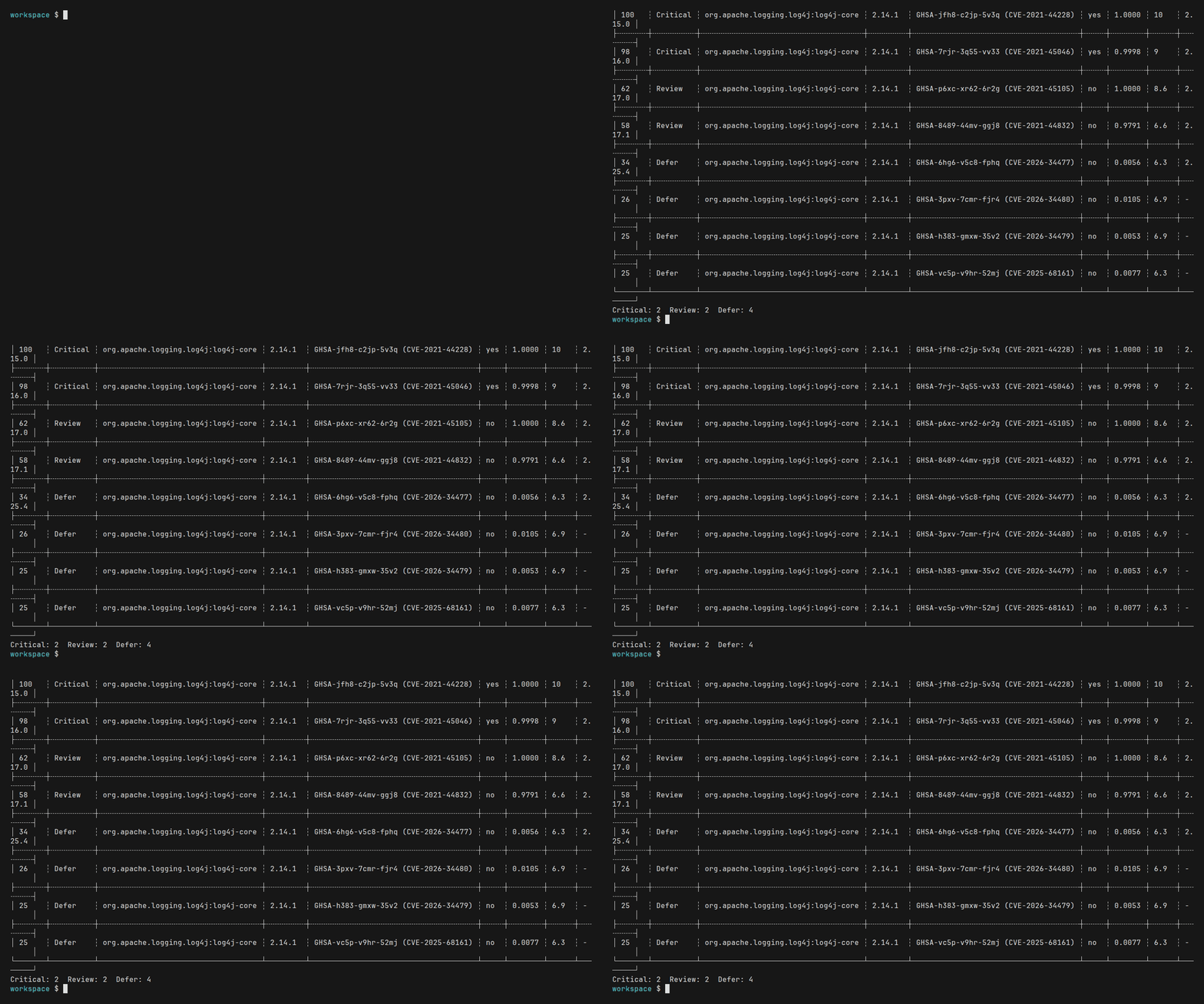
Example output:
┌───────┬──────────┬─────────────────────────────────────┬─────────┬──────────────────────────────────────┬─────┬────────────────────────────┬──────┬────────┐
│ Score ┆ Tier     ┆ Package                             ┆ Version ┆ Advisory/CVE                         ┆ KEV ┆ EPSS                       ┆ CVSS ┆ Fix    │
╞═══════╪══════════╪═════════════════════════════════════╪═════════╪══════════════════════════════════════╪═════╪════════════════════════════╪══════╪════════╡
│ 100   ┆ Critical ┆ org.apache.logging.log4j:log4j-core ┆ 2.14.1  ┆ GHSA-jfh8-c2jp-5v3q (CVE-2021-44228) ┆ yes ┆ 1.0000 (percentile 1.0000) ┆ 10   ┆ 2.15.0 │
│ 62    ┆ Review   ┆ org.apache.logging.log4j:log4j-core ┆ 2.14.1  ┆ GHSA-p6xc-xr62-6r2g (CVE-2021-45105) ┆ no  ┆ 1.0000 (percentile 0.9999) ┆ 8.6  ┆ 2.17.0 │
│ 34    ┆ Defer    ┆ org.apache.logging.log4j:log4j-core ┆ 2.14.1  ┆ GHSA-6hg6-v5c8-fphq (CVE-2026-34477) ┆ no  ┆ 0.0056 (percentile 0.4647) ┆ 6.3  ┆ 2.25.4 │
└───────┴──────────┴─────────────────────────────────────┴─────────┴──────────────────────────────────────┴─────┴────────────────────────────┴──────┴────────┘
Critical: 2  Review: 2  Defer: 4
Command reference
patchsense <COMMAND>

  scan     Scan lockfiles and print matching advisories
  cache    Inspect or delete the local SQLite cache
  init     Write an example config, agent instructions, or MCP snippets
  comment  Create or update a pull-request comment from a JSON report
  mcp      Run the MCP server on stdio
  help     Print help for a subcommand

  -h, --help     Print help
  -V, --version  Print version
patchsense scan [OPTIONS] [PATH]
PATH is a directory or a single lockfile. Default: the current directory.
| Option | Description |
|---|---|
--ecosystem <LIST> |
Ecosystems to scan, comma-separated (npm,pypi). Repeatable. Names: npm, pypi, packagist (or composer), go, maven, cargo (or crates.io). |
--no-dev |
Skip packages the parser marked as dev dependencies. |
--exclude <GLOB> |
Extra paths to skip. Repeatable. Added to [scan] exclude. |
--keep-going |
Continue after a lockfile fails to parse. This is the default. |
--no-keep-going |
Stop at the first lockfile that cannot be read or parsed. |
--fail-on <WHEN> |
Exit 1 when a finding reaches this bar: critical (default), review, any, never, or a score 0–100. |
--min-score <N> |
Hide findings below this score in every output. Does not change the exit code. |
-f, --format <FORMAT> |
table, json, sarif, markdown, or gitlab. Repeatable, paired with --output in order. |
-o, --output <FILE> |
Write the paired --format to this file instead of stdout. Repeatable. Parent directories are created. |
--no-color |
Plain table. NO_COLOR is also honored. |
--offline |
Use only the local cache. No network calls. |
--strict-cache |
With --offline, exit 2 when an EPSS row or the KEV catalog is missing or past its TTL. |
--no-cache |
Do not read or write the cache. |
--cache-dir <DIR> |
Directory containing cache.db. Overrides PATCHSENSE_CACHE_DIR. |
--config <FILE> |
Path to patchsense.toml. Overrides discovery and PATCHSENSE_CONFIG. |
--explain |
Ask a local coding agent CLI to explain the top findings. |
--agent <AGENT> |
Agent for --explain: auto, codex, claude, or cursor. |
--explain-top <N> |
Number of findings sent to the agent. Default from [explain] top (10). |
Writing several reports in one run:
Rules for pairing: the n-th --format goes to the n-th --output. At most one format may be left without an --output (it goes to stdout). More --output values than --format values is an error.
patchsense cache [--cache-dir <DIR>] <info|clear>
| Command | Description |
|---|---|
cache info |
Print the cache path, schema version, and row counts (osv_vuln, osv_query, epss, kev). |
cache clear |
Delete cache.db. |
--cache-dir works before or after the subcommand (cache info --cache-dir DIR or cache --cache-dir DIR info).
patchsense init [OPTIONS]
| Option | Description |
|---|---|
| (none) | Write an example patchsense.toml in the current directory. An existing file is kept. |
--force |
Replace an existing patchsense.toml. |
--agent [<AGENT>] |
Also write a PatchSense instruction block for all (default when no value), codex (AGENTS.md), claude (CLAUDE.md), or cursor (.cursor/rules/patchsense.mdc). The block sits between <!-- patchsense:start --> and <!-- patchsense:end --> and is updated in place on rerun. |
--print-mcp-config |
Print MCP config snippets for Cursor, Claude Code, and Codex. Writes no files and no patchsense.toml. |
patchsense comment --report <FILE> [OPTIONS]
Posts the Markdown summary of a JSON report as a pull-request comment (GitHub) or merge-request note (GitLab). A hidden <!-- patchsense-report --> marker means later runs edit the same comment instead of adding a new one.
| Option | Description |
|---|---|
--report <FILE> |
JSON report from patchsense scan --format json. Required. |
--provider <PROVIDER> |
auto (default), github, or gitlab. auto picks GitHub when GITHUB_ACTIONS=true, GitLab when GITLAB_CI=true. |
--top <N> |
Findings in the comment table. Default 20. |
--dry-run |
Print the Markdown and do not call any API. |
Environment it reads:
- GitHub:
GITHUB_TOKENwithpull-requests: write,GITHUB_REPOSITORY,GITHUB_EVENT_PATH, optionalGITHUB_API_URL. The comment is a pull-request conversation comment:GETandPOST /repos/{owner}/{repo}/issues/{pull_number}/comments, andPATCH /repos/{owner}/{repo}/issues/comments/{comment_id}. On a pull request,pull-requests: writeauthorizes those calls.issues: writeis not required. - GitLab:
GITLAB_TOKEN(project access token withapiscope;CI_JOB_TOKENcannot write notes),CI_API_V4_URL,CI_PROJECT_ID,CI_MERGE_REQUEST_IID.
patchsense mcp
Runs a Model Context Protocol server on stdio. Tools:
| Tool | Parameters | Returns |
|---|---|---|
list_supported_lockfiles |
none | Lockfile names and their OSV ecosystems |
scan_project |
path, ecosystems, min_score, include_dev, offline |
Top 50 findings plus the full summary |
get_finding |
id (GHSA, CVE, or OSV id), path |
One advisory |
get_fix_plan |
path, tier (critical, review, defer) |
Minimum upgrade covering every advisory on a package |
explain_score |
id, path |
Deterministic score breakdown (no AI call) |
patchsense init --print-mcp-config prints ready-to-paste snippets, for example Cursor's .cursor/mcp.json:
Claude Code: claude mcp add --transport stdio patchsense -- patchsense mcp
How the score works
Each finding gets 0–100 points:
| Signal | Default weight | Meaning |
|---|---|---|
| KEV | 35 | CVE is in the CISA Known Exploited Vulnerabilities catalog |
| EPSS | 25 | FIRST exploit probability; full weight at probability 0.10 (probability mode) |
| CVSS | 20 | Highest usable CVSS base score / 10 |
| Direct | 10 | Package is a direct dependency |
| Fix available | 10 | OSV lists a fixed version |
Tiers: Critical ≥ 70, Review ≥ 40, otherwise Defer. Weights that do not sum to 100 are scaled to 100, with a warning. All of this is configurable.
Configuration
PatchSense looks for patchsense.toml starting at the scan directory and walking up to the git root. --config or PATCHSENSE_CONFIG points at a specific file. Precedence: flag > environment variable > file > built-in default. Unknown keys are rejected. Every key is optional; this is the full file with defaults:
= 1 # only 1 is accepted
[]
= ["npm", "pypi", "packagist", "go", "maven", "cargo"] # default: all
= [] # extra glob patterns to skip
= true # false = same as --no-dev
= "critical" # critical | review | any | never | 0-100
[] # Go import check, see below
= true # skip directories named vendor
= true # skip directories named testdata
= true # skip *_test.go
[]
= 35
= 25
= 20
= 10
= 10
[]
= "probability" # probability | percentile
= 0.10 # probability that earns the full EPSS weight
[]
= 70
= 40
[]
= 1.0 # share of the direct weight when the parser cannot tell
[]
= 24 # whole hours
= 24
= 24
= false # true = --strict-cache
[]
= 20 # rows in the Markdown report
[]
= "auto" # auto | codex | claude | cursor
= 10 # findings sent to the agent
= 120
# Suppress an advisory. Repeat the table for more rules.
[[]]
= "GHSA-xxxx-xxxx-xxxx" # OSV, GHSA, or CVE id (aliases match too)
= "Used only in a build script" # required
= "2027-01-31" # optional, inclusive YYYY-MM-DD
Ignored findings are listed under ignored in the JSON report. An expired rule is dropped with a warning. [explain] lang from older configs is accepted but ignored (output is English only).
Environment variables
| Variable | Effect |
|---|---|
PATCHSENSE_CONFIG |
Config file path (overridden by --config) |
PATCHSENSE_CACHE_DIR |
Cache directory (overridden by --cache-dir) |
PATCHSENSE_FAIL_ON |
Same values as --fail-on |
PATCHSENSE_AGENT |
Same values as --agent |
PATCHSENSE_OSV_URL |
OSV API base URL (default https://api.osv.dev) |
PATCHSENSE_EPSS_URL |
EPSS API base URL (default https://api.first.org) |
PATCHSENSE_KEV_URL |
Full URL of the CISA KEV JSON feed |
NO_COLOR |
Disable table colors |
Output formats
| Format | Use |
|---|---|
table |
Human-readable priority table. Default when stdout is a terminal. |
json |
Full report (schema_version, tool, target, lockfiles, data_sources, summary, findings, ignored, warnings, …). Default when stdout is a pipe or file. Schema: schemas/report.v1.json. |
sarif |
SARIF 2.1.0 for GitHub code scanning and other SARIF viewers. |
markdown |
Summary and findings table with per-finding details. This is the PR/MR comment body. |
gitlab |
GitLab Dependency Scanning report (schema 15.2.5). |
Warnings (stale cache, parse failures, unsupported lockfiles) go to stderr and are also stored in the JSON and Markdown reports.
Exit codes
| Code | Meaning |
|---|---|
0 |
Scan finished and no finding reached the --fail-on bar |
1 |
At least one finding reached the --fail-on bar |
2 |
The scan could not run: bad config or flag value, no supported lockfile, unreadable input, every lockfile failed, offline OSV cache missing or expired, --strict-cache with missing or expired EPSS/KEV, or a comment API error |
--fail-on never always exits 0 when the scan runs. --min-score never changes the exit code.
Offline mode and cache
Data is cached in cache.db:
| OS | Default location |
|---|---|
| Linux | $XDG_CACHE_HOME/patchsense/ or ~/.cache/patchsense/ |
| macOS | ~/Library/Caches/patchsense/ (or $XDG_CACHE_HOME/patchsense/ if set) |
| Windows | %LOCALAPPDATA%\patchsense\ (or $XDG_CACHE_HOME/patchsense/ if set) |
Online scans reuse rows younger than their TTL and refetch older ones. With --offline:
- OSV results must be in the cache and within
ttl_hours_osv. A missing or expired row exits 2 and the error says which package and how old. No partial report is printed. - EPSS / KEV: a missing row is a warning and that signal counts as absent. An expired row is still used, with a warning naming its age, so scores do not drop just because the cache aged.
--strict-cache(or[cache] strict_cache = true) turns missing or expired EPSS/KEV into exit 2.
Typical CI pattern: run one online scan to warm the cache, then --offline for later runs.
CI usage
Any CI that has Rust:
GitHub Actions with a PR comment:
permissions:
  contents: read
  pull-requests: write

jobs:
  scan:
    runs-on: ubuntu-latest
    steps:
      - uses: actions/checkout@v4
      - uses: dtolnay/rust-toolchain@stable
      - run: cargo install patchsense --locked
      - run: patchsense scan . --no-color --format json --output patchsense-report.json
      - if: always() && github.event_name == 'pull_request'
        run: patchsense comment --report patchsense-report.json
        env:
          GITHUB_TOKEN: ${{ secrets.GITHUB_TOKEN }}
pull-requests: write is the permission for that comment. patchsense comment writes a pull-request conversation comment through the issue-comment routes above, and GitHub authorizes those routes on a pull request with pull-requests: write. issues: write is not required. On GitLab, run the same scan with --format gitlab --output gl-dependency-scanning-report.json and patchsense comment --provider gitlab with a masked GITLAB_TOKEN.
Supported ecosystems and lockfiles
| Ecosystem | Files |
|---|---|
| npm | package-lock.json, pnpm-lock.yaml, yarn.lock |
| PyPI | poetry.lock, requirements.txt |
| Packagist (PHP) | composer.lock |
| Go | go.sum |
| Maven | pom.xml |
| crates.io | Cargo.lock |
Details:
- Directories named
node_modules,vendor,target,.git,.venv, andvenvare skipped during discovery. - requirements: discovery also picks up
requirements-*.txt,requirements_*.txt,*.requirements.txt, and any.txtinside arequirements/directory (case-insensitive).-r/--requirementand-c/--constraintincludes are followed relative to the including file. A cycle or missing include is a warning; remote includes are skipped with a warning. - Composer:
platformconstraints such asphp: ^8.3are skipped; a concrete version such asphp: 8.3.35is scanned. - Go import check: when an OSV advisory lists affected import paths, PatchSense checks
.gofiles under the scan root. If none of those packages is imported, the finding stays (same score and tier) but gets the noteimported package not seen(JSON fieldimport_note). Subpackages, aliases, dot, and blank imports count. Seedocs/go-import-reachability.md. - Not supported:
bun.lock/bun.lockb(a warning is printed when one is found).
--explain (optional AI summary)
patchsense scan . --explain sends the top findings to a local, read-only coding agent CLI found on PATH: codex, claude, or Cursor's agent / cursor-agent. With auto they are tried in that order. The text is labeled AI explanation, may be wrong. A missing agent, a timeout ([explain] timeout_secs), or a bad response is only a warning and never changes the exit code.
Troubleshooting / FAQ
error: no supported lockfile found in . — Run from the project root, pass the lockfile path directly, or check that the file is not under a skipped directory or --exclude / [scan] exclude.
error: offline cache is missing OSV results … — Run one scan without --offline first, using the same --cache-dir (or PATCHSENSE_CACHE_DIR). --offline together with --no-cache can never succeed.
offline cache expired … — Rerun online, or raise [cache] ttl_hours_osv.
more than one --format would be written to stdout — Give every --format except one an --output.
failed to parse fail_on — Use critical, review, any, never, or an integer 0–100.
unknown field in the config — Keys are strict; compare with the configuration reference above.
could not detect a comment provider — Outside GitHub Actions or GitLab CI, pass --provider github or --provider gitlab, or use --dry-run to preview.
A Go finding says imported package not seen. — Your code does not import the vulnerable package of that module. The finding is kept because tests, vendored code, and build tags are not fully analysed; verify before ignoring it with an [[ignore]] rule.
Is my code uploaded anywhere? — No. Only package names and versions are sent to OSV, and CVE ids to EPSS; the KEV catalog is downloaded as a whole. --offline makes no network calls.
Links
- Repository: https://github.com/Widyasa/patchsense
- Changelog: https://github.com/Widyasa/patchsense/blob/master/CHANGELOG.md
- Known limitations: https://github.com/Widyasa/patchsense/blob/master/docs/limitations.md
- Issues: https://github.com/Widyasa/patchsense/issues
- Library API docs: https://docs.rs/patchsense
License
Licensed under either of MIT or Apache-2.0, at your option.