
PatchSense
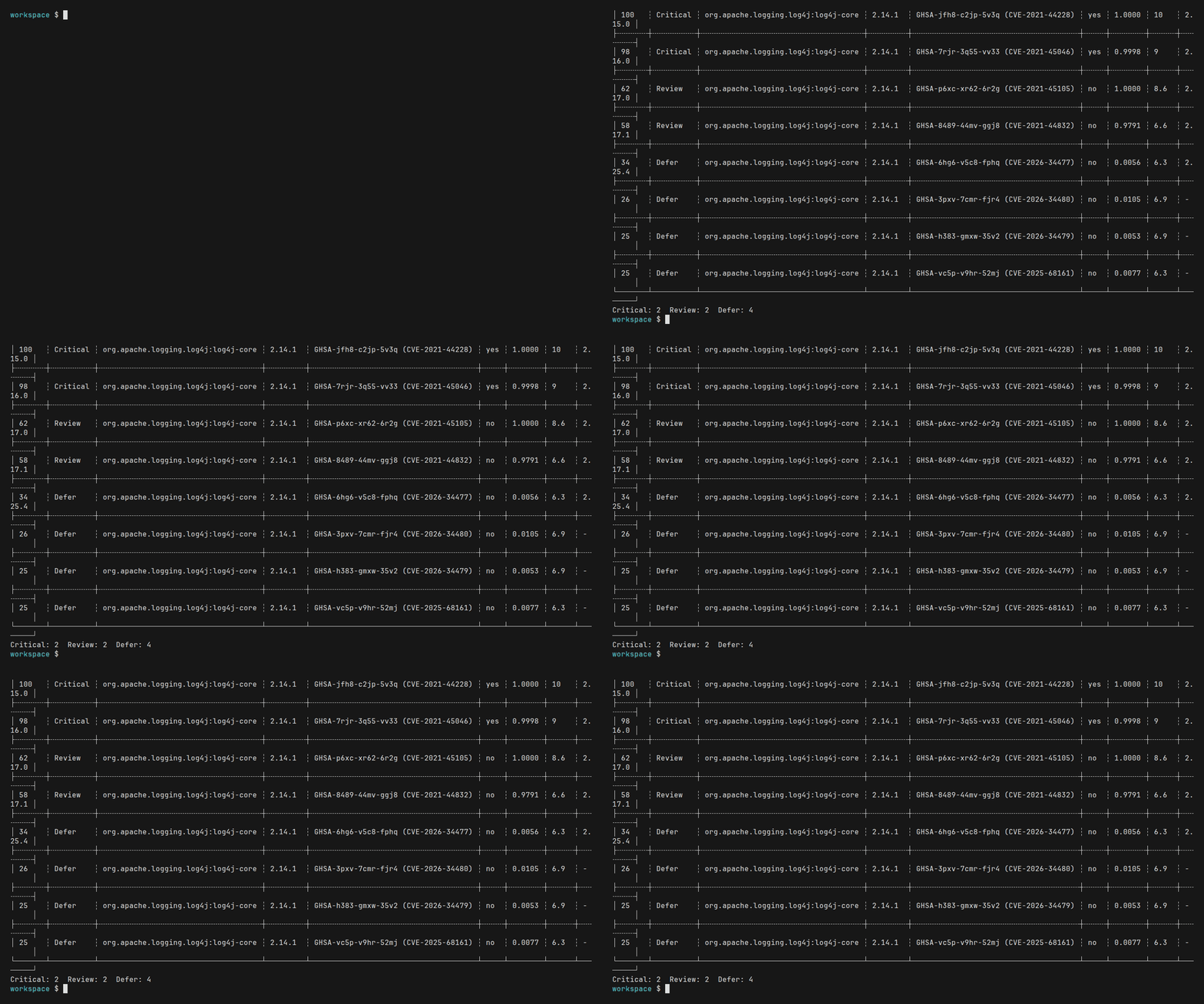
patchsense scan . reads lockfiles, matches them to OSV, and ranks each advisory with EPSS, CISA KEV, and CVSS. The table says which findings are Critical, which are Review, and which are Defer.
License: MIT OR Apache-2.0 (LICENSE-MIT, LICENSE-APACHE).
Repository: github.com/Widyasa/patchsense.
Install
0.1.0 is the crates.io release. Widya publishes it with cargo publish (docs/release-checklist.md). There is no git tag and no GitHub Release for 0.1.0.
Available for 0.1.0
That compiles from crates.io. It needs Rust 1.99 (rust-version in Cargo.toml).
From a git checkout, build the same binary without installing:
cargo run -p patchsense -- --version prints patchsense 0.1.0.
Coming in v0.1.1
npm, pip, Composer, Go, Homebrew, the shell installer, and Docker are not part of 0.1.0. They need GitHub Release binaries, or a PyPI wheel, and those are planned for v0.1.1 after GitHub Actions billing is fixed. The commands below are kept so that release has a known shape. They do not work today.
| Channel | Command (coming in v0.1.1) | Notes |
|---|---|---|
| npm | npm install --save-dev patchsense then npx patchsense scan . |
cargo-dist package. Also pnpm add -D patchsense && pnpm exec patchsense scan . and yarn add -D patchsense && yarn patchsense scan . |
| pip | pip install patchsense or pipx install patchsense or uv tool install patchsense |
Wheels from pypi.yml: Linux x64/arm64 (manylinux, glibc), macOS x64/arm64, Windows x64. Not Alpine |
| Composer | composer require --dev widyasa/patchsense then vendor/bin/patchsense scan . |
Root composer.json. First run downloads and checks sha256 |
| Go | go install github.com/Widyasa/patchsense/go/cmd/patchsense@v0.1.0 |
Same download and sha256 check. @latest tracks the newest tag. Before any tag, @latest is a pseudo-version and still looks for release v0.1.0 |
| Homebrew | brew install Widyasa/tap/patchsense |
Formula is pushed to Widyasa/homebrew-tap by the release workflow |
| shell | curl --proto '=https' --tlsv1.2 -fsSL https://github.com/Widyasa/patchsense/releases/download/v0.1.0/patchsense-installer.sh | sh |
cargo-dist installer. Checks sha256 before unpacking |
| Docker | docker build -t patchsense . then docker run --rm -v "$PWD:/work" -w /work patchsense scan . |
Local image only. Alpine x64, so it uses the musl archive. The image is not pushed to a registry |
Those commands still name v0.1.0 because that is the version recorded in the launchers. Phase B bumps the version to 0.1.1 and retargets the tag. Do not run them for the crates.io release.
cargo-dist archives for that later release cover:
| Triple | Where it runs |
|---|---|
x86_64-unknown-linux-gnu |
Linux x64, glibc |
x86_64-unknown-linux-musl |
Linux x64, musl (Alpine) |
aarch64-unknown-linux-gnu |
Linux arm64, glibc |
x86_64-apple-darwin |
macOS x64 |
aarch64-apple-darwin |
macOS arm64 |
x86_64-pc-windows-msvc |
Windows x64 |
There is no Linux arm64 musl archive and no Windows arm64 archive.
Composer, Go, and scripts/fetch-release.sh (the Docker entrypoint) cache the binary under ~/.cache/patchsense (PATCHSENSE_CACHE_DIR overrides it). A later run does not need the network. curl and PHP's curl extension honor https_proxy / http_proxy. The Go launcher uses Go's default proxy rules, which skip loopback addresses. The cargo-dist npm installer stores the binary inside the installed package and does not check sha256. The shell installer, Homebrew formula, Composer, Go, and Docker entrypoint do.
PATCHSENSE_TARGET overrides target detection (x86_64-unknown-linux-musl, for example) when libc detection is wrong. It does not change the version.
PATCHSENSE_BINARY skips the download for Composer, Go, and the Docker entrypoint. Set it to a patchsense binary you already built. An empty value is ignored. Until the v0.1.1 GitHub Release exists, those three say release v0.1.0 is not published yet and list cargo install, building from source (cargo build --release -p patchsense), and PATCHSENSE_BINARY. From a checkout:
PATCHSENSE_BINARY=/target/release/patchsense
That prints patchsense 0.1.0.
go install github.com/Widyasa/patchsense/go/cmd/patchsense@latest before the first git tag installs a pseudo-version such as v0.0.0-20261028141100-abcdefabcdef. That names a commit, not a release. The launcher still requests GitHub Release v0.1.0, the version recorded in the source, and explains the pseudo-version when that release is missing. The 0.1.0 crates.io publish does not create that tag. @latest and @v0.1.0 match a release only after Phase B tags v0.1.1 and bumps the version constant.
The pip wheel does not download a release, so it has no 404 path and does not read PATCHSENSE_BINARY. The npm package is generated by cargo-dist when the v0.1.1 release is published. It is not stored in this repository, and that generated installer does not read PATCHSENSE_BINARY either. Until v0.1.1, use cargo install or PATCHSENSE_BINARY with Composer, Go, or Docker.
Quick start
init writes patchsense.toml and does not replace an existing file unless you pass --force. A TTY prints a table. A pipe prints JSON. Write every report in one pass:
The demo GIF scans examples/kev-log4shell, which pins log4j-core 2.14.1 (CVE-2021-44228, CISA KEV). examples/php2shell-demo pins PHP 8.3.35. On 25 Oct 2026 OSV returned no advisory for that Packagist php package, so the GIF uses Log4Shell.
How the score works
Each finding is 0–100. Default weights sum to 100. A weight set that does not sum to 100 is scaled and a warning is printed.
| Signal | Default weight | What it measures |
|---|---|---|
| KEV | 35 | CVE is in the CISA Known Exploited Vulnerabilities catalog |
| EPSS | 25 | FIRST exploit probability, saturated at 0.10 in probability mode |
| CVSS | 20 | Highest usable CVSS base score, divided by 10 |
| Direct | 10 | The package is a direct dependency |
| Fix available | 10 | OSV lists a fixed version |
Default tiers: Critical at 70 and above, Review at 40 and above, otherwise Defer. --fail-on critical is the default, so a Critical finding exits 1. Output is English only.
GitHub Actions
The composite action's default path downloads a GitHub Release installer. That installer is coming in v0.1.1, not with the crates.io 0.1.0 publish. Until then, build the binary and pass binary-path (see .github/workflows/self-test.yml):
- uses: actions/checkout@v4
- uses: dtolnay/rust-toolchain@stable
- run: cargo build --release -p patchsense --bin patchsense
- uses: ./
  with:
    path: .
    fail-on: critical
    binary-path: target/release/patchsense
After v0.1.1 is released, the composite action installs the published binary. The v0 tag is created then, not during the crates.io publish. That uses: line depends on the release:
- uses: Widyasa/patchsense@v0
  with:
    path: .
    fail-on: critical
GitLab CI
Copy templates/gitlab/patchsense.gitlab-ci.yml or include it. The installer URL in that template depends on a GitHub Release, which is coming in v0.1.1. A pipeline that reaches the install step fails until that release exists. Details: docs/gitlab.md.
include:
  - local: templates/gitlab/patchsense.gitlab-ci.yml

variables:
  PATCHSENSE_FAIL_ON: critical
Set a masked GITLAB_TOKEN (project access token, api scope) when the job should comment on the merge request.
MCP and --explain
--print-mcp-config prints snippets for Cursor (.cursor/mcp.json), Claude Code, and Codex. It does not write those files. --agent writes an instruction block between <!-- patchsense:start --> and <!-- patchsense:end --> in AGENTS.md, CLAUDE.md, and .cursor/rules/patchsense.mdc.
patchsense scan . --explain asks a local read-only agent (Codex, Claude Code, or Cursor) to explain the top findings. The text is labeled AI explanation, may be wrong. A missing agent, a timeout, or a bad response is a warning. It does not change the exit code. This command needs one of those CLIs on PATH.
MCP tools: list_supported_lockfiles, scan_project, get_finding, get_fix_plan, explain_score. explain_score is deterministic. It does not call an AI model.
Exit codes
| Code | Meaning |
|---|---|
| 0 | Scan finished and --fail-on did not trip |
| 1 | A finding reached the --fail-on bar (critical, review, any, or a score) |
| 2 | The scan could not run: bad config, unreadable input, every lockfile failed, --offline is missing or past the OSV TTL, or --strict-cache found missing or expired EPSS or KEV. A launcher that cannot start the binary (missing PATCHSENSE_BINARY, unpublished release) also exits 2 |
--fail-on never stays 0 when findings exist. --min-score only hides rows. It does not change the exit code.
Configuration
patchsense init writes the example. Flags override environment variables, which override the file. Useful variables: PATCHSENSE_CONFIG, PATCHSENSE_CACHE_DIR, PATCHSENSE_FAIL_ON, PATCHSENSE_AGENT, PATCHSENSE_OSV_URL, PATCHSENSE_EPSS_URL, PATCHSENSE_KEV_URL.
patchsense cache info and patchsense cache clear manage the SQLite cache (~/.cache/patchsense/cache.db on Linux). --cache-dir works before or after info and clear.
--offline reads OSV, EPSS, and KEV from that cache and does not call the network. Cache age follows [cache] ttl_hours_osv, ttl_hours_epss, and ttl_hours_kev (24 hours each when omitted). A missing OSV query or advisory exits 2. An expired one also exits 2, and the error names the age and the TTL. A missing EPSS row or KEV catalog is a warning, and that signal counts as absent. An expired EPSS or KEV row is still scored, with a warning that includes its age. The warning is printed on stderr, stored in the JSON report, and included in the Markdown report and in PR or MR comments. --strict-cache (or strict_cache = true) exits 2 when an EPSS row or the KEV catalog is missing or expired. When the setting comes from the file, the error says to set [cache] strict_cache = false. Run one online scan before using --offline in CI.
Supported lockfiles: package-lock.json, pnpm-lock.yaml, yarn.lock, poetry.lock, requirements.txt, composer.lock, go.sum, pom.xml, Cargo.lock. Requirements discovery also accepts requirements-*.txt (requirements-dev.txt), requirements_*.txt (requirements_rag.txt), *.requirements.txt, and any .txt file in a directory named requirements. The same paths work when passed explicitly. Matching ignores ASCII case. -r, --requirement, -c, and --constraint are read relative to the file that names them. A repeated name and version is kept once. A cycle or a missing include is a warning, not a failed scan. A remote include is skipped with a warning.
Go findings are version matches on the module in go.sum. When the advisory lists affected[].ecosystem_specific.imports, PatchSense also reads .go import blocks under the scan root. An exact path matches, and so does a subpackage (golang.org/x/crypto/openpgp/packet matches golang.org/x/crypto/openpgp). Aliases, dot imports, blank imports, and build-tag files count. vendor/, testdata/, and *_test.go are skipped unless [scan.go_imports] turns a skip off. If none of the listed paths are imported, the finding stays and gains the note imported package not seen in the table, JSON (import_note), SARIF, markdown, PR and MR comments, --explain, and MCP. The score and tier do not change: a missing import is not proof the package is unused. An advisory with no imports data is reported exactly as before. Details are in docs/go-import-reachability.md.
Spec
The design source is docs/PRD.md. The task list is docs/TASKS.md. Known gaps are docs/limitations.md. Agent rules are AGENTS.md.
Contributing
Contributions are licensed under MIT OR Apache-2.0, the same as the project. Fork the repository, branch from master, and open a pull request that says Closes #N. CONTRIBUTING.md covers the toolchain, the local checks, and how to add a lockfile parser or a report format.