
oops
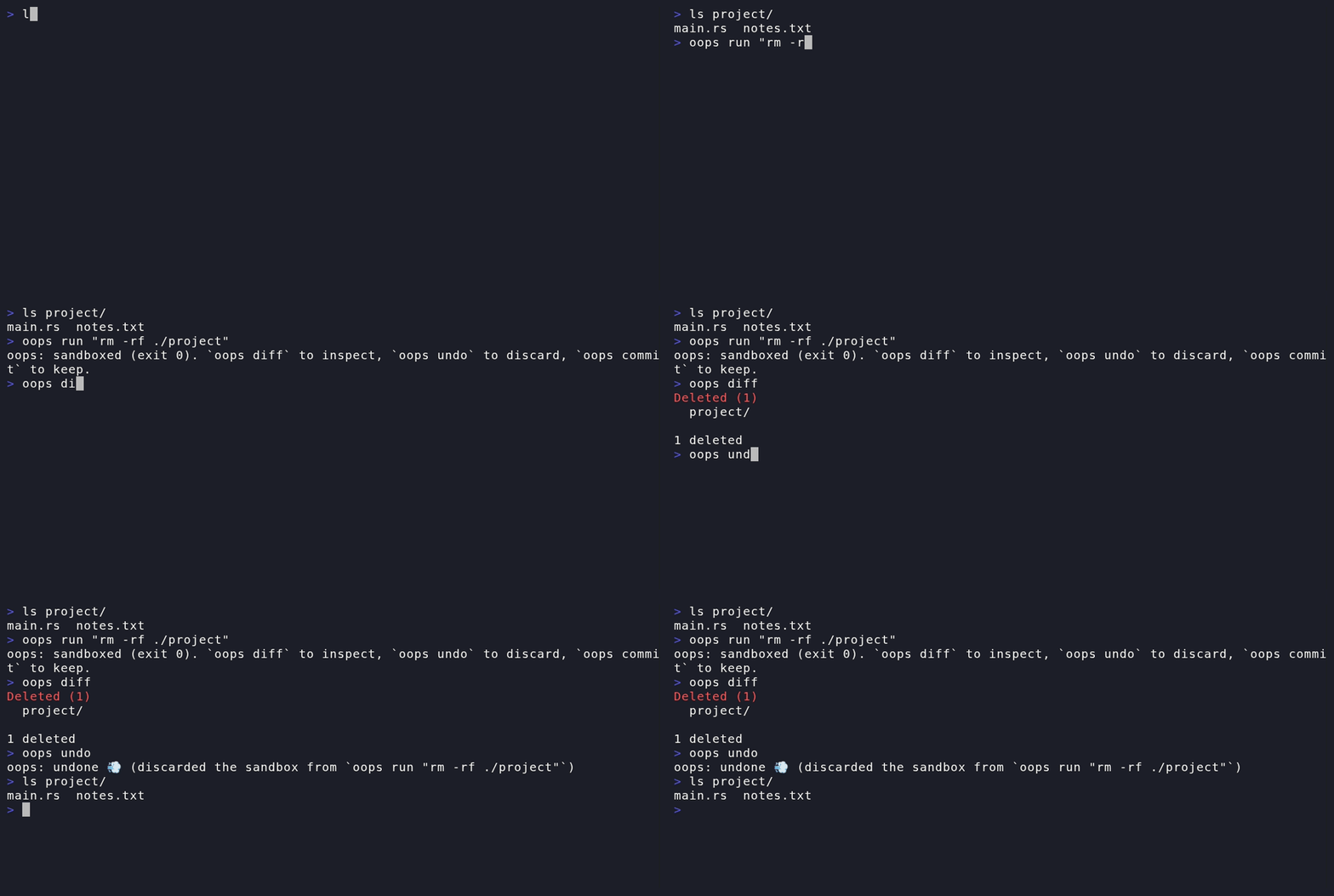
Any command can be undone.
$ oops run "rm -rf ./project"
$ oops undo
# → files are back. oops. 💨
oops is a command-line safety layer: it runs any command inside a lightweight copy-on-write filesystem sandbox, so destructive actions become reversible. Built for the AI-agent era — coding agents can run at full speed without permission-prompt fatigue, because every filesystem change they make can be inspected and rolled back.
The four verbs
| Command | What it does |
|---|---|
oops run "<cmd>" |
Run a command; its filesystem writes land in a sandbox layer, not your files |
oops diff |
See what the command created (A), modified (M), deleted (D) |
oops undo |
Discard the sandbox — your files were never touched |
oops commit |
Apply the sandbox to your real files |
Reading the diff
$ oops run "rm -rf legacy/ && touch NOTES.md"
$ oops diff
Created (1)
  NOTES.md

Deleted (1)
  legacy/

1 created, 1 deleted
Colored on a TTY (honors NO_COLOR). For scripts and agents,
oops diff --porcelain is the stable interface: A/M/D path lines,
byte-order sorted, a deleted directory as a single D path/ entry (the
subtree is not expanded), empty output when nothing changed, exit 0 either
way. Known limitation: paths containing newlines can't be represented in
the line-oriented format (-z is reserved for a future NUL-terminated
variant).
Install
$ cargo install oops-sh
The crate is oops-sh, the command is oops — the crates.io name
oops was already taken, so you install oops-sh and run oops.
Runs natively on Linux (OverlayFS) and macOS (APFS clonefile,
no root needed). On any other platform oops run refuses to execute the
command rather than run it unsandboxed.
Two backends, two guarantees
The four verbs behave identically, but the protection model differs — read this table once:
| Linux · OverlayFS | macOS · APFS | |
|---|---|---|
| Model | interception | snapshot-restore |
Real files during run |
never touched | modified — restorable |
| Guarantee | "it never happened" | "it can always be put back" |
undo |
discard layer, O(1) | atomic swap, O(1) |
commit |
replay layer, O(changes) | keep tree, O(1) |
| Crash mid-window | tree already pristine | tree modified; oops undo after restart restores |
| Other processes' writes during run | survive undo | reverted by undo (collateral) |
| Cloud-synced folders | safe | transient damage may propagate — avoid |
| Root required | yes (for now) | no |
diff cost |
O(changes) | O(tree) metadata |
On macOS, between run and undo/commit your real files hold the
command's changes: file watchers, editors, Spotlight, and cloud sync
clients (iCloud Drive, Dropbox) can observe — and may propagate — that
transient state. Don't point oops at cloud-synced directories on macOS.
macOS modification detection uses size + nanosecond mtime; a command that
forges both back escapes M detection (a --verify mode is planned).
The honest fine print (guarantee boundary)
The sandbox covers filesystem writes under the directory where you invoked
oops run — nothing else. Not undoable:
- writes outside that tree (
/tmp,$HOME, other mounts) - network side effects (that email is sent)
- spawned daemons and other process state
Safety invariants (see openspec/specs/safety/): if sandbox setup fails,
oops refuses to run the command at all — it never silently falls back to
running unsandboxed; undo modifies exactly the protected directory tree
(restoring it) and oops's own state roots (~/.local/state/oops/, plus
<volume>/.oops/state/ for targets on other volumes) — nothing else,
ever.
Development
The dev host can be macOS; everything that touches OverlayFS runs inside a privileged Linux container:
make test-linux    # OverlayFS suite in the container
make bench-linux   # Linux undo < 100ms benchmark
make test-apfs     # APFS suite on a macOS host (triple-gated, tempdir-confined)
make bench-apfs    # macOS undo benchmark + snapshot setup cost
make shell-linux   # interactive shell in the Linux test environment
make check         # fast host-side compile check
make demo-gif      # re-render demo/demo.gif from demo/demo.tape (VHS)
Work is spec-driven via OpenSpec:
capabilities live in openspec/specs/, changes in openspec/changes/.
License
Dual-licensed under either of MIT or Apache License 2.0, at your option. Unless you explicitly state otherwise, any contribution intentionally submitted for inclusion in oops shall be dual-licensed as above, without any additional terms.