
oops
Any command can be undone.
$ oops run "rm -rf ./project"
$ oops undo
# → files are back. oops. 💨
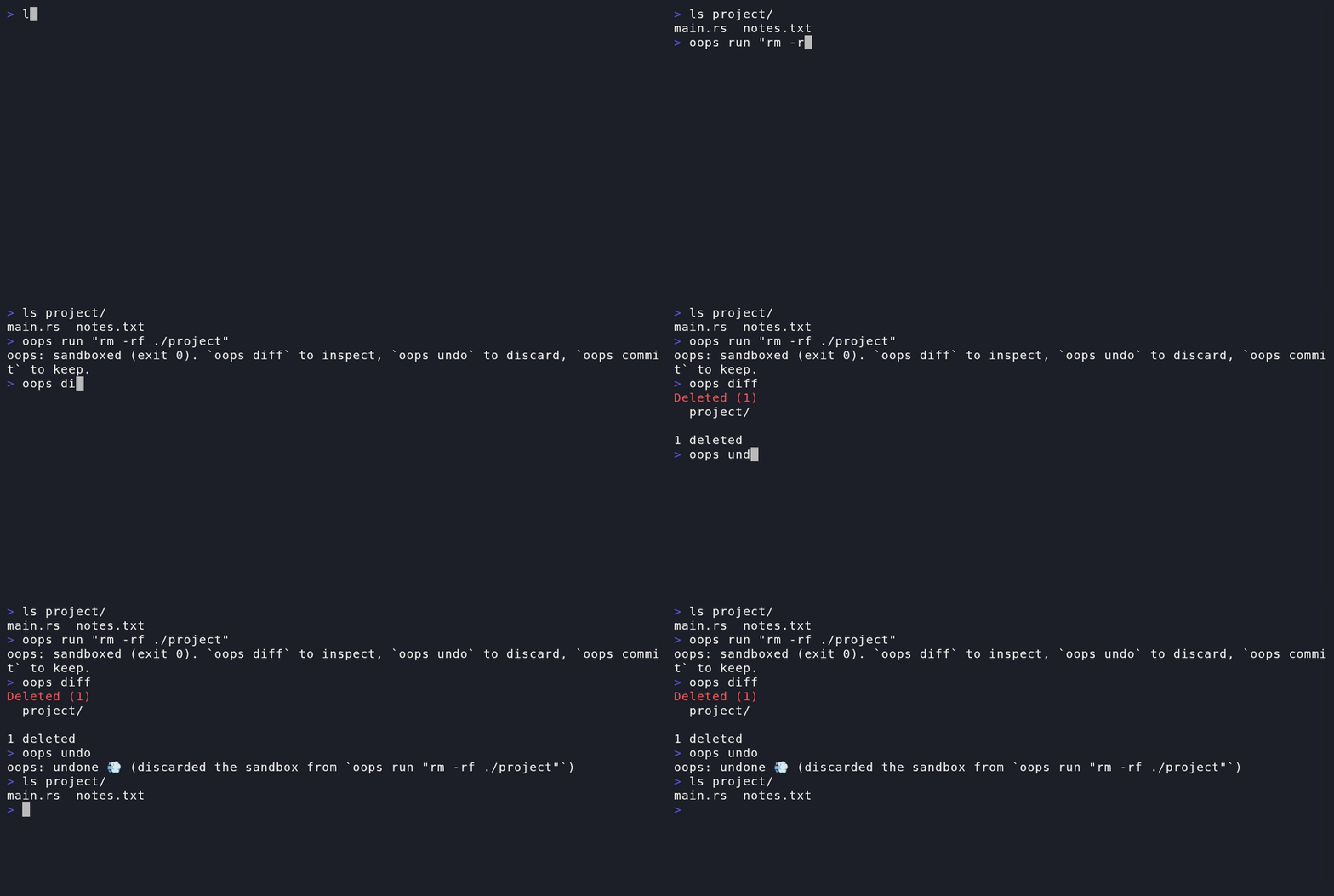
oops is a command-line safety layer: it runs any command inside a lightweight copy-on-write filesystem sandbox, so destructive actions become reversible. Built for the AI-agent era — coding agents can run at full speed without permission-prompt fatigue, because every filesystem change they make can be inspected and rolled back.
The four verbs
| Command | What it does |
|---|---|
oops run "<cmd>" |
Run a command; its filesystem writes land in a sandbox layer, not your files |
oops diff |
See what the command created (A), modified (M), deleted (D) |
oops undo |
Discard the sandbox — your files were never touched |
oops commit |
Apply the sandbox to your real files |
Reading the diff
$ oops run "rm -rf legacy/ && touch NOTES.md"
$ oops diff
Created (1)
  NOTES.md

Deleted (1)
  legacy/

1 created, 1 deleted
Colored on a TTY (honors NO_COLOR). For scripts and agents,
oops diff --porcelain is the stable interface: A/M/D path lines,
byte-order sorted, a deleted directory as a single D path/ entry (the
subtree is not expanded), empty output when nothing changed, exit 0 either
way. Known limitation: paths containing newlines can't be represented in
the line-oriented format (-z is reserved for a future NUL-terminated
variant).
Install
$ cargo install oops-sh
The crate is oops-sh, the command is oops — the crates.io name
oops was already taken, so you install oops-sh and run oops.
Runtime is Linux-only for now (the sandbox is OverlayFS). On any other
platform oops run refuses to execute the command rather than run it
unsandboxed. On macOS, use a Linux container or VM — this repo's
make shell-linux gives you one.
Status: Phase 0 (proof of the core loop)
Working today, inside a Linux environment:
- OverlayFS-backed sandbox (
SnapshotBackendtrait; APFS backend planned) - The full run → diff → undo/commit loop, with integration tests proving the flagship demo above restores a byte-identical tree
undois O(1) — one atomic rename — measured at < 1ms on a 10,000-file tree (target: < 100ms)
The honest fine print (guarantee boundary)
The sandbox covers filesystem writes under the directory where you invoked
oops run — nothing else. Not undoable:
- writes outside that tree (
/tmp,$HOME, other mounts) - network side effects (that email is sent)
- spawned daemons and other process state
Safety invariants (see openspec/specs/safety/): if sandbox setup fails,
oops refuses to run the command at all — it never silently falls back to
running unsandboxed; and undo/gc can only ever delete inside oops's own
state directory (~/.local/state/oops/).
Development
The dev host can be macOS; everything that touches OverlayFS runs inside a privileged Linux container:
make test-linux    # full test suite in the container
make bench-linux   # the undo < 100ms benchmark
make shell-linux   # interactive shell in the test environment
make check         # fast host-side compile check
make demo-gif      # re-render demo/demo.gif from demo/demo.tape (VHS)
Work is spec-driven via OpenSpec:
capabilities live in openspec/specs/, changes in openspec/changes/.
License
Dual-licensed under either of MIT or Apache License 2.0, at your option. Unless you explicitly state otherwise, any contribution intentionally submitted for inclusion in oops shall be dual-licensed as above, without any additional terms.