# netls
`netls` - a network connections viewer built for developer workflows and automation.
- **JSON & CSV output** - pipe directly into `jq`, scripts, or AI agents
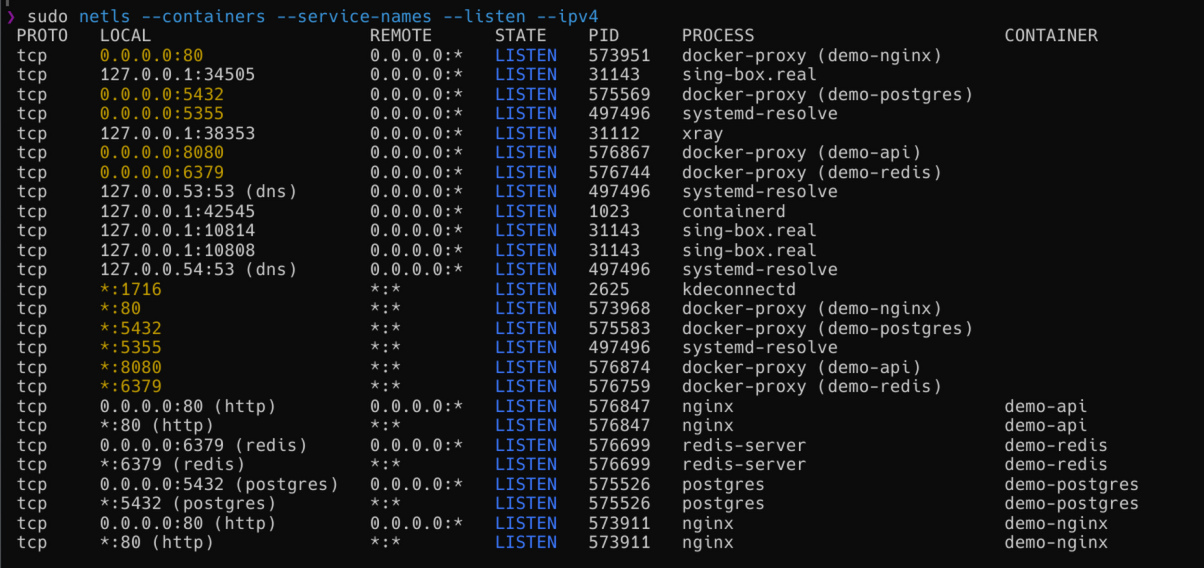
- **Container visibility** - shows which container owns each connection (Docker and Podman)
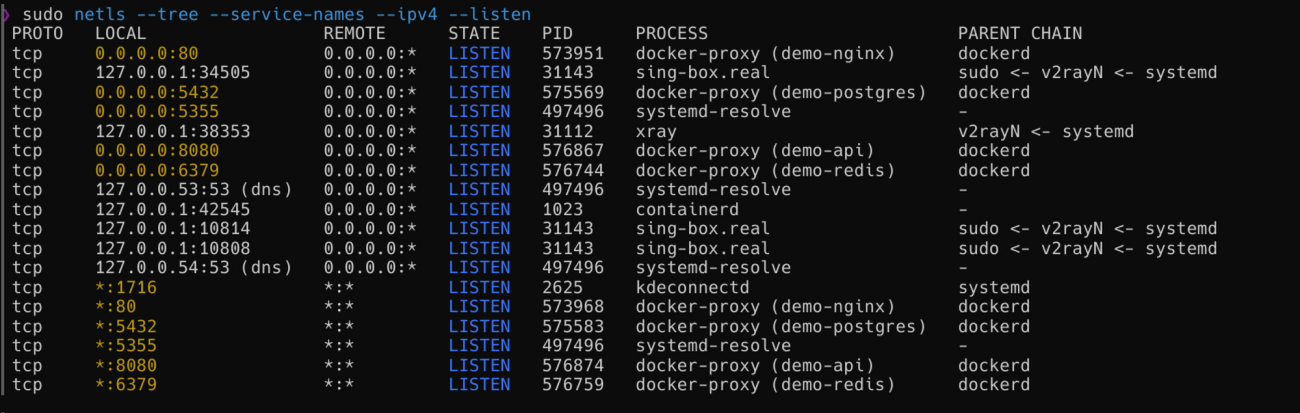
- **Process tree** - trace any connection back to its parent process chain
- **Watch mode** - live diff, see new and closed connections in real time
- **CI-friendly** - `--wait-for 8080` blocks until a port is up
- **Configs & profiles** - save common flag sets and switch with one flag
- **And more** - TUI, snapshot diff, service name annotations, port utilities
- **Linux & macOS** - full support on both platforms; macOS works entirely without root
[](https://github.com/NEOFIT-dev/netls/actions)
[](https://crates.io/crates/netls)
[](https://docs.rs/netls)
## Contents
- [Installation](#installation)
- [Usage](#usage)
- [Output](#output)
- [Configuration](#configuration)
- [As a library](#as-a-library)
## Quick look
**Container visibility** - which container owns each connection:
**Process tree** - full parent chain per connection:
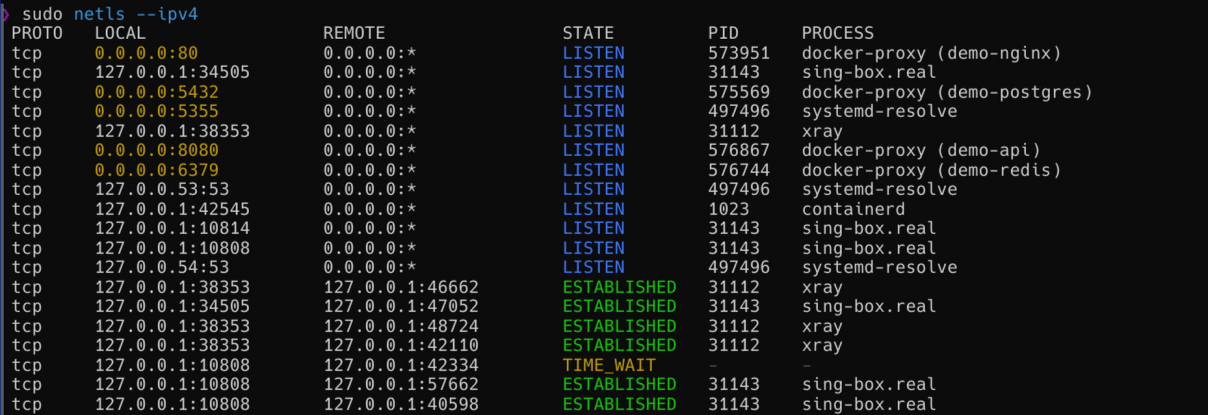
**Default output:**
## Installation
Supported platforms: Linux, macOS. Requires Rust 1.88 or newer.
```bash
cargo install netls
```
## Usage
```bash
netls # table (default)
netls --json # JSON output (one object per line)
netls --json --pretty # pretty-printed JSON
netls --csv # CSV output
netls --watch # refresh every 2s with diff
netls --watch 5 # refresh every 5s
netls --tui # interactive TUI
```
### Filters
```bash
netls --port 8080 # filter by port
netls --pid 1234 # filter by PID
netls --process nginx # filter by process name (case-insensitive substring)
netls --state established # filter by state
netls --proto tcp # filter by protocol: tcp, udp, unix, icmp, raw
netls --proto icmp # ICMP datagram sockets: blackbox_exporter, k8s probes, Go net/icmp monitors
netls --proto raw # raw IP sockets (SOCK_RAW): tcpdump, routing daemons (bird, FRR), nmap
netls --ipv4 # show only IPv4 connections
netls --ipv6 # show only IPv6 connections
netls --no-loopback # hide loopback connections (127.x and ::1)
netls --listen # show only listening sockets
netls --all # include Unix domain sockets (hidden by default)
```
Filters can be combined:
```bash
netls --proto tcp --state listen
netls --proto tcp --port 443 --json
netls --no-loopback --state established
```
### Extra columns
```bash
netls --queues # RECV-Q / SEND-Q (TCP buffer fill in bytes)
netls --service-names # annotate ports with service names (curated built-ins + /etc/services)
netls --age # approximate connection age (Linux only)
netls --tree # parent process chain: "bash <- tmux"
netls --systemd # owning systemd unit: "nginx.service" (Linux only)
netls --fd # open file-descriptor count/limit per process
netls --cmdline # full command line instead of short process name
netls --containers # include connections from Docker / Podman containers
netls --resolve-dns # resolve remote IPs to hostnames (may be slow)
netls --resolve-proxy # show real originating process for proxied connections
```
### Aggregation and analysis
```bash
netls --summary # connections grouped by protocol and state
netls --summary --warn-timewait # warn if TIME_WAIT count exceeds 500
netls --summary --warn-timewait 200
netls --top # top 10 processes by connection count
netls --top 5
netls --count # print only the count of matching connections
netls --sort port # sort by column: proto, local, remote, state, pid, port, process
netls --group-by remote-ip # group by field: remote-ip, process, port, proto
```
### Snapshot and diff
```bash
netls --save before.json # save current snapshot to file
netls --diff before.json # compare current state with saved snapshot
```
### Port utilities
```bash
netls --check-port 8080 # check if a port is free (exit 0 = free, 1 = in use)
netls --kill 8080 # send SIGTERM to process listening on port (asks for confirmation)
netls --kill 8080 --force # skip confirmation
netls --wait-for 8080 # block until port is listening (timeout: 30s)
netls --wait-for 8080 --timeout 60
```
## Output
### Table (default)
Colors are enabled automatically when stdout is a terminal and disabled in pipes/redirects.
### JSON
```bash
netls --json
```
```json
{"proto":"tcp","local":"127.0.0.1:8080","remote":"127.0.0.1:54321","state":"ESTABLISHED","pid":1234,"process":"cargo","recv_q":0,"send_q":0}
{"proto":"tcp","local":"0.0.0.0:22","remote":"0.0.0.0:*","state":"LISTEN","pid":891,"process":"sshd","recv_q":0,"send_q":0}
{"proto":"tcp","local":"0.0.0.0:8443","remote":"0.0.0.0:*","state":"LISTEN","pid":null,"process":null,"recv_q":0,"send_q":0}
```
One JSON object per line. Use `--pretty` for human-readable output:
```bash
netls --json --pretty
```
```json
{
"proto": "tcp",
"local": "0.0.0.0:22",
"remote": "0.0.0.0:*",
"state": "LISTEN",
"pid": 891,
"process": "sshd",
"recv_q": 0,
"send_q": 0
}
```
### CSV
```bash
netls --csv
```
```
proto,local,remote,state,pid,process
tcp,127.0.0.1:8080,127.0.0.1:54321,ESTABLISHED,1234,cargo
tcp,0.0.0.0:22,0.0.0.0:*,LISTEN,891,sshd
```
### Watch mode
```bash
netls --watch
```
Refreshes every 2 seconds. New connections are shown in green, closed connections in red. Exit with Ctrl+C.
```bash
netls --watch 5 --proto tcp --state established
```
### TUI
```bash
netls --tui
```
Interactive mode with live updates, keyboard navigation, and inline filtering. Exit with `q` or Ctrl+C.
## Configuration
netls can read defaults and named profiles from a TOML config file. Location
(first match wins):
1. `--config PATH` flag
2. `NETLS_CONFIG` environment variable
3. `~/.config/netls/config.toml` (or the platform equivalent)
Example `~/.config/netls/config.toml`:
```toml
# Applied at every invocation unless overridden on the command line
[defaults]
proto = "tcp"
sort = "port"
service_names = true
# Extend the built-in port -> service-name map
[ports]
3000 = "vite-dev"
4321 = "astro-dev"
9229 = "node-debug"
# Named overlays activated with --profile <name>
[profiles.k8s]
all = true
containers = true
[profiles.dev]
listen = true
no_loopback = true
[profiles.audit]
state = "listen"
no_loopback = true
```
Usage:
```bash
netls # applies [defaults]
netls --profile k8s # applies [defaults] then [profiles.k8s] on top
netls --proto udp # CLI flag overrides config, regardless of profile
```
Helper commands:
```bash
netls --init-config # write a starter config to ~/.config/netls/config.toml
netls --init-config --force # overwrite an existing file
netls --show-config # print resolved config with origin per field
```
All three accept `--config PATH` to target a specific file instead of the default.
Notes:
- Config field names match long-form CLI flags with `-` replaced by `_`
(`no_loopback`, `service_names`, `group_by`, etc.).
- One-shot actions (`--watch`, `--summary`, `--top`, `--count`, `--tui`,
`--check-port`, `--kill`, `--wait-for`, `--save`, `--diff`, `--warn-timewait`,
`--timeout`, `--force`) are not configurable.
- A non-empty `[ports]` auto-enables `--service-names`. Set
`service_names = false` in `[defaults]` to opt out.
- `NETLS_CONFIG` expands a leading `~` / `~/` to your home directory.
### Negation flags
Every boolean flag that can be set from `[defaults]` or a profile has a
`--no-X` counterpart to turn it back off on the command line. For example:
```bash
netls --profile dev --no-listen # dev profile sets listen = true; cancel it
netls --profile dev --loopback # dev profile sets no_loopback = true; cancel it
netls --no-service-names # overrides the [ports] auto-enable
```
Negation flags are hidden from `--help` to keep it readable. If `--X` and
`--no-X` appear on the same command line, the last one wins.
The `--no-loopback` flag is itself already negative; its antonym is
`--loopback`.
## As a library
`netls` is also a Rust library for programmatic access to socket information:
```toml
[dependencies]
netls = "1"
```
```rust
use netls::{Filter, Proto, State, snapshot};
fn main() -> anyhow::Result<()> {
let filter = Filter::default().proto(Proto::Tcp).state(State::Established);
let connections = snapshot(&filter)?;
for conn in connections {
println!("{} {} -> {}", conn.process.as_deref().unwrap_or("-"), conn.local, conn.remote);
}
Ok(())
}
```
## License
Licensed under either of [MIT](LICENSE-MIT) or [Apache-2.0](LICENSE-APACHE) at your option.