
mirador





An opinionated personal dashboard for your terminal: world clocks, a calendar, weather, a real task list, notes, a market watchlist, and live CPU and network charts, laid out how you want them.
It is built for one job — to sit in a terminal tab you leave open all day and glance at. That single constraint drives every decision below: nothing blinks, nothing shimmers, and nothing is designed to pull you back to it.
A mirador is a lookout — the tower you climb to see everything at once.
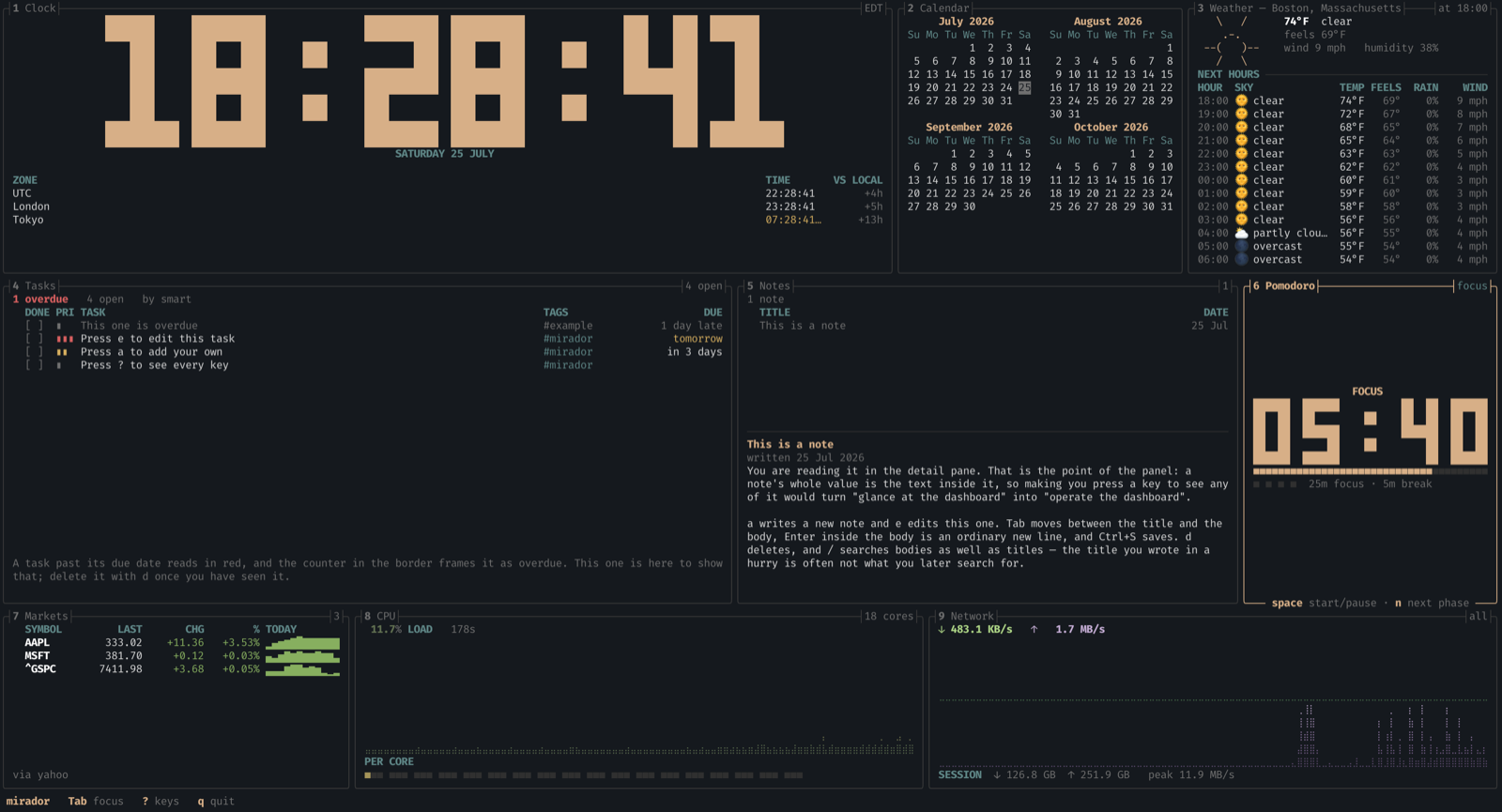
All eight panels on a wide terminal, on a first run — the tasks and the note are the examples mirador seeds for you. Every screen in this README is a real capture, not a mock-up.
Why
There are good terminal dashboards already, but the task panels in them tend to be flat checklists. mirador treats the to-do list as a first-class feature: due dates, priorities, notes, tags, and full editing without leaving the dashboard. Everything is stored in a plain TOML file you can hand-edit or keep in git.
No accounts. No API keys. No telemetry. Weather comes from Open-Meteo, which is free and key-less.
Install
From crates.io, if you have Rust:
Without Rust, on macOS or Linux:
|
and on Windows:
irm https://github.com/jchultarsky/mirador/releases/latest/download/mirador-installer.ps1 | iex
Both fetch the right archive for your platform, check it against its published checksum, and unpack the binary. If you would rather read the script before running it, it is an ordinary file at that URL, and the manual route is below.
From source:
Or download a pre-built binary from the
latest release.
Every archive carries a .sha256 beside it, so verify it before running:
| Platform | Archive |
|---|---|
| macOS, Apple silicon | mirador-aarch64-apple-darwin.tar.gz |
| macOS, Intel | mirador-x86_64-apple-darwin.tar.gz |
| Linux x86-64 | mirador-x86_64-unknown-linux-gnu.tar.gz |
| Windows x86-64 | mirador-x86_64-pc-windows-msvc.zip |
Requires Rust 1.95 or newer to build from source.
On Windows, the binary is built but not yet exercised — everything under
it is cross-platform (crossterm for the terminal, sysinfo for the
metrics), and nothing in mirador is Unix-specific, but "compiles" and "behaves"
are different claims and only the first has been checked. Reports welcome.
Windows on ARM is deliberately absent: ring, reached through ureq's TLS,
does not build for it.
Quick start
On first run it writes a commented config file, lays out all eight panels, and
seeds the task list and notes with a few examples so nothing starts blank. The
examples are ordinary entries — they explain the keys and then you delete them
with d. They are seeded only when there is no file yet, so once you clear
them they stay cleared.
To find the config:
Edit [weather].location to your own city and you are done. Nothing else is
required: no account, no API key, no environment variables.
The panels
Eight widgets, each answering one question. Put the ones you want in the layout and drop the rest — an unused widget costs nothing but is also not built.
Tasks
The reason this project exists. Other terminal dashboards tend to render a to-do list as a flat checklist; this one has due dates, priorities, tags, notes, filtering and full editing without leaving the dashboard.
╭┤3 Tasks├───────────────────────────────────────────────────────────┤3 open├╮
│ 1 overdue   1 due today   3 open   by smart                                │
│   DONE PRI TASK                              TAGS                      DUE │
│   [ ]  ▮▮▮ Renew the domain                  #admin            2 days late │
│   [ ]  ▮▮  Reply to the design review        #work                   today │
│   [ ]  ▮   Read the ratatui layout docs      #rust              Fri 07 Aug │
│                                                                            │
│ Card on file expired; the registrar will not auto-renew.                   │
╰────────────────────────────────────────────────────────────────────────────╯
The selected task's note sits at the foot of the panel, so a one-line summary in the list does not mean losing the detail behind it. Priority reads as bars rather than colour alone, and an overdue task is red and counted in the header — the same fact twice, because colour is the first thing a terminal theme can take away from you.
smart sort is the default and means: unfinished first, then overdue, then by
priority, then by due date. s cycles to plain due, priority, created
or title when you want something simpler.
Notes
Free-form notes in a master-detail layout, the shape a mail client uses.
╭┤2 Notes├───────────────────────────────┤1├╮
│ 1 note                                    │
│   TITLE                              DATE │
│   Release checklist                ·25 J… │
│ ───────────────────────────────────────── │
│ Release checklist                         │
│ written 22 Jul 2026   edited 25 Jul 2026  │
│ Bump the version, run the four gates, tag │
│ v-something, and let CI build the three   │
╰───────────────────────────────────────────╯
The body is visible without pressing anything, which is the whole point: a
note's value is the text inside it, and making you press a key to see any of
it turns "glance at the dashboard" into "operate the dashboard". / searches
bodies as well as titles, because the title you wrote in a hurry is often not
what you later search for.
Clock and calendar
The first configured zone renders large; the rest become a table showing their
offset relative to that zone, which is the number you actually want when
scheduling across one. The calendar prints month grids in the shape cal
does, with today marked.
╭┤1 Calendar├───────────────────╮
│      July 2026                │
│ Su Mo Tu We Th Fr Sa          │
│           1  2  3  4          │
│  5  6  7  8  9 10 11          │
│ 12 13 14 15 16 17 18          │
│ 19 20 21 22 23 24 25          │
│ 26 27 28 29 30 31             │
╰───── n/p month · t today ─────╯
The calendar is deliberately offline — it reads no mail server and no account.
months sets how many sit across; a taller panel stacks more rather than
leaving a void, up to a year in view.
Weather
Current conditions and an hourly forecast from Open-Meteo,
which needs no key and no account. u switches between imperial and metric at
runtime, converting what is already on screen rather than re-fetching.
A failed refresh keeps the last reading and shows its age in amber rather than blanking the panel — weather two hours old is still useful, and an empty panel is not. Columns drop as the panel narrows, in the order that costs you least.
Markets
A watchlist with the last price, the day's change, and an intraday sparkline.
╭┤1 Markets├──────────────────────────────────────────────────────────────┤3├╮
│   SYMBOL         LAST       CHG        % TODAY                             │
│ ▸ AAPL         333.02    +11.36   +3.53% ▂▄▅▆▇█▇▇▇▇▇▇                      │
│   MSFT         381.70     +0.12   +0.03% ▄▃▅▇▆▇▆▆▇▆▆▃                      │
│   ^GSPC       7411.98     +3.68   +0.05% ▃▃▃▆▇▇▅▆▅▂▁▂                      │
│ via yahoo                                                                  │
╰─────────────────────── a add · d remove · r refresh ───────────────────────╯
a adds a symbol and d removes one, and those edits stick — the watchlist
is a data file rather than config, which is what lets the panel own it. See
Market data before filing a bug about HTTP 429.
CPU and network
CPU shows average load, a moving history graph and a per-core meter row. Network shows receive and transmit rates as two graphs, plus a session total and the peak rate seen.
Both draw their history in braille, which packs two samples into every character cell and four levels into every row — twice the horizontal resolution of a block-element sparkline in the same space. The colour gradient runs vertically by magnitude, one colour per row, so the profile stays put as data scrolls: a graph left on screen all day changes colour when the load changes, not merely because time passed.
These two panels are the one thing this README will not show you in a code block. Braille is missing from several of the fonts GitHub falls back to, so the glyphs render at a width the surrounding box characters do not share and the panel tears itself apart. The screenshot at the top of this file shows them as they actually look. It is a real terminal, which is the only place the alignment is guaranteed.
Both buffers grow to fill the panel, so history is a floor on what is kept
rather than a cap on what a wider panel can draw.
Keys
| Key | Action |
|---|---|
Tab / Shift+Tab |
Move focus between panels |
1 – 9 |
Jump straight to a panel |
? |
Show all key bindings |
q / Ctrl+C |
Quit |
In the task panel:
| Key | Action |
|---|---|
j / k, ↑ / ↓ |
Move the selection |
g / G |
Jump to first / last |
Space |
Toggle done |
a |
Add a task |
e |
Edit the selected task |
d |
Delete (asks first) |
p / P |
Cycle priority forward / back |
s |
Cycle sort mode |
c |
Show or hide completed tasks |
/ |
Filter by title, tag or notes |
o |
Show the task file path |
In the add/edit form, Tab and Shift+Tab move between fields, Enter saves
and Esc cancels. While a form is open, global keys are suppressed, so typing
a q into a task title does not quit the dashboard.
Due dates
The due field accepts more than ISO dates:
| Input | Meaning |
|---|---|
2026-07-28 |
That date |
today, tomorrow, yesterday |
Relative to now |
mon, friday, sat |
The next such weekday, never today |
+3d, 3d, 2w, 1m, 1y |
An offset from today |
| (empty) | No due date |
Anything else is rejected with an explanation rather than silently guessed.
Configuration
One TOML file. Run mirador --print-config to see the fully commented default.
The layout is a grid of rows, where height and width are relative weights
rather than cell counts, so proportions hold at any terminal size:
[]
= [
{ = 30, = [
{ = "clocks", = 26 },
{ = "calendar", = 34 },
{ = "weather", = 40 },
] },
{ = 45, = [
{ = "todo", = 58 },
{ = "notes", = 42 },
] },
{ = 25, = [
{ = "stocks", = 40 },
{ = "cpu", = 30 },
{ = "network", = 30 },
] },
]
Widgets
| Widget | What it shows |
|---|---|
clocks |
Any number of world clocks, by IANA timezone |
weather |
Current conditions plus a 1–7 day forecast |
todo |
The task list, with full editing |
notes |
Free-form notes: a list of titles and dates above the note you are reading |
stocks |
A watchlist: last price, the day's change, and an intraday sparkline |
calendar |
Month grids in the shape cal prints, with today marked |
cpu |
Average utilisation, a moving chart, and per-core meters |
network |
Receive and transmit rates as moving charts |
Market data
The watchlist reads a free, keyless endpoint. Two things follow from that, and they are worth knowing before you file a bug:
- Access is gated on your IP address, not on a key. Datacenter and VPN ranges are blocked wholesale, so the same build can work on your laptop and fail on a VPS. Persistent HTTP 429 is that, not a rate you can tune down. The data source is a swappable trait for exactly this reason.
- Polling is deliberately unhurried — no faster than once a minute, one symbol at a time. These services are free and unauthenticated, and a burst of parallel requests is what gets an address blocked for everyone behind it.
mirador ships no API key and never will: a key baked into a public binary is a shared secret, and its rate limit would be shared too. Prices are never written to disk, only the list of symbols.
Mouse
Click a panel to focus it, and scroll the wheel over a list or a calendar to move through it. Scrolling deliberately does not move focus, so running the wheel across the screen cannot take the keyboard away from what you were doing.
While mirador holds the mouse your terminal's own click-to-select-text stops
working; copying a value off the dashboard needs the terminal's override
modifier, which is Shift in most terminals and Option in macOS Terminal and
iTerm2. Set [general].mouse = false to keep ordinary selection instead.
Colours accept a name (red, light-blue), a hex string (#ff8800), or a
256-colour index (12). reset uses your terminal's own default.
An unknown widget name or a malformed colour is reported at startup with a message that says how to fix it, rather than being ignored.
Task file format
Tasks live in one TOML file — by default under your platform's data directory,
or wherever [todo].file points. Press o in the task panel to see the path.
[[]]
= 1
= "Publish 0.0.0 placeholder"
= "Reserve the crates.io name"
= "2026-07-28"
= "high" # high | medium | low | none
= ["mirador", "rust"]
= false
= "2026-07-25"
Writes are atomic — mirador writes a temporary file and renames it — so an interrupted save can never truncate your tasks.
Contributing
Bug reports, feature requests and pull requests are welcome. See CONTRIBUTING.md for the development workflow, and CODE_OF_CONDUCT.md for the ground rules.
Adding a widget means implementing the Panel trait, registering the name in
src/widgets/mod.rs, and documenting it here. Nothing else in the codebase
needs to know it exists.
Acknowledgements
mirador is a thin layer over other people's hard work. Ten direct dependencies, every one of them maintained by someone who did not have to.
ratatui deserves top billing. Every frame here is
ratatui: the layout solver, the buffer diffing that makes a redraw cheap
enough to leave running all day, the widget model that made Panel a
twenty-line trait instead of a framework. The border-embedded titles and hints
this project leans on are ratatui's block API being more flexible than it had
any obligation to be. It is the successor to
tui-rs by Florian Dehau, carried forward
by a community that kept it alive rather than letting it archive — and it
brings crossterm with it, which
is what makes the same binary work on macOS, Linux and Windows terminals.
| Crate | What it does here |
|---|---|
| ratatui | Every widget, layout and redraw |
| crossterm | Terminal control, key and mouse events |
| jiff | Dates, IANA timezones, the "2 days late" arithmetic |
| sysinfo | CPU and network counters, per platform |
| ureq | Blocking HTTP for weather and quotes |
| serde + toml + serde_json | Config, tasks and notes as hand-editable TOML; JSON from the APIs |
| anyhow | Error context that survives to the message a user reads |
| dirs | Finding the right config and data directory per platform |
| unicode-width | Measuring text in display cells, without which every table misaligns |
unicode-width is worth singling out: measuring chars() instead of display
cells is a bug this project shipped once, and one emoji is enough to slide
every column after it under the wrong header.
Services
Open-Meteo provides the weather, free and without an API key or an account, which is the only reason the weather panel can exist in a tool that refuses to bundle credentials. Their terms are generous to open source and they deserve the traffic; if you build on them at scale, pay them.
Market data comes from Yahoo Finance's public chart endpoint. It is not a
documented API and mirador treats it accordingly — one request per symbol, no
faster than once a minute, never persisted to disk. QuoteSource is a trait
so it can be replaced when it inevitably changes.
Prior art
Techniques were taken deliberately from projects that solved these problems
first, and are described in CLAUDE.md where they are implemented:
- btop and its ancestor bpytop — the braille level table, and the insight that a gradient should run vertically by magnitude so a graph does not shimmer as data scrolls. The CPU and network panels are wearing their ideas.
- clock-tui — run-length row encoding for block numerals, which turns thirteen glyphs and free integer scaling into about twenty lines.
- gitui, lazygit and ratatui's own tutorial — focus by dimming the unfocused rather than brightening the focused, hints in the bottom border, the jump key in the title.
License
MIT. See LICENSE.