# Architecture
- Purpose: Efficiently sample positions and evaluate them against a field-graph-based program to produce scatter data and auxiliary raster artifacts.
- Design pillars: separation of orchestration vs. evaluation, explicit compilation step with caching, streaming/chunked runtime, and texture-backed field sampling.
## High-level Components
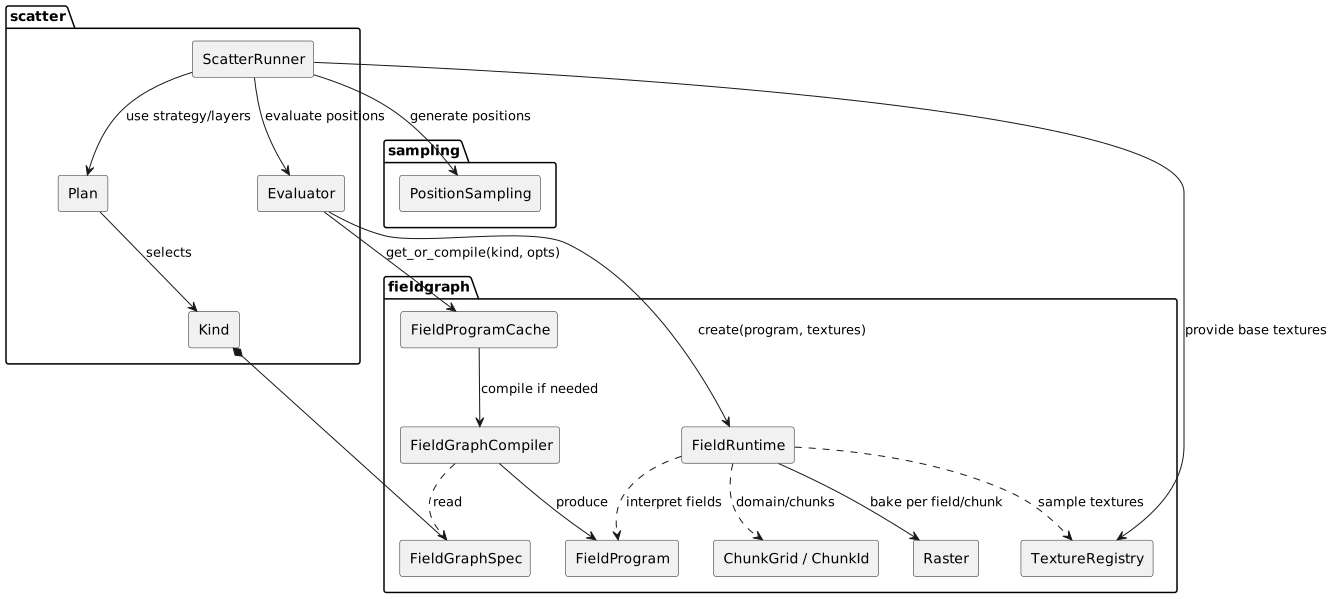
At a glance, the system is organized into three functional areas:
- sampling
- `PositionSampling` - produces candidate positions based on a configured sampling strategy.
- scatter
- `ScatterRunner` - end-to-end orchestration entrypoint.
- `Plan` - bundle of strategy and layer configuration; selects a `Kind`.
- `Kind` - identifies the field-graph specification to be used for a scenario.
- `Evaluator` - resolves/compiles the program and evaluates positions.
- fieldgraph
- `FieldGraphSpec` - declarative description of fields and their relationships.
- `FieldGraphCompiler` - turns a `Spec` into an executable `FieldProgram`.
- `FieldProgram` - compiled representation consumed by the runtime.
- `FieldRuntime` - interprets a `Program` over a spatial domain.
- `TextureRegistry` - provides texture lookups to the runtime.
- `ChunkGrid / ChunkId` - partitions the domain for streaming evaluation.
- `Raster` - per-field, per-chunk baked results.
- `FieldProgramCache` - caches compiled programs keyed by (`Kind`, options).
### Component Diagram
## End-to-End Flow
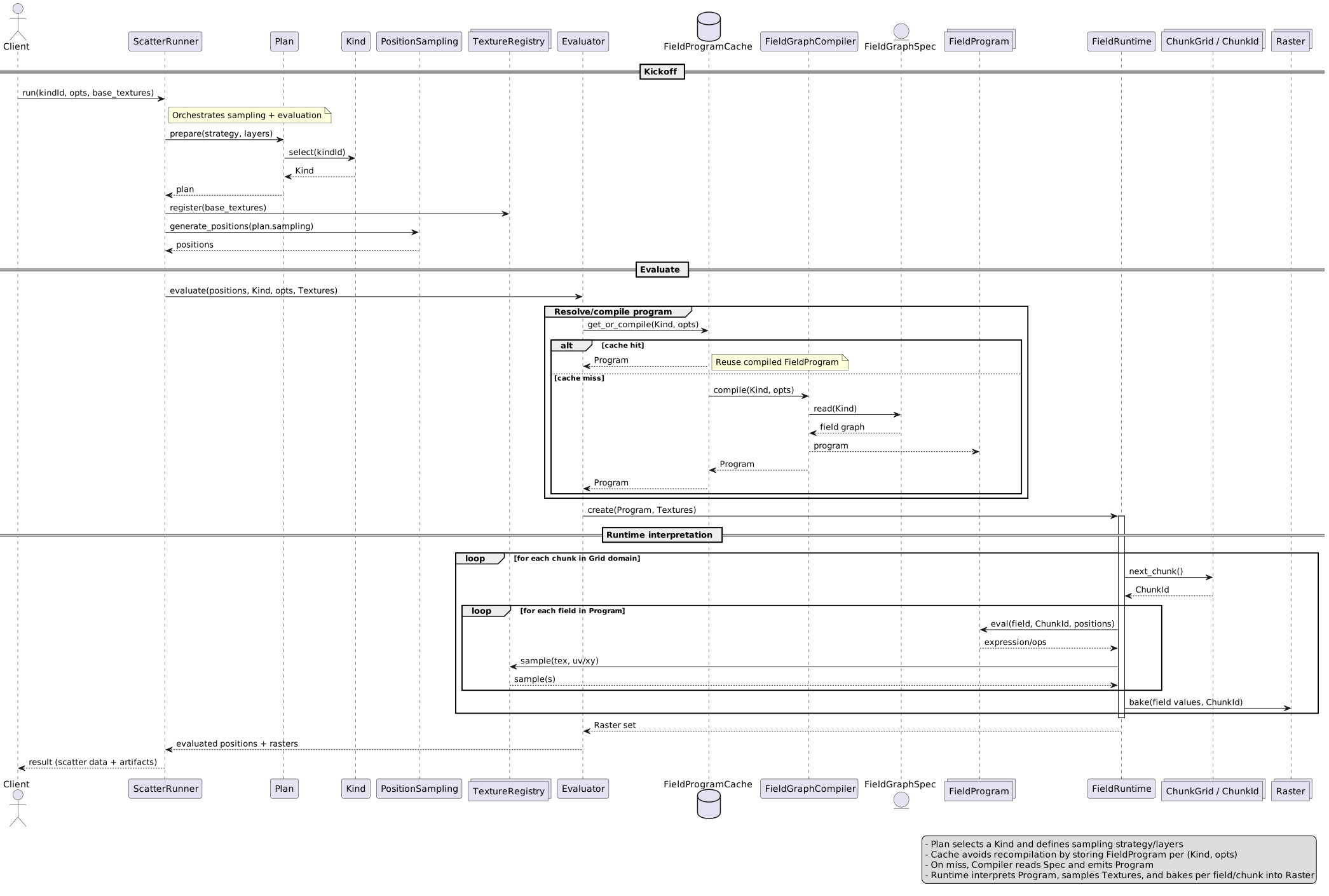
1. Kickoff
- A client asks `ScatterRunner` to run with a `KindId`, options, and base textures.
- `ScatterRunner` builds a `Plan` (strategy + layers), selects the `Kind`, registers textures, and generates positions via `PositionSampling`.
2. Evaluate
- `ScatterRunner` asks `Evaluator` to evaluate the positions using the chosen `Kind` and options.
- The `Evaluator` fetches or compiles a `FieldProgram` using `FieldProgramCache`.
- Cache hit: reuse the existing `Program`.
- Cache miss: `Compiler` reads the `Spec` for the `Kind` and emits a `Program`, which is stored in the cache.
3. Runtime Interpretation
- `Evaluator` creates a `FieldRuntime` with the `Program` and `Textures`.
- The runtime iterates the domain chunk-by-chunk (`ChunkGrid`), evaluates each field in the `Program`, samples textures as needed, and bakes resulting values into `Raster` outputs.
4. Results
- The evaluated positions and associated raster artifacts are returned to the client.
### Sequence Diagram
## Key Responsibilities
- ScatterRunner
- Orchestrates plan preparation, texture registration, position sampling, and evaluation calls.
- Plan
- Encapsulates the sampling configuration and layer strategy; selects a `Kind`.
- Kind
- Identifies which `FieldGraphSpec` to use.
- PositionSampling
- Generates candidate positions from the plan’s sampling configuration.
- Evaluator
- Bridges from positions and `Kind` to runnable `FieldProgram`, managing cache/compile and runtime evaluation.
- FieldProgramCache
- Avoids redundant compilation by caching programs keyed by (`Kind`, options).
- FieldGraphCompiler
- Reads the `FieldGraphSpec` for a `Kind` and emits a `FieldProgram`.
- FieldRuntime
- Interprets the `FieldProgram` over the chunked domain, samples `Textures`, and produces `Raster` data.
- TextureRegistry
- Provides texture access (e.g., by name/handle) for the runtime.
- ChunkGrid / ChunkId
- Defines the spatial tiling of evaluation, enabling streaming and memory-friendly processing.
- Raster
- Holds per-field, per-chunk baked values, useful as artifacts or inputs to downstream steps.
## Data Model: Inputs and Outputs
- Inputs
- `kindId` and evaluation options
- Base textures registered in `TextureRegistry`
- Plan-derived sampling parameters
- Outputs
- Scatter results (positions with evaluated attributes)
- Raster artifacts per field/chunk
## Performance Considerations
- Compilation caching
- `FieldProgramCache` eliminates repeated compile work for the same (`Kind`, options) pair.
- Chunked evaluation
- `ChunkGrid` limits working set size and supports streaming execution across large domains.
- Texture-backed fields
- Texture access is centralized through `TextureRegistry` for efficient reuse and sampling.
## Extensibility
- New Kind or Spec
- Add/extend a `FieldGraphSpec`. The `Compiler` will generate a `FieldProgram` that the runtime can interpret.
- New sampling strategies
- Extend `PositionSampling` and reference it from `Plan`.
- New fields or operations
- Enhance the `Spec` and ensure the `Compiler` and `Runtime` support the corresponding operations.