
Please check the build logs for more information.
See Builds for ideas on how to fix a failed build, or Metadata for how to configure docs.rs builds.
If you believe this is docs.rs' fault, open an issue.
logimesh
logimesh is a Rust microcomponent 2.0 framework inspired by the Towards Modern Development of Cloud Applications paper.
(This is one of my amateur idea and is only developed in leisure-time.)


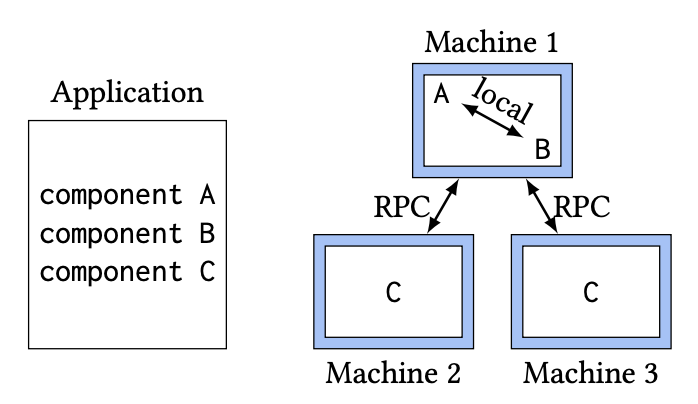
Some features of logimesh:
- The client supports both local calls and remote calls simultaneously, meaning that users can dynamically switch the calling method according to the context.
Usage
Add to your Cargo.toml dependencies:
= "0.1"
The logimesh::component attribute expands to a collection of items that form an component component.
These generated types make it easy and ergonomic to write servers with less boilerplate.
Simply implement the generated component trait, and you're off to the races!
Example
This example uses tokio, so add the following dependencies to
your Cargo.toml:
[]
= "service"
= "src/lib.rs"
...
[]
= "1.0"
= "0.3"
= { = "0.1" }
= { = "1.0", = ["macros"] }
For a more real-world example, see logimesh-example.
First, let's set up the dependencies and component definition.
lib.rs file
# extern crate futures;
use ;
use ;
// This is the component definition. It looks a lot like a trait definition.
// It defines one RPC, hello, which takes one arg, name, and returns a String.
This component definition generates a trait called World. Next we need to
implement it for our Server struct.
# extern crate futures;
# use ;
# use ;
# // This is the component definition. It looks a lot like a trait definition.
# // It defines one RPC, hello, which takes one arg, name, and returns a String.
#
#
/// This is the type that implements the generated World trait. It is the business logic
/// and is used to start the server.
;
server.rs file
use Parser;
use future;
use *;
use Incoming;
use ;
use Json;
use ;
use ;
async
async
client.rs file
use Parser;
use RandomBalance;
use FixedDiscover;
use ConfigExt;
use Endpoint;
use context;
use ;
use SocketAddr;
use Duration;
use sleep;
use Instrument;
async