Context Metadata API
====================
Use the Context Metadata API to define custom counters in your code with
special attributes. You can also get a set of metrics for the collected data
in any classical form of data representation (bandwidth/latency/utilization
metrics) in Intel® VTune™ Profiler.
You can use Context Metadata API to collect counter-based metrics and
attribute these metrics to hardware topology like:
- PCIe devices
- Block devices
- CPU cores
- Threads
**Define and create a counter object**
Use this structure to store context metadata:
.. code-block:: cpp
__itt_context_metadata
{
__itt_context_type type; /*!< Type of the context metadata value */
void* value; /*!< Pointer to context metadata value itself */
}
The structure accepts the following types of context metadata:
+-------------------------------+------------------------------------+-----------------------------------------------+
| __itt_context_type | Value | Description |
+===============================+====================================+===============================================+
| .. code-block:: cpp | ASCII string char* / | The name of the counter-based metric. |
| | Unicode string wchar_t* | This value is required. |
| __itt_context_name | | |
| | | |
+-------------------------------+------------------------------------+-----------------------------------------------+
| .. code-block:: cpp | ASCII string char* / | Statistics subdomain to break down the |
| | Unicode string wchar_t* | counter samples (for example, network port |
| __itt_context_device | | ID, disk partition, etc.) |
| | | |
+-------------------------------+------------------------------------+-----------------------------------------------+
| .. code-block:: cpp | ASCII string char* / | Units of measurement. For measurement of |
| | Unicode string wchar_t* | time, use the ns/us/ms/s units to correct |
| __itt_context_units | | data representation in VTune Profiler. |
| | | |
+-------------------------------+------------------------------------+-----------------------------------------------+
| .. code-block:: cpp | ASCII string char* / | PCI address of device to associate with |
| | Unicode string wchar_t* | the counter. |
| __itt_context_pci_addr | | |
| | | |
+-------------------------------+------------------------------------+-----------------------------------------------+
| .. code-block:: cpp | Unsigned 64-bit integer type | |
| | | Thread ID to associate with the counter. |
| __itt_context_tid | | |
| | | |
+-------------------------------+------------------------------------+-----------------------------------------------+
| .. code-block:: cpp | Unsigned 64-bit integer type (0,1) | If this flag is set to 1, calculate latency |
| | | histogram and counter/sec timeline |
| __itt_context_bandwidth_flag| | distribution. |
| | | |
+-------------------------------+------------------------------------+-----------------------------------------------+
| .. code-block:: cpp | Unsigned 64-bit integer type (0,1) | If this flag is set to 1, calculate the |
| | | throughput histogram and counter/sec |
| __itt_context_latency_flag | | timeline distribution. |
| | | |
+-------------------------------+------------------------------------+-----------------------------------------------+
| .. code-block:: cpp | Unsigned 64-bit integer type (0,1) | If this flag is set to 1, show the counter |
| | | on top of the Thread graph as percentage |
| __itt_context_on_thread_flag| | of the CPU Time distribution. |
| | | |
+-------------------------------+------------------------------------+-----------------------------------------------+
Before you associate context metadata with a counter, make sure to create
an ITT API Domain and ITT API Counter Instances first.
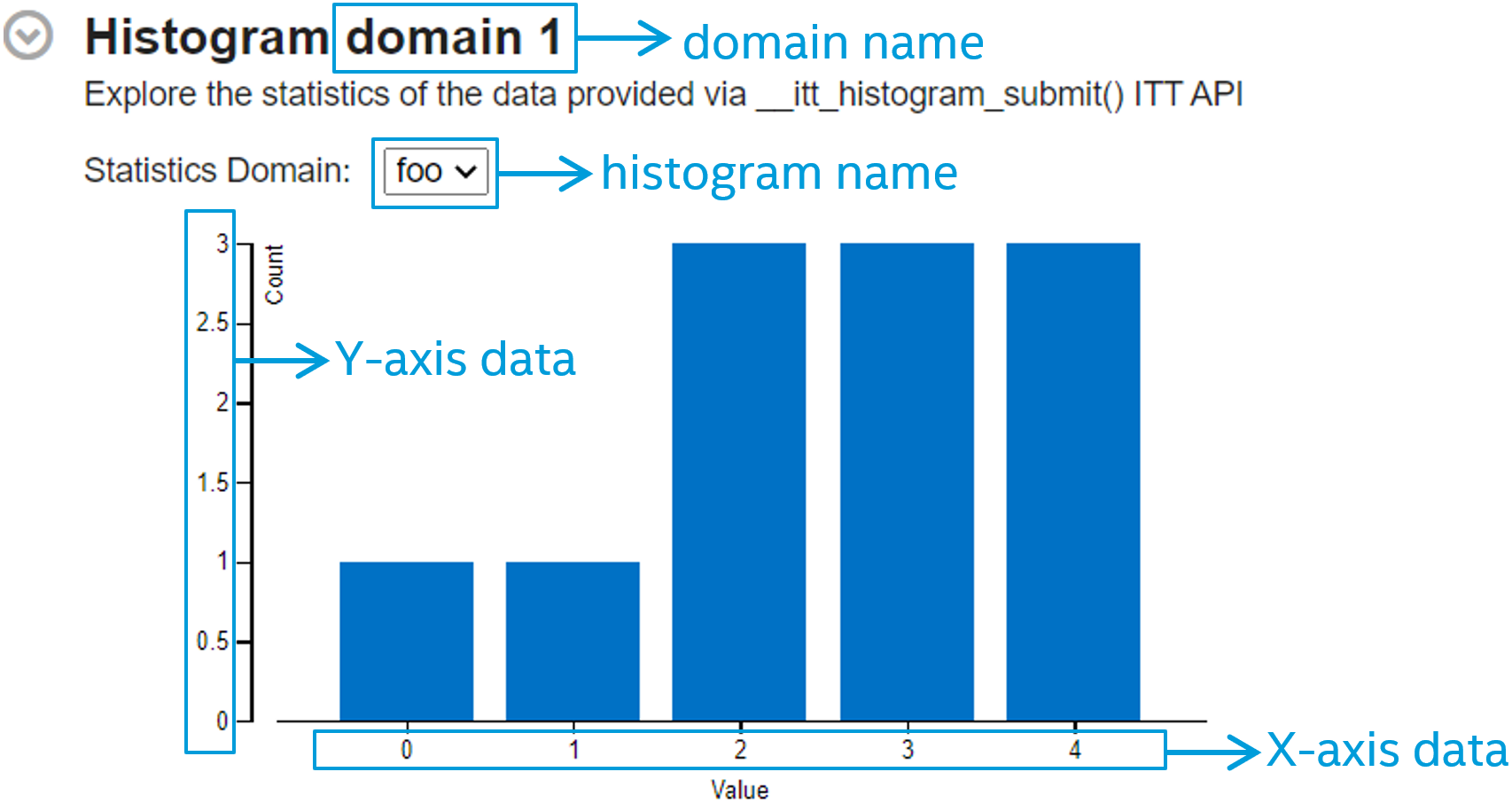
The domain name provides a heading for the section of metrics for the
counters in the results of VTune Profiler. A single domain can combine
data from any number of counters. However, the name of the counters must
be unique within the same domain.
You can combine different counters under a single metric of the Context
Metadata.
**Add context information**
Once you have created all objects, you can add context information for
the selected counters. Use these primitives:
.. code-block:: cpp
__itt_bind_context_metadata_to_counter(
__itt_counter counter, size_t length, __itt_context_metadata* metadata);
**Parameters of the primitive:**
+--------+-------------------------------+-----------------------------------------------------+
| Type | Parameter | Description |
+========+===============================+=====================================================+
| [in] | .. code-block:: cpp | Pointer to the counter instance associated with the |
| | | |
| | __itt_counter counter | context metadata |
+--------+-------------------------------+-----------------------------------------------------+
| [in] | .. code-block:: cpp | Number of elements in the array of context metadata |
| | | |
| | size_t length | |
+--------+-------------------------------+-----------------------------------------------------+
| [in] | .. code-block:: cpp | Pointer to the array of context metadata |
| | | |
| | __itt_context_metadata* | |
| | metadata | |
+--------+-------------------------------+-----------------------------------------------------+
To create counter instances and submit counter data, use:
.. code-block:: cpp
__itt_counter_create_v3(__itt_domain* domain, const char* name, __itt_metadata_type type);
__itt_counter_set_value_v3(__itt_counter counter, void *value_ptr);
Usage Example
-------------
This example creates counters with context metadata that measures random
read operation metrics for an SSD NVMe device:
.. code:: cpp
#include "ittnotify.h"
#include "ittnotify_types.h"
// Create domain and counters:
__itt_domain* domain =
__itt_domain_create("ITT API collected data");
__itt_counter counter_read_op =
__itt_counter_create_v3(domain, "Read Operations", __itt_metadata_u64);
__itt_counter counter_read_mb =
__itt_counter_create_v3(domain, "Read Megabytes", __itt_metadata_u64);
__itt_counter counter_spin_time =
__itt_counter_create_v3(domain, "Spin Time", __itt_metadata_u64);
// Create context metadata:
__itt_context_metadata metadata_read_op[] = {
{__itt_context_name, "Reads"},
{__itt_context_device, "NVMe SSD Intel DC 660p"},
{__itt_context_units, "Operations"},
{__itt_context_pci_addr, "0001:10:00.1"},
{__itt_context_latency_flag, &true_flag}
};
__itt_context_metadata metadata_read_mb[] = {
{__itt_context_name, "Read"},
{__itt_context_device, "NVMe SSD Intel DC 660p"},
{__itt_context_units, "MB"},
{__itt_context_pci_addr, "0001:10:00.1"},
{__itt_context_bandwidth_flag, &true_flag}
};
__itt_context_metadata metadata_spin_time[] = {
{__itt_context_name, "Spin Time"},
{__itt_context_device, "NVMe SSD Intel DC 660p"},
{__itt_context_units, "ms"},
{__itt_context_tid, &thread_id}
};
// Bind context metadata to counters:
__itt_bind_context_metadata_to_counter(counter_read_op, n, metadata_read_op);
__itt_bind_context_metadata_to_counter(counter_read_mb, n, metadata_read_mb);
__itt_bind_context_metadata_to_counter(counter_spin_time, n, metadata_spin_time);
while(1)
{
// Get collected data:
uint64_t read_op = get_user_read_operation_num();
uint64_t read_mb = get_user_read_megabytes_num();
uint64_t spin_time = get_user_spin_time();
// Dump collected data:
__itt_counter_set_value_v3(counter_read_op, &read_op);
__itt_counter_set_value_v3(counter_read_mb, &read_mb);
__itt_counter_set_value_v3(counter_spin_time, &spin_time);
}