# ghpending
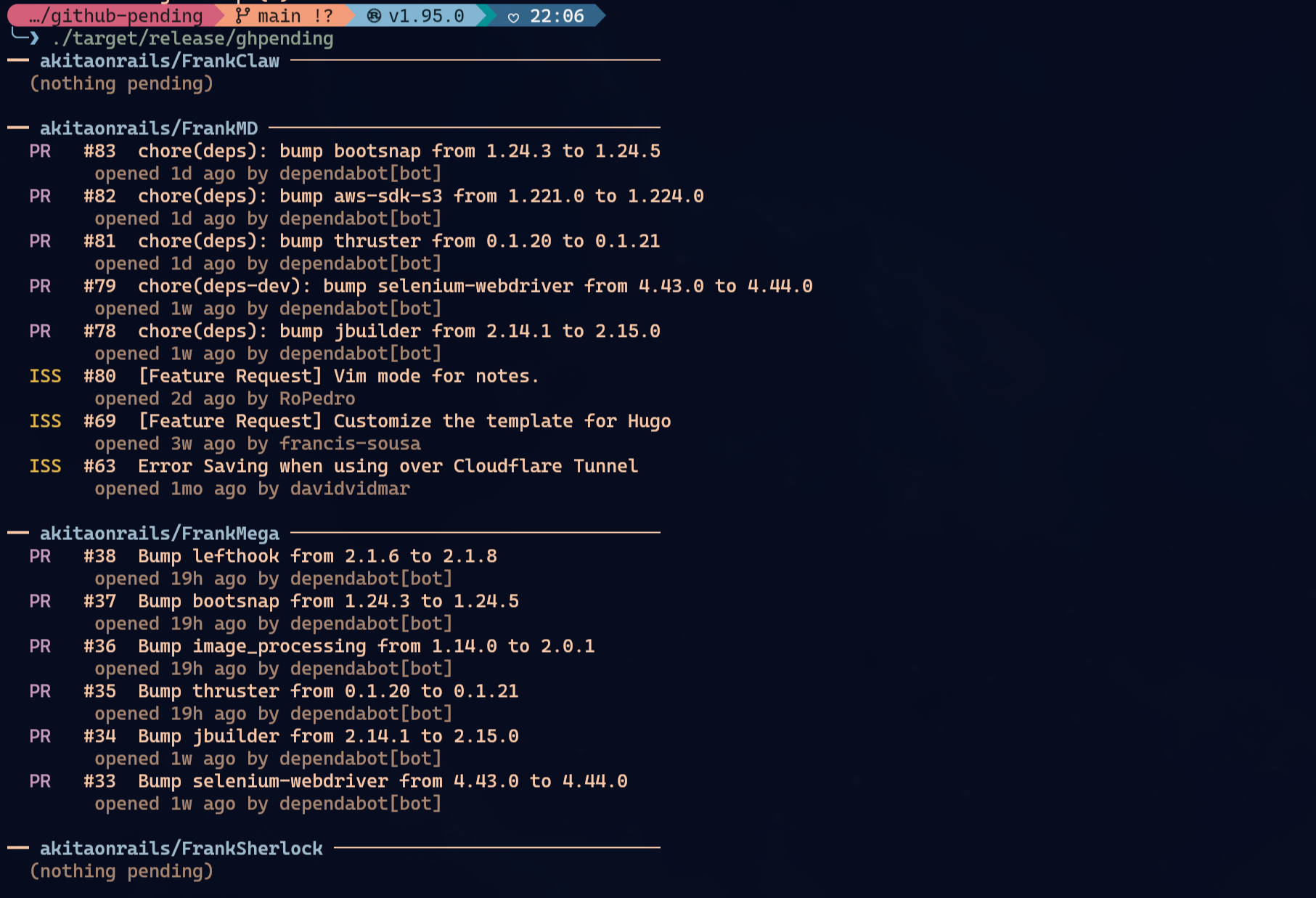
See open issues and pull requests across the GitHub repos you care about, at a glance.
## Install
### Homebrew (macOS / Linux)
```sh
brew tap akitaonrails/tap && brew install ghpending
```
### Arch Linux (AUR)
```sh
yay -S ghpending-bin # prebuilt x86_64 binary, fastest
yay -S ghpending # builds from source, x86_64/aarch64
```
### Cargo
```sh
cargo install ghpending
```
### mise
```sh
mise use -g github:akitaonrails/ghpending
```
### From source
```sh
git clone https://github.com/akitaonrails/ghpending
cargo install --path ghpending
```
## Upgrading
```sh
# Homebrew
brew upgrade ghpending
# AUR (any helper that respects upstream changes)
yay -Syu ghpending-bin
# Cargo
cargo install ghpending --force
# mise
mise upgrade ghpending
# From source
cd ghpending && git pull && cargo install --path .
```
## Usage
```sh
ghpending add # pick repos from the saved user/org to track
ghpending add --user <name> # switch to a different user/org (replaces the saved one)
ghpending add --all # pick from every repo your token can reach (private included)
ghpending # print the digest
ghpending --limit 20 # cap the digest at 20 items, distributed proportionally per repo
ghpending --subscribed # show only issues and PRs you are subscribed to
ghpending --sort count # order repos by open item count instead of activity
ghpending list # show tracked repos
ghpending rm # remove repos from the list
```
- `ghpending add` — lists repos and lets you select which to track. The username is saved so subsequent `add` runs skip the prompt. Pass `--user <name>` to switch to a different user/org without editing the config; it replaces the saved one.
- **Private repos:** with a `GITHUB_TOKEN` that has the `repo` scope, `add` includes private repos automatically when the target is your own account or an org you belong to. For a third-party user only their public repos are visible.
- `--all` lists every repo your token can reach — owned, collaborator and organization-member, private included — in a single picker, ignoring the saved user. Use it to grab private repos you collaborate on across different owners.
- `ghpending` — fetches tracked repos concurrently and prints their open issues and pull requests. Pass `--subscribed` to show only items that the authenticated user is subscribed to. Pass `--limit <count>` to cap the total number of displayed items; each repository receives a proportional share while preserving its existing item order. Pass `--sort <mode>` to control repo order: `activity` (default, most recently updated open item first), `name` (alphabetical, the config-file order), `count` (most open items first) or `stale` (most neglected repo — oldest-updated open item — first). Within each repo, items you authored are de-emphasized and listed below everyone else's — they're waiting on other people, not on you — and marked "by you" instead of your login; other people's items keep full color since those are the ones to act on. Comment counts show up wherever the API provides them and are highlighted when nonzero, so feedback stands out at a glance.
- `ghpending list` — prints the repos currently in your watch list.
- `ghpending rm` — opens an interactive menu to select repos to remove from tracking.
## Forks
Forks are detected automatically — no configuration needed. When a tracked repo turns out to be a fork (e.g. `akitaonrails/omarchy`, forked from `omacom/omarchy`), you almost never care about issues or PRs on the fork itself, so the digest switches to showing the issues and pull requests **you opened on the upstream project** instead: still open, with comment counts and review decisions so you can see if there's feedback waiting. Detection results are cached in the config's `[forks]` table (tracked fork name → upstream name, or an empty string for a confirmed non-fork) so repeat runs don't pay for the extra lookup. Manual edits to that table always win: delete an entry to force re-detection, set it to `""` to opt a fork out of the upstream view (useful for forks you maintain as independent projects), or point it at a different upstream entirely.
## Authentication
`GITHUB_TOKEN` is optional. Without one, public repository access is subject to GitHub's 60 requests/hour limit. Set a token for a 5,000 requests/hour limit, access to private repositories, and faster digests (all repos are fetched in one batched GraphQL request instead of two REST calls each):
```sh
GITHUB_TOKEN=$(gh auth token) ghpending
```
The `--subscribed` filter requires a token because GitHub subscriptions are user-specific:
```sh
GITHUB_TOKEN=$(gh auth token) ghpending --subscribed
```
To include **private** repos, the token needs the `repo` scope (classic) or read access to the repo's Contents, Issues and Pull requests (fine-grained). The token is read silently at startup.
### GitHub API proxy (optional)
If a SOCKS proxy is already listening at `127.0.0.1:9050`, `ghpending` uses it for GitHub API calls and falls back to direct API access when it is not available. You can also force a SOCKS proxy with `GHPENDING_GITHUB_PROXY=socks5h://host:port`; existing `HTTPS_PROXY` / `ALL_PROXY` values are honored when they use `socks5` or `socks5h`.
## Config
The config file lives at:
- Linux: `~/.config/ghpending/config.toml`
- macOS: `~/Library/Application Support/ghpending/config.toml`
Example:
```toml
user = "akitaonrails"
repos = ["ratatui-org/ratatui", "tokio-rs/tokio"]
sort = "name"
```
Run `ghpending add --user <name>` to change the `user` field, or edit the file directly to reorder repos. Set `sort` to `activity`, `name`, `count` or `stale` to change the default repo order without passing `--sort` each time.
## Themes
Pass `--theme nerv` on the command line (any subcommand) or set `theme = "nerv"` in the config file to switch to the NERV interface palette. The older purple-accent Evangelion palette is still available as `evangelion`.
```toml
user = "akitaonrails"
repos = ["ratatui-org/ratatui"]
theme = "nerv"
```
The environment variables `GHPENDING_THEME` (specific) and `TCLOCK_WIDGET_THEME` (generic, set by [tclock](https://github.com/akitaonrails/clock-tui) for its widget subprocesses) are also honored, so running ghpending as a tclock widget follows the clock's theme cycling automatically.
Precedence: `--theme` flag, then `GHPENDING_THEME`, then `TCLOCK_WIDGET_THEME`, then the config file, then `default`. An unknown name in an env var is skipped with a warning; an unknown name in the flag is an error.
## License
MIT