1
2
3
4
5
6
7
8
9
10
11
12
13
14
15
16
17
18
19
20
21
22
23
24
25
26
27
28
29
30
31
32
33
34
35
36
37
38
39
40
41
42
43
44
45
46
47
48
49
50
51
52
53
54
55
56
57
58
59
60
61
62
63
64
65
66
67
68
69
70
71
72
73
74
75
76
77
78
79
80
81
82
83
84
85
86
87
88
89
90
91
92
93
94
95
96
97
98
99
100
101
102
103
104
105
106
107
108
109
110
111
112
113
114
115
116
117
118
119
120
121
122
123
124
125
126
127
128
129
130
131
132
133
134
135
136
137
138
139
140
141
142
143
144
145
146
147
148
149
150
151
152
153
154
155
156
157
158
159
160
161
162
163
164
165
166
167
168
169
170
171
172
173
174
175
176
177
178
179
180
181
182
183
184
185
186
187
188
189
190
191
192
193
194
195
196
197
198
199
200
201
202
203
204
205
206
207
208
209
210
211
212
213
214
215
216
217
218
219
220
221
222
223
224
225
226
227
228
229
230
231
232
233
234
235
236
237
238
239
240
241
242
243
244
245
246
247
248
249
250
251
252
253
254
255
256
257
258
259
260
261
262
263
264
265
266
267
268
269
270
271
272
273
274
275
276
277
278
279
280
281
282
283
284
285
286
287
288
289
290
291
292
293
294
295
296
297
298
299
300
301
302
303
304
305
306
307
308
309
310
311
312
313
314
315
316
317
318
319
320
321
322
323
324
325
326
327
328
329
330
331
332
333
334
335
336
337
338
339
340
341
342
343
344
345
346
347
348
349
350
351
352
353
354
355
356
357
358
359
360
361
362
363
364
365
366
367
368
369
370
371
372
373
374
375
376
377
378
379
380
381
382
383
384
385
386
387
388
389
390
391
392
393
394
395
396
397
398
399
400
401
402
403
404
405
406
407
408
409
410
411
412
413
414
415
416
417
418
419
420
421
422
423
424
425
426
427
428
429
430
431
432
433
434
435
436
437
438
439
440
441
442
443
444
445
//! A fast algebraic expression evaluation library.
//!
//! # Built-in Functions and Constants
//!
//! ```text
//! * print(...strings and values...) -- Prints to stderr. Very useful to 'probe' an expression.
//! Evaluates to the last value.
//! Example: `print("x is", x, "and y is", y)`
//! Example: `x + print("y:",y) + z == x+y+z`
//!
//! * log(base=10, val) -- Logarithm with optional 'base' as first argument.
//! Example: `log(100) + log(e(),100)`
//!
//! * e() -- Euler's number (2.718281828459045)
//! * pi() -- π (3.141592653589793)
//!
//! * int(val)
//! * ceil(val)
//! * floor(val)
//! * round(modulus=1, val) -- Round with optional 'modulus' as first argument.
//! Example: `round(1.23456) == 1 && round(0.001, 1.23456) == 1.235`
//!
//! * abs(val)
//! * sign(val)
//!
//! * min(val, ...) -- Example: `min(1,-2,3,-4) == -4`
//! * max(val, ...) -- Example: `max(1,-2,3,-4) == 3`
//!
//! * sin(radians) * asin(val)
//! * cos(radians) * acos(val)
//! * tan(radians) * atan(val)
//! * sinh(val) * asinh(val)
//! * cosh(val) * acosh(val)
//! * tanh(val) * atanh(val)
//! ```
//!
//! # Examples
//!
//! ## Easy evaluation of constant expressions
//! The `ez_eval()` function performs the entire allocation-parse-eval process
//! for you. It is a little bit inefficient because it always allocates a
//! fresh Slab, but it is very simple to use:
//!
//! ```
//! fn main() -> Result<(), fasteval::Error> {
//! let val = fasteval::ez_eval(
//! "1+2*3/4^5%6 + log(100) + log(e(),100) + [3*(3-3)/3] + (2<3) && 1.23", &mut fasteval::EmptyNamespace)?;
//! // | | | | | | |
//! // | | | | | | boolean logic with ternary support
//! // | | | | | comparisons
//! // | | | | square-brackets act like parenthesis
//! // | | | built-in constants: e(), pi()
//! // | | 'log' can take an optional first 'base' argument, defaults to 10
//! // | many built-in functions: print, int, ceil, floor, abs, sign, log, round, min, max, sin, asin, ...
//! // standard binary operators
//!
//! assert_eq!(val, 1.23);
//!
//! Ok(())
//! }
//! ```
//!
//!
//! ## Simple variables
//! Several namespace types are supported, each designed for different
//! situations. ([See the various Namespace types here.](evalns/index.html)) For simple cases, you can define variables with a `BTreeMap`:
//!
//! ```
//! use std::collections::BTreeMap;
//! fn main() -> Result<(), fasteval::Error> {
//! let mut map : BTreeMap<String,f64> = BTreeMap::new();
//! map.insert("x".to_string(), 1.0);
//! map.insert("y".to_string(), 2.0);
//! map.insert("z".to_string(), 3.0);
//!
//! let val = fasteval::ez_eval(r#"x + print("y:",y) + z"#, &mut map)?;
//! // |
//! // prints "y: 2" to stderr and then evaluates to 2.0
//!
//! assert_eq!(val, 6.0);
//!
//! Ok(())
//! }
//! ```
//!
//! ## Advanced variables and custom functions
//! This time, instead of using a map, we will use a namespace with a callback
//! function, which enables us to do advanced things, like define custom
//! functions and array-like objects:
//!
//! ```
//! fn main() -> Result<(), fasteval::Error> {
//! let mut ns = fasteval::CachedFlatNamespace::new(|name:&str, args:Vec<f64>| -> Option<f64> {
//! let mydata : [f64; 3] = [11.1, 22.2, 33.3];
//! match name {
//! "x" => Some(3.0),
//! "y" => Some(4.0),
//! "sum" => Some(args.into_iter().fold(0.0, |s,f| s+f)),
//! "data" => args.get(0).and_then(|f| mydata.get(*f as usize).copied()),
//! _ => None,
//! }
//! });
//!
//! let val = fasteval::ez_eval("sum(x^2, y^2)^0.5 + data[0]", &mut ns)?;
//! // | | |
//! // | | square-brackets act like parenthesis
//! // | variables are like custom functions with zero args
//! // custom function
//!
//! assert_eq!(val, 16.1);
//!
//! Ok(())
//! }
//! ```
//!
//! ## Re-use the Slab to go faster
//! If we perform the parse and eval ourselves (without relying on the 'ez'
//! interface), then we can re-use the Slab allocation for subsequent parsing
//! and evaluations. This avoids a significant amount of slow memory
//! operations:
//!
//! ```
//! use std::collections::BTreeMap;
//! use fasteval::Evaler; // import this trait so we can call eval().
//! fn main() -> Result<(), fasteval::Error> {
//! let mut slab = fasteval::Slab::new();
//!
//! let expr_ref = fasteval::parse("x + 1", &mut slab.ps)?.from(&slab.ps);
//!
//! // Let's evaluate the expression a couple times with different 'x' values:
//!
//! let mut map : BTreeMap<String,f64> = BTreeMap::new();
//! map.insert("x".to_string(), 1.0);
//! let val = expr_ref.eval(&slab, &mut map)?;
//! assert_eq!(val, 2.0);
//!
//! map.insert("x".to_string(), 2.5);
//! let val = expr_ref.eval(&slab, &mut map)?;
//! assert_eq!(val, 3.5);
//!
//! // Now, let's re-use the Slab for a new expression.
//! // (This is much cheaper than allocating a new Slab.)
//!
//! slab.clear();
//! let expr_ref = fasteval::parse("x * 10", &mut slab.ps)?.from(&slab.ps);
//!
//! let val = expr_ref.eval(&slab, &mut map)?;
//! assert_eq!(val, 25.0);
//!
//! Ok(())
//! }
//! ```
//!
//! ## Compile to go super fast!
//! If you plan to evaluate an expression just one or two times, then you
//! should parse-eval as shown in previous examples. But if you expect to
//! evaluate an expression three or more times, you can dramatically improve
//! your performance by compiling. The compiled form is usually more than 10
//! times faster than the un-compiled form, and for constant expressions it is
//! usually more than 200 times faster.
//! ```
//! use std::collections::BTreeMap;
//! use fasteval::Compiler; // import this trait so we can call compile().
//! use fasteval::Evaler; // import this trait so we can call eval().
//! fn main() -> Result<(), fasteval::Error> {
//! let mut slab = fasteval::Slab::new();
//! let mut map = BTreeMap::new();
//!
//! let expr_str = "sin(deg/360 * 2*pi())";
//! let compiled = fasteval::parse(expr_str, &mut slab.ps)?.from(&slab.ps).compile(&slab.ps, &mut slab.cs);
//! for deg in 0..360 {
//! map.insert("deg".to_string(), deg as f64);
//! // When working with compiled constant expressions, you can use the
//! // eval_compiled*!() macros to save a function call:
//! let val = fasteval::eval_compiled!(compiled, &slab, &mut map);
//! eprintln!("sin({}°) = {}", deg, val);
//! }
//!
//! Ok(())
//! }
//! ```
//!
//! ## Unsafe Variables
//! If your variables *must* be as fast as possible and you are willing to be
//! very careful, you can build with the `unsafe-vars` feature (`cargo build
//! --features unsafe-vars`), which enables pointer-based variables. These
//! unsafe variables perform 2x-4x faster than the compiled form above. This
//! feature is not enabled by default because it slightly slows down other
//! non-variable operations.
//! ```
//! use fasteval::Compiler; // import this trait so we can call compile().
//! use fasteval::Evaler; // import this trait so we can call eval().
//! fn main() -> Result<(), fasteval::Error> {
//! let mut slab = fasteval::Slab::new();
//! let mut deg : f64 = 0.0;
//! unsafe { slab.ps.add_unsafe_var("deg".to_string(), °); } // Saves a pointer to 'deg'.
//!
//! let mut ns = fasteval::EmptyNamespace; // We only define unsafe variables, not normal variables,
//! // so EmptyNamespace is fine.
//!
//! let expr_str = "sin(deg/360 * 2*pi())";
//! let compiled = fasteval::parse(expr_str, &mut slab.ps)?.from(&slab.ps).compile(&slab.ps, &mut slab.cs);
//! for d in 0..360 {
//! deg = d as f64;
//! let val = fasteval::eval_compiled!(compiled, &slab, &mut ns);
//! eprintln!("sin({}°) = {}", deg, val);
//! }
//!
//! Ok(())
//! }
//! ```
//!
//!
//! # Performance Benchmarks
//!
//! These benchmarks were performed on 2019-12-25.
//!
//! Here are links to all the libraries/tools included in these benchmarks:
//!
//! * [fasteval (this library)](https://github.com/likebike/fasteval)
//! * [caldyn](https://github.com/Luthaf/caldyn)
//! * [rsc](https://github.com/codemessiah/rsc)
//! * [meval](https://github.com/rekka/meval-rs)
//! * [calc](https://github.com/redox-os/calc/tree/master/src)
//! * [tinyexpr (Rust)](https://github.com/kondrak/tinyexpr-rs)
//! * [tinyexpr (C)](https://github.com/codeplea/tinyexpr)
//! * [bc](https://www.gnu.org/software/bc/)
//! * [python3](https://www.python.org/)
//!
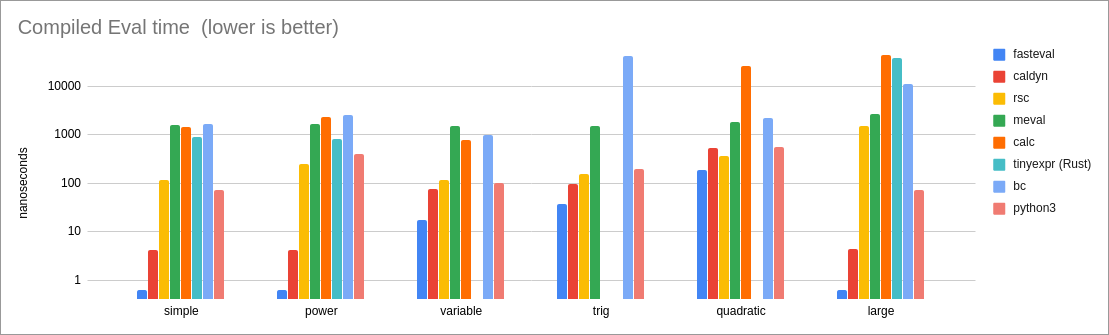
//! ## Charts
//! Note that the following charts use logarithmic scales. Therefore, tiny
//! visual differences actually represent very significant performance
//! differences.
//!
//!
//! **Performance of evaluation of a compiled expression:**
//! 
//!
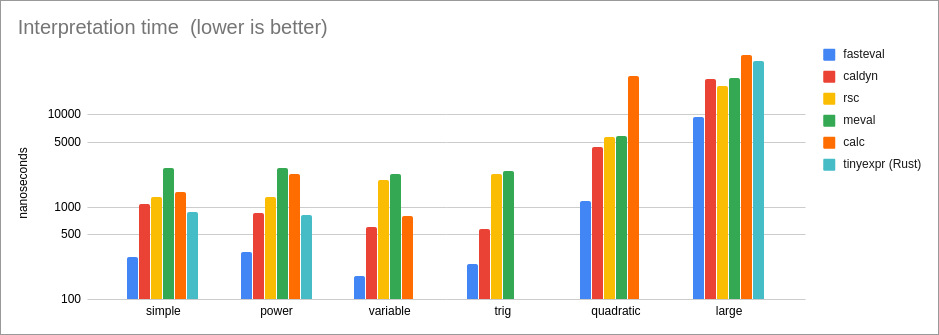
//! **Performance of one-time interpretation (parse and eval):**
//! 
//!
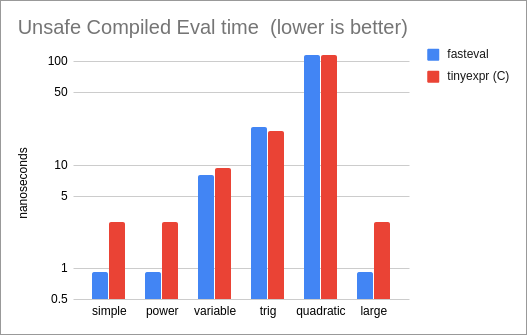
//! **Performance of compiled Unsafe Variables, compared to the tinyexpr C library (the
//! only other library in our test set that supports this mode):**
//! 
//!
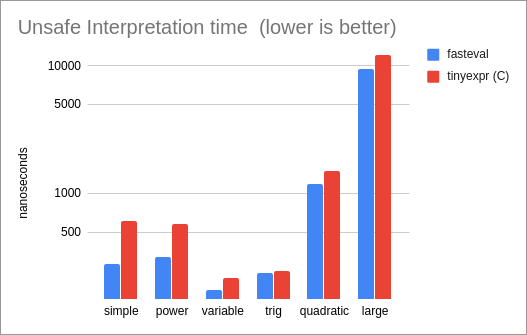
//! **Performance of interpreted Unsafe Variables, compared to the tinyexpr C library (the
//! only other library in our test set that supports this mode):**
//! 
//!
//! ## Summary
//!
//! The impressive thing about these results is that 'fasteval' consistently
//! achieves the fastest times across every benchmark and in every mode of
//! operation (interpreted, compiled, and unsafe). It's easy to create a
//! design to claim the #1 spot in any one of these metrics by sacrificing
//! performance in another, but it is difficult to create a design that can be
//! #1 across-the-board.
//!
//! Because of the broad and robust performance advantages, 'fasteval' is very
//! likely to be an excellent choice for your dynamic evaluation needs.
//!
//! ## Benchmark Descriptions & Analysis
//! ```text
//! * simple = `3 * 3 - 3 / 3`
//! This is a simple test with primitive binary operators.
//! Since the expression is quite simple, it does a good job of showing
//! the intrinsic performance costs of a library.
//! Results:
//! * For compiled expressions, 'fasteval' is 6x as fast as the closest
//! competitor (caldyn) because the `eval_compiled!()` macro is able to
//! eliminate all function calls. If the macro is not used and a
//! normal `expr.eval()` function call is performed instead, then
//! performance is very similar to caldyn's.
//! * For interpreted expressions, 'fasteval' is 2x as fast as the
//! tinyexpr C lib, and 3x as fast as the tinyexpr Rust lib.
//! This is because 'fasteval' eliminates redundant work and memory
//! allocation during the parse phase.
//!
//! * power = `2 ^ 3 ^ 4`
//! `2 ^ (3 ^ 4)` for 'tinyexpr' and 'rsc'
//! This test shows the associativity of the exponent operator.
//! Most libraries (including 'fasteval') use right-associativity,
//! but some libraries (particularly tinyexpr and rsc) use
//! left-associativity.
//! This test is also interesting because it shows the precision of a
//! library's number system. 'fasteval' just uses f64 and therefore truncates
//! the result (2417851639229258300000000), while python, bc, and the
//! tinyexpr C library produce a higher precision result
//! (2417851639229258349412352).
//! Results:
//! Same as the 'simple' case.
//!
//! * variable = `x * 2`
//! This is a simple test of variable support.
//! Since the expression is quite simple, it shows the intrinsic
//! performance costs of a library's variables.
//! Results:
//! * The tinyexpr Rust library does not currently support variables.
//! * For safe compiled evaluation, 'fasteval' is 4.4x as fast as the closest
//! competitor (caldyn).
//! * For safe interpretation, 'fasteval' is 3.3x as fast as the closest
//! competitor (caldyn).
//! * For unsafe variables, 'fasteval' is 1.2x as fast as the
//! tinyexpr C library.
//!
//! * trig = `sin(x)`
//! This is a test of variables, built-in function calls, and trigonometry.
//! Results:
//! * The tinyexpr Rust library does not currently support variables.
//! * The 'calc' library does not support trigonometry.
//! * For safe compiled evaluation, 'fasteval' is 2.6x as fast as the
//! closest competitor (caldyn).
//! * For safe interpretation, 'fasteval' is 2.3x as fast as the closest
//! competitor (caldyn).
//! * Comparing unsafe variables with the tinyexpr C library,
//! 'fasteval' is 8% slower for compiled expressions (tinyexpr uses a
//! faster 'sin' implementation) and 4% faster for interpreted
//! expressions ('fasteval' performs less memory allocation).
//!
//! * quadratic = `(-z + (z^2 - 4*x*y)^0.5) / (2*x)`
//! This test demonstrates a more complex expression, involving several
//! variables, some of which are accessed more than once.
//! Results:
//! * The tinyexpr Rust library does not currently support variables.
//! * For safe compiled evaluation, 'fasteval' is 2x as fast as the
//! closest competitor (rsc).
//! * For safe interpretation, 'fasteval' is 3.7x as fast as the
//! closest competitor (caldyn).
//! * Comparing unsafe variables with the tinyexpr C library,
//! 'fasteval' is the same speed for compiled expressions,
//! and 1.2x as fast for interpretation.
//!
//! * big = `((((87))) - 73) + (97 + (((15 / 55 * ((31)) + 35))) + (15 - (9)) - (39 / 26) / 20 / 91 + 27 / (33 * 26 + 28 - (7) / 10 + 66 * 6) + 60 / 35 - ((29) - (69) / 44 / (92)) / (89) + 2 + 87 / 47 * ((2)) * 83 / 98 * 42 / (((67)) * ((97))) / (34 / 89 + 77) - 29 + 70 * (20)) + ((((((92))) + 23 * (98) / (95) + (((99) * (41))) + (5 + 41) + 10) - (36) / (6 + 80 * 52 + (90))))`
//! This is a fairly large expression that highlights parsing costs.
//! Results:
//! * Since there are no variables in the expression, 'fasteval' and
//! 'caldyn' compile this down to a single constant value. That's
//! why these two libraries are so much faster than the rest.
//! * For compiled evaluation, 'fasteval' is 6x as fast as 'caldyn'
//! because it is able to eliminate function calls with the
//! `eval_compiled!()` macro.
//! * For interpretation, 'fasteval' is 2x as fast as the closest
//! competitor (rsc).
//! * Comparing unsafe variables with the tinyexpr C library,
//! 'fasteval' is 3x as fast for compiled evaluation, and
//! 1.2x as fast for interpretation.
//! ```
//!
//! ## Methodology
//! I am running Ubuntu 18.04 on an Asus G55V (a 2012 laptop with Intel Core i7-3610QM CPU @ 2.3GHz - 3.3GHz).
//!
//! All numeric results can be found in `fasteval/benches/bench.rs`.
//!
//! ### Disable Power Saving Mode
//!
//! for F in /sys/devices/system/cpu/cpufreq/policy*/scaling_governor; do echo $F; cat $F; done
//! for F in /sys/devices/system/cpu/cpufreq/policy*/scaling_governor; do echo performance >$F; done
//!
//! ### Always Use `RUSTFLAGS="--emit=asm"`
//! For some reason which I have been unable to find any documentation about, the emission of assembly code during compilation causes LLVM to dramatically improve the optimization of the resulting binary (often a 3x difference for critical sections!). In particular, it makes better choices regarding variable localization and function inlining. I suggest that you *always* use this option for everything you do.
//!
//! ### Layout Randomization
//! I use a poor-man's Layout Randomization method similar to [Coz](https://www.youtube.com/watch?v=r-TLSBdHe1A). The size and location of your code has significant impact on its performance. The compiler often makes poor decisions about code placement, which results in up to 40% performance differences! When benchmarking, it is important to remove this source of noise so that you can see the real effects of your changes.
//!
//! Rather than using [Coz](https://github.com/alexcrichton/coz-rs), I use a poor-man's approach which has no dependencies and works across languages: During each iteration of my benchmark loop, I inject a random number of no-op instructions into my benchmark code (using 'sed'). This shifts everything around in the address space so that I end up hitting all fast and slow scenarios.
//!
//! I then run the benchmark loop many times, keeping track of the fastest-seen times until I no longer observe any improvements in any part of the banchmark suite for 500 seconds. At that point, I say that I have reached a stable point and can draw conclusions from the statistics.
//!
//! Here is my benchmark loop, which performs Layout Randomization:
//!
//! ```text
//! while true; do echo "time: $(date +%s)"; cat benches/bench.rs.tmpl | sed "s|//SHIFT_CODE|$( N=$(( 1 + $RANDOM % 1024 )); while [[ $N > 0 ]]; do N=$(( $N - 1 )); echo -n 'let x=black_box(x+1);'; done )|g" >benches/bench.rs; RUSTFLAGS="--emit=asm" cargo bench; done >bench.out
//! ```
//!
//! I monitor the results with this:
//!
//! ```text
//! cat bench.out | awk -v "now=$(date +%s)" '$1=="time:"{when=$2} $3=="..." && $4=="bench:" {gsub(/,/, "", $5); v=$5+0; if (t[$2]=="" || v<t[$2]){t[$2]=v; w[$2]=when;}} END{for (k in t) { printf "%-40s %9d ns/iter %5ds ago\n",k,t[k],now-w[k] }}' | sort
//! ```
//!
//! # How is `fasteval` so fast?
//!
//! A variety of techniques are used to optimize performance:
//! * Minimization of memory allocations/deallocations;
//! I just pre-allocate a large slab during initialization.
//! * Elimination of redundant work, especially when parsing.
//! * Compilation: Constant Folding and Expression Simplification.
//! Boosts performance up to 1000x.
//! * Profile-driven application of inlining. Don't inline too much or too little.
//! * Use of macros to eliminate call overhead for the most-frequently-used
//! functions. (Macros are often more efficient than inlined functions.)
//! * Don't `panic!()`. If *anything* in your code can panic, then much code
//! must be run on every function call to handle stack unwinding.
//! * Localize variables. Use "--emit asm" as a guide.
//!
//! # Can `fasteval` be faster?
//!
//! Yes, but not easily, and not by much.
//!
//! To boost the 'eval' phase, we would really need to perform compilation to
//! machine code, which is difficult and non-portable across platforms. Also,
//! the potential gains are limited: We already run at
//! half-the-speed-of-compiled-optimized-Rust for constant expressions (the
//! most common case). So for constant expressions, the most you could gain
//! from compilation-to-machine-code is a 2x performance boost. We are already
//! operating close to the theoretical limit!
//!
//! It is possible to perform faster evaluation of non-constant expressions by
//! introducing more constraints or complexity:
//! * If I introduce a 'const' var type, then I can transform variable
//! expressions into constant expressions. I don't think this would be
//! useful-enough in real-life to justify the extra complexity.
//! * Evaluation could be paralellized (with a more complex design).
//!
//! It is possible to boost overall speed by improving the parsing algoritm
//! to produce a Reverse Polish Notation AST directly, rather than the currennt
//! infix AST which is then converted to RPN during compilation. However, this
//! isn't as simple as just copying the Shunting-Yard algorithm because I
//! support more advanced (and customizable) syntax (such as function calls and
//! strings), while Shunting-Yard is designed only for algebraic expressions.
//#![warn(missing_docs)]
pub use Error;
pub use ;
pub use ;
pub use IUnsafeVar;
pub use Evaler;
pub use Slab;
pub use ;
pub use ez_eval;