cadrum
Rust CAD library powered by statically linked, headless OpenCASCADE (OCCT 8.0.0) — runs natively and in the browser via WebAssembly.



What is cadrum
cadrum is a Rust library for building parametric 3D CAD models. It is
designed to be a clean, scriptable foundation for scientific and engineering
work — short, deterministic Rust programs that produce high-quality solid
geometry.
cadrum has several goals:
- Parametric and scriptable. Models are ordinary Rust values, so
dimensions and topology are driven by code, not a GUI.
- Single-binary redistribution. cadrum ships statically linkable
OpenCASCADE binaries, so a build links OCCT in with no system install and
redistributes as one self-contained binary.
- Runs in the browser. cadrum also ships a static OpenCASCADE build for
the
wasm32-unknown-unknown target, making it well suited to running what
you build directly in the browser via WebAssembly.
Live demo — STEP → glTF converted entirely in-browser (source).
- Fully headless. No GUI, no windowing, no OS-specific dependencies —
cadrum is pure geometry and I/O, suitable for servers, CI, and wasm.
- Major formats in and out. Reads and writes STEP and BRep,
and exports glTF (
.glb), STL, and PNG — so models flow into CAD
tools, web / three.js viewers, 3D printers, and docs.
Build
Add this to your Cargo.toml:
[dependencies]
cadrum = "^0.8"
cargo build automatically downloads a prebuilt OCCT 8.0.0 binary for these targets:
|
Target |
Prebuilt OCCT |
 |
x86_64-unknown-linux-gnu |
✅ |
|
aarch64-unknown-linux-gnu |
✅ |
 |
x86_64-pc-windows-msvc |
✅ |
|
x86_64-pc-windows-gnu |
✅ |
 |
aarch64-apple-darwin |
✅ |
|
x86_64-apple-darwin |
✅ |
 |
wasm32-unknown-unknown |
✅ (build in Docker) |
Native targets build with a plain cargo build — no system OpenCASCADE install,
no C++ toolchain setup. wasm32-unknown-unknown additionally needs a wasi-sdk
C/C++ toolchain to compile cadrum's OCCT wrapper, so build it in Docker (below).
Building for wasm32-unknown-unknown
We ship the wasi-sdk toolchain as a ready-to-use Docker image,
ghcr.io/lzpel/cross-wasm32-unknown-unknown (built from
docker/Dockerfile_wasm32-unknown-unknown)
— so you don't install wasi-sdk locally. Mount your project and build as usual:
docker run --rm -v "$PWD":/work -w /work ghcr.io/lzpel/cross-wasm32-unknown-unknown cargo build --release
The image cross-compiles to wasm32-unknown-unknown by default; you get a .wasm
from a binary or a crate-type = ["cdylib"] crate (a plain lib produces an .rlib).
Code requirement: run cadrum's wasm init once at startup, before the first cadrum
call (e.g. from a #[wasm_bindgen(start)] function) — otherwise OCCT's C++ constructors
never run and the call traps:
cadrum::__anchor_wasi_stub();
unsafe extern "C" {
    fn __wasm_call_ctors();
}
unsafe { __wasm_call_ctors() };
Then run the output through wasm-bindgen / wasm-pack for browser glue. See
opencascade-wasm32-unknown-unknown-example for a complete setup.
Runtime requirement: the module is built with Wasm exception handling
(-fwasm-exceptions, the legacy encoding), so it needs a runtime that supports the
Wasm exception-handling proposal — any current browser, or Node (no
--experimental-wasm-exnref flag required).
Building for other targets
For a target without a prebuilt OCCT, build OCCT from source:
OCCT_ROOT=/path/to/occt cargo build --features source
If OCCT_ROOT is unset, the source build is cached under target/. Requires a
C++17 compiler (GCC, Clang, or MSVC) and CMake.
Capabilities
| Area |
Methods |
| Primitives |
Solid::cube, Solid::sphere, Solid::cylinder, Solid::cone, Solid::torus, Solid::half_space |
| Curves |
Edge::line, Edge::arc_3pts, Edge::circle, Edge::polygon, Edge::helix, Edge::bspline |
| Surfacing |
Solid::extrude, Solid::sweep, Solid::loft, Solid::bspline |
| Editing |
Solid::shell, Solid::fillet_edges, Solid::chamfer_edges, Solid::clean |
| Queries |
Solid::volume, Solid::area, Solid::center, Solid::inertia, Solid::bounding_box, Solid::contains |
| Topology |
Solid::iter_face, Solid::iter_edge, Face::iter_edge, Face::project, Edge::project |
| Identity / history |
Solid::id, Face::id, Edge::id, Solid::iter_history |
| I/O |
Solid::read_step / Solid::write_step, Solid::read_brep / Solid::write_brep (BRep = OCCT's BinTools binary format) |
| Mesh |
Solid::mesh → Mesh, Mesh::write_stl, Mesh::write_gltf_binary, Mesh::scene → Scene2D, Scene2D::write_svg, Scene2D::write_png (png), Solid::write_multiview_png (png) |
Color (feature color) |
per-face and per-solid color preserved across STEP / BRep / STL / glTF / SVG round-trips |
Features
color (default): Enables Solid::color and colormap propagation
through STEP / BRep / STL / glTF / SVG I/O via OCCT's XDE document model.
Disable for a smaller binary if shape color is irrelevant.png (default): PNG raster output — Scene2D::write_png and
Solid::write_multiview_png — via the pure-Rust tiny-skia rasterizer.
Disable to drop the tiny-skia dependency when SVG / STL / glTF output is
enough.source: Build OCCT from upstream sources with CMake instead of
downloading a prebuilt tarball. Off by default — most users use the
prebuilt path. Enable it for targets that have no published prebuilt.
Examples
Primitives
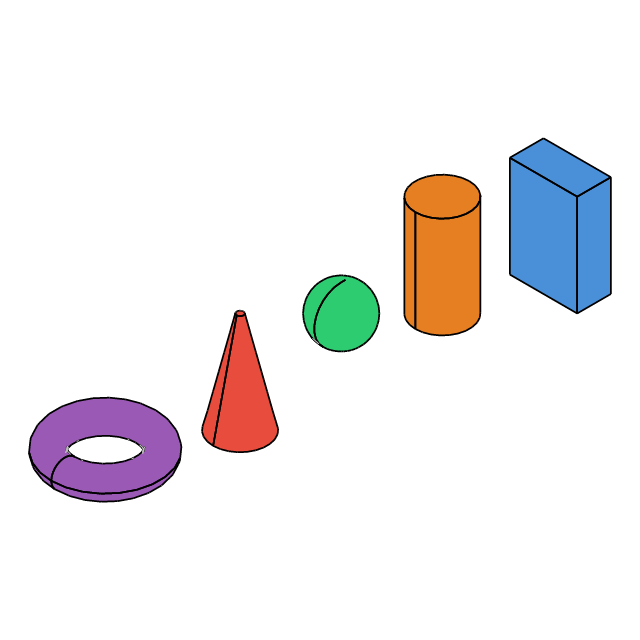
Primitive solids: box, cylinder, sphere, cone, torus — colored and exported as STEP + SVG.
cargo run --example 01_primitives
use cadrum::{DVec3, Solid};
fn main() -> Result<(), cadrum::Error> {
let example_name = std::path::Path::new(file!()).file_stem().unwrap().to_str().unwrap();
let solids = [Solid::cube(DVec3::ZERO, DVec3::new(10.0, 20.0, 30.0)).color("#4a90d9"), Solid::cylinder(8.0, DVec3::Z * 30.0).translate(DVec3::X * 30.0).color("#e67e22"), Solid::sphere(8.0).translate(DVec3::X * 60.0 + DVec3::Z * 15.0).color("#2ecc71"), Solid::cone(8.0, 1.0, DVec3::Z * 30.0).translate(DVec3::X * 90.0).color("#e74c3c"), Solid::torus(12.0, 4.0, DVec3::Z).translate(DVec3::X * 130.0 + DVec3::Z * 15.0).color("#9b59b6")];
Solid::write_step(&solids, &mut std::fs::File::create(format!("{example_name}.step")).unwrap())?;
let mesh = Solid::mesh(&solids, Default::default())?;
let scene = mesh.scene(Default::default());
scene.write_svg(&mut std::fs::File::create(format!("{example_name}.svg")).unwrap())?;
scene.write_png([640, 640], &mut std::fs::File::create(format!("{example_name}.png")).unwrap())?;
mesh.write_stl(&mut std::fs::File::create(format!("{example_name}.stl")).unwrap())?;
mesh.write_gltf_binary(&mut std::fs::File::create(format!("{example_name}.glb")).unwrap())?;
println!("wrote {example_name}.step / {example_name}.svg / {example_name}.png");
Ok(())
}
Output: 01_primitives.png | 01_primitives.step | 01_primitives.glb | 01_primitives.stl | 01_primitives.svg
Write read
Read and write: chain STEP and BRep round-trips with progressive rotation.
cargo run --example 02_write_read
use cadrum::{DVec3, Solid};
use std::f64::consts::FRAC_PI_8;
fn main() -> Result<(), cadrum::Error> {
let example_name = std::path::Path::new(file!()).file_stem().unwrap().to_str().unwrap();
let step_path = format!("{example_name}.step");
let brep_path = format!("{example_name}.brep");
let manifest_dir = env!("CARGO_MANIFEST_DIR");
let original = Solid::read_step(&mut std::fs::File::open(format!("{manifest_dir}/steps/colored_box.step")).expect("open file"))?;
let a_written: Vec<Solid> = original.clone().into_iter().map(|s| s.rotate_x(FRAC_PI_8)).collect();
Solid::write_step(&a_written, &mut std::fs::File::create(&step_path).expect("create file"))?;
let a = Solid::read_step(&mut std::fs::File::open(&step_path).expect("open file"))?;
let b_written: Vec<Solid> = a.clone().into_iter().map(|s| s.rotate_x(FRAC_PI_8)).collect();
Solid::write_brep(&b_written, &mut std::fs::File::create(&brep_path).expect("create file"))?;
let b = Solid::read_brep(&mut std::fs::File::open(&brep_path).expect("open file"))?;
let [min, max] = original[0].bounding_box();
let spacing = (max - min).length() * 1.5;
let all: Vec<Solid> = [original, a, b].into_iter().enumerate().flat_map(|(i, solids)| solids.into_iter().map(move |s| s.translate(DVec3::X * spacing * i as f64))).collect();
let mesh = Solid::mesh(&all, Default::default())?;
let scene = mesh.scene(cadrum::SceneOption { view: DVec3::new(1.0, 1.0, 2.0), ..Default::default() });
scene.write_svg(&mut std::fs::File::create(format!("{example_name}.svg")).unwrap())?;
scene.write_png([640, 640], &mut std::fs::File::create(format!("{example_name}.png")).unwrap())?;
mesh.write_stl(&mut std::fs::File::create(format!("{example_name}.stl")).unwrap())?;
mesh.write_gltf_binary(&mut std::fs::File::create(format!("{example_name}.glb")).unwrap())?;
let stl_path = format!("{example_name}.stl");
for (label, path) in [("STEP", &step_path), ("BRep", &brep_path), ("STL", &stl_path)] {
let size = std::fs::metadata(path).map(|m| m.len()).unwrap_or(0);
println!("{label:12} {path:30} {size:>8} bytes");
}
Ok(())
}
Output: 02_write_read.png | 02_write_read.step | 02_write_read.glb | 02_write_read.brep | 02_write_read.stl | 02_write_read.svg
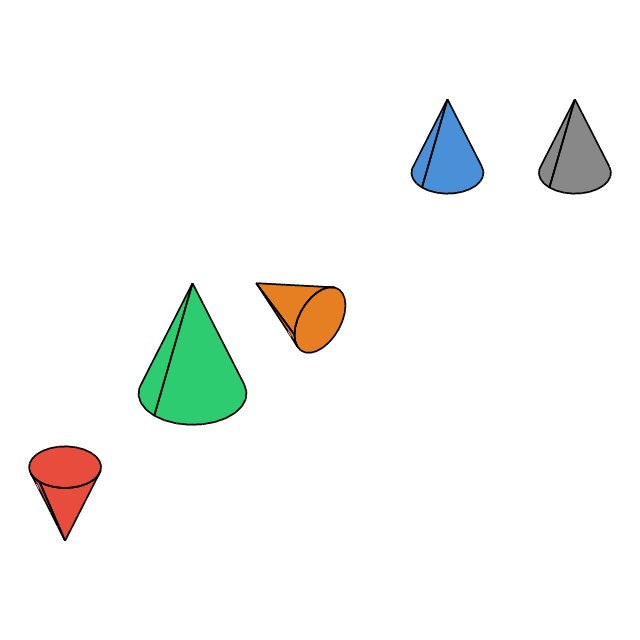
Transform
Transform operations: translate, rotate, scale, and mirror applied to a cone.
cargo run --example 03_transform
use cadrum::{DVec3, Solid};
use std::f64::consts::PI;
fn main() -> Result<(), cadrum::Error> {
let example_name = std::path::Path::new(file!()).file_stem().unwrap().to_str().unwrap();
let base = Solid::cone(8.0, 0.0, DVec3::Z * 20.0).color("#888888");
let solids = [
base.clone(),
base.clone().color("#4a90d9").translate(DVec3::X * 40.0 + DVec3::Z * 20.0),
base.clone().color("#e67e22").rotate_x(PI / 2.0).translate(DVec3::X * 80.0),
base.clone().color("#2ecc71").scale(DVec3::ZERO, 1.5).translate(DVec3::X * 120.0),
base.clone().color("#e74c3c").mirror(DVec3::ZERO, DVec3::Z).translate(DVec3::X * 160.0),
];
Solid::write_step(&solids, &mut std::fs::File::create(format!("{example_name}.step")).unwrap())?;
let mesh = Solid::mesh(&solids, Default::default())?;
let scene = mesh.scene(Default::default());
scene.write_svg(&mut std::fs::File::create(format!("{example_name}.svg")).unwrap())?;
scene.write_png([640, 640], &mut std::fs::File::create(format!("{example_name}.png")).unwrap())?;
mesh.write_stl(&mut std::fs::File::create(format!("{example_name}.stl")).unwrap())?;
mesh.write_gltf_binary(&mut std::fs::File::create(format!("{example_name}.glb")).unwrap())?;
println!("wrote {example_name}.step / {example_name}.svg / {example_name}.png");
Ok(())
}
Output: 03_transform.png | 03_transform.step | 03_transform.glb | 03_transform.stl | 03_transform.svg
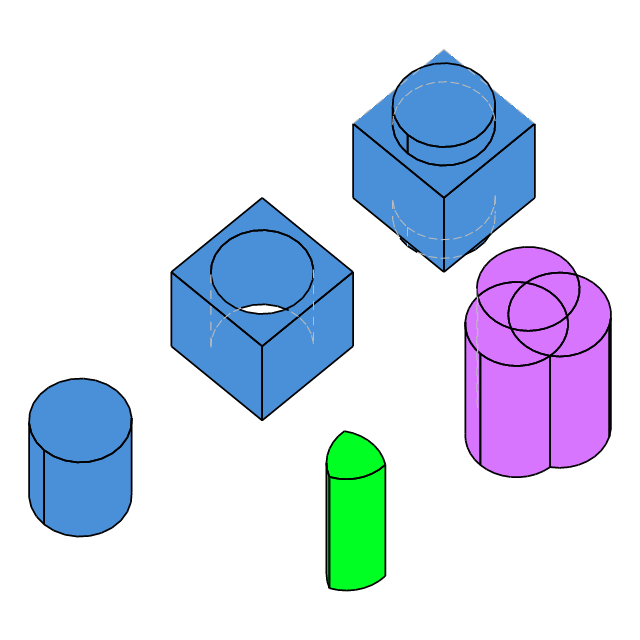
Boolean
Boolean operations: union, subtract, and intersect between a box and a cylinder.
cargo run --example 04_boolean
use cadrum::{Boolean, DVec3, Solid};
fn main() -> Result<(), cadrum::Error> {
let example_name = std::path::Path::new(file!()).file_stem().unwrap().to_str().unwrap();
let make_box = Solid::cube(DVec3::ZERO, DVec3::splat(20.0)).translate(DVec3::X * -10. + DVec3::Y * -10.).color("#4a90d9");
let make_cyl = Solid::cylinder(8.0, DVec3::Z * 30.0).translate(DVec3::Z * -5.);
let union: Solid = (&make_box + &make_cyl).build()?;
let subtract: Solid = (&make_box - &make_cyl).build()?;
let intersect: Solid = (&make_box * &make_cyl).build()?;
let cylinder = Solid::cylinder(8.0, DVec3::Z * 30.0).translate(DVec3::X * 4.);
let [cylinder0, cylinder1, cylinder2] = [cylinder.clone(), cylinder.clone().rotate_z(std::f64::consts::TAU / 3.), cylinder.clone().rotate_z(-std::f64::consts::TAU / 3.)];
let sum: Solid = [&cylinder0, &cylinder1, &cylinder2].into_iter().map(Boolean::from).reduce(|a, s| a + s).unwrap().build()?;
let sum = sum.color("#d875ff");
let product: Solid = [&cylinder0, &cylinder1, &cylinder2].into_iter().map(Boolean::from).reduce(|a, b| a * b).unwrap().build()?;
let product = product.color("#00ff22");
let shapes = [union.translate(DVec3::X * 0.0), subtract.translate(DVec3::X * 40.0), intersect.translate(DVec3::X * 80.0), sum.translate(DVec3::X * 20.0 + DVec3::Y * 40.0), product.translate(DVec3::X * 60.0 + DVec3::Y * 40.0)];
Solid::write_step(&shapes, &mut std::fs::File::create(format!("{example_name}.step")).unwrap())?;
let mesh = Solid::mesh(&shapes, Default::default())?;
let scene = mesh.scene(cadrum::SceneOption { view: DVec3::new(1.0, 1.0, 2.0), ..Default::default() });
scene.write_svg(&mut std::fs::File::create(format!("{example_name}.svg")).unwrap())?;
scene.write_png([640, 640], &mut std::fs::File::create(format!("{example_name}.png")).unwrap())?;
mesh.write_stl(&mut std::fs::File::create(format!("{example_name}.stl")).unwrap())?;
mesh.write_gltf_binary(&mut std::fs::File::create(format!("{example_name}.glb")).unwrap())?;
println!("wrote {example_name}.step / {example_name}.svg / {example_name}.png");
Ok(())
}
Output: 04_boolean.png | 04_boolean.step | 04_boolean.glb | 04_boolean.stl | 04_boolean.svg
Extrude
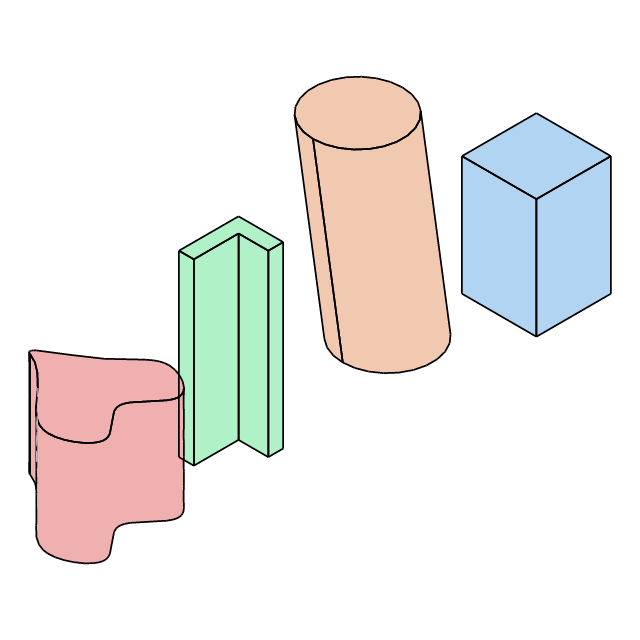
Demo of Solid::extrude: push a closed 2D profile along a direction vector.
cargo run --example 05_extrude
use cadrum::{BSplineEnd, DVec3, Edge, Error, Solid};
fn build_box() -> Result<Solid, Error> {
let profile = Edge::polygon(&[DVec3::new(0.0, 0.0, 0.0), DVec3::new(5.0, 0.0, 0.0), DVec3::new(5.0, 5.0, 0.0), DVec3::new(0.0, 5.0, 0.0)])?;
Solid::extrude(&profile, DVec3::Z * 8.0)
}
fn build_oblique_cylinder() -> Result<Solid, Error> {
let profile = [Edge::circle(3.0, DVec3::Z)?];
Solid::extrude(&profile, DVec3::new(-4.0, -6.0, 8.0))
}
fn build_l_beam() -> Result<Solid, Error> {
let profile = Edge::polygon(&[DVec3::new(0.0, 0.0, 0.0), DVec3::new(4.0, 0.0, 0.0), DVec3::new(4.0, 1.0, 0.0), DVec3::new(1.0, 1.0, 0.0), DVec3::new(1.0, 3.0, 0.0), DVec3::new(0.0, 3.0, 0.0)])?;
Solid::extrude(&profile, DVec3::Z * 12.0)
}
fn build_heart() -> Result<Solid, Error> {
let profile = [Edge::bspline(
&[
DVec3::new(0.0, -4.0, 0.0), DVec3::new(2.0, -1.5, 0.0),
DVec3::new(4.0, 1.5, 0.0),
DVec3::new(2.5, 3.5, 0.0), DVec3::new(0.0, 2.0, 0.0), DVec3::new(-2.5, 3.5, 0.0), DVec3::new(-4.0, 1.5, 0.0),
DVec3::new(-2.0, -1.5, 0.0),
],
BSplineEnd::Periodic,
)?];
Solid::extrude(&profile, DVec3::Z * 7.0)
}
fn main() -> Result<(), Error> {
let example_name = std::path::Path::new(file!()).file_stem().unwrap().to_str().unwrap();
let box_solid = build_box()?.color("#b0d4f1");
let oblique = build_oblique_cylinder()?.color("#f1c8b0").translate(DVec3::X * 10.0);
let l_beam = build_l_beam()?.color("#b0f1c8").translate(DVec3::X * 20.0);
let heart = build_heart()?.color("#f1b0b0").translate(DVec3::X * 30.0);
let result = [box_solid, oblique, l_beam, heart];
Solid::write_step(&result, &mut std::fs::File::create(format!("{example_name}.step")).unwrap())?;
let mesh = Solid::mesh(&result, Default::default())?;
let scene = mesh.scene(Default::default());
scene.write_svg(&mut std::fs::File::create(format!("{example_name}.svg")).unwrap())?;
scene.write_png([640, 640], &mut std::fs::File::create(format!("{example_name}.png")).unwrap())?;
mesh.write_stl(&mut std::fs::File::create(format!("{example_name}.stl")).unwrap())?;
mesh.write_gltf_binary(&mut std::fs::File::create(format!("{example_name}.glb")).unwrap())?;
println!("wrote {example_name}.step / {example_name}.svg / {example_name}.png");
Ok(())
}
Output: 05_extrude.png | 05_extrude.step | 05_extrude.glb | 05_extrude.stl | 05_extrude.svg
Loft
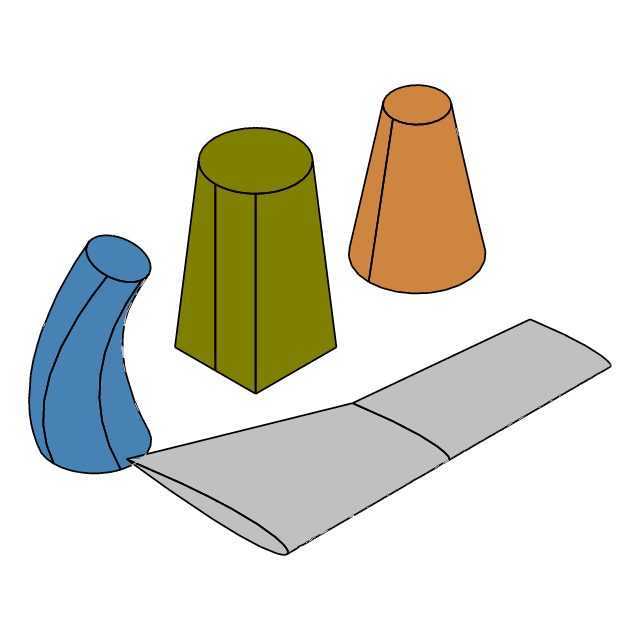
Demo of Solid::loft: skin a solid through cross-section wires.
cargo run --example 06_loft
use cadrum::{BSplineEnd, DVec2, DVec3, Edge, Error, Solid};
fn build_frustum() -> Result<Solid, Error> {
let lower = [Edge::circle(3.0, DVec3::Z)?];
let upper = [Edge::circle(1.5, DVec3::Z)?.translate(DVec3::Z * 8.0)];
Ok(Solid::loft(&[lower, upper], false)?.color("#cd853f"))
}
fn build_morph() -> Result<Solid, Error> {
let r = 2.5;
let square = Edge::polygon(&[DVec3::new(-r, -r, 0.0), DVec3::new(r, -r, 0.0), DVec3::new(r, r, 0.0), DVec3::new(-r, r, 0.0)])?;
let circle = Edge::circle(r, DVec3::Z)?.translate(DVec3::Z * 10.0);
Ok(Solid::loft([square.as_slice(), std::slice::from_ref(&circle)], false)?.color("#808000"))
}
fn build_tilted() -> Result<Solid, Error> {
let bottom = [Edge::circle(2.5, DVec3::Z)?];
let mid = [Edge::circle(2.0, DVec3::new(0.3, 0.0, 1.0).normalize())?.translate(DVec3::X + DVec3::Z * 5.0)];
let top = [Edge::circle(1.5, DVec3::new(-0.2, 0.3, 1.0).normalize())?.translate(DVec3::new(-0.5, 1.0, 10.0))];
Ok(Solid::loft(&[bottom, mid, top], false)?.color("#4682b4"))
}
fn naca_points(n: usize) -> Vec<DVec2> {
let half = |x: f64| 5.0 * 0.12 * (0.2969 * x.sqrt() - 0.1260 * x - 0.3516 * x * x + 0.2843 * x.powi(3) - 0.1036 * x.powi(4));
let upper: Vec<DVec2> = (0..=n)
.map(|i| {
let x = (1.0 + (std::f64::consts::PI * i as f64 / n as f64).cos()) / 2.0;
DVec2::new(x, half(x))
})
.collect();
let lower: Vec<DVec2> = (1..=n)
.map(|i| {
let x = (1.0 - (std::f64::consts::PI * i as f64 / n as f64).cos()) / 2.0;
DVec2::new(x, -half(x))
})
.collect();
[upper, lower].concat()
}
fn build_wing(scale: f64) -> Result<Solid, Error> {
let stations = [(1.0, 0.0), (0.6, 1.0), (0.5, 2.0)];
let sections: Vec<[Edge; 1]> = stations
.iter()
.map(|&(c, z)| {
let points: Vec<DVec3> = naca_points(60).into_iter().map(|p| DVec3::new(c * p.x, c * p.y, z) * scale).collect();
[Edge::bspline(&points, BSplineEnd::NotAKnot).expect("NACA bspline section")]
})
.collect();
Ok(Solid::loft(§ions, true)?.color("silver"))
}
fn main() -> Result<(), Error> {
let example_name = std::path::Path::new(file!()).file_stem().unwrap().to_str().unwrap();
let frustum = build_frustum()?;
let morph = build_morph()?.translate(DVec3::X * 10.0);
let tilted = build_tilted()?.translate(DVec3::X * 20.0);
let wing = build_wing(10.0)?.align_z(-DVec3::X, -DVec3::Y).translate(DVec3::X * 20.0 + DVec3::Y * 12.0);
let result = [frustum, morph, tilted, wing];
Solid::write_step(&result, &mut std::fs::File::create(format!("{example_name}.step")).unwrap())?;
let mesh = Solid::mesh(&result, Default::default())?;
let scene = mesh.scene(Default::default());
scene.write_svg(&mut std::fs::File::create(format!("{example_name}.svg")).unwrap())?;
scene.write_png([640, 640], &mut std::fs::File::create(format!("{example_name}.png")).unwrap())?;
mesh.write_stl(&mut std::fs::File::create(format!("{example_name}.stl")).unwrap())?;
mesh.write_gltf_binary(&mut std::fs::File::create(format!("{example_name}.glb")).unwrap())?;
println!("wrote {example_name}.step / {example_name}.svg / {example_name}.png");
Ok(())
}
Output: 06_loft.png | 06_loft.step | 06_loft.glb | 06_loft.stl | 06_loft.svg
Sweep
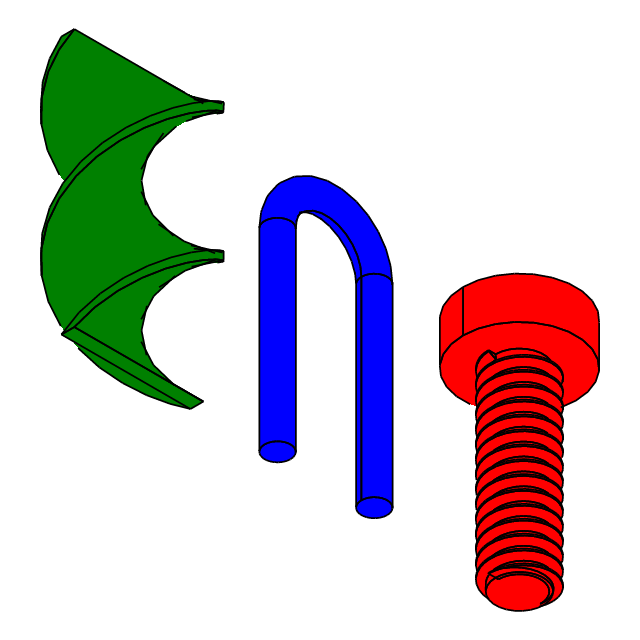
Sweep showcase: M2 screw (helix spine) + U-shaped pipe (line+arc+line spine)
cargo run --example 07_sweep
use cadrum::{DVec3, Edge, Error, ProfileOrient, Solid};
fn build_m2_screw() -> Result<Solid, Error> {
let r = 1.0;
let h_pitch = 0.4;
let h_thread = 6.0;
let r_head = 1.75;
let h_head = 1.3;
let r_delta = 3f64.sqrt() / 2.0 * h_pitch;
let helix = Edge::helix(r - r_delta, h_pitch, h_thread, DVec3::Z, DVec3::X)?;
let profile = Edge::polygon(&[DVec3::new(0.0, -h_pitch / 2.0, 0.0), DVec3::new(r_delta, 0.0, 0.0), DVec3::new(0.0, h_pitch / 2.0, 0.0)])?;
let profile: Vec<Edge> = profile.into_iter().map(|e| e.align_z(helix.start_tangent(), helix.start_point()).translate(helix.start_point())).collect();
let thread = Solid::sweep(&profile, &[helix], ProfileOrient::Up(DVec3::Z))?;
let shaft = Solid::cylinder(r - r_delta * 6.0 / 8.0, DVec3::Z * h_thread);
let crest = Solid::cylinder(r - r_delta / 8.0, DVec3::Z * h_thread);
let thread_shaft: Solid = ((&thread + &shaft) * &crest).build()?;
let head = Solid::cylinder(r_head, DVec3::Z * h_head).translate(DVec3::Z * h_thread);
let res: Solid = (&thread_shaft + &head).build()?;
Ok(res.color("red"))
}
fn build_u_pipe() -> Result<Solid, Error> {
let pipe_radius = 0.4;
let leg_length = 6.0;
let gap = 3.0;
let half_gap = gap / 2.0;
let bend_radius = half_gap;
let a = DVec3::new(-half_gap, 0.0, 0.0);
let b = DVec3::new(-half_gap, 0.0, leg_length);
let arc_mid = DVec3::new(0.0, 0.0, leg_length + bend_radius);
let c = DVec3::new(half_gap, 0.0, leg_length);
let d = DVec3::new(half_gap, 0.0, 0.0);
let up_leg = Edge::line(a, b)?;
let bend = Edge::arc_3pts(b, arc_mid, c)?;
let down_leg = Edge::line(c, d)?;
let profile = Edge::circle(pipe_radius, DVec3::Z)?.translate(a);
let pipe = Solid::sweep(&[profile], &[up_leg, bend, down_leg], ProfileOrient::Up(DVec3::Y))?;
Ok(pipe.translate(DVec3::X * 6.0).color("blue"))
}
fn build_twisted_ribbon() -> Result<Solid, Error> {
let h = 8.0;
let aux_r = 3.0;
let spine = Edge::line(DVec3::ZERO, DVec3::Z * h)?;
let aux = Edge::helix(aux_r, h, h, DVec3::Z, DVec3::X)?;
let profile = Edge::polygon(&[DVec3::new(-2.0, -0.2, 0.0), DVec3::new(2.0, -0.2, 0.0), DVec3::new(2.0, 0.2, 0.0), DVec3::new(-2.0, 0.2, 0.0)])?;
let ribbon = Solid::sweep(&profile, &[spine], ProfileOrient::Auxiliary(&[aux]))?;
Ok(ribbon.translate(DVec3::X * 12.0).color("green"))
}
fn main() -> Result<(), Error> {
let example_name = std::path::Path::new(file!()).file_stem().unwrap().to_str().unwrap();
let all = [build_m2_screw()?, build_u_pipe()?, build_twisted_ribbon()?];
Solid::write_step(&all, &mut std::fs::File::create(format!("{example_name}.step")).unwrap())?;
let mesh = Solid::mesh(&all, Default::default())?;
let scene = mesh.scene(cadrum::SceneOption { view: DVec3::new(1.0, 1.0, -1.0), hidden_edges: false, ..Default::default() });
scene.write_svg(&mut std::fs::File::create(format!("{example_name}.svg")).unwrap())?;
scene.write_png([640, 640], &mut std::fs::File::create(format!("{example_name}.png")).unwrap())?;
mesh.write_stl(&mut std::fs::File::create(format!("{example_name}.stl")).unwrap())?;
mesh.write_gltf_binary(&mut std::fs::File::create(format!("{example_name}.glb")).unwrap())?;
println!("wrote {example_name}.step / {example_name}.svg / {example_name}.png ({} solids)", all.len());
Ok(())
}
Output: 07_sweep.png | 07_sweep.step | 07_sweep.glb | 07_sweep.stl | 07_sweep.svg
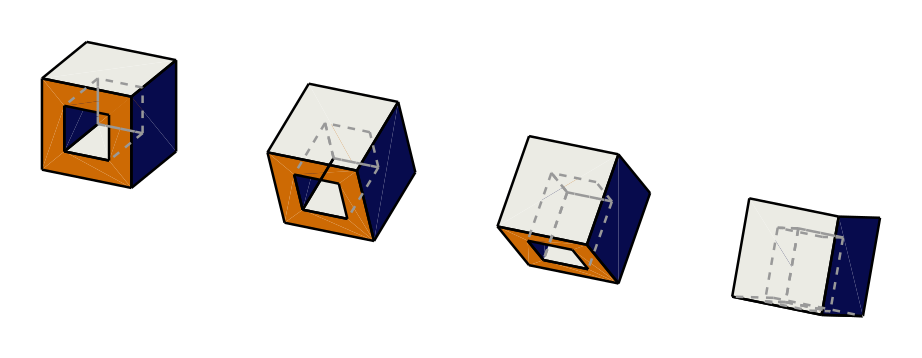
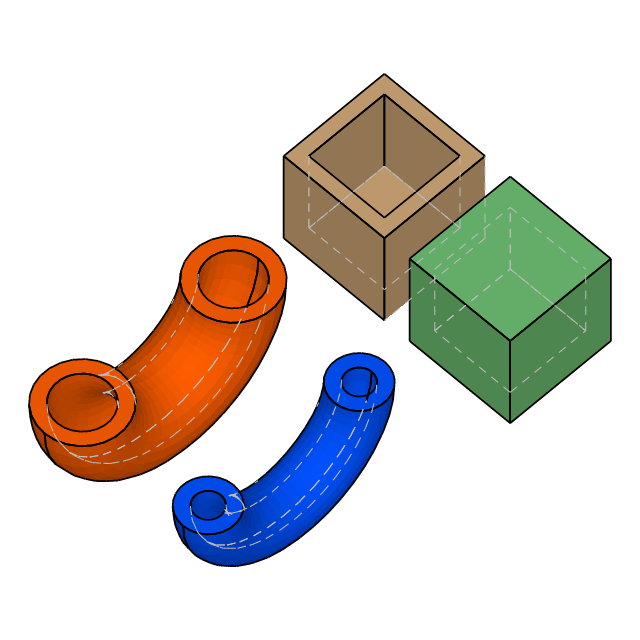
Shell
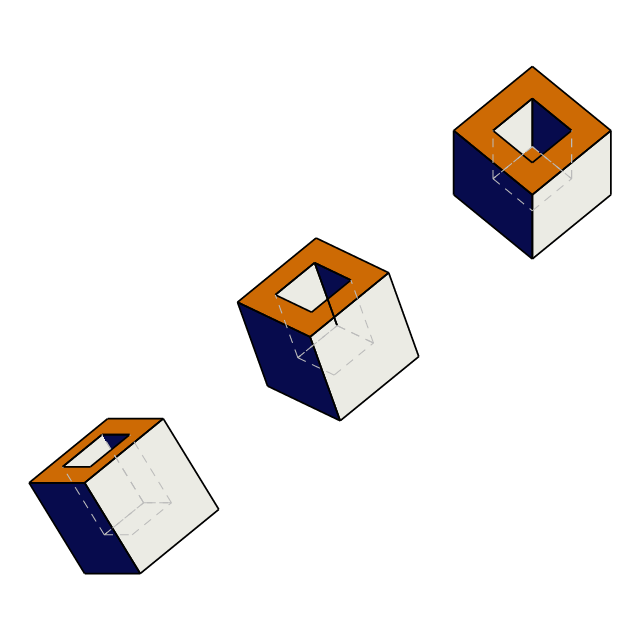
Demo of Solid::shell:
cargo run --example 08_shell
use cadrum::{DVec3, Error, Solid};
fn hollow_cube() -> Result<Solid, Error> {
let cube = Solid::cube(DVec3::ZERO, DVec3::splat(8.0));
let top = cube.iter_face().last().expect("cube has faces");
cube.shell(-1.0, [top])
}
fn sealed_cube() -> Result<Solid, Error> {
let cube = Solid::cube(DVec3::ZERO, DVec3::splat(8.0));
cube.shell(-1.0, std::iter::empty::<&cadrum::Face>())
}
fn halved_shelled_torus(thickness: f64) -> Result<Solid, Error> {
let torus = Solid::torus(6.0, 2.0, DVec3::Y);
let cutter = Solid::half_space(DVec3::ZERO, -DVec3::Z);
let cutter_face_ids: std::collections::HashSet<u64> = cutter.iter_face().map(|f| f.id()).collect();
let half: Solid = (&torus * &cutter).build()?;
let from_cutter: std::collections::HashSet<u64> = half.iter_history().filter_map(|[post, src]| cutter_face_ids.contains(&src).then_some(post)).collect();
half.shell(thickness, half.iter_face().filter(|f| from_cutter.contains(&f.id())))
}
fn main() -> Result<(), Error> {
let example_name = std::path::Path::new(file!()).file_stem().unwrap().to_str().unwrap();
let result = [hollow_cube()?.color("#d0a878"), sealed_cube()?.color("#6fbf73").translate(DVec3::Y * 10.0), halved_shelled_torus(1.0)?.color("#ff5e00").translate(DVec3::X * 18.0), halved_shelled_torus(-1.0)?.color("#0052ff").translate(DVec3::X * 18.0 + DVec3::Y * 10.0)];
Solid::write_step(&result, &mut std::fs::File::create(format!("{example_name}.step")).unwrap())?;
let mesh = Solid::mesh(&result, Default::default())?;
let scene = mesh.scene(cadrum::SceneOption { view: DVec3::new(1.0, 1.0, 2.0), shading: true, ..Default::default() });
scene.write_svg(&mut std::fs::File::create(format!("{example_name}.svg")).unwrap())?;
scene.write_png([640, 640], &mut std::fs::File::create(format!("{example_name}.png")).unwrap())?;
mesh.write_stl(&mut std::fs::File::create(format!("{example_name}.stl")).unwrap())?;
mesh.write_gltf_binary(&mut std::fs::File::create(format!("{example_name}.glb")).unwrap())?;
println!("wrote {example_name}.step / {example_name}.svg / {example_name}.png");
Ok(())
}
Output: 08_shell.png | 08_shell.step | 08_shell.glb | 08_shell.stl | 08_shell.svg
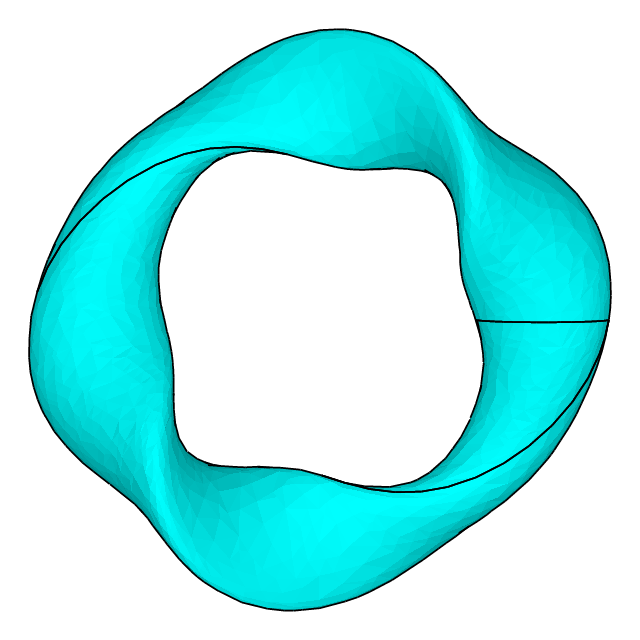
Bspline
cargo run --example 09_bspline
use cadrum::{DQuat, DVec3, Solid};
use std::f64::consts::TAU;
const M: usize = 48; const N: usize = 24; const RING_R: f64 = 6.0;
fn point(i: usize, j: usize) -> DVec3 {
let phi = TAU * (i as f64) / (M as f64);
let theta = TAU * (j as f64) / (N as f64);
let two_phi = 2.0 * phi;
let a = 1.8 + 0.6 * two_phi.sin();
let b = 1.0 + 0.4 * two_phi.cos();
let psi = two_phi; let z_shift = 1.0 * two_phi.sin();
let local_raw = DVec3::X * (a * theta.cos()) + DVec3::Z * (b * theta.sin());
let local_twisted = DQuat::from_axis_angle(DVec3::Y, psi) * local_raw;
let local_shifted = local_twisted + DVec3::Z * z_shift;
let translated = local_shifted + DVec3::X * RING_R;
DQuat::from_axis_angle(DVec3::Z, phi) * translated
}
fn main() -> Result<(), cadrum::Error> {
let example_name = std::path::Path::new(file!()).file_stem().unwrap().to_str().unwrap();
let plasma = Solid::bspline(M, N, true, point).expect("2-period bspline torus should succeed");
let objects = [plasma.color("cyan")];
Solid::write_step(&objects, &mut std::fs::File::create(format!("{example_name}.step")).unwrap())?;
let mesh = Solid::mesh(&objects, Default::default())?;
let scene = mesh.scene(cadrum::SceneOption { view: DVec3::new(0.05, 0.05, 1.0), up: DVec3::Y, hidden_edges: false, shading: true });
scene.write_svg(&mut std::fs::File::create(format!("{example_name}.svg")).unwrap())?;
scene.write_png([640, 640], &mut std::fs::File::create(format!("{example_name}.png")).unwrap())?;
mesh.write_stl(&mut std::fs::File::create(format!("{example_name}.stl")).unwrap())?;
mesh.write_gltf_binary(&mut std::fs::File::create(format!("{example_name}.glb")).unwrap())?;
println!("wrote {example_name}.step / {example_name}.svg / {example_name}.png");
Ok(())
}
Output: 09_bspline.png | 09_bspline.step | 09_bspline.glb | 09_bspline.stl | 09_bspline.svg
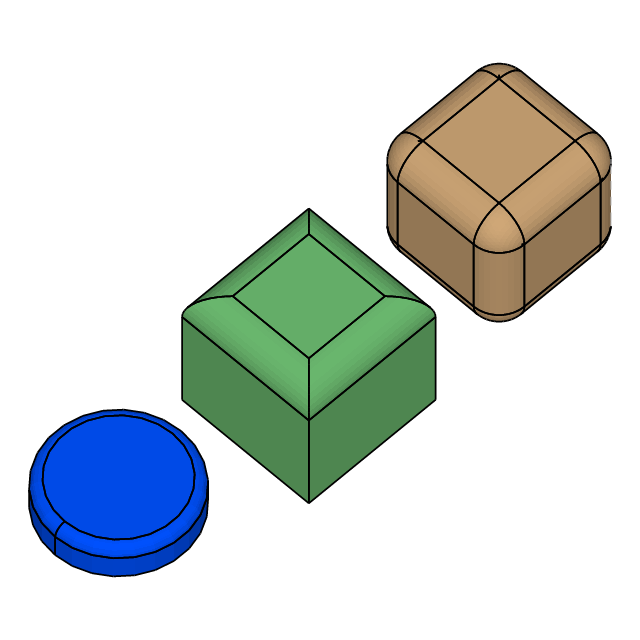
Fillet
Demo of Solid::fillet_edges:
cargo run --example 10_fillet
use cadrum::{DVec3, Error, Solid};
fn rounded_cube(size: f64) -> Result<Solid, Error> {
let cube = Solid::cube(DVec3::ZERO, DVec3::splat(size)).translate(-DVec3::ONE * (size / 2.0));
let radius = size * 0.2;
cube.fillet_edges(radius, cube.iter_edge())
}
fn soft_top_cube(size: f64) -> Result<Solid, Error> {
let cube = Solid::cube(DVec3::ZERO, DVec3::splat(size)).translate(-DVec3::ONE * (size / 2.0));
let radius = size * 0.2;
let top_edges = cube.iter_edge().filter(|e| [e.start_point(), e.end_point()].iter().all(|p| (p.z - size / 2.0).abs() < 1e-6));
cube.fillet_edges(radius, top_edges)
}
fn coin(radius: f64, height: f64) -> Result<Solid, Error> {
let cyl = Solid::cylinder(radius, DVec3::Z * height);
let radius = height * 0.3;
let top_circle = cyl.iter_edge().filter(|e| [e.start_point(), e.end_point()].iter().all(|p| (p.z - height).abs() < 1e-6));
cyl.fillet_edges(radius, top_circle)
}
fn main() -> Result<(), Error> {
let example_name = std::path::Path::new(file!()).file_stem().unwrap().to_str().unwrap();
let result = [rounded_cube(8.0)?.color("#d0a878"), soft_top_cube(8.0)?.color("#6fbf73").translate(DVec3::X * 12.0), coin(4.0, 2.0)?.color("#0052ff").translate(DVec3::X * 24.0)];
Solid::write_step(&result, &mut std::fs::File::create(format!("{example_name}.step")).unwrap())?;
let mesh = Solid::mesh(&result, Default::default())?;
let scene = mesh.scene(cadrum::SceneOption { view: DVec3::new(1.0, 1.0, 2.0), shading: true, ..Default::default() });
scene.write_svg(&mut std::fs::File::create(format!("{example_name}.svg")).unwrap())?;
scene.write_png([640, 640], &mut std::fs::File::create(format!("{example_name}.png")).unwrap())?;
mesh.write_stl(&mut std::fs::File::create(format!("{example_name}.stl")).unwrap())?;
mesh.write_gltf_binary(&mut std::fs::File::create(format!("{example_name}.glb")).unwrap())?;
println!("wrote {example_name}.step / {example_name}.svg / {example_name}.png");
Ok(())
}
Output: 10_fillet.png | 10_fillet.step | 10_fillet.glb | 10_fillet.stl | 10_fillet.svg
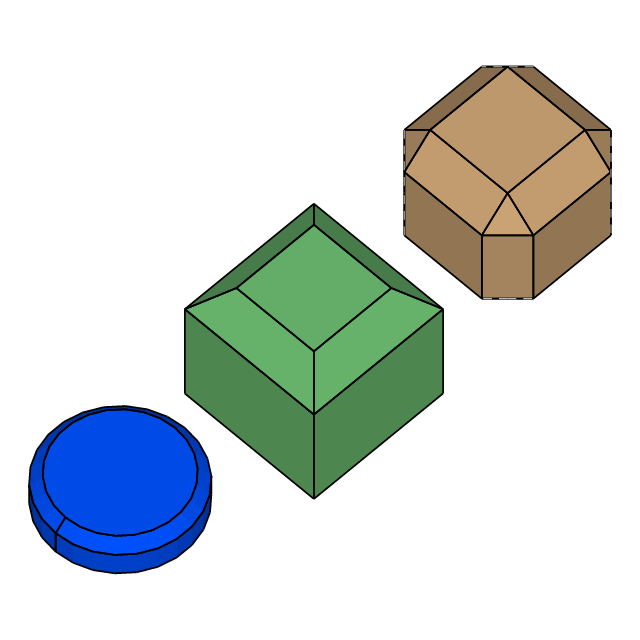
Chamfer
Demo of Solid::chamfer_edges — mirror of 10_fillet.rs using bevels:
cargo run --example 11_chamfer
use cadrum::{DVec3, Error, Solid};
fn beveled_cube(size: f64) -> Result<Solid, Error> {
let cube = Solid::cube(DVec3::ZERO, DVec3::splat(size)).translate(-DVec3::ONE * (size / 2.0));
let distance = size * 0.2;
cube.chamfer_edges(distance, cube.iter_edge())
}
fn beveled_top_cube(size: f64) -> Result<Solid, Error> {
let cube = Solid::cube(DVec3::ZERO, DVec3::splat(size)).translate(-DVec3::ONE * (size / 2.0));
let distance = size * 0.2;
let top_edges = cube.iter_edge().filter(|e| [e.start_point(), e.end_point()].iter().all(|p| (p.z - size / 2.0).abs() < 1e-6));
cube.chamfer_edges(distance, top_edges)
}
fn beveled_coin(radius: f64, height: f64) -> Result<Solid, Error> {
let cyl = Solid::cylinder(radius, DVec3::Z * height);
let distance = height * 0.3;
let top_circle = cyl.iter_edge().filter(|e| [e.start_point(), e.end_point()].iter().all(|p| (p.z - height).abs() < 1e-6));
cyl.chamfer_edges(distance, top_circle)
}
fn main() -> Result<(), Error> {
let example_name = std::path::Path::new(file!()).file_stem().unwrap().to_str().unwrap();
let result = [beveled_cube(8.0)?.color("#d0a878"), beveled_top_cube(8.0)?.color("#6fbf73").translate(DVec3::X * 12.0), beveled_coin(4.0, 2.0)?.color("#0052ff").translate(DVec3::X * 24.0)];
Solid::write_step(&result, &mut std::fs::File::create(format!("{example_name}.step")).unwrap())?;
let mesh = Solid::mesh(&result, Default::default())?;
let scene = mesh.scene(cadrum::SceneOption { view: DVec3::new(1.0, 1.0, 2.0), shading: true, ..Default::default() });
scene.write_svg(&mut std::fs::File::create(format!("{example_name}.svg")).unwrap())?;
scene.write_png([640, 640], &mut std::fs::File::create(format!("{example_name}.png")).unwrap())?;
mesh.write_stl(&mut std::fs::File::create(format!("{example_name}.stl")).unwrap())?;
mesh.write_gltf_binary(&mut std::fs::File::create(format!("{example_name}.glb")).unwrap())?;
println!("wrote {example_name}.step / {example_name}.svg / {example_name}.png");
Ok(())
}
Output: 11_chamfer.png | 11_chamfer.step | 11_chamfer.glb | 11_chamfer.stl | 11_chamfer.svg
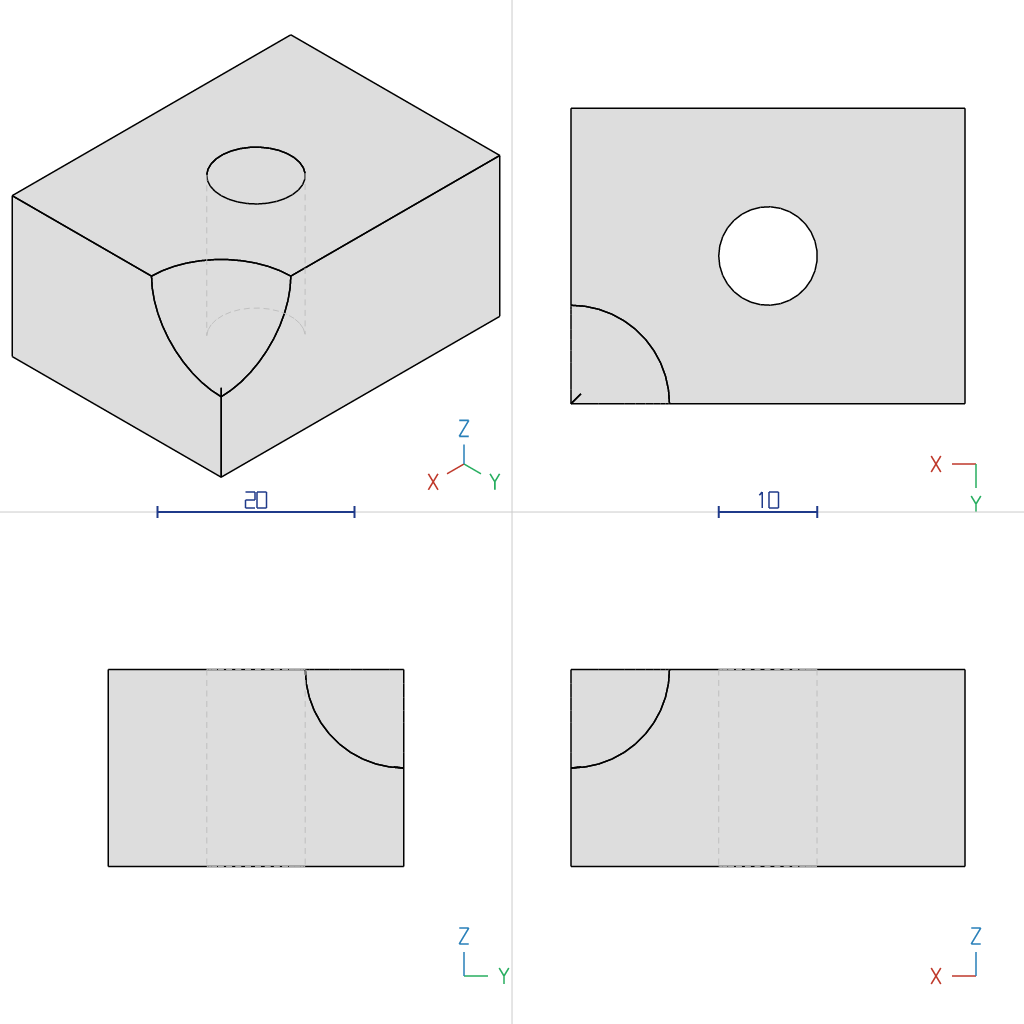
Multiview
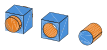
Fixed 4-view multiview PNG for LLM-driven design loops.
cargo run --example 12_multiview
use cadrum::{DVec3, Solid};
fn main() -> Result<(), cadrum::Error> {
let example_name = std::path::Path::new(file!()).file_stem().unwrap().to_str().unwrap();
let block = Solid::cube(DVec3::ZERO, DVec3::new(40.0, 30.0, 20.0)).translate(-DVec3::new(20.0, 15.0, 10.0));
let hole = Solid::cylinder(5.0, DVec3::Z * 30.0).translate(-DVec3::Z * 15.0);
let corner_cut = Solid::sphere(10.0).translate(DVec3::new(20.0, 15.0, 10.0));
let part: Solid = (&block - &hole - &corner_cut).build()?;
part.write_multiview_png(&mut std::fs::File::create(format!("{example_name}.png")).unwrap())?;
let mesh = Solid::mesh([&part], Default::default())?;
mesh.write_stl(&mut std::fs::File::create(format!("{example_name}.stl")).unwrap())?;
mesh.write_gltf_binary(&mut std::fs::File::create(format!("{example_name}.glb")).unwrap())?;
println!("wrote {example_name}.png / {example_name}.stl / {example_name}.glb");
Ok(())
}
Output: 12_multiview.png | 12_multiview.glb | 12_multiview.stl
The Type Map
Three concrete shape types form the whole public surface — there are no
collection wrapper traits:
    Edge  ── single 3D curve         ┐
    Face  ── trimmed 3D surface      │ concrete BRep handles
    Solid ── connected closed body   ┘
Every method is inherent on the concrete type — no trait import is ever
needed:
# use cadrum::{DVec3, Solid};
let s = Solid::cube(DVec3::ZERO, DVec3::ONE).rotate_z(0.5).translate(DVec3::X);
let v = s.volume();
Errors
Every fallible operation returns Result<T, Error> with Error
enumerating the failure modes (Error::SweepFailed,
Error::FilletFailed, Error::InvalidEdge, etc.). Variants that need
detail carry a String payload identifying which constructor or parameter
combination tripped OCCT, so panics are reserved for true logic bugs.
License
This project is licensed under the MIT License.
Compiled binaries include OpenCASCADE Technology (OCCT),
which is licensed under the LGPL 2.1.
Users who distribute applications built with cadrum must comply with the LGPL 2.1 terms.
Since cadrum builds OCCT from source, end users can rebuild and relink OCCT to satisfy this requirement.