
bunflared
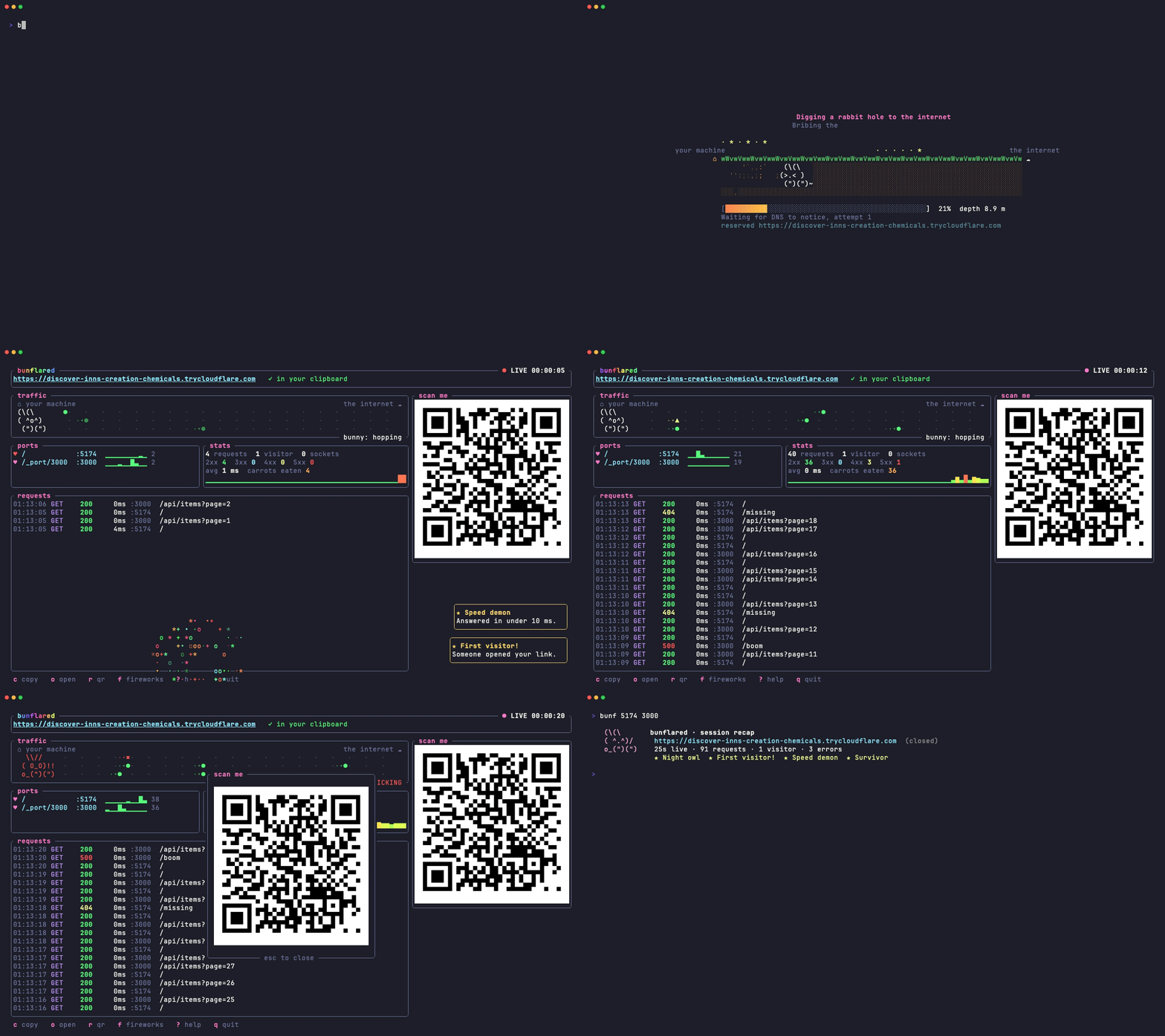
bunflared 5173 3000 puts your local app on a temporary
https://<words>.trycloudflare.com link, through a Cloudflare quick tunnel.
No account, no deploy. Send the link to a client, open it on your phone,
close the terminal and it is gone.
It shares several ports behind one link, so a frontend and its API travel
together: the first port is served at /, the others under /_port/<port>,
and http://localhost:<port> inside your pages and scripts is rewritten to
match. WebSockets pass through, so hot reload keeps working for the person on
the other end.
And it is a show. The screen catches fire while the tunnel opens, meteors crash into the flames, a firefighter bunny tries his best, and a phoenix rises out of the fire carrying your link. Then every request flies across a traffic lane, the bunny naps when nobody visits and panics on a 5xx. There are achievements. There are secrets.
And it is a live session with the people on the link: chat with them, send them to the page you just fixed, see where their pointer is, get their reactions and their notes pinned on the exact element they mean.
Install
macOS and Linux:
|
Windows (PowerShell):
powershell -ExecutionPolicy Bypass -c "irm https://github.com/mirkobozzetto/bunflared/releases/latest/download/bunflared-installer.ps1 | iex"
That is all: no Rust, no cloudflared to install first. You get bunflared
and its short name bunf. On the first share, bunflared downloads
Cloudflare's own cloudflared if it is not already installed.
With Rust: cargo install bunflared.
Then, once, so your coding agents know to reach for it when you ask to share something:
Use
bunf and bunflared are the same command.
In the dashboard:
| Key | Does |
|---|---|
c |
copy the link (it is already in your clipboard) |
o |
open it in your browser |
r |
big QR code, for phones (it flashes when already on screen) |
f |
fireworks |
↑ ↓ |
pick a visitor; commands then go to them only |
Tab |
switch between the visitors and the requests |
Esc |
pick nobody: commands go to everyone again |
m |
message the visitor, or everyone |
g |
send them to a page (the pages already seen are offered) |
R |
reload their page, after a fix |
e |
send them a reaction |
Enter |
on a request: its headers and bodies |
p |
replay the picked request to your local server |
? |
help |
q |
stop sharing |
Colors follow your terminal: bunflared asks it for its background and picks a
light or dark palette. --theme light or --theme dark forces one. NO_COLOR
is respected. When a shared port stops answering, visitors get a
small bunny page that retries by itself.
Feedback from the people you share with
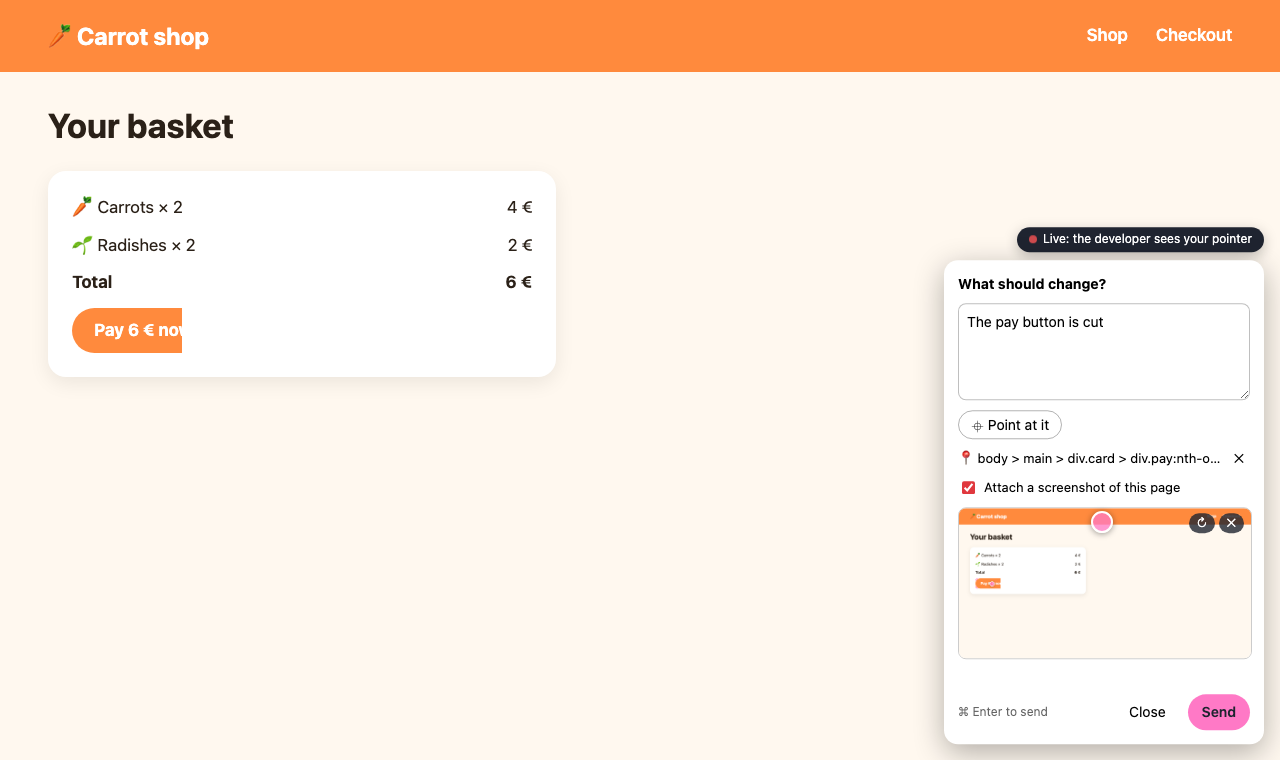
Every shared page gets a small ✎ Feedback button. Your client writes a
remark, a screenshot of the page is attached (or they paste their own), and it
lands in bunflared-feedback/, in the folder you ran bunflared from: one
Markdown file per note, the image next to it. With Point at it they click
the element they mean first: the note records its CSS selector, its text and
its position, and the screenshot shows it outlined.
That folder ignores itself in git, so client notes never end up in a commit. Hand it to your coding agent: "read the feedback and fix what they found".
Meanwhile the dashboard shows who is on which page, whether their tab is in front, how long they have been idle and how many times they clicked.
Live session
Each page holds a live connection to the dashboard, and reconnects by itself. The GIF at the top is one: a message from the terminal, the answer from the page, a reaction.
- Chat:
mopens a message box. The message pops up on their page, they answer from it, and the answer lands in the chat panel and as a toast. - Drive the demo:
gsends them to a page,Rreloads it. - Radar: pick a visitor and the radar draws their pointer on an outline of their screen. Their page shows a small "Live" pill while it is followed, and nothing is sent while the pointer rests.
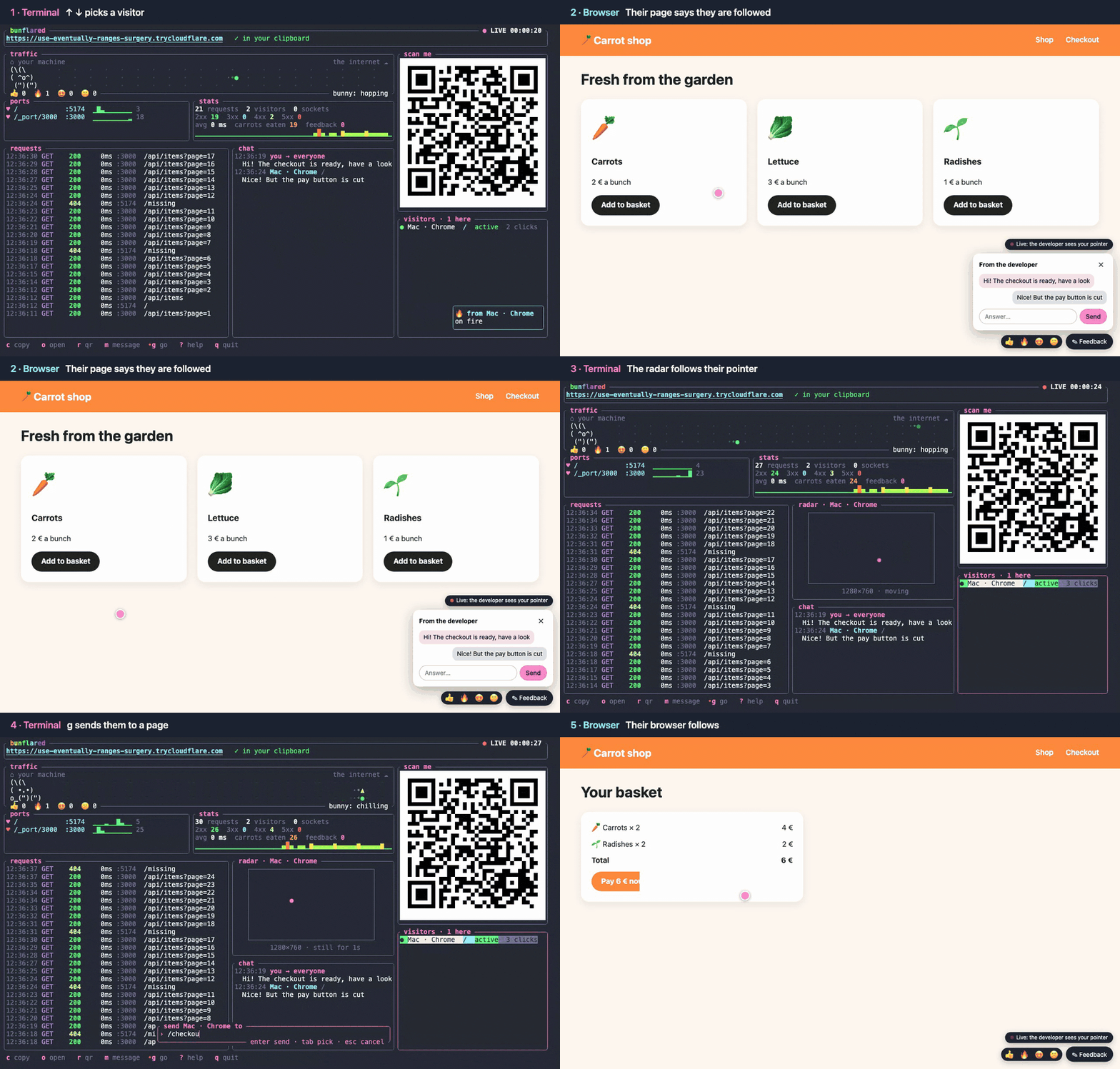
- Reactions: 👍 🔥 😍 😕 next to the feedback button. Each one has its own
show in the dashboard, confetti, fireworks, hearts or a worried bunny, and a
counter.
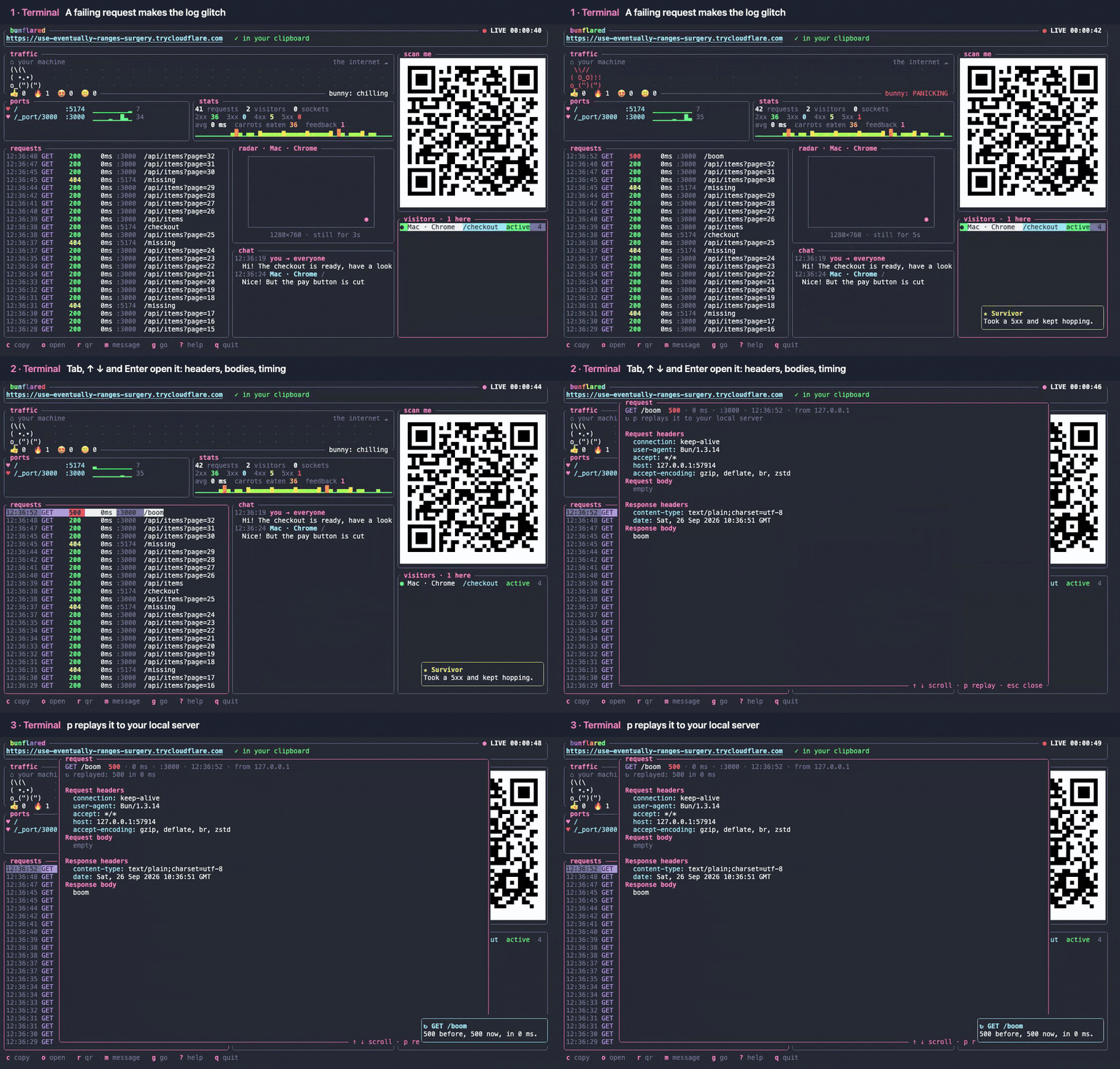
esends one back. - Inspector:
Tabto the requests, pick one,Entershows its headers and the start of its bodies,preplays it to your local server and shows the new status next to the old one.
The chat, the reactions and a link to every note are kept in one
session_<date>.md next to the notes, so the whole conversation is there for
you or your coding agent afterwards. The widget adapts to phones and follows
the page's light or dark look.
Tell the people you share with that their visit is followed. --no-widget
leaves the pages untouched. The screenshot library is loaded from jsDelivr
only when someone sends a screenshot.
For AI agents
Outside a terminal, or with --json, there is no dashboard: one JSON line on
stdout once the link works, one on stderr if it fails, and a meaningful exit
code. --detach returns as soon as the link works and keeps sharing in the
background.
The feedback button stays on the pages of a detached share: you can leave
notes on your app while your agent works, and it reads them in
bunflared-feedback/.
Teach your agents
bunflared agents writes a short note into the global instructions of
every coding agent it finds, so any session knows the command without being
told:
| Agent | Where the note goes |
|---|---|
| Claude Code | ~/.claude/rules/bunflared.md |
| omp | ~/.omp/agent/rules/bunflared.md |
| pi | ~/.pi/agent/AGENTS.md, in a marked block |
| prime-agent | ~/.prime/agent/AGENTS.md, in a marked block |
| Codex | ~/.codex/AGENTS.md, in a marked block |
Run it again after an update to refresh the note, bunflared agents --remove
to take it back out. For any other agent, paste the output of
bunflared agents --print into its rules.
Prefer skills? skills/bunflared/SKILL.md follows the Agent Skills format, and
skills installs it into Claude Code,
Codex, Cursor, pi and many more in one line:
Limits
- Anyone with the link reaches your dev server. The random name is the only protection.
- Quick tunnels allow 200 requests in flight and do not carry Server-Sent Events (Cloudflare docs).
- Quick tunnels refuse to start while
~/.cloudflared/config.yamlexists. - Cloudflare hands out a limited number of new quick links in a short time. Past it, bunflared says so: wait a few minutes.
- The inspector keeps the first 32 KiB of each body, in memory, for the last 200 requests. A request with a bigger body cannot be replayed.
- Tested by hand on macOS. The Linux and Windows builds compile in CI but have not been tried by hand yet.
License
MIT