
bevy_flora
⚠️ Vibe Coded. This crate was written by an AI agent working from a human's direction. It is covered by tests and by a rendered visual QA loop (
qa/visual_findings.mdin the repository), but it has had no line-by-line human audit. Read it before you trust it.



Parametric, stylized procedural trees for Bevy that grow over time. Pick one of 15 presets or tune every parameter, spawn a component, and watch a seedling grow into a mature tree. The same seed always gives the same tree.
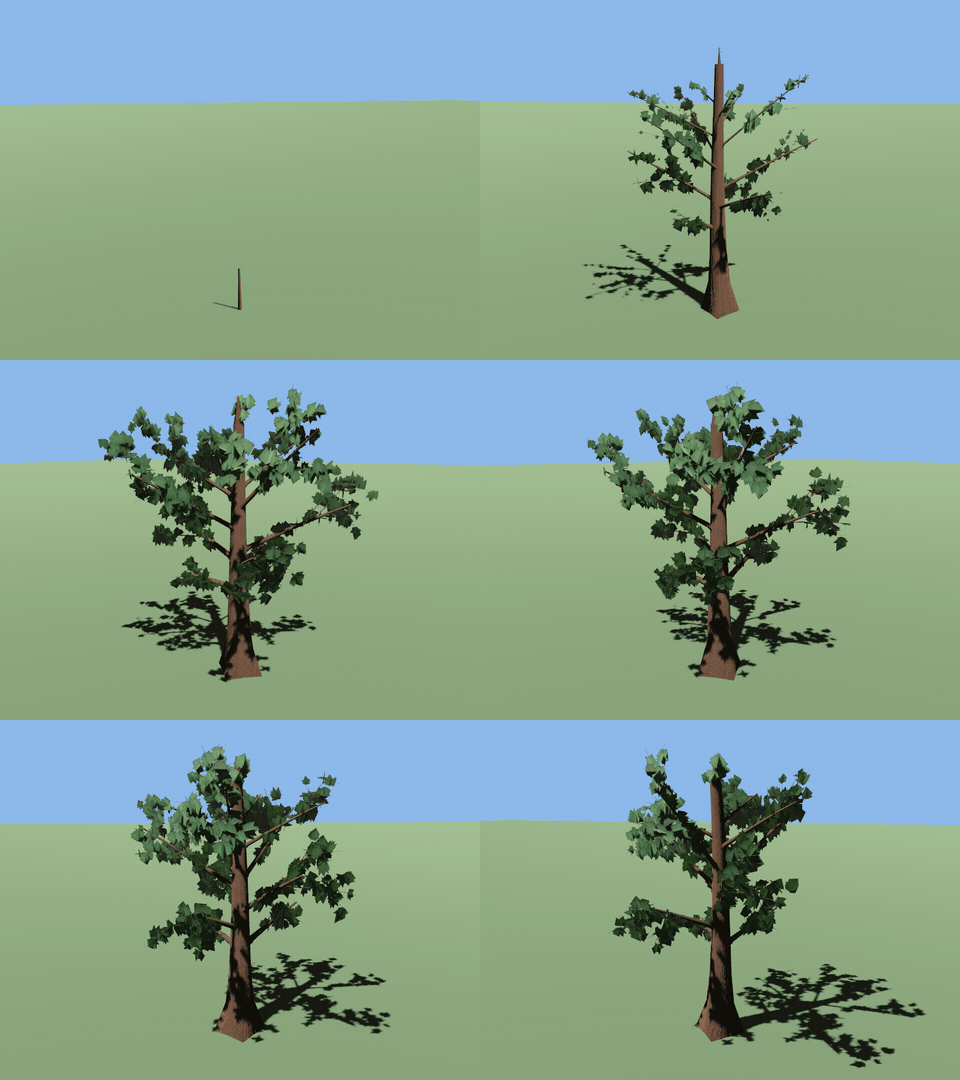
cargo run --release --example capture_growth: the maple preset from age 0 to maturity, one frame per age step, in a light wind.
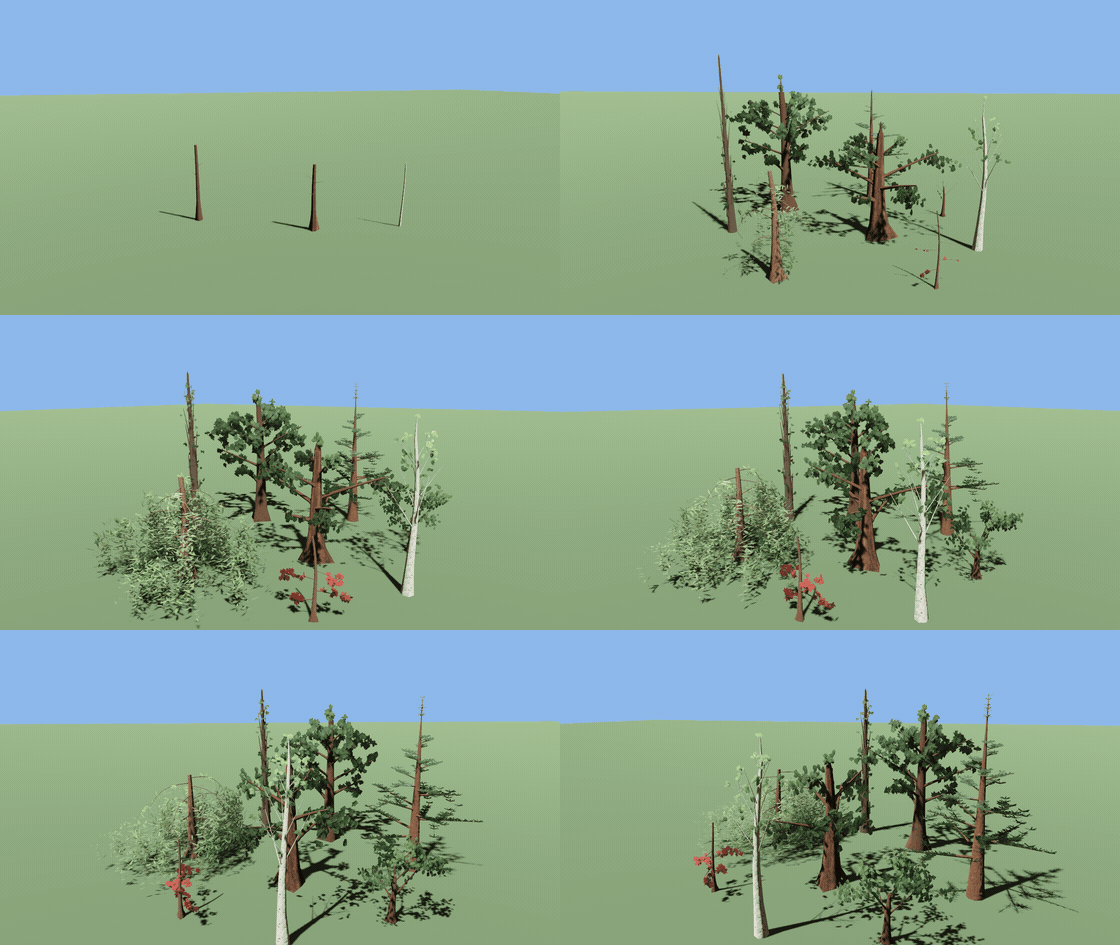
cargo run --release --example capture_growth -- --grove: a grove of oak, two maples, two birches, a pine, a cypress, a willow and a Japanese maple, each at its own age, with a gust front crossing it in the last seconds. Every tree is a ProceduralTree with its own seed.
Compatibility
bevy_flora |
bevy |
Rust |
|---|---|---|
| 0.6 | 0.20 | 1.97.1+ (edition 2024) |
Install
[]
= "0.6"
| feature | default | what it does |
|---|---|---|
serde |
— | Serialize / Deserialize on every parameter type, so trees can be authored in RON or JSON |
The library depends on bevy with default features off (std, bevy_asset, bevy_color, bevy_log, bevy_mesh, bevy_pbr), so it adds no windowing or audio to a build.
Quickstart
Add the plugin and spawn a tree. Growing advances its age every frame until it is mature; leave it off and set TreeAge yourself (the default, f32::INFINITY, is the mature tree).
use *;
use ;
The plugin keeps two child entities on each tree (wood and leaves) and rebuilds their meshes whenever ProceduralTree or TreeAge changes. It sends a TreeGenerated message after each rebuild.
Growing many trees: GpuGrowth
A growing tree normally rebuilds both meshes every frame, 0.1 to 0.4 ms of CPU per tree. Add GpuGrowth and the tree is built once, at maturity, and grown in the vertex shader: each frame the plugin ages the skeleton and writes a few kilobytes of per-node state, and nothing else is uploaded.
use *;
use ;
Main-world cost per frame with every tree growing (a headless App, release build, Apple M-series, median of three runs):
| 200 growing trees | CPU rebuild | GpuGrowth |
|---|---|---|
| oak | 17.6 ms | 0.81 ms |
| willow | 25.4 ms | 0.90 ms |
| oak, 2 smoothing passes | 69.8 ms | 0.70 ms |
Shadows follow the growth (the prepass shares the vertex shader), and the grown frames match the CPU path: over all 319 gallery scenarios the mean difference between the two renders is 0.08 of 255 (105 PNGs are byte-identical, the worst is a willow at 2.2). What differs, and why, is listed on GpuGrowth in the docs: smoothing is computed once on the mature mesh and deformed, side counts stay at the mature count, AllBranches leaves keep their mature positions, and the Mesh assets (picking, physics, culling) are the mature tree. It needs storage buffers in the vertex stage, so not WebGL2; there the trees grow on the CPU.
Drawing a forest: TreePool
ProceduralTree gives every tree its own meshes, which a GPU can draw a few thousand of. Trees with equal looks (the same colours, trunk height, wind response and leaf shading; seeds and every other parameter may differ) share their two materials, so a thousand oaks cost 22 ms a frame, not 58; give each tree its own colour or trunk height and each gets its own materials again. For a forest build a TreePool once, a few seed variants of one tree, and place PooledTrees from it. Entities that share a mesh and a material are drawn in one instanced call, and the distance to the camera picks what is drawn: the full tree up close, two coarser levels of detail (30 m and 80 m by default, cross-fading) and, beyond 200 m, one camera-facing quad per tree that shows a view of the variant baked in the running app.
use *;
use ;
Measured for 0.6.1 with cargo run --release --example forest -- --offscreen (1920x1080, one shadow-casting sun, wind on, an oak forest on an 8 m grid seen across it from 30 m up, Apple M4 Pro, release build; the median of three runs on a machine with nothing else running, the runs within 1% of each other; the larger forests are not run with a mesh per tree, which would take an estimated 15 and 75 GB of GPU memory):
| trees | one ProceduralTree each |
pool, levels of detail only | pool, with impostors |
|---|---|---|---|
| 1 000 | 22 ms | 4.2 ms | 3.3 ms |
| 5 000 | 60 ms | 8.0 ms | 3.3 ms |
| 20 000 | not run | 18.7 ms | 3.4 ms |
| 100 000 | not run | 64.7 ms | 7.3 ms |
The pool's trees are static: they have the age the pool was built at, and growing trees stay ProceduralTree (with GpuGrowth), which suits the few that are close. Impostors are baked once per variant by a few frames of offscreen rendering, so a tree appears when that is done, and they need FloraPlugin added after DefaultPlugins (before it, with no renderer, or on a device without storage buffers in the vertex stage such as WebGL2, the coarsest level is drawn at every distance and one warning says so). They are baked unlit, as a colour and a surface picture, and shaded by the scene's own lights every frame: they follow the time of day, glow with the sun behind them and sway with the wind. They cast no shadows, and they show one of eight views, at one elevation. With MSAA an impostor keeps the gaps of its crown: each pixel draws the share of its samples the baked tree covers, so a far crown is as airy, and as light, as the leaves it stands for. Level 2 and the impostors replace thin twigs and most leaves, so a forest seen from above or close up should keep its near trees at level 0.
Leaf shading and wind
Trees drawn by the plugin move in the wind, with no cost to the CPU per frame. FloraWind is a global resource: how hard (strength), which way (direction), how fast (speed), how far trees bend (bend), how much leaves flutter (flutter, flutter_frequency), how much the wind comes in gusts (gust_strength, gust_frequency) and sways across itself (turbulence). TreeParams::wind is how a species answers it, and the presets set their own: a willow moves more than an oak, a bonsai hardly at all. A GustFront is a band of stronger wind that sweeps across the world:
use *;
use ;
// Call this once, when the storm begins (from an event or a timer), not every frame: launching a
// gust restarts its front at `origin`.
Changing FloraWind writes one small shared buffer (FloraWindBuffer) and touches no material, so you can animate it every frame (a storm that builds, a wind that turns): a pooled forest of 20 000 trees takes 3.3 ms a frame with the wind changing every frame, where 0.5 took 212 ms (Apple M4 Pro). Launching a gust front writes the same buffer. Wind writes no motion vectors, and branches do not sway on their own: the whole tree bends and the leaves flutter. Leaf shading and wind need storage buffers in the vertex stage; on a device without them (WebGL2) trees are drawn with plain materials and one warning says so.
Without the plugin
build_tree is a pure function from parameters and age to CPU meshes and the aged skeleton, so you can bake trees offline, feed your own renderer, or build colliders from the skeleton:
use ;
let params = Pine.params;
let tree = build_tree;
let wood = tree.trunk.clone.into_bevy_mesh; // bevy::mesh::Mesh
let leaves = tree.foliage.into_bevy_mesh;
assert!;
Features
- 15 presets: oak, pine, willow, birch, palm, cypress, bonsai, maple, spruce, poplar, baobab, dragon tree, Japanese maple, dead tree and redwood. Each is a plain
TreeParamsvalue you can edit. - Growth over time. Every branch has a birth age and a growth duration, derived from where it sits on the tree. A tree can be shown at any age, branches thicken after they lengthen, and leaves grow to full size without re-rolling or disappearing as the tree ages.
- Deterministic. Each branch draws randomness from its own seeded stream, so the same
seedgives the same tree on every run, and aging never re-rolls branches or leaves that already exist. - Branch shape: crown envelopes, phyllotaxis, apical dominance, Y-splits, recursive sub-branches, twist, and a gravity bend that sub-branches and leaves follow. Floor avoidance keeps even strongly drooping wood above the ground.
- Closed wood. Branches meet the trunk through flared collars and root segments, forks taper into their halves, and trunk tops end in a flat cap, a cone or a leader branch. Optional pipe-model radii, radius-adaptive ring counts and volume-preserving (Taubin) smoothing that keeps seams, branch ends and twig seats in place.
- Leaves: five styles (crossed planes, single quad, cluster sphere, star burst, needle cluster), three placements (terminal branches, all branches, tip clusters) and four orientations. Leaf cards are leaf-shaped (cut into the geometry, so there is no alpha-mask
discard) and grow out of their twigs, crowns shade as one soft volume through crown-bent normals (normal_bend), and each leaf gets its own brightness (color_variation), hue (hue_variation) and share of the sky (occlusion), all baked into the mesh. The plugin draws trees withFloraMaterial, aStandardMaterialwith a leaf shader: a darker, glossier upper side, a paler matte lower side, veins, and light through a leaf lit from behind (LeafShading); facing the sun, the gloss gives way to that glow, so a backlit crown stays green instead of mirroring the sun white. The meshes also draw with a plainStandardMaterial, without those. - Wind.
FloraWindbends every tree and flutters its leaves in the vertex shader, shadows and impostors included, with a travellingGustFront, and each species answers in its own way (TreeParams::wind). - Forest scale.
TreePoolbuilds a few variants of a tree once, each at three levels of detail made from the skeleton (thin wood dropped, fewer sides and rings, fewer and larger leaves) and a baked camera-facing impostor for the far field;PooledTreeplaces them. 100 000 oak trees draw at 7.3 ms a frame, leaf shading and wind included (see above). A forest of individualProceduralTrees is fine for a few thousand trees, because trees with equal looks share their materials (1 000 oaks: 22 ms a frame), but each keeps its own meshes, so use a pool beyond that.
Examples
| example | what it shows |
|---|---|
showcase |
An interactive growing tree. Right-drag / wheel orbits, [ ] cycle presets, N reseeds, Space toggles growth, R restarts, M jumps to mature, G rebuilds, U switches between growing in the vertex shader (GpuGrowth) and rebuilding on the CPU. |
gallery |
Renders 319 scenarios (every preset at several ages and seeds, forced splits, smoothing, pipe radii (mature and young) and a wobbly twisted trunk on every preset, every leaf style × placement × orientation, every crown shape, parameter extremes) offscreen to four-view PNGs plus a stats.tsv with mesh sanity flags. This is the visual QA harness. --filter <substr> narrows it; --gpu grows every tree in the vertex shader. |
compare_gallery |
Compares two renders directory against directory (CPU gallery against gallery --gpu, or two capture_growth runs): mean difference and share of close pixels per PNG, non-zero exit past the limits. |
inspect |
Photographs one tree under controlled conditions, to see how it reads: a camera that backs off through every level of detail and into the impostor (--distance a,b --frames n), optionally zooming so the tree keeps its size on screen and a level switch shows as a jump (--constant-size), any bearing, height and field of view, one level forced at every distance (--level), the empty scene (--empty) to measure the tree's pixels against, with or without MSAA. The clock is fixed, so runs repeat. |
capture_growth |
Records the clips above as numbered PNG frames: one tree growing (--preset <name>, default maple) or, with --grove, a grove of mixed species with a gust front crossing it (--gpu grows the trees in the vertex shader). The clock steps a fixed 1/24 s per frame, so the wind sways smoothly and two runs write the same frames; the ffmpeg commands that make the GIFs are in the example's docs. |
forest |
The forest-scale benchmark: up to 100 000 trees on a grid under a shadow-casting sun, drawn from a TreePool (--mode pool, the default), as a ProceduralTree each (--mode naive), or as GpuGrowth trees, fully grown or growing for the whole run (--mode gpu, gpu-live; --mode cpu-live is the CPU-rebuilt equivalent), timed per frame or saved as a screenshot. --offscreen times the real frame cost without a window and the result line gives the mean, p95, median, minimum and CPU time per frame; --no-impostors, --lod and --shadows change the setup; --sun <x,y,z>, --wind <strength>, --wind-dir <x,z>, --gust <speed> and --wind-animate (the strength changes every frame) move the light and the weather; --deterministic fixes the clock at 1/60 s, so two builds' --screenshots compare byte for byte. |
How it works
TreeParams → skeleton (a node tree of trunk, leader, primaries, splits and sub-branches) → birth times → the skeleton at a given age → wood mesh and leaf points → MeshData → Bevy Mesh. ARCHITECTURE.md has the details and the invariants (winding, bend, junctions) the meshers rely on.
License
Licensed under either of
- Apache License, Version 2.0 (LICENSE-APACHE or http://www.apache.org/licenses/LICENSE-2.0)
- MIT license (LICENSE-MIT or http://opensource.org/licenses/MIT)
at your option.
Unless you explicitly state otherwise, any contribution intentionally submitted for inclusion in the work by you, as defined in the Apache-2.0 license, shall be dual licensed as above, without any additional terms or conditions.