
bevy_flora
⚠️ Vibe Coded. This crate was written by an AI agent working from a human's direction. It is covered by tests and by a rendered visual QA loop (
qa/visual_findings.mdin the repository), but it has had no line-by-line human audit. Read it before you trust it.



Parametric, stylized procedural trees for Bevy that grow over time. Pick one of 18 presets (17 trees and a shrub) or tune every parameter, spawn a component, and watch a seedling grow into a mature tree. The same seed always gives the same tree.
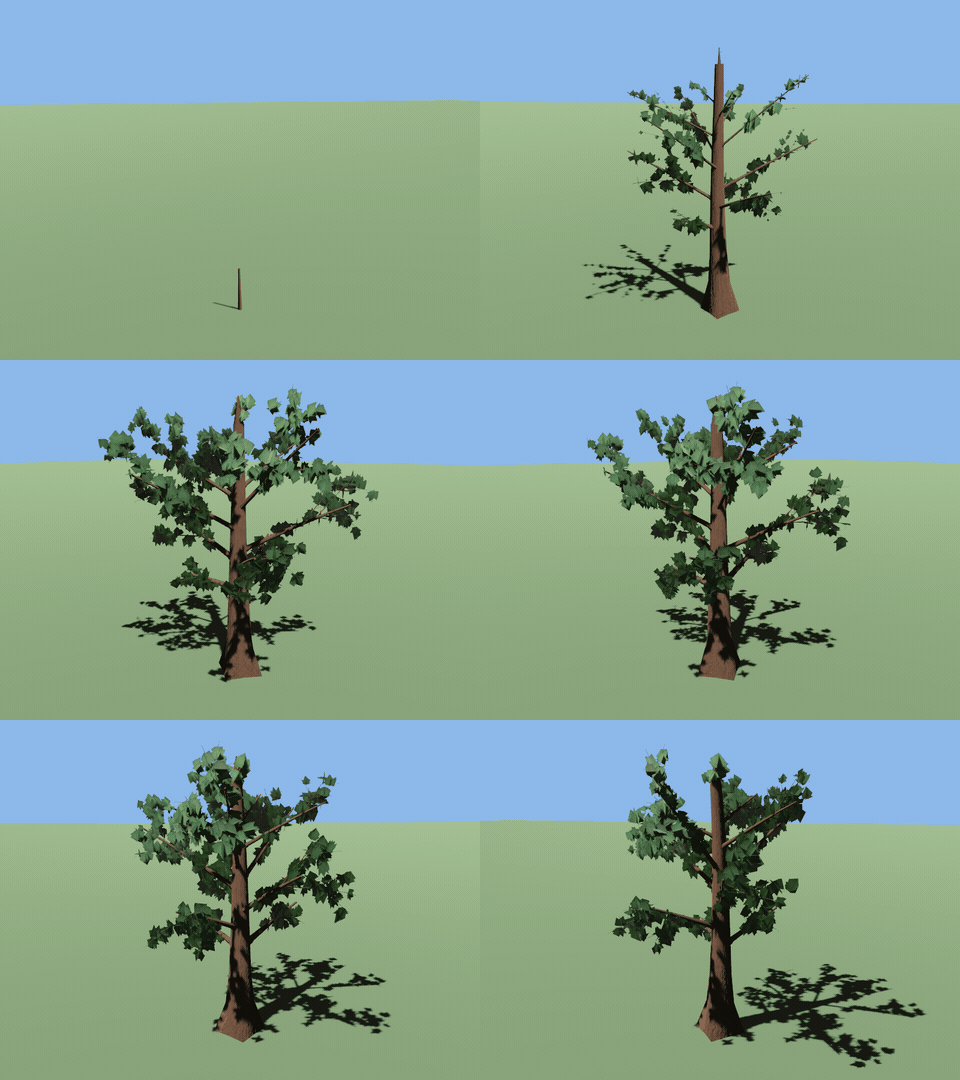
cargo run --release --example capture_growth: the maple preset from age 0 to maturity, one frame per age step, in a light wind.
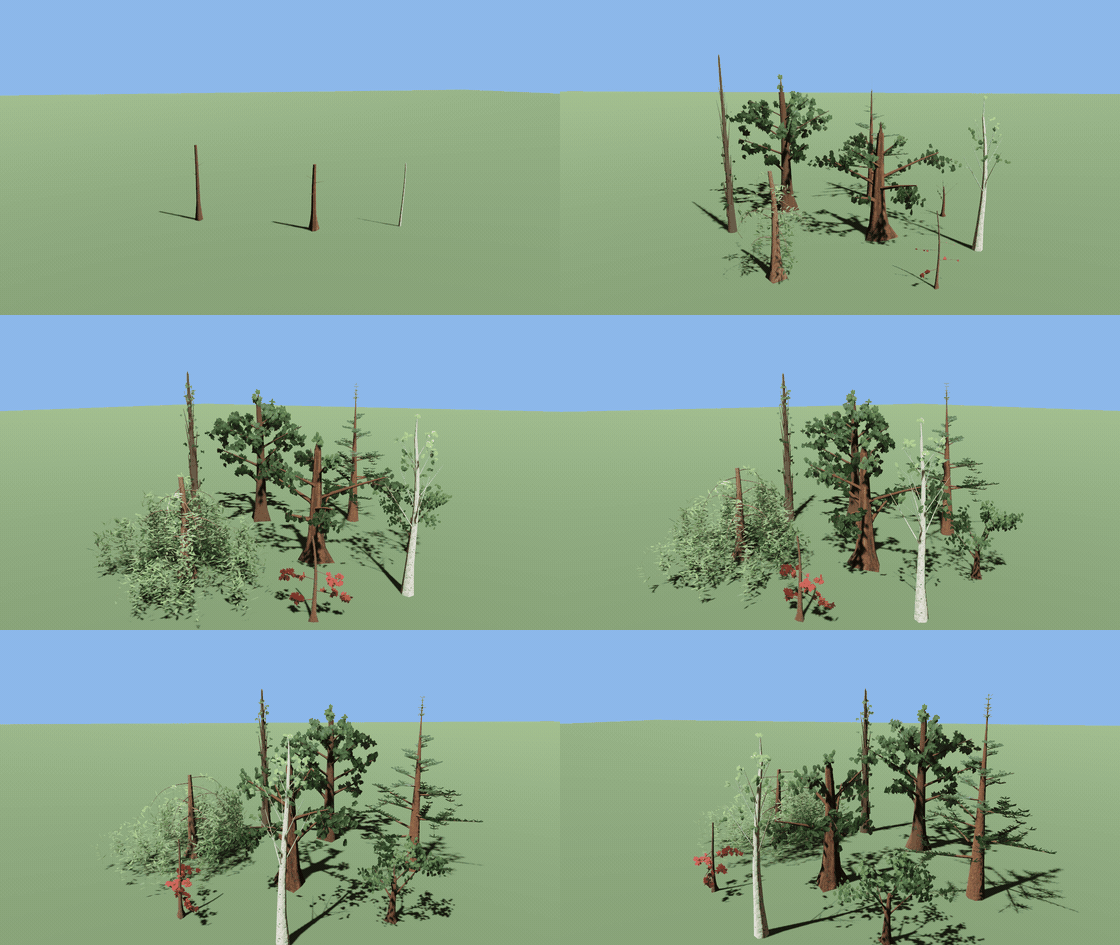
cargo run --release --example capture_growth -- --grove: a grove of an oak, a maple, a Japanese maple, a birch, a cherry, a pine, a cypress and a willow, each at its own age, with a gust front crossing it in the last seconds. Every tree is a ProceduralTree with its own seed.
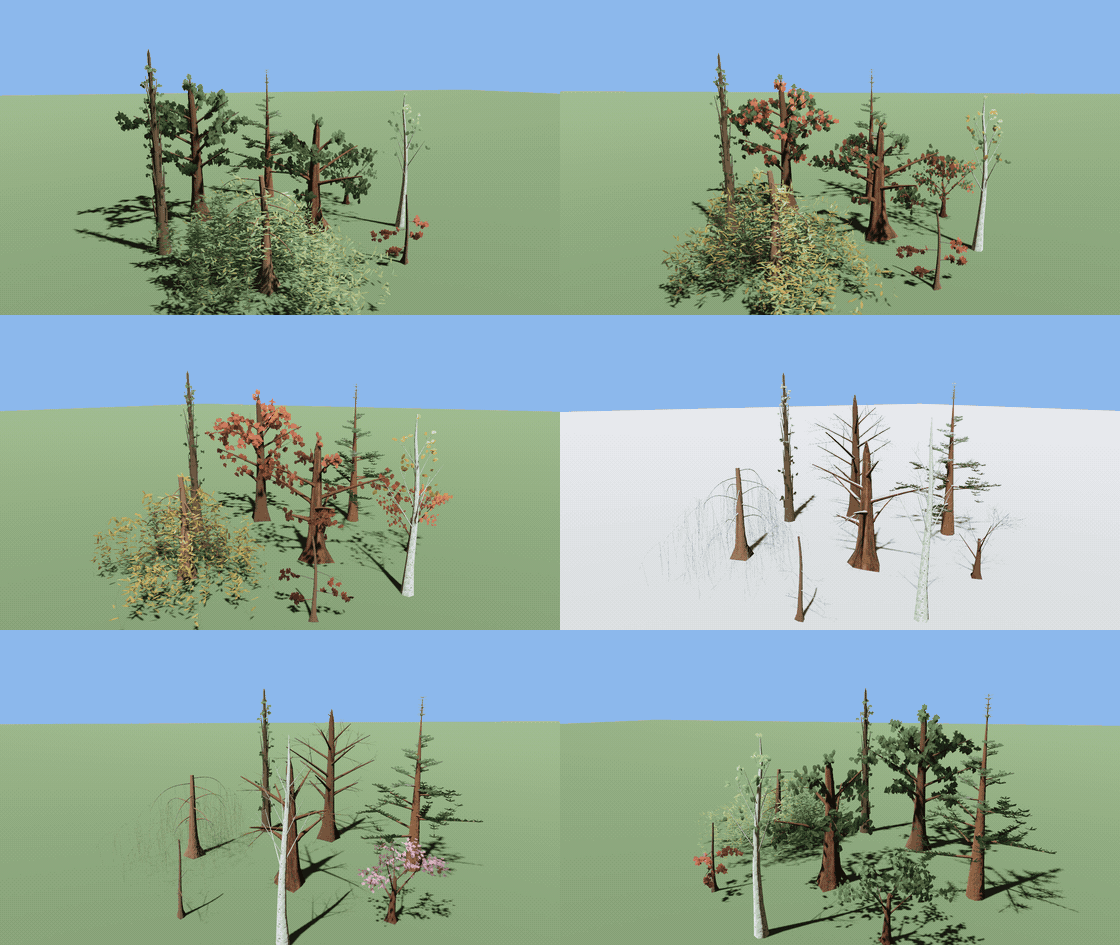
cargo run --release --example capture_growth -- --seasons: the grove from late summer through autumn, leaf fall, snow and winter into spring, driven by FloraSeason::of_year. The deciduous presets carry an autumn colour, the cherry blossoms before its leaves come back, and the pine and the cypress are evergreen.
Compatibility
bevy_flora |
bevy |
Rust |
|---|---|---|
| 0.34 | 0.20 | 1.97.1+ (edition 2024) |
Install
[]
= "0.34"
| feature | default | what it does |
|---|---|---|
textures |
yes | The bundled CC0 bark and leaf scans (about 3.6 MB of JPEG compiled into the crate). Without it every scan is absent: wood is plain colour and leaves keep their procedural outline |
serde |
— | Serialize / Deserialize on every parameter type and on Scatter, so trees and forests can be authored in RON or JSON. A tree's fields may be left out (they keep their defaults); an unknown field is an error |
ron |
— | serde, plus the .tree.ron asset loader and TreeParams::to_ron / from_ron (see Trees from files) |
file_watcher |
— | Bevy's file_watcher: assets, .tree.ron trees included, reload when their files are saved. An app without an assets folder then logs a warning at startup |
The library depends on bevy with default features off (std, bevy_asset, bevy_color, bevy_log, bevy_mesh, bevy_pbr, and jpeg to decode the bundled textures), so it adds no windowing or audio to a build.
Quickstart
Add the plugin and spawn a tree. Growing advances its age every frame until it is mature; leave it off and set TreeAge yourself (the default, f32::INFINITY, is the mature tree).
use *;
use ;
The plugin keeps two child entities on each tree (wood and leaves) and rebuilds their meshes whenever ProceduralTree or TreeAge changes. It sends a TreeGenerated message after each rebuild.
Trees from files: ProceduralTreeAsset and .tree.ron
TreeParams is an asset. Spawn ProceduralTreeAsset(handle) in place of ProceduralTree(params) and the plugin gives the entity its ProceduralTree once the asset has loaded, and replaces it whenever the asset changes, so every tree that shares the handle follows an edit, made in code (Assets<TreeParams>::get_mut), in an inspector (the asset is registered for reflection) or in a file. With the ron feature the plugin loads .tree.ron files, and with Bevy's file_watcher (this crate's file_watcher feature turns it on) saving one rebuilds its trees while the game runs, a few tenths of a second after the save: tune a tree without recompiling. TreeParams::to_ron writes any tree as a file to start from (cargo run --example tree_file --features ron -- --export oak). A file may leave fields out, which keep their defaults; a misspelt field is an error that gives the line and the fields that exist; and a file that fails to load keeps the last good tree.
use *;
use *;
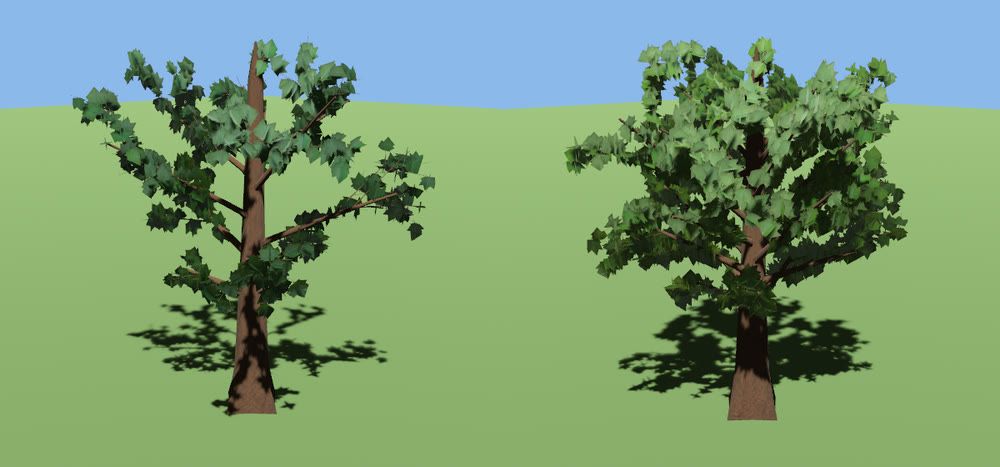
cargo run --release --example tree_file --features ron (add file_watcher to rebuild on save): left, examples/assets/trees/maple.tree.ron as exported; right, the same file with the branch density raised from 3 to 7, the leaf density from 4.5 to 7 and the leaf colour lightened.
Pools are built from a value (build_pool(assets.get(&handle).unwrap(), ..)), so a pool does not follow later edits to the asset.
Growing many trees: GpuGrowth
A growing tree normally rebuilds both meshes every frame, 0.1 to 0.4 ms of CPU per tree. Add GpuGrowth and the tree is built once, at maturity, and grown in the vertex shader: each frame the plugin ages the skeleton and writes a few kilobytes of per-node state, and nothing else is uploaded.
use *;
use ;
Main-world cost per frame with every tree growing (a headless App, release build, Apple M-series, median of three runs):
| 200 growing trees | CPU rebuild | GpuGrowth |
|---|---|---|
| oak | 17.6 ms | 0.81 ms |
| willow | 25.4 ms | 0.90 ms |
| oak, 2 smoothing passes | 69.8 ms | 0.70 ms |
Shadows follow the growth (the prepass shares the vertex shader), and the grown frames match the CPU path: over all 357 gallery scenarios the mean difference between the two renders is 0.07 of 255 (48 PNGs are byte-identical, the worst is a toon maple at 1.31). What differs, and why, is listed on GpuGrowth in the docs: smoothing is computed once on the mature mesh and deformed, side counts stay at the mature count, AllBranches leaves keep their mature positions, and the Mesh assets (picking, physics, culling) are the mature tree. It needs storage buffers in the vertex stage, so not WebGL2; there the trees grow on the CPU.
Planting without a hitch: BuildInBackground
A tree is built in the frame it is spawned (or its ProceduralTree changes), on all cores, and that frame waits for it: a game that plants a chunk of trees as the player walks feels it. Add BuildInBackground and the tree is built on Bevy's async compute pool instead; the frame goes on, and the tree appears the frame its build is done, usually a few later (TreeGenerated is sent then; until its first build a tree has no TreeRender and draws nothing). The meshes are the same: a screenshot of a forest built either way is the same image, byte for byte.
use *;
use *;
// A streamed chunk of the world comes in: plant its trees without stalling the frame.
The frame the trees are spawned in, measured in a headless App that does 8 ms of other work a frame (release build, Apple M4 Pro); the GPU uploads of their meshes come on top, in the frames their builds land:
| spawned in one frame | built in the frame | BuildInBackground: worst frame |
all drawn after |
|---|---|---|---|
| 10 oaks | 4.0 ms | 0.3 ms | 2 frames |
| 50 oaks | 8.2 ms | 0.4 ms | 2 frames |
| 200 oaks | 22.8 ms | 0.5 ms | 3 frames |
| 200 cherries | 37.7 ms | 0.5 ms | 5 frames |
A change of parameters while a build runs starts a new one in its place (the tree keeps its old meshes until the new ones are in), and a change of age waits for it and is caught up after. A Growing tree is rebuilt in the background at every age too, so it shows each age a frame or two late; GpuGrowth trees build their mature meshes in the background and age in the frame, as they do without it. forest --background builds its trees this way.
Distant trees for less: TreeLod
A ProceduralTree is drawn in full at every distance: an oak 150 m away costs as many vertices as the one beside the camera. Add TreeLod and it is drawn the way a pool draws its trees, from the same levels (build_lods): in full up close; from 30 m (LodDistances::lod1) without the branches thinner than 1.5 cm and with a third of the leaves, made larger to cover the same crown; from 80 m (lod2) with the limbs thicker than 5 cm and an eighth of the leaves; cross-fading over 2 m at each switch. There is no impostor: level 2 is drawn at every distance beyond lod2. The trees stay individual trees, which grow, change their parameters, keep their own looks and fall.
use *;
use *;
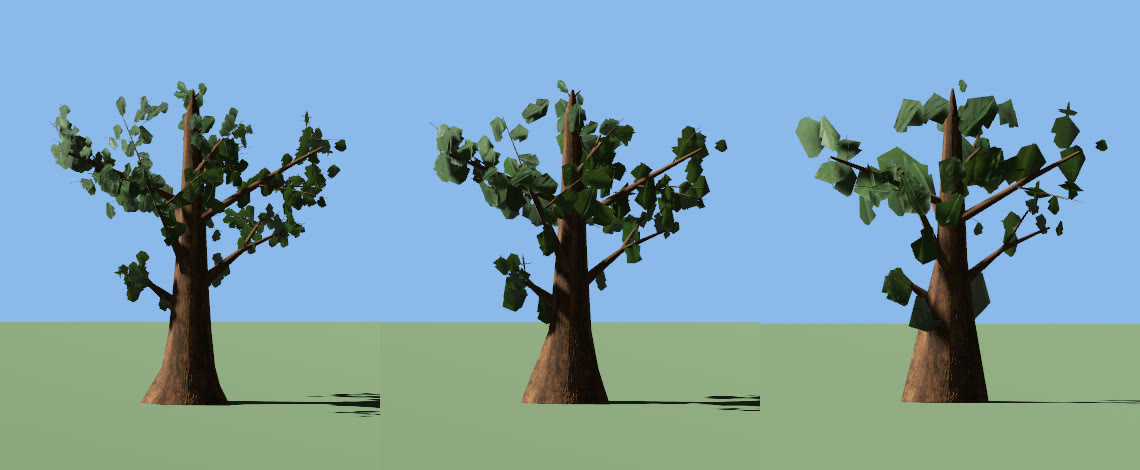
The same oak at level 0 (25 m), level 1 (33 m) and level 2 (91 m), each zoomed to the same size.
Measured with forest --mode naive --offscreen --deterministic (1920x1080, Apple M4 Pro, interleaved runs of 0.23.0):
without TreeLod |
with TreeLod |
|
|---|---|---|
| 1 000 oaks, fully grown | 24.4 ms | 6.5 ms |
200 oaks growing on the CPU (--mode cpu-live) |
10.1 ms | 14.1 ms |
Every rebuild builds the coarse levels too, from the same skeleton, so a tree growing on the CPU pays for them with every new age; a GpuGrowth tree ignores TreeLod. Each coarse level adds two children to the tree, a wood and a leaf child (marked plugin::TreeLodMesh), drawn with the tree's own materials; a flowering tree's flowers ride in their leaves, as on a pool's. A felled tree drops them at the cut and falls in full. forest --tree-lod draws its trees this way, and inspect --mode tree --lod a,b,c photographs one through the switches.
Drawing a forest: TreePool
ProceduralTree gives every tree its own meshes, which a GPU can draw a few thousand of. Trees with equal looks (the same colours, trunk height, wind response and leaf shading; seeds and every other parameter may differ) share their two materials, so a thousand oaks cost 22 ms a frame, not 58; give each tree its own colour or trunk height and each gets its own materials again. For a forest build a TreePool once, a few seed variants of one tree, and place PooledTrees from it. Entities that share a mesh and a material are drawn in one instanced call, and the distance to the camera picks what is drawn: the full tree up close, two coarser levels of detail (30 m and 80 m by default, cross-fading) and, beyond 200 m, one camera-facing quad per tree that shows a view of the variant baked in the running app.
use *;
use ;
Measured for 0.6.1 with cargo run --release --example forest -- --offscreen (1920x1080, one shadow-casting sun, wind on, an oak forest on an 8 m grid seen across it from 30 m up, Apple M4 Pro, release build; the median of three runs on a machine with nothing else running, the runs within 1% of each other; the larger forests are not run with a mesh per tree, which would take an estimated 15 and 75 GB of GPU memory):
| trees | one ProceduralTree each |
pool, levels of detail only | pool, with impostors |
|---|---|---|---|
| 1 000 | 22 ms | 4.2 ms | 3.3 ms |
| 5 000 | 60 ms | 8.0 ms | 3.3 ms |
| 20 000 | not run | 18.7 ms | 3.4 ms |
| 100 000 | not run | 64.7 ms | 7.3 ms |
Bark (0.7.0) and leaf scans (0.8.0) leave these figures where they were, within what could be measured: the machine these were taken on has been loaded by other builds since, so the table above was not re-measured, and the releases were compared by interleaved runs instead (see the CHANGELOG). In those, 100 000 pooled oaks cost no more in 0.8.0 than in 0.7.0 (0.6.2 and 0.7.0 took 7.41 and 7.45 ms), and a thousand individual ProceduralTree oaks cost 4 to 10% more, because a leaf card cut to a real outline has more vertices than the old fan. The looks of 0.9.0 do not move them: the natural look draws the same pixels as 0.8.0 with the same shaders, and in interleaved runs 100 000 pooled oaks took 12 to 16 ms in all three looks on a machine under load, a thousand individual ones 31 to 48. Seasons (0.11.0) add under 1%: 100 000 pooled oaks took 7.33 ms in 0.10.0 and 7.40 in 0.11.0, a thousand individual oaks 23.4 and 23.6 ms (medians of three interleaved runs on a quiet machine), and half-bare trees are cheaper (22.1 ms).
The pool's trees are static: they have the age the pool was built at, and growing trees stay ProceduralTree (with GpuGrowth), which suits the few that are close. Impostors are baked once per variant by a few frames of offscreen rendering, so a tree appears when that is done, and they need FloraPlugin added after DefaultPlugins (before it, with no renderer, or on a device without storage buffers in the vertex stage such as WebGL2, the coarsest level is drawn at every distance and one warning says so). They are baked unlit, as a colour and a surface picture, and shaded by the scene's own lights every frame: they follow the time of day, glow with the sun behind them and sway with the wind. They cast no shadows, and they show one of eight views, at one elevation. With MSAA an impostor keeps the gaps of its crown: each pixel draws the share of its samples the baked tree covers, so a far crown is as airy, and as light, as the leaves it stands for. Level 2 and the impostors replace thin twigs and most leaves, so a forest seen from above or close up should keep its near trees at level 0.
Planting a forest: Scatter
A grid of trees reads as an orchard. Scatter spreads them the way a forest stands: trunks never closer than spacing and otherwise irregular (Poisson-disc sampling, Bridson 2007), species in groves about grove_size wide whose borders bend instead of salt and pepper, and every tree its own yaw, size (scale, 0.85 to 1.15 by default) and pool variant. points_where takes a density for each spot, 0 for a road, a lake or a village and a fraction for open woodland, and only ever removes trees, so carving a clearing never moves the trees around it. It is pure CPU and deterministic per seed: 90 000 trees in groves take 0.2 s (Apple M4 Pro), once.
use *;
use *;
forest --scatter oak:3,birch:2,maple:2,pine:1 --grove 60 --clearing 25 plants one, here in autumn so the groves show:
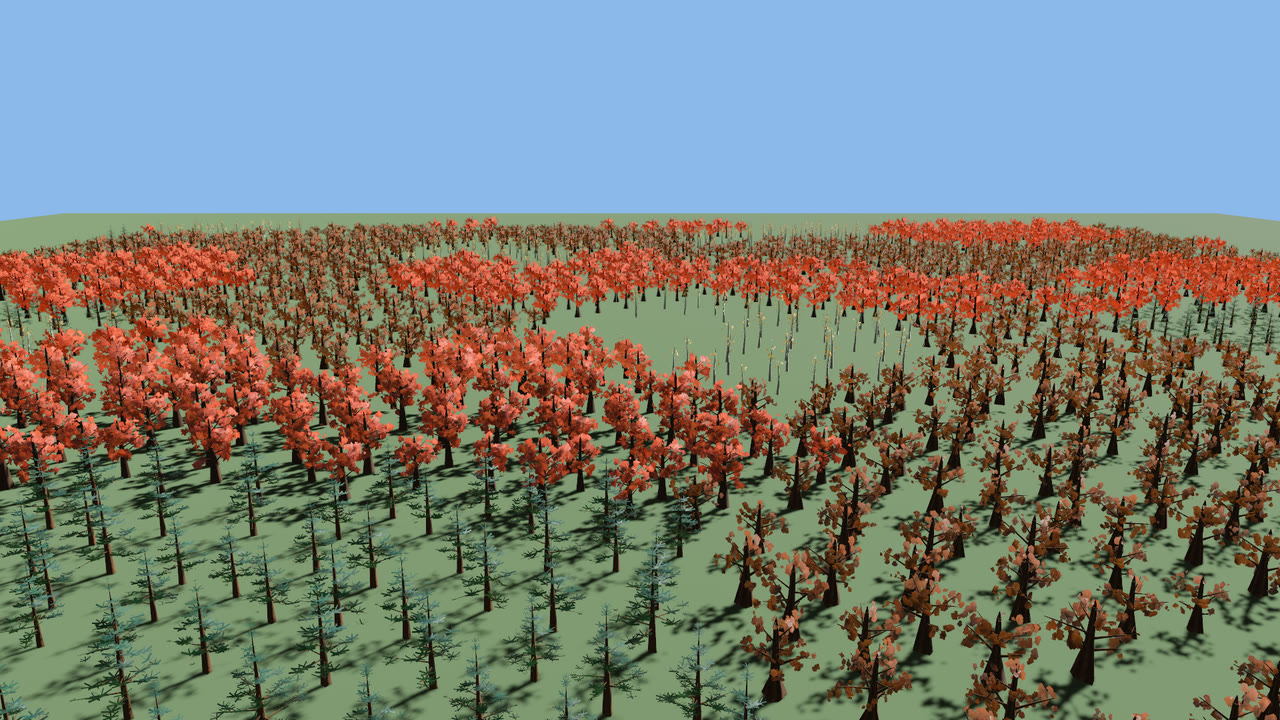
cargo run --release --example forest -- --trees 3000 --spacing 7 --scatter oak:3,birch:2,maple:2,pine:1 --grove 60 --clearing 25 --season 1,0 --eye 0,45,-200 --at 0,0,-20 --wind 0 --deterministic --screenshot scatter.png
Undergrowth is a second, closer scatter that keeps clear of the trunks, drawn from the Shrub preset (a mound of arching stems about 1.4 m high and 1.9 m across: 5 900 wood and 17 600 leaf triangles up close, 2 100 in all at its coarsest level):
use *;
use *;
// Shrubs at least 2.5 m apart and 1.5 m from every trunk. For a big forest, look the trunks up in a
// grid instead of all of them (the `forest` example does).
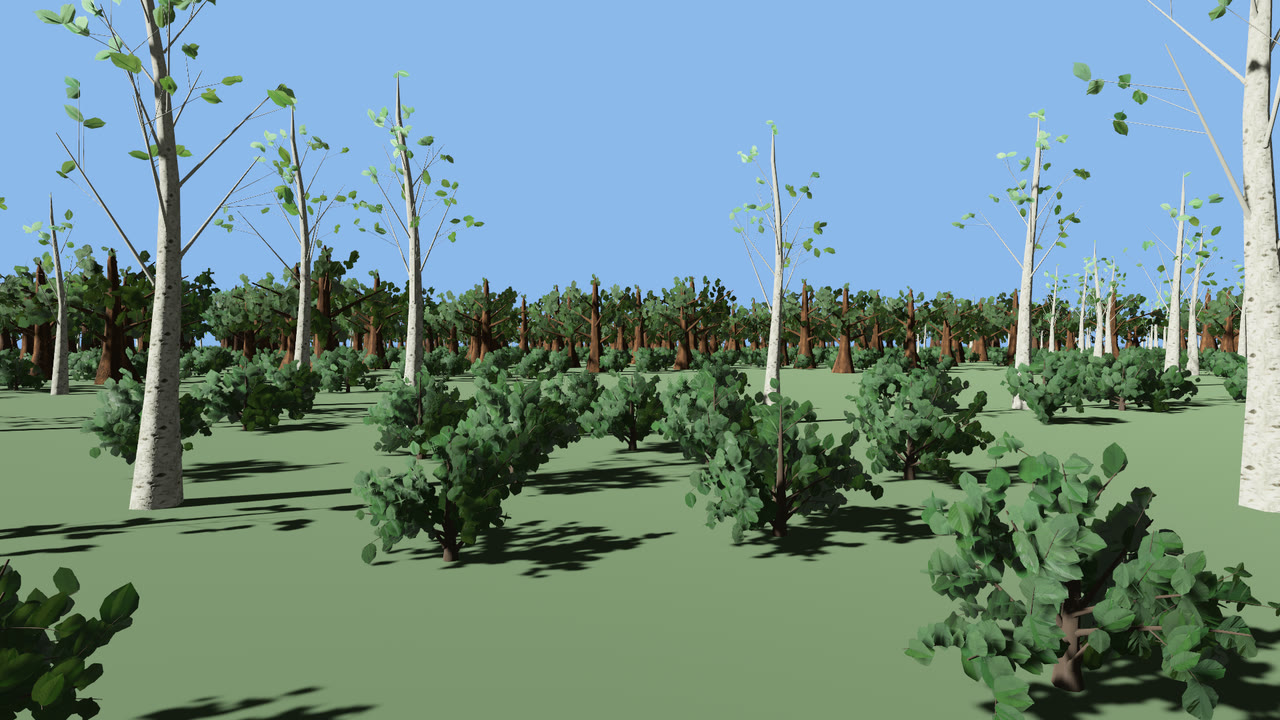
cargo run --release --example forest -- --trees 1500 --spacing 7 --scatter oak:3,birch:2,maple:2 --grove 30 --clearing 14 --undergrowth shrub:2.5 --eye -14,1.8,-30 --at 6,1,0 --fov 55 --sun 20,25,-30 --wind 0 --deterministic --screenshot undergrowth.png: the example's undergrowth also thins out in patches about 30 m across.
A shrub stands about a tenth as tall as a tree, so its pool can hand over to coarser levels much nearer: build it with half the default distances, LodSettings { distances: LodDistances { lod1: 15.0, lod2: 40.0, impostor: 100.0 }, ..default() }, as the example does. In the forest above (1 372 trees and 4 863 shrubs, --offscreen --deterministic, the default camera), the trees alone take 2.7 ms a frame; with the shrubs at the trees' distances 7.9 ms, at half of them 3.3 ms (Apple M4 Pro).
On terrain: FloraGround
A tree stood at the ground's height under its centre floats on a slope: the downhill side of its trunk hangs in the air over the ground, its flat base showing. FloraGround is the height of your ground at every point (x, z), your terrain's height function or a lookup into its heightmap, and footing(at, radius) is the lowest ground under a trunk's base, where a tree stands so that its trunk meets the ground all round. TreeParams::base_radius() is that base, flare and root ridges included, and ScatterPoint::transform_on(&ground, ¶ms) does it for a scattered tree at its own scale. slope(at) and normal(at) keep trees off cliffs and screes.
use *;
use *;
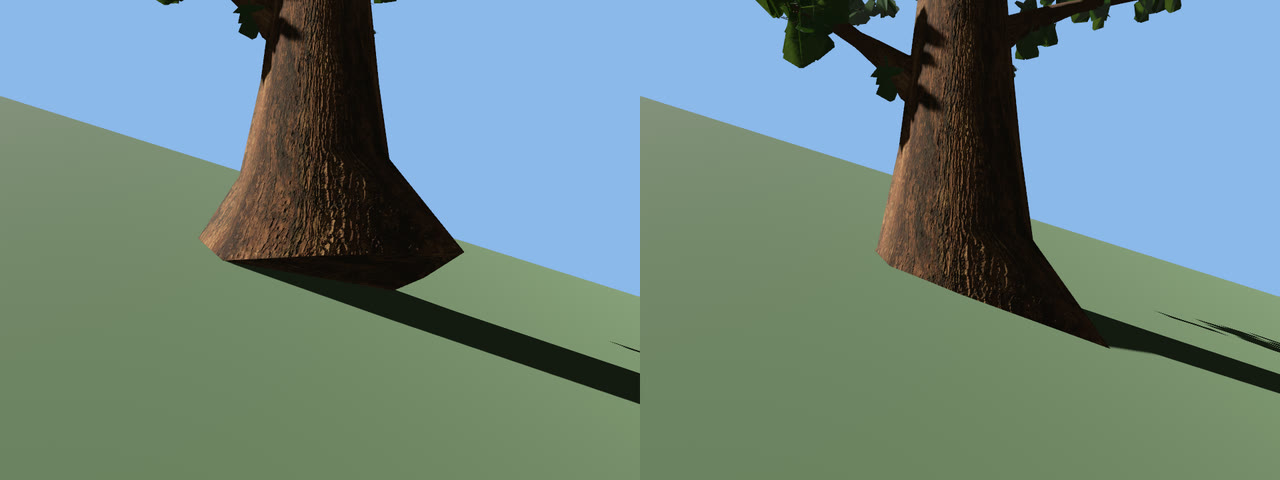
cargo run --release --example inspect -- --out target/footing --preset oak --mode tree --slope 25 --distance 4 --eye 0.6 --look 0.04 (right), with --on-centre (left).
As a resource it is also the ground felling uses: the saw goes in cut_height above the trunk's uphill side, so a stump on a slope is taller on its downhill side, and a felled tree comes to rest where its trunk or limbs meet the terrain, turning further than on flat ground when it falls down the slope and less when it falls against it. Without it the ground is flat at each tree's own height, as before. The crate does not draw the ground: FloraGround is only what trees stand and fall on, so it must match the terrain you draw. Branches and leaves are not bent to the slope: on steep ground a spruce's lowest whorls and a willow's strands on the uphill side run into the hillside.
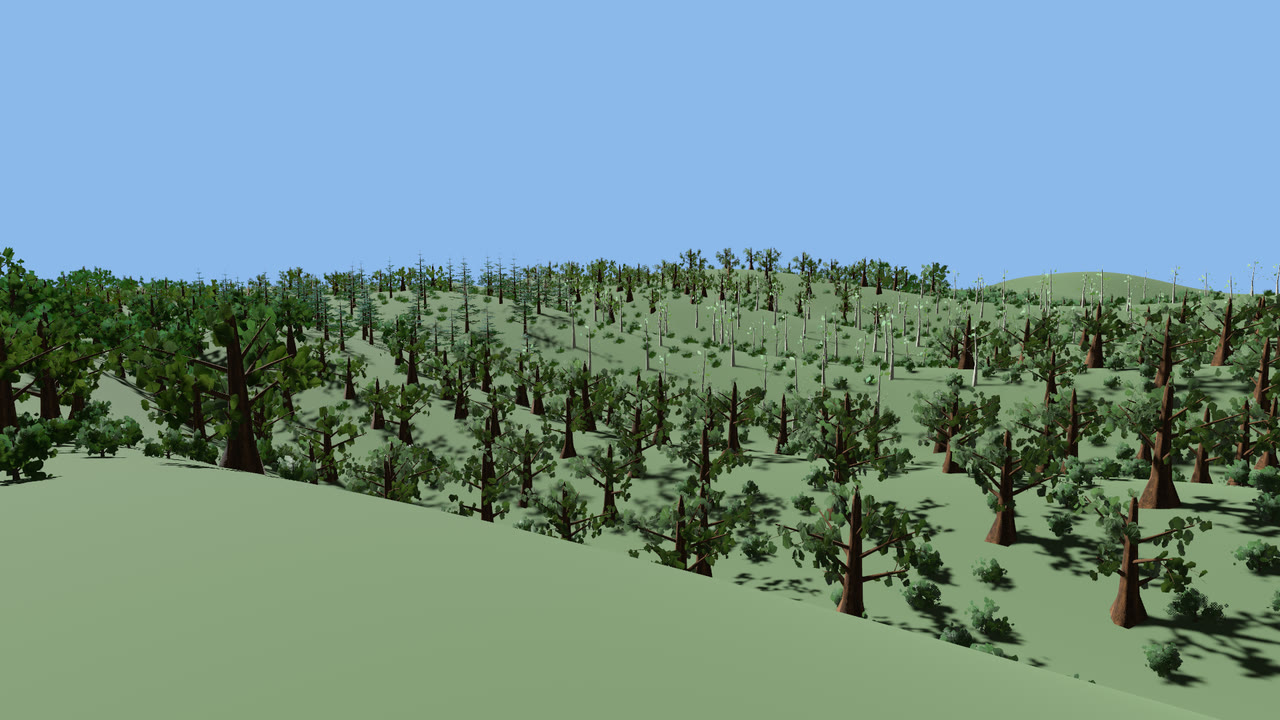
cargo run --release --example forest -- --trees 3000 --spacing 7 --scatter oak:3,birch:2,pine:2,maple:1 --grove 50 --clearing 30 --terrain 14 --undergrowth shrub:3 --eye 0,2,0 --at -80,8,0 --fov 50 --wind 0.3 --deterministic --screenshot terrain.png: --terrain 14 draws hills about 14 m high and plants every tree and shrub at its footing, none on ground steeper than 30°.
Leaf shading and wind
Trees drawn by the plugin move in the wind, with no cost to the CPU per frame. FloraWind is a global resource: how hard (strength), which way (direction), how fast (speed), how far trees bend (bend), how much leaves flutter (flutter, flutter_frequency), how much the wind comes in gusts (gust_strength, gust_frequency) and sways across itself (turbulence). TreeParams::wind is how a species answers it, and the presets set their own: a willow moves more than an oak, a bonsai hardly at all. A GustFront is a band of stronger wind that sweeps across the world:
use *;
use ;
// Call this once, when the storm begins (from an event or a timer), not every frame: launching a
// gust restarts its front at `origin`.
Changing FloraWind writes one small shared buffer (FloraWindBuffer) and touches no material, so you can animate it every frame (a storm that builds, a wind that turns): a pooled forest of 20 000 trees takes 3.3 ms a frame with the wind changing every frame, where 0.5 took 212 ms (Apple M4 Pro). Launching a gust front writes the same buffer. Wind writes no motion vectors, and branches do not sway on their own: the whole tree bends and the leaves flutter. Leaf shading and wind need storage buffers in the vertex stage; on a device without them (WebGL2) trees are drawn with plain materials and one warning says so.
Bark
Trunks and branches wear a bundled CC0 bark scan (a colour map and a normal map, 512 px wide, about 3.1 MB for all 14). Each preset picks the scan of its species (TreeParams::bark); BarkParams sets how it follows the wood's growth. The scan is laid out in metres on the mature tree, so a growing tree's bark never slides; wood thinner than smooth_below is smooth, and by fissured_above it shows the whole scan, so a young branch gains relief as it thickens. The scan's average colour is divided out of the material's base colour, so a textured tree keeps its preset colour, and far trees, impostors and the plain StandardMaterial fallback look as they always did.
use ;
The textures are compiled in by the default textures feature (about 3.6 MB of JPEG for the bark and the leaf scans); with default-features = false every scan is absent, wood is plain colour and leaves keep their procedural outline. Their sources and licences (all CC0 1.0, no attribution required) are in src/textures/CREDITS.md.
Leaves: real outlines and grown veins
Seven presets (oak, willow, birch, bonsai, maple, poplar and Japanese maple) cut their leaf cards to the real outline of a scanned leaf and wear it. FoliageParams::scan (LeafScan) picks one of seven bundled CC0 atlases of four photographed leaves each; every leaf is one of the four (chosen by a hash of its own random draws, which never change as the tree ages, so a leaf keeps its shape while the tree grows and on GpuGrowth too), the card is as wide as that leaf is, and its length is the leaf's size. The atlas's colour and normal maps are applied in the fragment shader and its average colour is divided out of the leaf colour, so a crown keeps its preset colour. Distant levels of detail cut the cards to a coarser outline.
Leaves with no scan (the other presets and any TreeParams of your own, since scan defaults to None) keep the procedural outline, and their veins are no longer a formula: a vein network is grown from the petiole toward auxin sources scattered over the card by space colonisation (Runions et al., SIGGRAPH 2005), widths by Murray's law, drawn into one small image that every such leaf shares (bevy_flora::venation; LeafShading::veins sets how strongly the shader draws them). Needle clusters and cluster spheres are not leaf-shaped and have none.
use ;
Looks: natural, painterly, toon
TreeParams::style (RenderStyle) changes how a tree is lit, not its shape; every preset is Natural. Painterly gives each leaf the normal that points out of the centre of its own clump (the leaves of one primary branch, the leader or one half of a split) instead of out of the crown's centre, so a crown reads as a cluster of rounded masses, each with a lit side and a shaded side; the lighting is the same physically based lighting as Natural. Toon keeps those normals, cuts the light of each directional light into three bands (0.15, 0.55 and 1 at N·L of 0 and 0.5) times its shadow and the surface colour, keeps the light that comes through backlit leaves, and darkens every surface toward its silhouette with an ink rim. Point and spot lights do not light a toon. Pools, impostors, GpuGrowth and growing trees draw them all; without the renderer's plugins (the plain-material fallback) a toon is lit as a painterly tree.
use ;
Seasons
FloraSeason is a global resource like FloraWind: how far the leaves have turned (autumn, 0 summer green to 1 every leaf in its autumn colour), how many have fallen (leaf_fall, 0 to 1, bare), how much snow lies on the trees (snow, 0 to 1) and how far flowering trees are in blossom (blossom, 0 to 1). The deciduous presets (oak, willow, birch, bonsai, maple, poplar, baobab, Japanese maple and cherry) carry an autumn colour, FoliageParams::autumn; the evergreens have None and keep their needles. Leaves turn one at a time, each at its own moment, and fall in the order they turned. A fallen leaf is dropped in the vertex shader, so it leaves the shadows with it, and a leaf keeps its moment as the tree grows, on GpuGrowth, and on a pool's levels of detail; an impostor turns in patches of a few texels and thins its crown's coverage. Snow settles on every tree, first on what faces straight up and, as more falls, on steeper faces: the tops of branches, and on leaf and needle cards the side the camera sees when that side faces up (a tier of needles is white from above and green from below), as much as the leaf sees of the sky, with a light dusting on every exposed needle so a snowy conifer reads as snowy from below too. Impostors take it by their baked normals. The season shares the wind's buffer, so changing it every frame writes 96 bytes in place and touches no material: a year costs nothing per tree.
use *;
use *;
// A year every two minutes: green until 0.55 of the way through, turning to 0.75, falling from
// 0.7 to 0.9, snowing from 0.88 to 0.92, melting from 0.98, the cherries in blossom from the
// year's turn to 0.07, and in leaf again by 0.07.
// Or set it outright: `FloraSeason::AUTUMN` is every leaf turned, `WINTER` bare trees, `SNOW`
// bare trees and every tree under snow, and `BLOSSOM` flowering trees in blossom on bare branches.
// A preset's autumn colour, or one for a tree of your own; and flowers for any tree.
A flowering tree (FoliageParams::blossom, the cherry's pale pink) has a five-petalled flower at every leaf's stem, which opens as blossom rises, each at its own moment, and falls in the reverse order; of_year brings the cherry into blossom on bare branches as the snow goes and drops the flowers while the leaves come back. The flowers sway and rustle with the leaves, cast shadows, grow on GpuGrowth and thin out on a pool's coarser levels (with simpler petals there); an impostor paints them over its picture in patches. They are a mesh of their own (TreeMeshes::flowers), on a third child of the tree (TreeRender::flower_entity) that the plugin does not draw while blossom is 0, so out of season a flowering tree costs what it would without flowers. In blossom they are most of its vertices (the cherry: 18 400 leaf and 28 500 flower vertices at level 0, 4 900 and 3 400 at level 1, 1 900 and 1 300 at level 2): a thousand individual cherries take 22 ms a frame out of season and 41 ms in full blossom, where a thousand oaks take 24 ms (Apple M4 Pro). A pool keeps its flowers in its leaf meshes and the shaders hide them out of season, so a pooled tree drawn at its finest level still fetches them; but a pool draws most of its trees at the coarser levels and as impostors, and 100 000 pooled cherries take what 100 000 oaks do (7.6 and 7.5 ms).
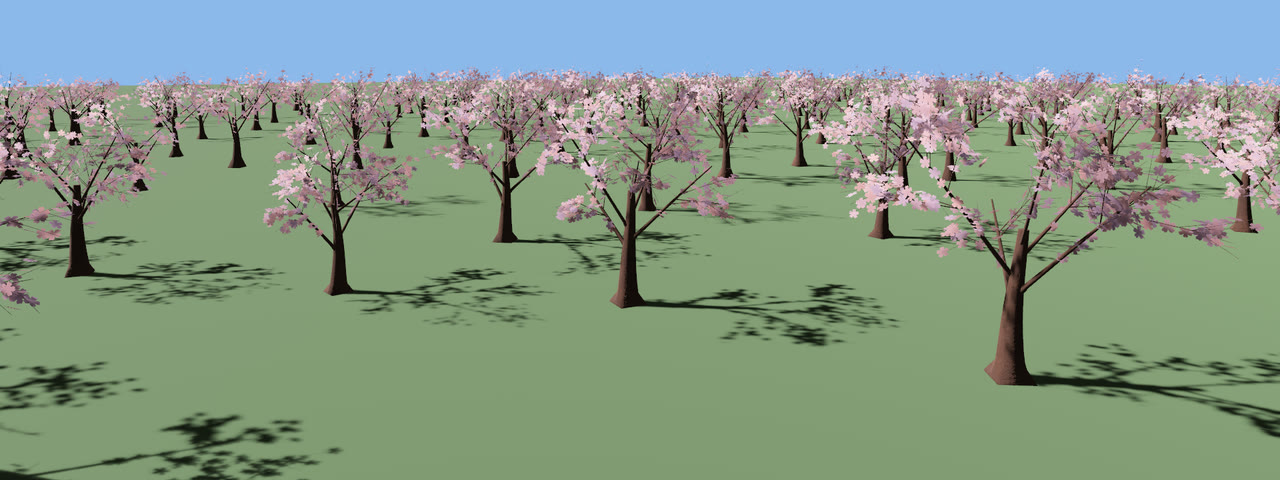
cargo run --release --example forest -- --trees 700 --spacing 5 --scatter cherry:1 --clearing 7 --season 0,1,0,1 --wind 0.3 --sun -20,25,20 --eye 2,4.5,2 --at -25,1.5,-18 --fov 50 --deterministic --screenshot blossom.png, cropped.
A fruiting tree (FoliageParams::fruit: a FruitParams colour, radius and share of the leaves that bear one; the Apple preset's red apples on one leaf in eight) hangs a round fruit below the stem of some of its leaves. The fruit is in the leaf mesh: it sways with its leaf, stays round in the crown's shade (its underside is baked darker), grows with its leaf on a young tree and on GpuGrowth, and a pool's coarser levels carry fewer, larger fruit; an impostor, a few pixels across, leaves it out. The season brings it: no fruit while the blossom is out, then fruit all summer, dropping one by one in the first two thirds of the leaf fall, so FloraSeason::of_year gives an apple tree white blossom in spring, red apples through summer and bare branches by winter. A fruit is 63 vertices (35 on the coarser levels).
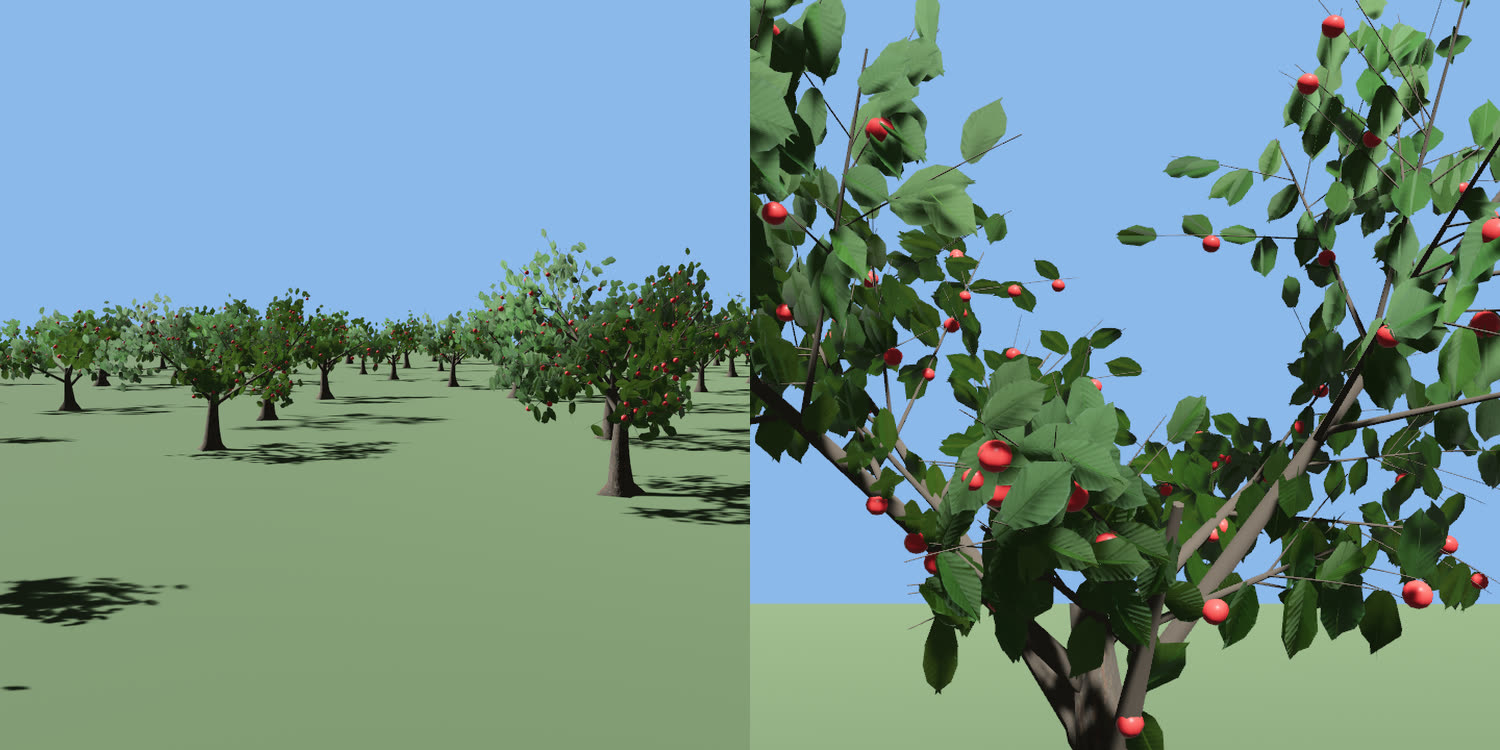
cargo run --release --example forest -- --mode pool --trees 400 --spacing 6.5 --scatter apple:1 --clearing 6 --wind 0.3 --sun -20,25,20 --eye 2,2.6,2 --at -20,1.8,-15 --fov 50 --deterministic --screenshot orchard.png, cropped, and cargo run --release --example inspect -- --out target/apple --preset apple --mode tree --distance 3.2 --yaw 300 --eye 1.6 --look 0.55 --fov 50.
A scattered winter forest under FloraSeason::SNOW: the spruces and pines keep their needles with snow on the tiers that face up, the oaks and birches stand bare with snow along their branches (the white ground is the example's, not the crate's):
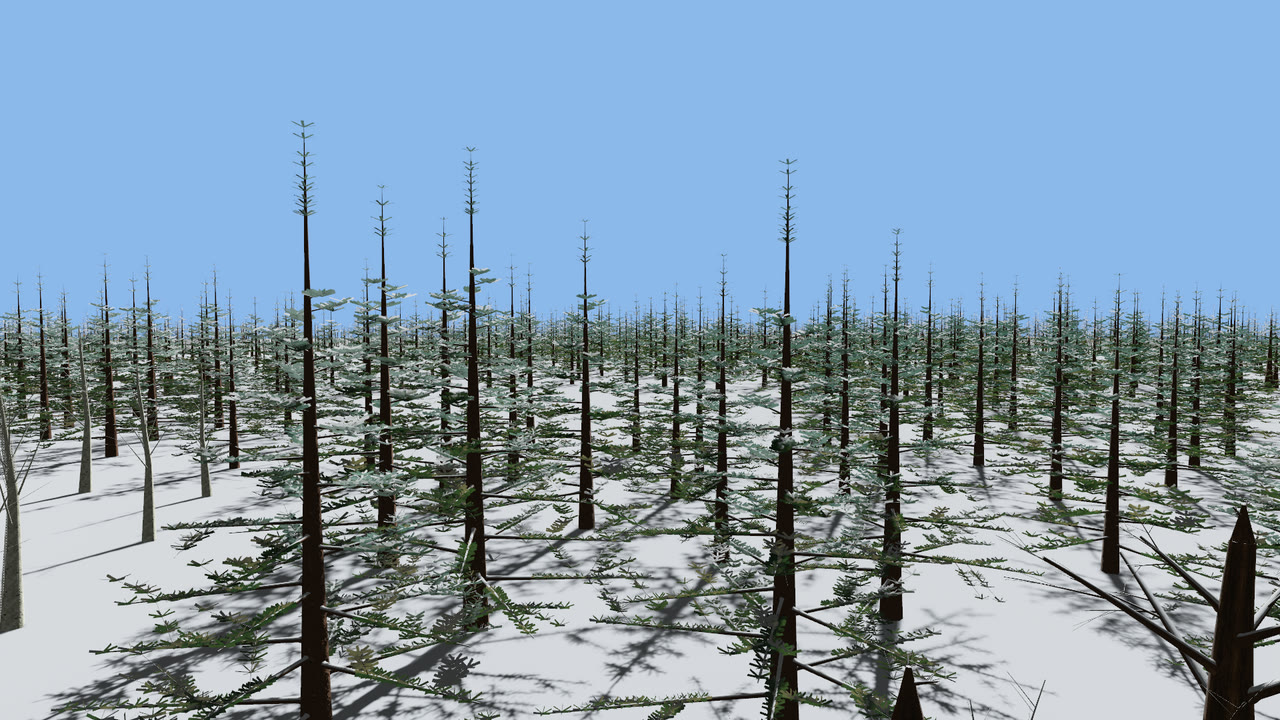
cargo run --release --example forest -- --trees 3000 --spacing 7 --scatter spruce:3,pine:2,birch:2,oak:1 --grove 50 --clearing 25 --season 1,1,1 --eye 25,9,-75 --at 0,6,-20 --fov 50 --wind 0 --deterministic --screenshot snow.png
Rain: FloraWetness
FloraWetness is how wet the trees are, 0 (dry, the default) to 1 (soaked), for the game's weather to raise while it rains and lower as the trees dry. Wet bark darkens to about half, its colour deepens and it turns glossy; a leaf keeps its brightness and only its green grows richer (a darker or glossier leaf lets the sky's white sheen grey the crown, which then reads as frost, not rain). It reaches every way a tree is drawn, pools and impostors included, snow lies over it, and changing it writes one value of the shared buffer, no material: dry, every tree is exactly as before.
use *;
use *;
/// The game's weather.
;
// A shower: soaked in a minute, dry again ten minutes after it stops.
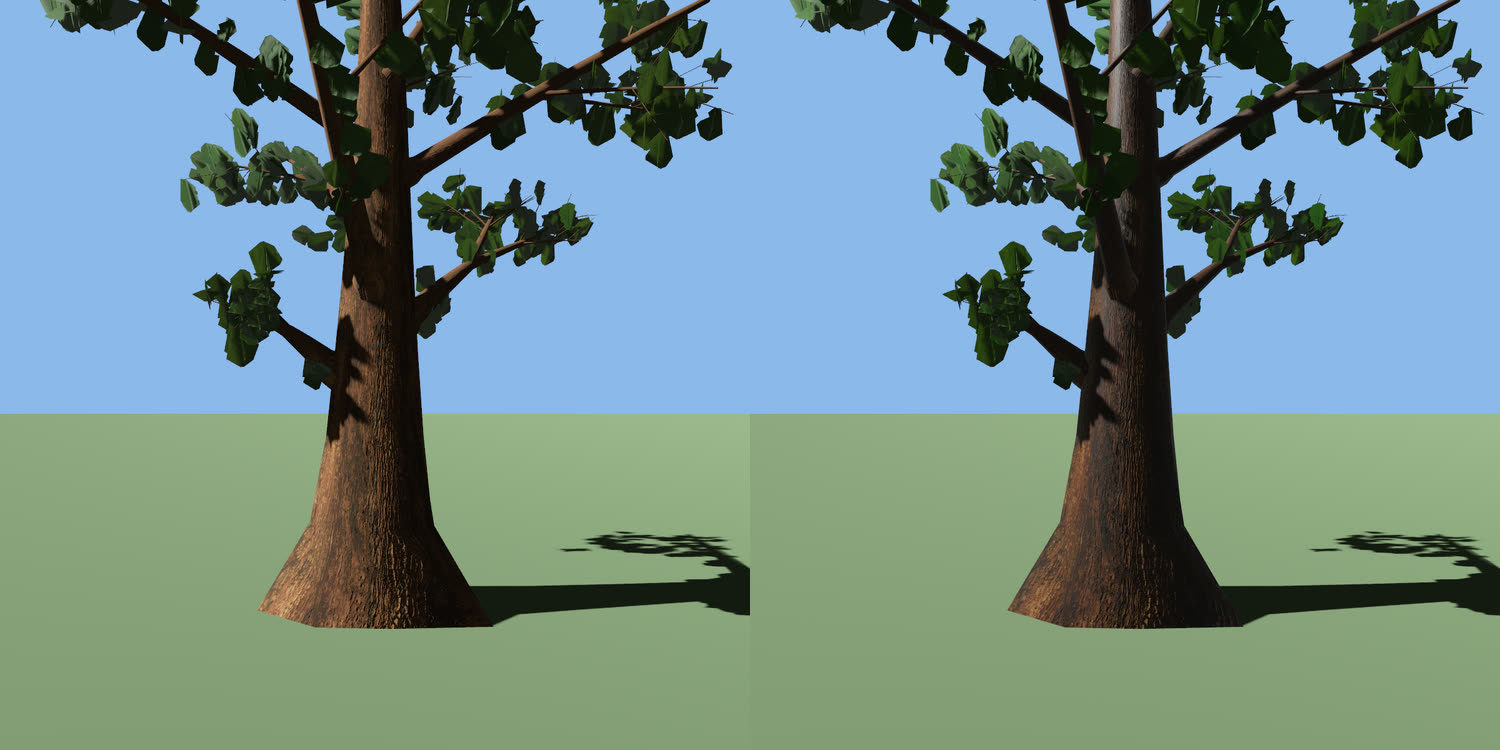
cargo run --release --example inspect -- --out target/wet --preset oak --mode tree --wet 1 --distance 6.5 --yaw 35 --eye 1.7 --look 0.3 --fov 55 --size 1200x1200 (and --wet 0), side by side.
Trees that react: TreeShakes
A game hits trees. TreeShakes is a resource like FloraWind: shake(TreeShake { at, radius, strength, direction, duration }, &time) swings every tree whose trunk stands within radius metres of at (world x and z), the nearest the most, first away from at (or along direction), then back and forth, dying away over duration seconds, while its leaves rustle. About a metre of radius singles out the tree that was hit; tens of metres reach a whole grove. Each tree swings at its own pace, taller trees slower, and the whole tree bends as it does in the wind, on every way a tree is drawn: ProceduralTree, GpuGrowth, pooled trees and their impostors. Up to eight shakes run at once (TreeShakes::MAX; a new one takes the place of the one that ends soonest, so a knock always shows). They live in the wind's shared buffer, so a shake writes a few hundred bytes and touches no material, and while none is under way the shaders compare one number a vertex. A shake is drawn, not simulated: colliders (TreeShape) stay where they are.
use *;
use *;
// An axe on the tree standing at `trunk`, swung along `swing`: a metre of radius singles it out.
// A blast: every tree within 30 m swings away from it.
;
// A character pushing through a thicket: a small knock where it is, a few times a second.
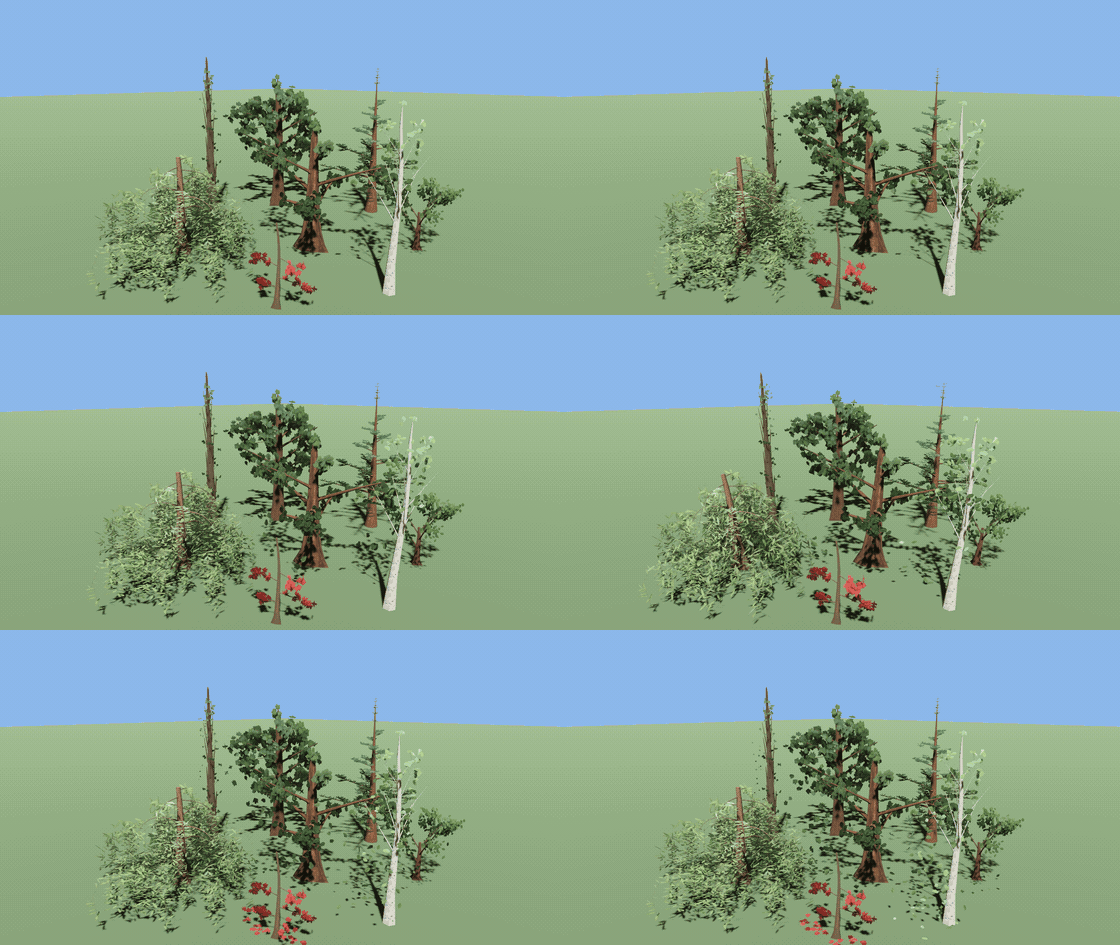
cargo run --release --example capture_growth -- --shake: an axe on the oak, one on the birch, then a blast at the grove's middle, in a light wind; leaves fall from every tree hit.
Falling leaves: DropLeaves
Hit a tree and leaves come off it. Every new shake knocks FallingLeaves::per_shake leaves (12 by default) off each tree it reaches, times its strength and fewer toward its radius, and a felled tree sheds per_landing (80) as it lands. DropLeaves { tree, count } drops leaves from any tree whenever the game wants: a bird lands, an arrow hits, a gust. The leaves are copies of the tree's own cards: each hangs where it grew until its moment (a drop lets go over half a second), falls, picking up speed to between 0.9 and 1.5 m/s, tumbles about an axis of its own and swings from side to side, drifts with FloraWind, turns flat as it reaches the ground (FloraGround, or the height the tree stands at), lies there for about FallingLeaves::rest seconds (6) and shrinks away. They wear the tree's scan, tint and season (a red maple drops red leaves, and a deciduous tree drops none of those it has already shed), cast shadows, and a leaf of crossed planes or a star folds flat when it lands.
use *;
use *;
// A bird lands in the oak.
// More leaves to a hit, lying longer.
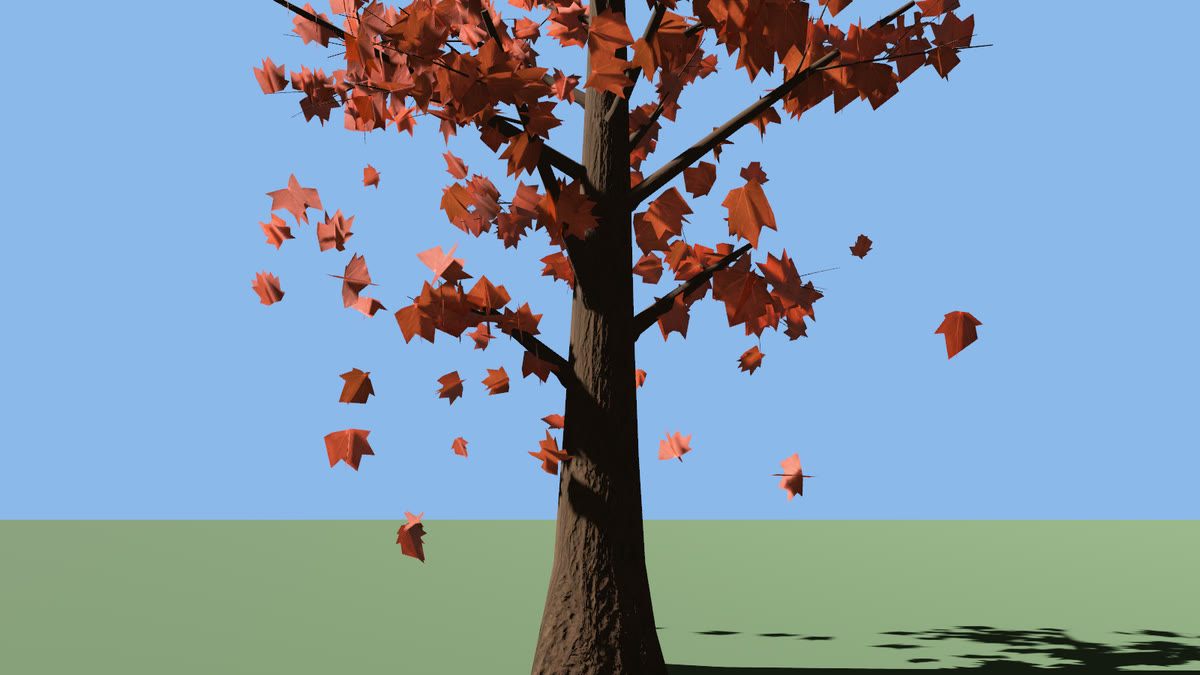
inspect --mode tree --preset maple --season 1,0.3 --drop 40,2.6: forty leaves of an autumn maple, 2.6 seconds after they let go.
In autumn the falling leaves are the tree's own. The shaders stop drawing a deciduous tree's leaf once FloraSeason::leaf_fall passes the leaf's moment, so raising it a little at a time (a season passing, as FloraSeason::of_year does) thins the crown leaf by leaf; on the trees within FallingLeaves::autumn_distance (50 m) of a camera each of those leaves now lets go from where it hung and falls like the others (every tenth of a second, those passed meanwhile, in one burst per look of leaves). A rise of more than 0.1 in one frame, such as setting FloraSeason::WINTER, is a season set, not one passing: those leaves are gone at once, as before, and spring brings leaves back without dropping any. Leaves fall at their real speed, so a season sped up to a few seconds leaves them in the air into winter: the seasons clip above, a year in eight seconds, sets autumn_distance to 0.
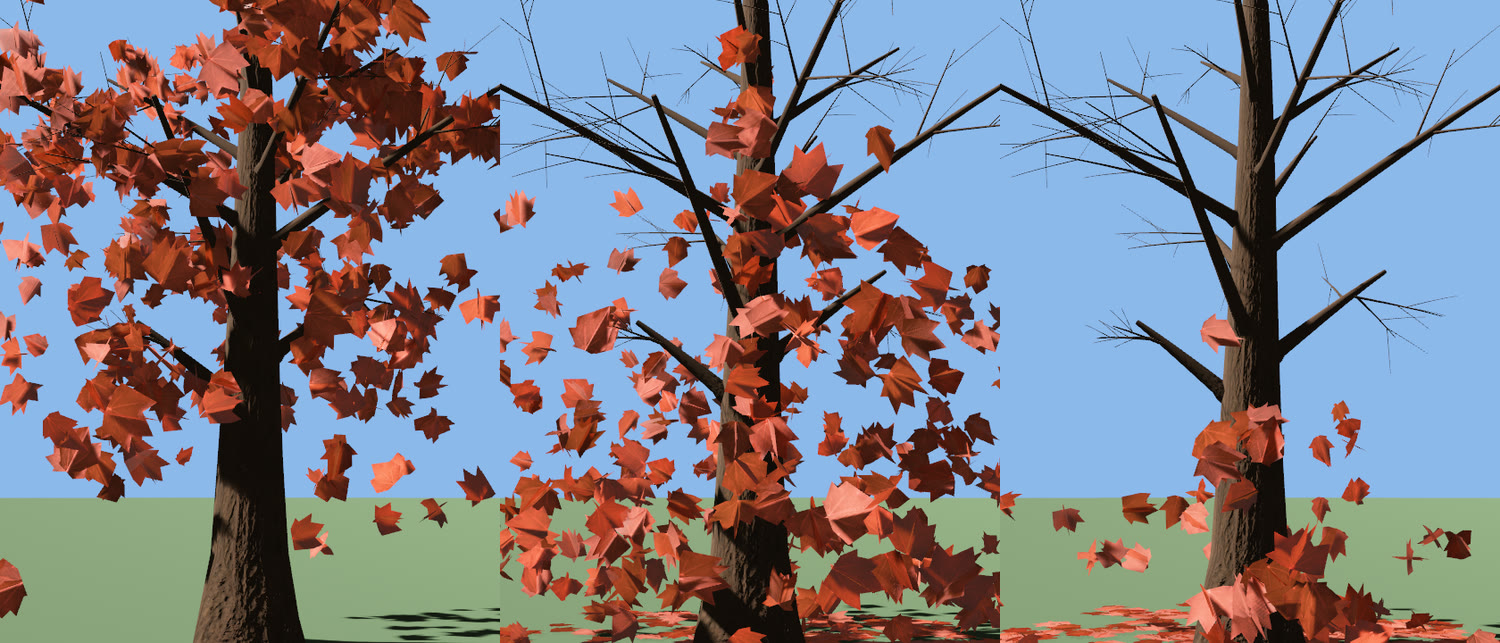
inspect --mode tree --preset maple --season 1,0 --autumn 6,0.5,0.75 --frames 14, frames 3, 9 and 13: the leaf fall rises from 0 to 1 over six seconds; 2.75, 7.25 and 10.25 s in.
Nothing moves on the CPU: a drop is one entity (LeafBurst) with one small mesh, drawn with a copy of its tree's leaf material that moves the cards in its vertex stage (FloraExtension::falling), and despawned when its last leaf is gone. Making one reads the tree's leaf mesh (a pool's variants once, then kept), and FallingLeaves::max_leaves (5 000) caps how many fall or lie at once. On an Apple M4 Pro (forest --offscreen): knocking trees every few frames with every shake slot busy (--shake-animate), so that thousands of leaves are always falling, cost 2% more frame time over 100 000 pooled oaks than before falling leaves and 4% over 1 000 individual ones; an autumn every six seconds, over and over (--leaf-fall-animate 6), costs 1 000 individual oaks 1% more than the same autumn standing still, and 100 000 pooled oaks 2 to 4%. With nothing falling no system runs. Trees drawn on the CPU and from pools drop leaves; GpuGrowth trees and trees drawn with plain StandardMaterials do not. The see-through fade cuts falling leaves as it cuts the trees. A shake's or a drop's leaves are copies: the tree keeps its own, and a few falling copies are not missed from a crown of thousands.
Picking fruit: TreeFruit
A fruiting tree (FoliageParams::fruit, the Apple preset) drawn as a ProceduralTree gets a TreeFruit once it is built: the fruit it grew, each with a key that holds as the tree grows, where it hangs in the tree's own space and its radius. on_tree(&season) lists the fruit the season hangs on it, nearest(&season, tree, at, max) finds the one nearest a hand, and pick(key) takes it off the tree: the shaders stop drawing it, on every level of detail, and it stays picked when the tree is rebuilt, until the next blossom brings the fruit back. A shake (TreeShakes) knocks loose a share of the fruit of the trees it reaches (FallingFruit::per_shake, 0.3 of it at strength 1, less the further the tree stands): each falls from where it hung as a FallenFruit entity (a sphere of its colour; its Transform's scale is its radius), bounces and lies on the ground (FloraGround, or the height the tree stands at) for FallingFruit::rest seconds (60) for the game to pick up, and a FruitFell message tells of each. Pooled trees share their meshes, so their fruit hangs as the season says, and a tree grown on the GPU has no TreeFruit.
use *;
use *;
// The player picks the apple nearest their hand, and gathers the fallen ones within reach.
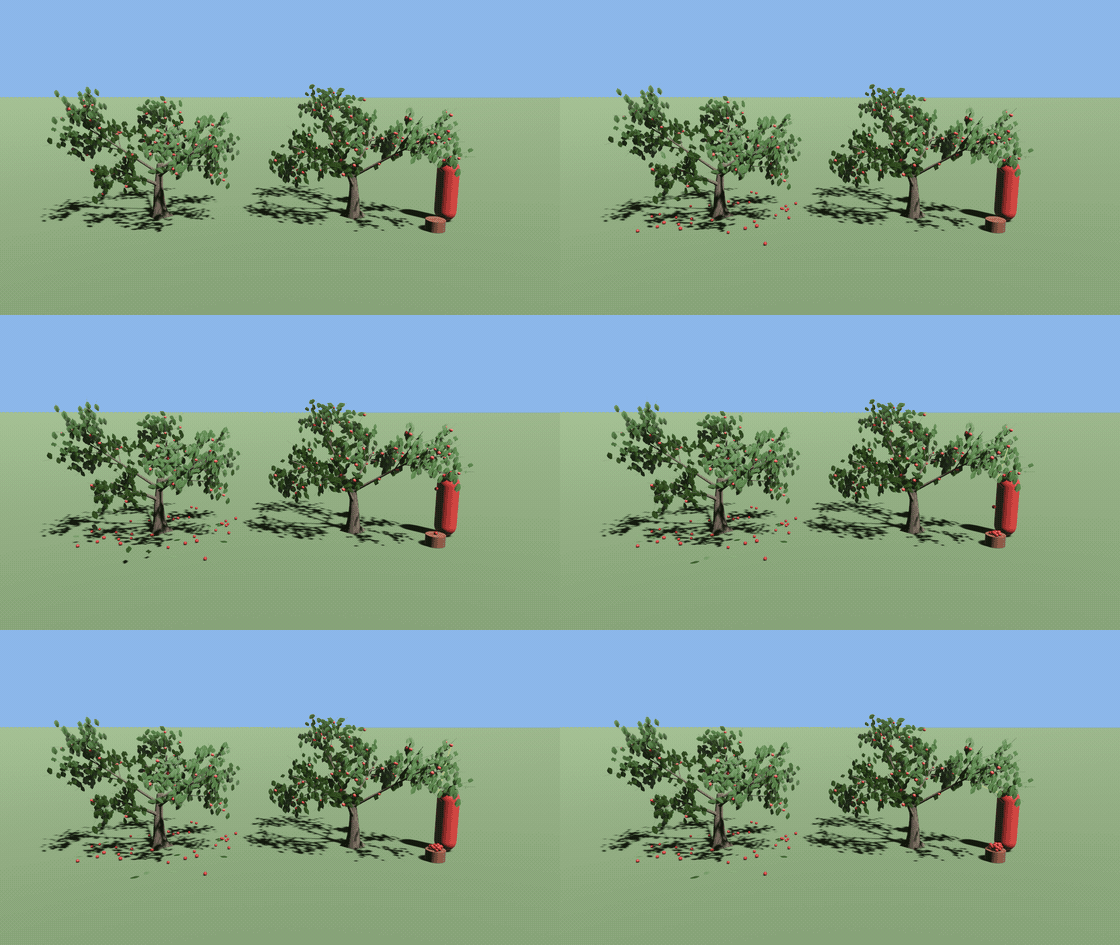
cargo run --release --example capture_growth -- --harvest: TreeShakes, FallenFruit and TreeFruit::nearest and pick.
Felling: FellTree
Insert FellTree { direction, cut_height, speed } on a tree and it comes down. The plugin cuts its wood at cut_height: what stays becomes a TreeStump entity, and what falls keeps the tree's entity, both closed by a cut face that shows the end grain (pale sapwood, rings, the pith and a few checks). The tree tips over toward direction about the front edge of the cut, as a felled trunk turns on its hinge, slowly at first and then faster as a rod of its height would (the oak below lands about 2.7 seconds after the cut), until its trunk or one of its big limbs reaches the ground; it lands there with a small bounce, thin branches and leaves on the near side giving way into the ground. TreeLanded is sent the frame it hits, with the point it hit, for the crash, the dust and the camera shake, and the landing shakes the crowns of the trees it fell through and rustles its own leaves. Felled says how far it has tipped and when it lies still. A PooledTree becomes the ProceduralTree of its variant before it is cut (the same tree as the pool's finest level), and a GpuGrowth tree is moved to the CPU path first, so any tree in a forest can be felled. On a hillside, a FloraGround resource (see "On terrain" above) is the ground it is cut above and lands on.
use *;
use *;
// The player's axe finished the job: the tree falls away from them.
// When it lands: a crash and dust where it hit; a minute later, swap it for logs.
Once it has landed the tree no longer sways (its leaves still flutter), it is not rebuilt if its ProceduralTree or TreeAge changes, and it stays until you despawn it or buck it (below); its TreeShape, if it has one, turns with it and is not cut. There is no physics: the fall is drawn, as a shake is.
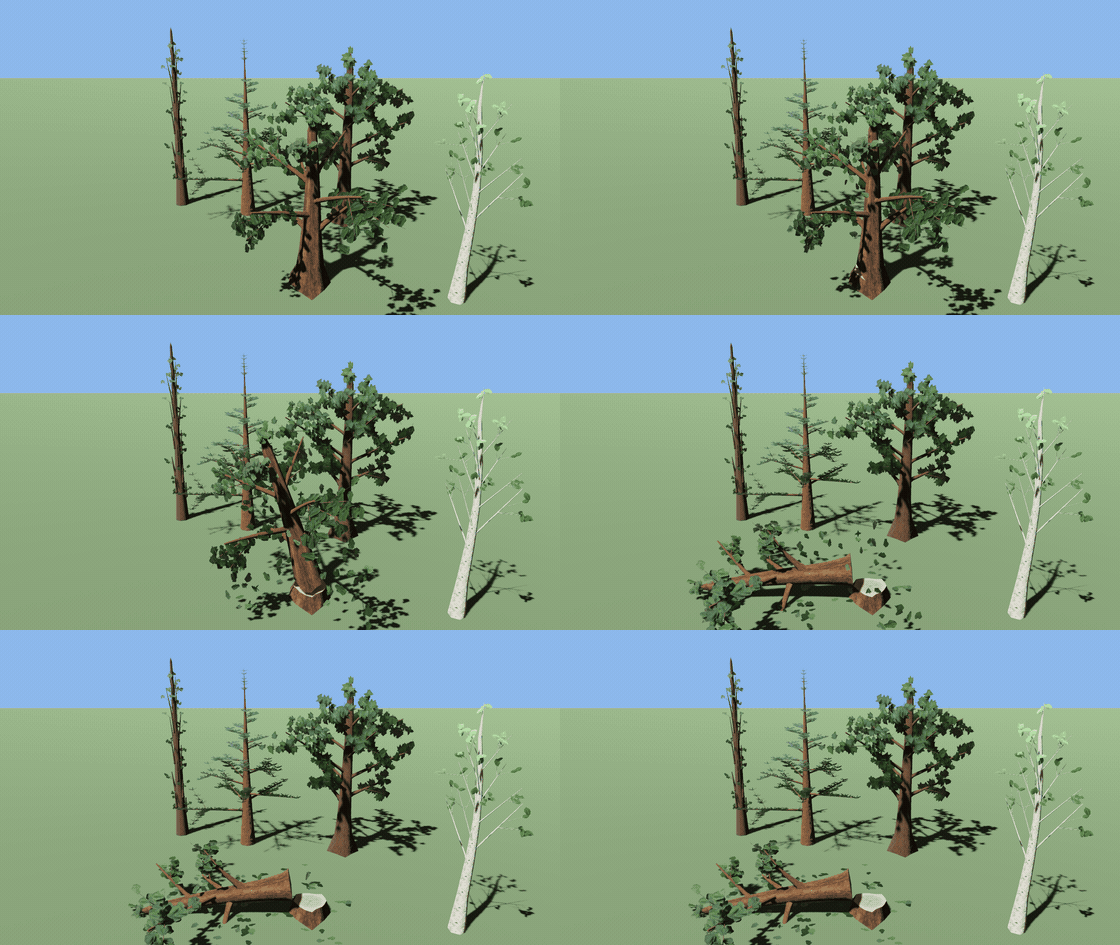
cargo run --release --example capture_growth -- --fell
Notching: TreeNotch
Before the saw, the axe. Insert TreeNotch { direction, height, depth } on a standing tree (a ProceduralTree, or a PooledTree, which becomes the tree of its variant as for felling) and the plugin carves an axe's notch out of its trunk: a wedge on the side direction points to, its floor level height above the base (0.5 m by default; with a FloraGround, above the uphill side, as the saw's cut), its face rising from the floor at 45°, reaching depth of the way through the trunk (0.25 by default, at most 0.9). Both faces show the end grain, its rings centred on the trunk's pith. Change depth with each blow and the notch is carved again; remove the component and the trunk is whole. Fell a notched tree and the saw goes in at the notch's floor whatever cut_height says: the stump keeps the floor and the falling trunk takes the face, as a real felling notch splits. A notched tree stops growing, a change of its ProceduralTree or TreeAge rebuilds it notch and all, and with TreeLod only its nearest level is notched. Pair each blow with a TreeShake and the crown shivers and drops a few leaves, as in the clip above.
use *;
use *;
// One blow of the player's axe on the side facing them: the notch deepens; once it is a third of
// the way through, the tree falls toward the notch.
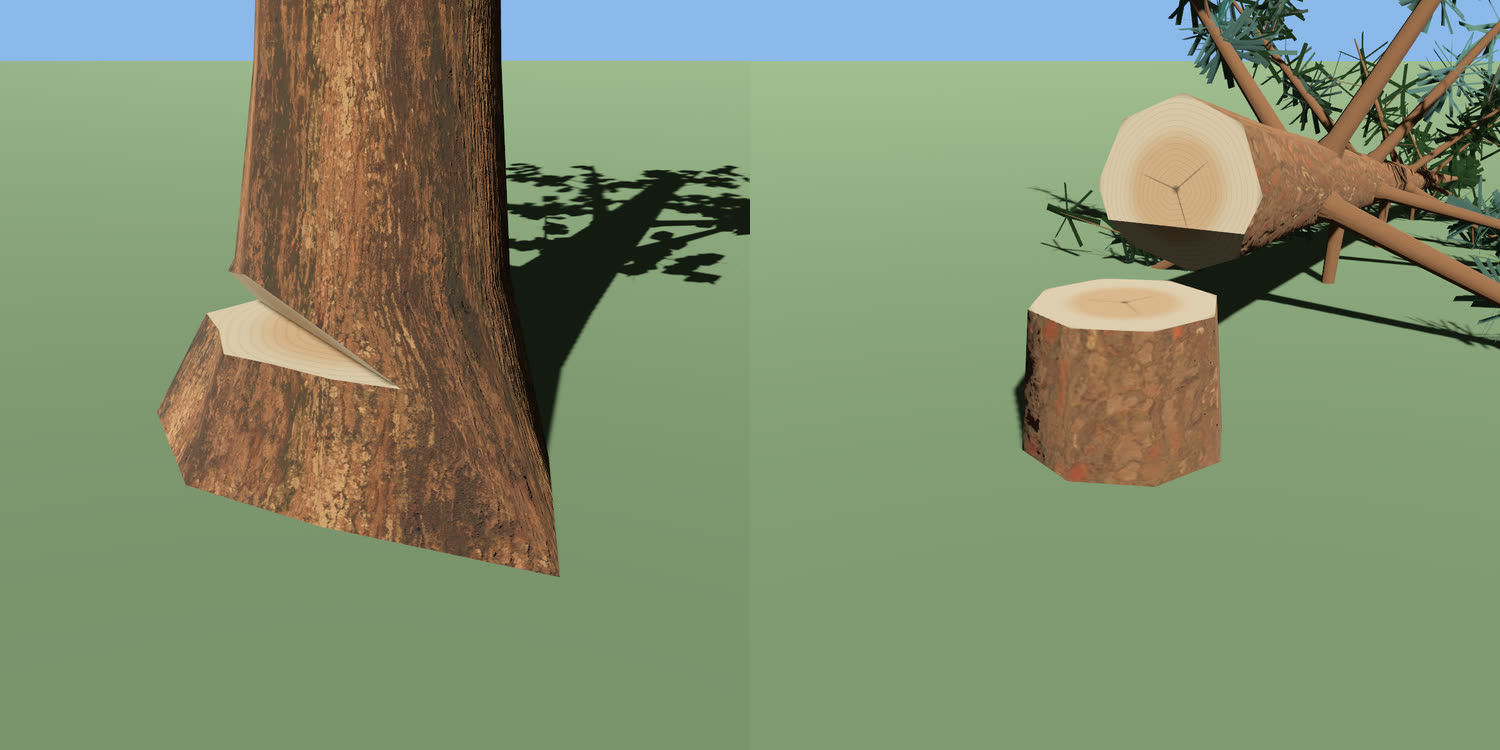
cargo run --release --example inspect -- --out target/notch --preset oak --mode tree --notch 90,0.3 --distance 3.1 --yaw 60 --eye 1.5 --look 0.042 --fov 50 --sun 20,25,30 --size 1200x1200 and -- --out target/notch_fell --preset pine --mode tree --notch 0,0.3,0.6 --fell 0 --distance 3.1 --yaw 300 --eye 1.5 --look 0.03 --fov 50 --size 1200x1200, side by side.
Insert BuckTree { log_length, min_radius } on a felled tree, with its FellTree or later, and once it lies still the plugin bucks it: its trunk is cut into logs log_length long (2 m by default), which lie on the ground in a row from the stump, the way the tree fell, on the FloraGround if there is one, each with its bark and end grain at both ends; the tree's entity and its crown are gone. The logs stop where the trunk gets thinner than min_radius (8 cm). Each is a TreeLog entity: index counts up the trunk from the butt, and capsule is a WoodCapsule in its own space, for its collider. TreeBucked { tree, stump, logs } is sent the same frame.
use *;
use *;
// Fell the tree away from the player, and buck it into 2 m logs once it lies still.
// A collider for every new log, for the player to pick up.
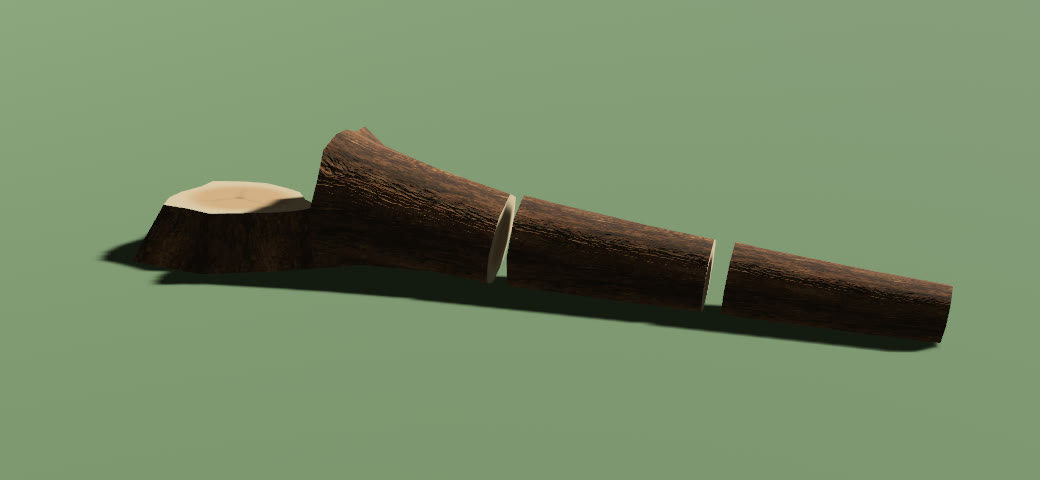
cargo run --release --example inspect -- --out target/logs --preset oak --mode tree --fell 0 --buck 1.5 --distance 11 --eye 3.2 --look 0 --yaw 25 --fov 40 --sun 25,22,-15 --size 1600x900, cropped.
Fire: FloraFire
Trees burn. Insert a FloraFire over the game's world, a square grid of cells that each hold how charred they are and how hot they burn, and light it where the game says (ignite(at, radius)): a lightning strike, a fire arrow, a campfire left burning. The plugin spreads it from cell to cell through the trees at FireSpread::speed (1 m/s by default) whatever the size of the cells, faster downwind (FloraWind), as far as there is something to burn: the cells within reach (3 m) of a trunk, so a clearing, a road or a firebreak stops it. Each tree it reaches scorches its leaves brown and burns them away one by one, each flaring as it goes (in the shadow maps too), and chars its wood from the ground up to black charcoal split into blocks whose seams glow while it burns and cool after. Every way a tree is drawn takes part: individual trees, TreeLod levels, pools and their impostors, GpuGrowth trees, and the leaves a burnt tree no longer has do not fall from it.
use *;
use *;
;
// A 512 m square around the origin, 128 cells a side (4 m each). Insert it while the level
// loads: the flora materials are prepared again once, with the fire in their shaders.
// The grid is the game's too: read it where the shaders do.
char_at and heat_at read the grid between the cell centres, as the shaders do: to hurt what stands in the fire, make a burnt tree worthless, or scorch the game's own ground (the clip below colours its ground by char_at). A tree the fire burns through (the char where its trunk stands passes BURNT, 0.95) is reported once with a TreeBurnt message and marked Burnt: insert Burnt on the burnt trees of a save, with the fire's restored grid, and loading reports none of them. extinguish puts the fire out where rain or water falls, keeping the char, and scorch lays an old burn down with no fire, for a level that starts burnt. FireSpread (FloraFire::with_spread) sets how fast the fire moves, how long a spot burns and its embers glow, how far a tree's fire reaches and whether the ground itself burns; FloraFire::with_cells sets the size of the cells (smaller cells burn along finer lines). The same fire lit the same way on the same clock burns the same way (FloraFire::seed makes its front ragged).
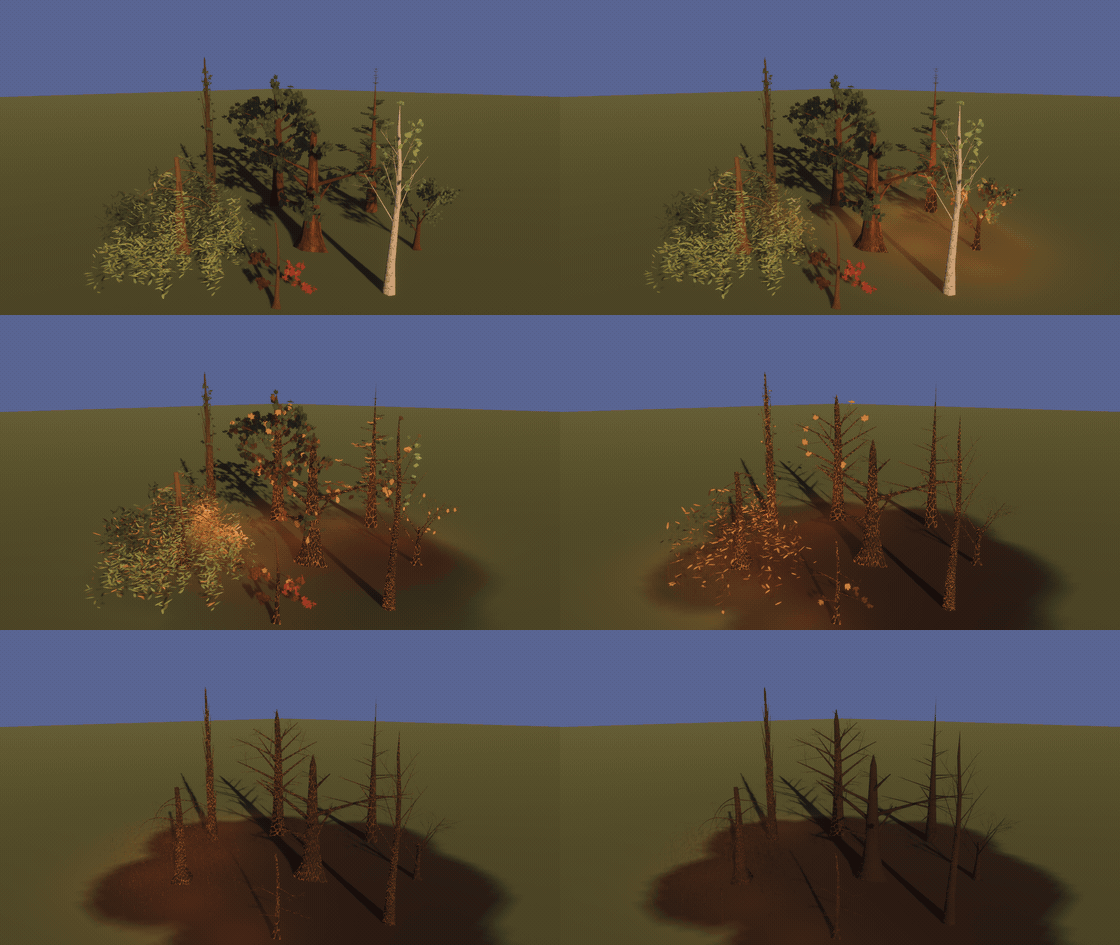
cargo run --release --example capture_growth -- --fire: the grove at dusk, a fire lit on its upwind edge. Like the rest of a clip it is sped up (FireSpread 3.5 m/s, each spot burnt through in 2.5 s), and the clip's own ground scorches by char_at.
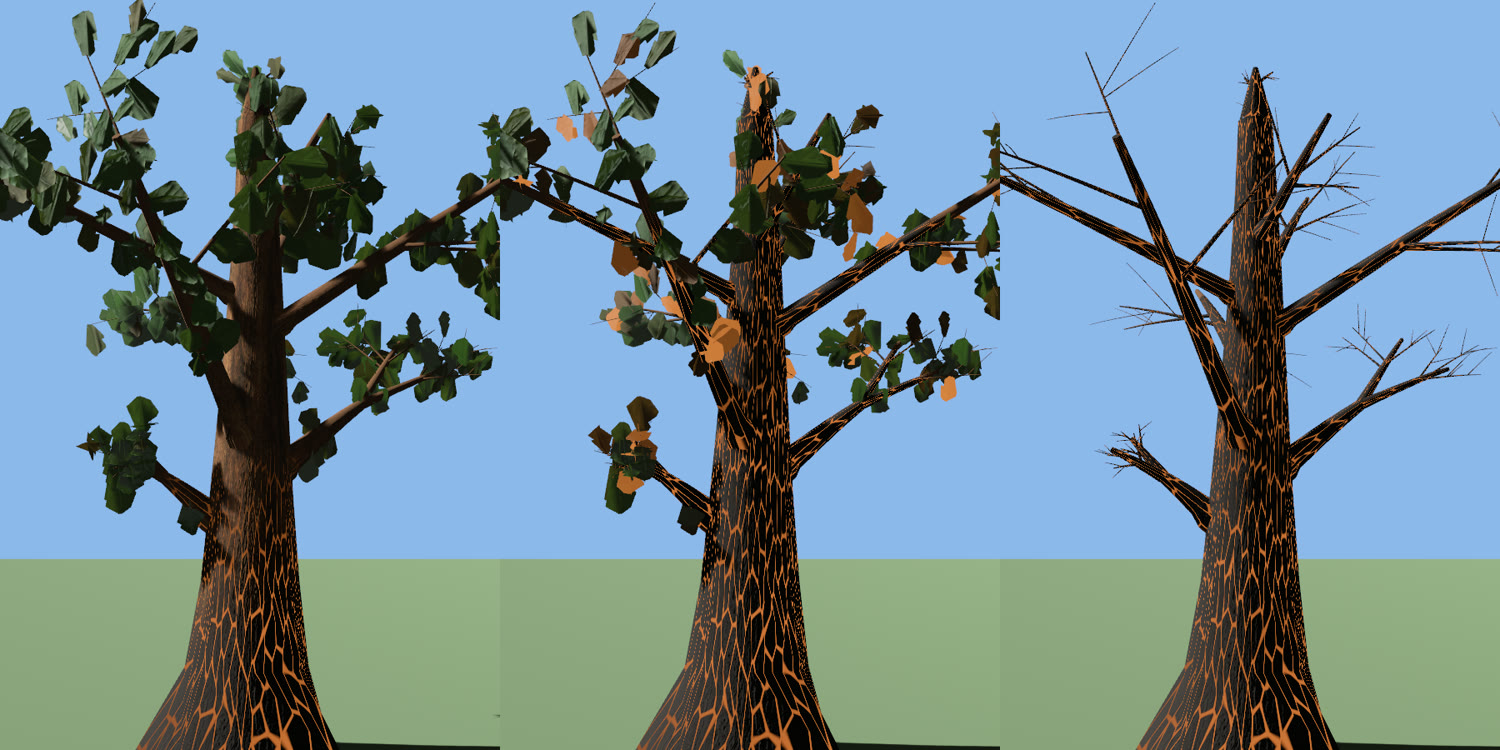
inspect --mode tree --preset oak --burn 1,2 --frames 12 --distance 9 --size 1280x960, frames 1, 3 and 6: 3, 7 and 13 s after the fire was lit at the oak's foot.
While no FloraFire exists no shader carries any of it, and frames cost what they did before (1 000 individual oaks 24.5 ms, 100 000 pooled oaks 7.5-7.6 ms, as in 0.25.0; Apple M4 Pro, forest --offscreen). Inserting one prepares the flora materials again once, with the fire in their shaders; with nothing burning a shader stops at the grid's header (1 000 oaks 24.6-24.7 ms, forest --fire armed), and outside the burnt rectangle a tree reads two vectors and no cell. A forest on fire costs 1 000 individual oaks 2% (25.0-25.1 ms, every tree within 60 m of the middle lit at once) and 100 000 pooled oaks nothing measurable (7.6 ms, within 300 m). The grid rides in the buffer the wind is in, written ten times a second while anything burns or glows (8 bytes a cell: 128 KB at 128 cells a side), so a wind that changes every frame uploads it too. Leaf shading and wind need storage buffers, and so does fire: on WebGL2 trees do not burn.
Seeing the player: SeeThroughTrees
A third-person or top-down camera in a forest loses the player behind trunks and crowns. Put SeeThroughTrees on the camera and keep its target on the player: the parts of trees between the camera and the target dither out, in a cone around the line of sight radius wide at the target and a third of that at the camera, which closes over the last tenth of the way so nothing behind the player is cut. Only that camera sees through: shadow maps keep the whole trees (the cut tree's shadow still falls on the player), and so do other cameras. Every way a tree is drawn takes part, pooled levels and impostors included, and so do the camera's prepasses, so a DepthPrepass (for TAA, SSAO or depth of field) leaves no holes where a tree was cut.
use *;
use *;
;
// Keep the clear view on the player's chest as it moves.
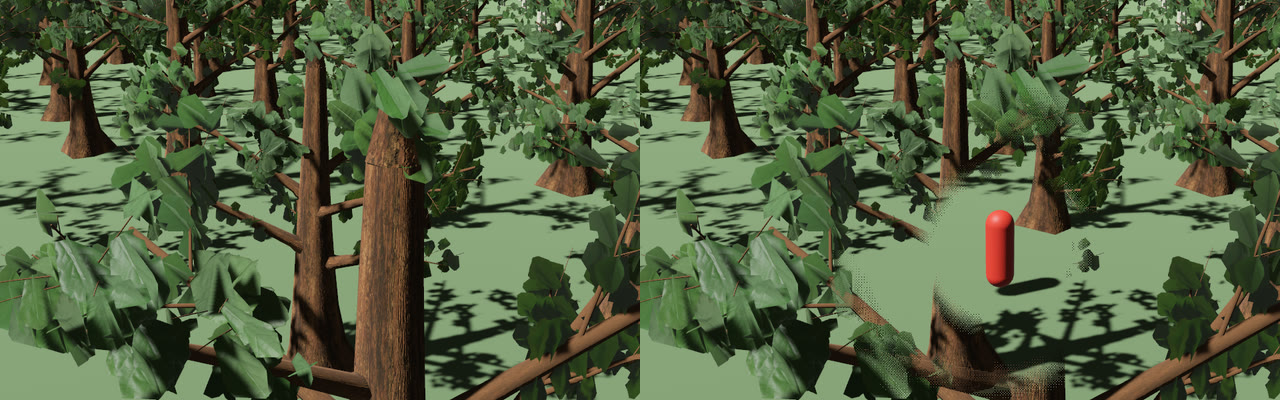
cargo run --release --example forest -- --mode naive --trees 1500 --spacing 6 --scatter oak:2,birch:1,maple:1 --grove 30 --eye 0,7,-15 --at 0,1.5,0 --fov 50 --sun 20,30,-10 --wind 0 --deterministic --see-through 0,1,0,1.8 --screenshot see_through.png, cropped; left without --see-through. The same images, byte for byte, with --prepass depth and --prepass all.
While no camera has it, no shader carries the fade and nothing draws or costs differently (the 424 gallery scenarios render as before; 1 000 individual oaks take 24.5 ms a frame and 100 000 pooled oaks 7.5 ms, as without it). While one has it, every flora pipeline carries the discard, which keeps the GPU from rejecting hidden fragments early, and a depth-only prepass gets a fragment stage: in forest --offscreen (Apple M4 Pro) 1 000 individual oaks take 27.0 ms instead of 24.5 (33.2 instead of 30.5 with a depth prepass), and 100 000 pooled oaks 7.5 ms either way. The edge of the clear view is a 4x4 ordered dither: TAA smooths it, and without TAA it reads as a fine screen door up close. One camera sees through at a time, and there is no fade with plain StandardMaterials.
Walking through undergrowth: FoliagePusher
Shrubs and low branches that a character walks through as if they were not there break the illusion. Put FoliagePusher on the player, the NPCs or a cart (radius, 0.45 m by default; height, 1.8 m, centred on its translation; strength, 1) and the leaves and thin stems it walks through give way: what is nearer its axis than its radius goes out of its way, bending a little down as a pushed stem does, and closes up behind it over half a second as it walks on. Trunks and limbs thicker than 5 cm stay where they are, and a plant stays rooted at its foot. The shaders do it, in the main pass and the shadows alike, on every way a plant is drawn up close (ProceduralTree, TreeLod, pooled levels, GpuGrowth); the plugin writes the MAX_PUSHERS (4) bodies nearest the camera into the shared buffer when they move.
use *;
use *;
;
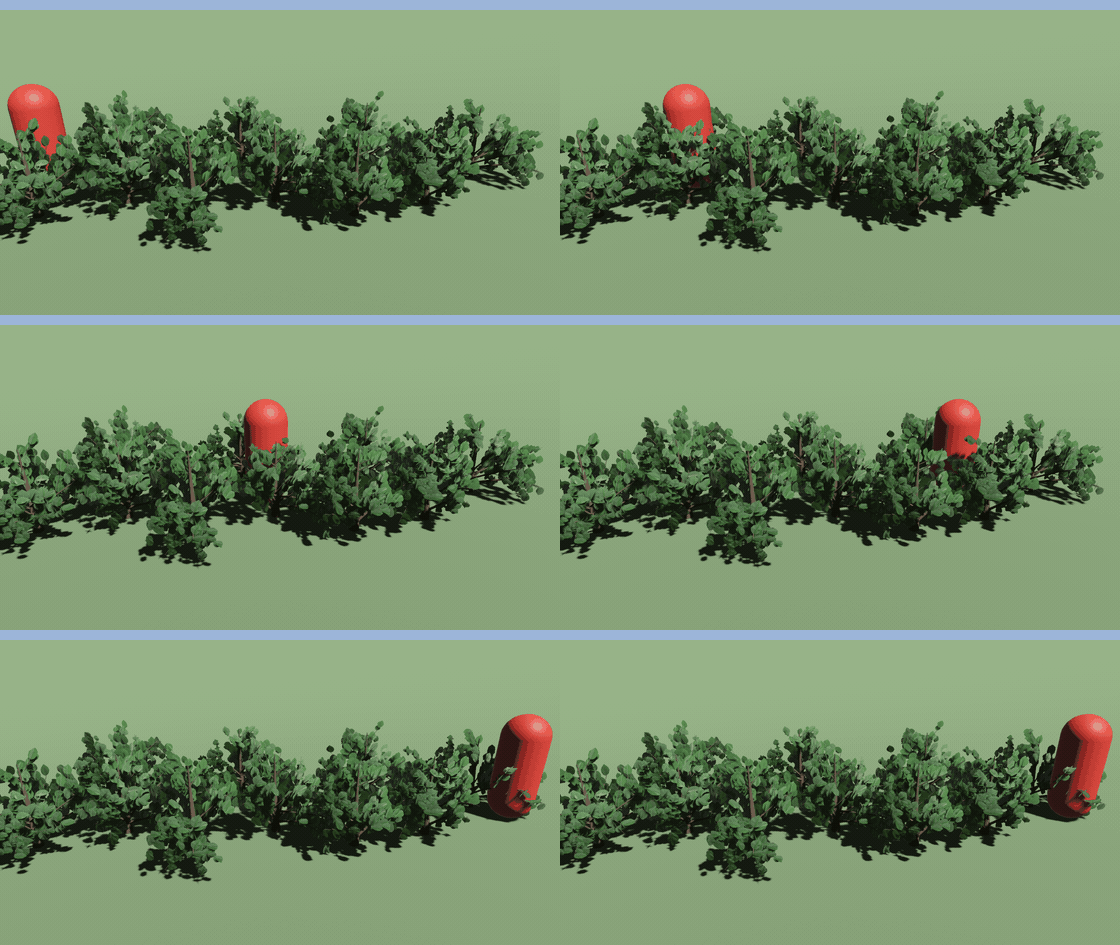
cargo run --release --example capture_growth -- --push: a FoliagePusher 0.45 m round walking at 1.4 m/s in a light wind.
While no entity has a FoliagePusher no shader carries the push, and frames cost what they did before. Inserting the first prepares the flora materials again once, with the push in their vertex stages; a vertex outside the circle around everything the pushers reach reads one vector and goes on. With one body standing in the forest (forest --push, Apple M4 Pro) 1 000 individual oaks take 24.9 ms a frame against 24.5 without it (2%), and 100 000 pooled oaks 7.6 ms against 7.5. A still body writes nothing; a moving one rewrites the shared buffer every frame (under a kilobyte, and the fire's grid with it while there is a fire). The push is in the vertex stages, so a leaf card bends with it and a card across the body's axis stretches in its core, which the body hides; shake a plant the body runs into (TreeShakes) to make it rustle as well.
Gameplay: colliders, growth events, the prelude
A game wants a tree's shape in a handful of primitives, not twenty thousand triangles. Insert TreeShape::default() next to a ProceduralTree (or a PooledTree) and the plugin keeps it up to date: three capsules up the trunk that taper with it (the lowest has the trunk's radius at hip height, so a walking character meets what it sees), one capsule for every stretch of wood at least limb_radius thick (6 cm by default; TreeShape::with_limb_radius), and a box around the leaves, all in the tree's local space. A growing tree's shape grows with it on both the CPU and the GpuGrowth path, and it is written only when it changes, so Changed<TreeShape> is the cue to rebuild colliders. WoodCapsule::to_primitive gives Bevy's Capsule3d and where it sits, which is what most physics engines' capsule colliders take. Building the shape costs about as much as ageing the skeleton (6 to 9 microseconds a tree on an Apple M4 Pro), which is why it is opt-in. TreeMature is sent once when a Growing tree reaches maturity, and use bevy_flora::prelude::*; brings in the plugin, the components, the presets and parameters, the wind and the shapes.
use *;
use *;
// Hand the capsules to your physics engine whenever the shape changes.
examples/showcase.rs draws the shape over the tree (C), and inspect --colliders photographs it:
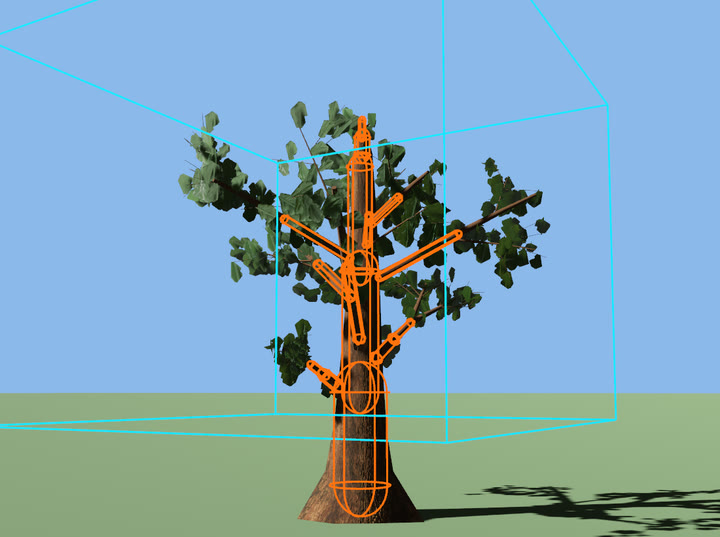
cargo run --release --example inspect -- --out target/shape --preset oak --mode tree --colliders --distance 13 --eye 2 --look 0.45 --yaw 30
Finding trees: FloraIndex
Which tree did the axe hit, which one is nearest the woodcutter, which ones stand in the blast? The plugin keeps a FloraIndex resource of every standing tree, ProceduralTree and PooledTree alike (a pooled one once its pool exists), each as its trunk: a cone from its foot to its top, at the age it shows and where it stands after transform propagation. A tree moved, rebuilt or grown is updated that frame, and a felled or despawned one leaves it. It is a grid of 8 m cells, so a query costs the trees near it, not all of them: with 100 000 pooled oaks, nearest takes about 1.6 µs and cast_ray over 50 m about 0.6 µs.
nearest(at, max): the tree whose bark at the foot is nearest a point (world x and z), withinmaxmetres.within(at, radius): every tree whose bark at the foot is withinradiusmetres.cast_ray(ray, max): the first trunk a ray meets, asTreeHit { tree, point, normal, distance }: the player's look, an arrow, a falling branch. Crowns and leaves do not stop it.get(entity),iter(),len(): each tree as anIndexedTree { entity, base, axis, height, base_radius, top_radius }.
use *;
use Ray3d;
use *;
// An axe's blow on the trunk the player looks at, within reach: the notch faces the player.
// The woodcutter's next tree, and the trees a blast shakes.
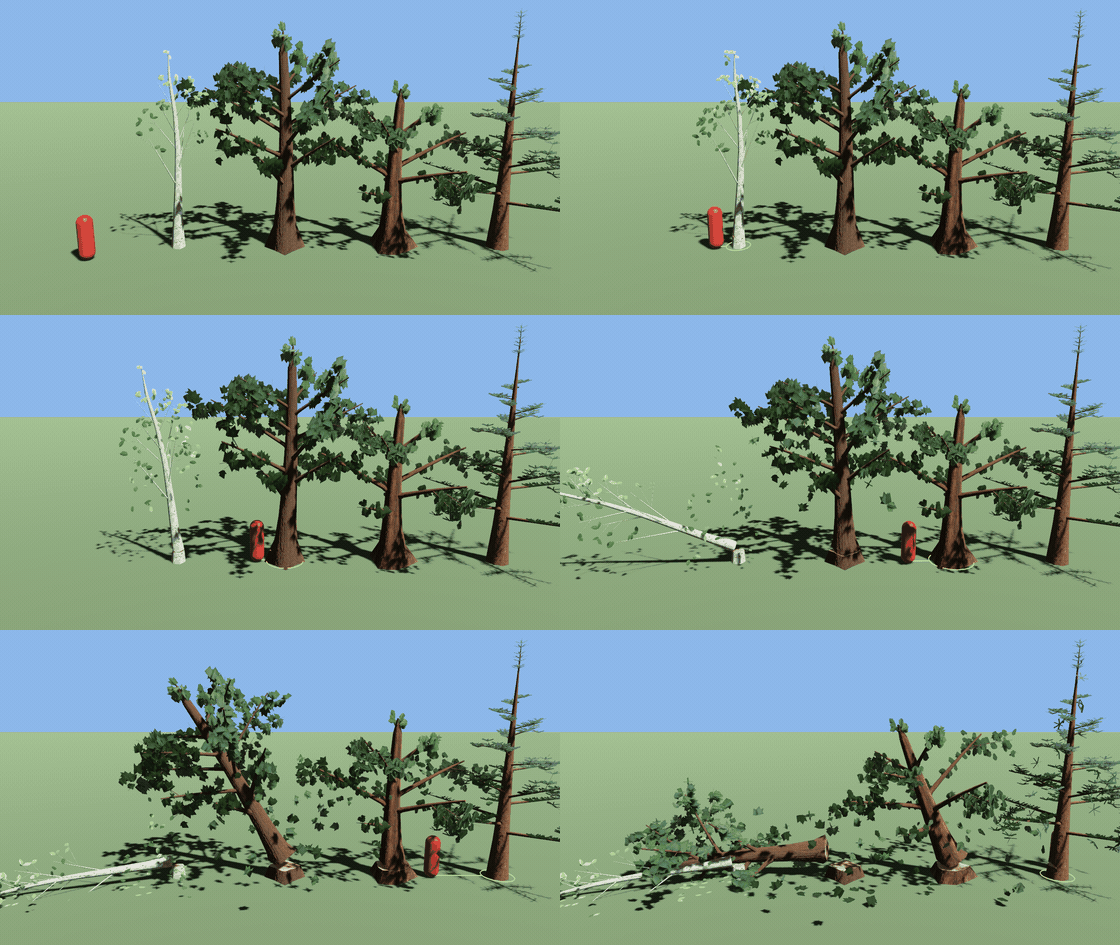
cargo run --release --example capture_growth -- --chop: the woodcutter asks FloraIndex::nearest for its next tree; a felled tree leaves the index at once, so the ring moves on while it falls.
Saving and loading the forest
A tree is its parameters and its seed, so a save holds what the game did to it:
- The tree. Its
TreeParams(with theserdefeature they serialize;ronwrites.tree.ronfiles) or its preset and seed, itsTransformand itsTreeAge. - A notch.
TreeNotchis plain values; inserted again, it is carved again. - A felled tree. How it was felled: on load,
FellTree { direction, lying: true, .. }lays it down at once where it came to rest, with its stump and cut faces and no landing (noTreeLanded, no shake, no leaves shed).BuckTreethen cuts it into logs as soon as it lies. - Picked fruit.
TreeFruit::picked()gives the keys; on load, spawn the tree withTreeFruit::with_picked(keys)and the same fruit stay off it. - A fire.
FloraFire::cells()with the grid's centre, size and cells per side; on load,FloraFire::with_cells(centre, size, side)andrestore(&cells): the char as it was, and the cells still burning burn on. - The weather and the year.
FloraWind,FloraSeasonandFloraWetnessare plain resources.FallenFruitentities are the game's to keep or let go.
use *;
use *;
/// One tree as a game might save it.
/// Plant the saved trees again, as the player left them.
Everything at once: the playground
examples/playground.rs is a small first-person game built on the crate, to read as an example of wiring its gameplay APIs together: walk among an apple tree, an oak and a ring of mixed trees, strike a trunk with an axe (FloraIndex::cast_ray finds it, TreeNotch deepens, the fourth blow fells it with FellTree), buck the fallen tree (BuckTree), shake a tree (TreeShakes) and gather the apples that fall (FallenFruit), pick apples off it (TreeFruit::nearest, pick), light a fire (FloraFire, counting TreeBurnt), call the rain (FloraWetness), move the year on (FloraSeason::of_year), and save and load all of it (FellTree::lying, TreeFruit::with_picked, Burnt, FloraFire::restore). Every action reads a Controls resource, so --demo plays a script through the same systems and records it.
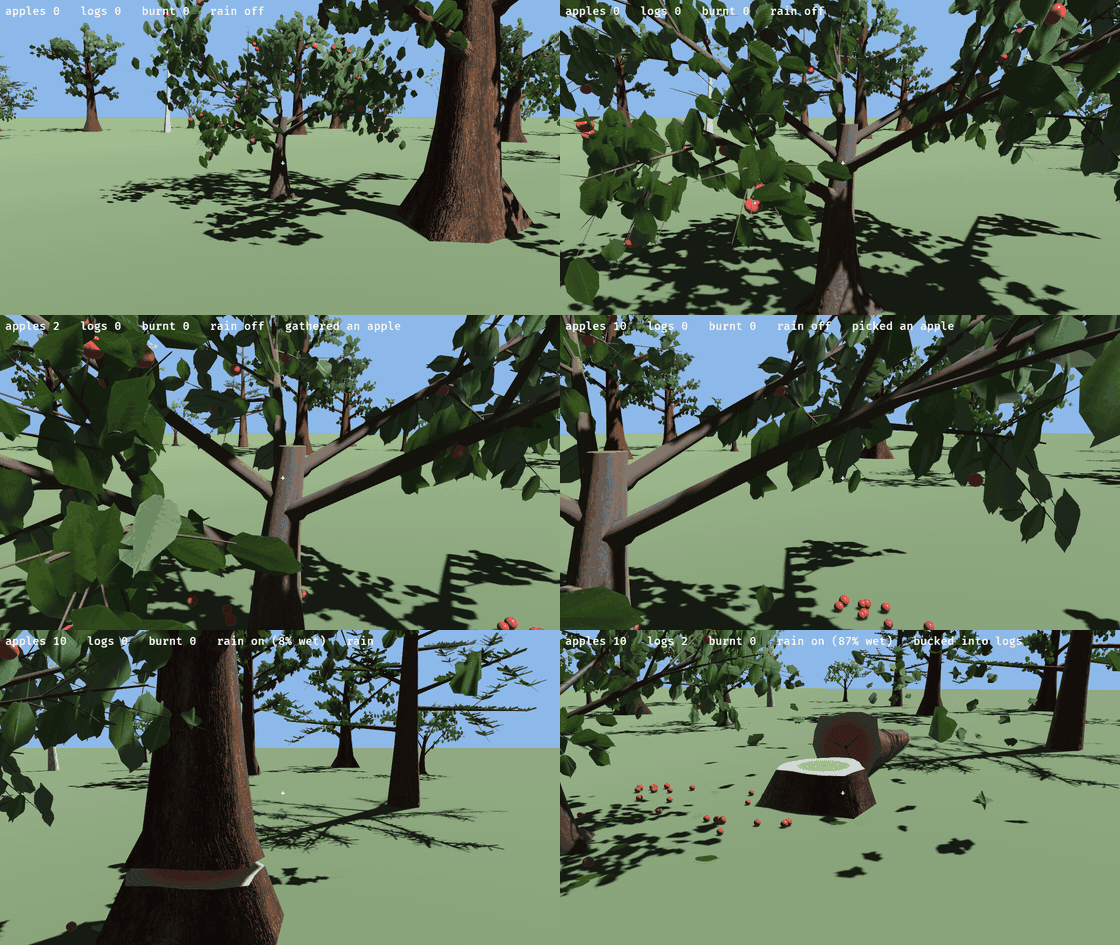
cargo run --release --example playground -- --demo; without --demo it is yours to play: W A S D walk, right mouse look, left click axe, F shake, E pick, B buck, G fire, R rain, Y a month on, F5 save, F9 load.
Without the plugin
build_tree is a pure function from parameters and age to CPU meshes and the aged skeleton, so you can bake trees offline, feed your own renderer, or build colliders from the skeleton:
use ;
let params = Pine.params;
let tree = build_tree;
let wood = tree.trunk.clone.into_bevy_mesh; // bevy::mesh::Mesh
let leaves = tree.foliage.into_bevy_mesh;
assert!; // a flowering tree's flowers (`FoliageParams::blossom`); a pine has none
assert!;
Features
- 18 presets: oak, pine, willow, birch, palm, cypress, bonsai, maple, spruce, poplar, baobab, dragon tree, Japanese maple, dead tree, redwood, a cherry that blossoms in spring, an apple tree that bears fruit, and a shrub for undergrowth. Each is a plain
TreeParamsvalue you can edit. - Growth over time. Every branch has a birth age and a growth duration, derived from where it sits on the tree. A tree can be shown at any age, branches thicken after they lengthen, and leaves grow to full size without re-rolling or disappearing as the tree ages.
- Deterministic. Each branch draws randomness from its own seeded stream, so the same
seedgives the same tree on every run, and aging never re-rolls branches or leaves that already exist. - Branch shape: crown envelopes, phyllotaxis, apical dominance, Y-splits, recursive sub-branches, twist, and a gravity bend that sub-branches and leaves follow. Floor avoidance keeps even strongly drooping wood above the ground.
- Closed wood. Branches meet the trunk through flared collars and root segments, forks taper into their halves, and trunk tops end in a flat cap, a cone or a leader branch. Optional pipe-model radii, radius-adaptive ring counts and volume-preserving (Taubin) smoothing that keeps seams, branch ends and twig seats in place.
- Leaves: five styles (crossed planes, single quad, cluster sphere, star burst, needle cluster), three placements (terminal branches, all branches, tip clusters) and four orientations. Leaf cards are leaf-shaped (cut into the geometry, so there is no alpha-mask
discard) and grow out of their twigs, crowns shade as one soft volume through crown-bent normals (normal_bend), and each leaf gets its own brightness (color_variation), hue (hue_variation) and share of the sky (occlusion), all baked into the mesh. The plugin draws trees withFloraMaterial, aStandardMaterialwith a leaf shader: a darker, glossier upper side, a paler matte lower side, veins, and light through a leaf lit from behind (LeafShading); facing the sun, the gloss gives way to that glow, so a backlit crown stays green instead of mirroring the sun white. The meshes also draw with a plainStandardMaterial, without those. - Wind.
FloraWindbends every tree and flutters its leaves in the vertex shader, shadows and impostors included, with a travellingGustFront, and each species answers in its own way (TreeParams::wind). - Bark. Trunks and branches wear one of 14 bundled CC0 bark scans (colour and normal map;
TreeParams::bark,BarkScan), laid out in metres on the mature tree so a growing tree's bark never slides, smooth on young wood and fissured as a branch thickens (BarkParams), and averaging the preset colour, so far trees, impostors and the plain-material fallback keep their colour. Compiled in by the defaulttexturesfeature. - Leaf scans and grown veins. Seven presets cut their leaf cards to the real outline of a bundled CC0 leaf scan and wear its colour and normal map (
FoliageParams::scan,LeafScan); every other leaf-shaped card has veins grown by space colonisation (venation), drawn by the leaf shader from one small shared image. - Looks.
TreeParams::styledraws a tree asNatural,Painterly(leaf normals point out of each clump's own centre: rounded masses) orToon(banded light and an ink rim); impostors and pools follow. - Seasons.
FloraSeasonturns deciduous trees to their autumn colour (FoliageParams::autumn), sheds their leaves one by one (near a camera they fall to the ground), lays snow on every tree, brings flowering trees into blossom in spring (FoliageParams::blossom: five-petalled flowers that open and fall one by one) and hangs fruit on fruiting trees through summer (FoliageParams::fruit, the apple), shadows, pools, impostors andGpuGrowthincluded, at no cost per tree;FloraSeason::of_yeardrives a whole year from one number. - Rain.
FloraWetnesssoaks every tree, pools and impostors included, from 0 (dry) to 1: wet bark darkens and turns glossy, the leaves' green grows richer; one value in the shared buffer, nothing per tree. - No hitches.
BuildInBackgroundbuilds a tree off the main thread: 200 oaks planted in one frame cost it 0.5 ms instead of 23 ms, and appear a few frames later. - Seeing the player.
SeeThroughTreeson the camera dithers out the trees between it and the player, prepasses included, while shadows keep the whole trees; nothing is compiled in while no camera has it. - Gameplay shapes.
TreeShape: capsules for the trunk and limbs and a box around the crown, kept up to date as a tree grows (CPU or GPU) and filled on pooled trees, ready to become colliders in any physics engine;TreeMatureannounces the moment a growing tree is done. - Finding trees.
FloraIndexholds every standing tree, pooled ones included, by where its trunk stands: the nearest tree to a point, the trees within a radius and the trunk a ray meets, in microseconds among 100 000 trees, kept up to date as trees are planted, grow, move, fall or go. - Saving and loading. A felled tree comes back lying where it fell (
FellTree::lying), picked fruit stays picked (TreeFruit::with_picked), and a fire's grid is restored as it was, still burning (FloraFire::restore). - Trees that react.
TreeShakesswings the trees near a hit, a passing character or a blast and rustles their leaves, on every way a tree is drawn, for one small buffer write and nothing per tree while nothing shakes. Hits knock leaves off and felled trees shed them as they land: they tumble down, drift with the wind and lie on the ground a while, moved on the GPU;DropLeavesdrops them from any tree. - Picking fruit.
TreeFruitlists a fruiting tree's fruit, finds the one nearest a hand and picks it off the tree until the next blossom; shakes knock fruit loose to fall, bounce and lie on the ground asFallenFruitentities for the game to pick up. - Fire.
FloraFirespreads a fire through the trees from where the game lights it, faster downwind and stopped where nothing burns: leaves scorch, flare and burn away, wood chars from the ground up with glowing seams, on every way a tree is drawn; the game reads the fire back to hurt what stands in it or scorch its own ground, and hears of each tree it burns through (TreeBurnt). - Walking through undergrowth.
FoliagePusheron the player or an NPC: the leaves and thin stems it walks through bend out of its way and close up behind it, shadows included, while trunks stay put. - Felling.
TreeNotchcuts an axe's notch into a standing trunk, deeper with each blow;FellTreecuts a tree, pooled ones included, at its notch if it has one: it falls about the hinge of the cut, lands on its limbs with a bounce (TreeLanded), and leaves aTreeStump; every cut face shows end grain.BuckTreethen cuts its trunk intoTreeLogs lying on the ground, each with a capsule for its collider. - Trees from files.
TreeParamsis an asset:ProceduralTreeAssetdraws a tree from a handle, and every tree sharing it follows edits; with theronfeature trees load from.tree.ronfiles and rebuild when the file is saved. - Forest scale.
TreePoolbuilds a few variants of a tree once, each at three levels of detail made from the skeleton (thin wood dropped, fewer sides and rings, fewer and larger leaves) and a baked camera-facing impostor for the far field;PooledTreeplaces them. 100 000 oak trees draw at 7.6 ms a frame, leaf shading, wind and seasons included (see above). A forest of individualProceduralTrees is fine for a few thousand trees, because trees with equal looks share their materials (1 000 oaks: 25 ms a frame) andTreeLoddraws each at the same three levels (6.5 ms), but each keeps its own meshes, so use a pool beyond that. - Planting forests.
Scattersays where the trees stand: trunks at least a spacing apart and otherwise irregular (Poisson disc), species in groves with bending borders, each tree its own yaw, size and variant, and a density per spot for roads and clearings; deterministic per seed. A second scatter of theShrubpreset, kept clear of the trunks, makes the undergrowth. - Terrain.
FloraGroundis your ground's height: trees stand at their footing, where the trunk meets a slope all round (ScatterPoint::transform_on),slopekeeps them off cliffs, and felled trees are cut above the uphill side and land on the hills.
Examples
| example | what it shows |
|---|---|
showcase |
An interactive growing tree. Right-drag / wheel orbits, [ ] cycle presets, N reseeds, Space toggles growth, R restarts, M jumps to mature, G rebuilds, U switches between growing in the vertex shader (GpuGrowth) and rebuilding on the CPU, C draws the gameplay shape, Y runs the year (FloraSeason::of_year, 40 s a year), H hits the tree (TreeShakes; leaves fall), X strikes it with an axe (TreeNotch, deeper with each blow; the fourth fells it), F fells it (FellTree) and then B bucks it into logs (BuckTree); any other key brings a new one. |
gallery |
Renders 441 scenarios (every preset at several ages and seeds, forced splits, smoothing, pipe radii (mature and young) and a wobbly twisted trunk on every preset, every leaf style × placement × orientation, every crown shape, every preset painterly and toon, parameter extremes, five deciduous presets and the pine turning, turned, half bare, bare and under snow, and the cherry's spring in blossom) offscreen to four-view PNGs plus a stats.tsv with mesh sanity flags. This is the visual QA harness. --filter <substr> narrows it; --gpu grows every tree in the vertex shader. |
compare_gallery |
Compares two renders directory against directory (CPU gallery against gallery --gpu, or two capture_growth runs): mean difference and share of close pixels per PNG, non-zero exit past the limits. |
inspect |
Photographs one tree under controlled conditions, to see how it reads: a camera that backs off through every level of detail and into the impostor (--distance a,b --frames n), optionally zooming so the tree keeps its size on screen and a level switch shows as a jump (--constant-size), any bearing, height and field of view, one level forced at every distance (--level), a ProceduralTree instead of a pooled tree (--mode tree, which --lod or --level give a TreeLod), the empty scene (--empty) to measure the tree's pixels against, with or without MSAA, in any look (`--style natural |
capture_growth |
Records the clips above as numbered PNG frames: one tree growing (--preset <name>, default maple), with --grove a grove of mixed species with a gust front crossing it, with --seasons the same grove fully grown through a year, with --shake the grove knocked by TreeShakes, with --fell an oak notched by an axe and felled among a few trees, with --fire the grove burning at dusk, with --push a body walking through a patch of shrubs, with --chop a woodcutter felling a row of trees one after another, each found by FloraIndex, or with --harvest an apple tree shaken and another picked into a basket (--gpu grows the trees in the vertex shader). The clock steps a fixed 1/24 s per frame, so the wind sways smoothly and two runs write the same frames; the ffmpeg commands that make the GIFs are in the example's docs. |
forest |
The forest-scale benchmark: up to 100 000 trees under a shadow-casting sun, on a grid or, with --scatter oak:3,birch:1,..., where Scatter puts them (--grove <m>, --clearing <m>; --undergrowth shrub:2.5 adds a patchy layer of shrubs 2.5 m apart and clear of the trunks), on flat ground or on rolling hills (--terrain <relief>: every tree at its footing on a FloraGround), drawn from a TreePool per species (--mode pool, the default), as a ProceduralTree each (--mode naive), or as GpuGrowth trees, fully grown or growing for the whole run (--mode gpu, gpu-live; --mode cpu-live is the CPU-rebuilt equivalent), built in the frame or in the background (--background), in full or at levels of detail (--tree-lod: TreeLod), timed per frame or saved as a screenshot. --offscreen times the real frame cost without a window and the result line gives the mean, p95, median, minimum and CPU time per frame; --no-impostors, --lod and --shadows change the setup; --sun <x,y,z>, --wind <strength>, --wind-dir <x,z>, --gust <speed> and --wind-animate (the strength changes every frame) move the light and the weather, --shake-animate knocks the trees every few frames (every shake slot busy), --leaf-fall-animate <s> runs an autumn every s seconds (leaves always falling), --season <autumn>,<leaf fall>[,<snow>[,<blossom>]] sets the season, --fire <x>,<z>[,<radius>] lights a FloraFire over the forest there (--fire armed: one that burns nothing), --push <x>,<z> stands a FoliagePusher there; --see-through <x,y,z>[,<radius>] stands a player in the forest for the camera to see through to (SeeThroughTrees) and `--prepass <none |
tree_file |
(--features ron) A tree from examples/assets/trees/maple.tree.ron (--tree <path> for another file); with file_watcher too it rebuilds when the file is saved, and a load error shows on screen while the last good tree stays. --export <preset> prints a preset as a tree file, --screenshot <path> saves the tree and exits. |
playground |
A first-person sandbox where the gameplay APIs meet: chop, buck, shake, pick, burn, soak and save the trees (see "Everything at once: the playground"); --demo plays and records a scripted eight seconds. |
How it works
TreeParams → skeleton (a node tree of trunk, leader, primaries, splits and sub-branches) → birth times → the skeleton at a given age → wood mesh and leaf points → MeshData → Bevy Mesh. ARCHITECTURE.md has the details and the invariants (winding, bend, junctions) the meshers rely on.
License
Licensed under either of
- Apache License, Version 2.0 (LICENSE-APACHE or http://www.apache.org/licenses/LICENSE-2.0)
- MIT license (LICENSE-MIT or http://opensource.org/licenses/MIT)
at your option.
Unless you explicitly state otherwise, any contribution intentionally submitted for inclusion in the work by you, as defined in the Apache-2.0 license, shall be dual licensed as above, without any additional terms or conditions.