Expand description
§Wingfoil
Wingfoil is a blazingly fast, highly scalable stream processing framework designed for latency-critical use cases such as electronic trading and real-time AI systems.
Wingfoil is a lingua franca of stream processing, making it easy to receive, process, and distribute streaming data.
§Features
- Fast: Ultra-low latency and high throughput with a efficent DAG based execution engine.
- Simple and obvious to use: Define your graph of calculations; Wingfoil manages it’s execution.
- Backtesting: Replay historical data to backtest and optimise strategies.
- Async/Tokio: seemless integration, allows you to leverage async at your graph edges.
- Multi-threading: distribute graph execution across cores.
§Quick Start
use wingfoil::*;
use std::time::Duration;
fn main() {
    let period = Duration::from_secs(1);
    ticker(period)
        .count()
        .map(|i| format!("hello, world {:}", i))
        .print()
        .run(RunMode::RealTime, RunFor::Duration(period*3)
    );
}
This output is produced:
hello, world 1
hello, world 2
hello, world 3§Graph Execution
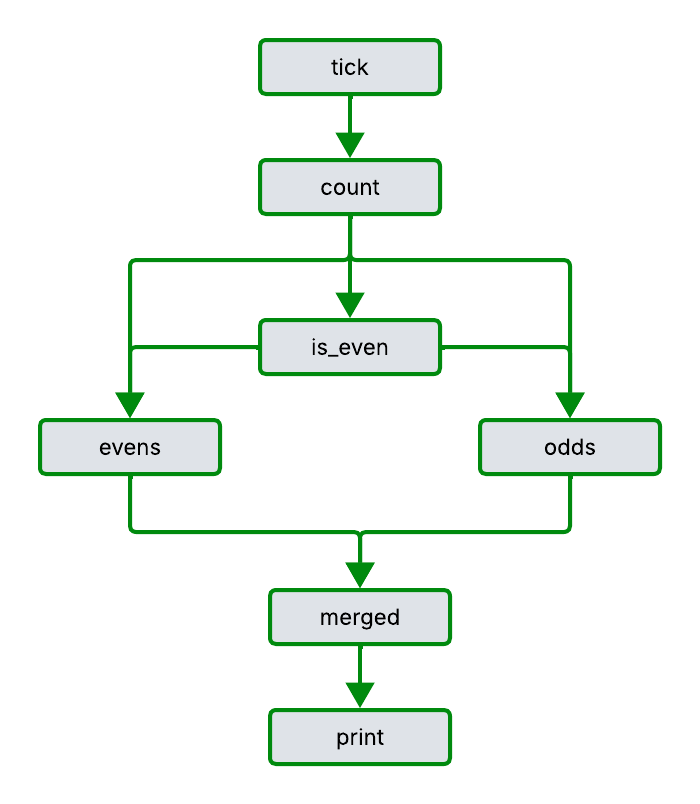
Wingfoil abstracts away the details of how to co-ordinate the calculation of your application, parts of which may executing at different frequencies. Only the nodes that actually require cycling are executed which allows wingfoil to efficiently scale to very large graphs. Consider the following example:
use wingfoil::*;
use std::time::Duration;
fn main() {
    let period = Duration::from_millis(10);
    let source = ticker(period).count(); // 1, 2, 3 etc
    let is_even = source.map(|i| i % 2 == 0);
    let odds = source
        .filter(is_even.not())
        .map(|i| format!("{:} is odd", i));
    let evens = source
        .filter(is_even)
        .map(|i| format!("{:} is even", i));
    merge(vec![odds, evens])
        .print()
        .run(
            RunMode::HistoricalFrom(NanoTime::ZERO),
            RunFor::Duration(period * 5),
        );
}
This output is produced:
1 is odd
2 is even
3 is odd
4 is even
5 is odd
6 is even
We can visualise the graph like this:
§Historical vs RealTime
Time is a first-class citizen in wingfoil. Engine time is measured in nanoseconds from the UNIX epoch and represented by a NanoTime.
In this example we compare and contrast RealTime vs Historical RunMode. RealTime is used for production deployment. Historical is used for development, unit-testing, integration-testing and back-testing.
use wingfoil::*;
use std::time::Duration;
use log::Level::Info;

pub fn main() {
    env_logger::init();
    for run_mode in vec![
        RunMode::RealTime,
        RunMode::HistoricalFrom(NanoTime::ZERO)
    ] {
        println!("\nUsing RunMode::{:?}", run_mode);
        ticker(Duration::from_secs(1))
            .count()
            .logged("tick", Info)
            .run(run_mode, RunFor::Cycles(3));
    }
}
This output is produced:
Using RunMode::RealTime
[17:34:46Z INFO wingfoil] 0.000_001 tick 1
[17:34:47Z INFO wingfoil] 1.000_131 tick 2
[17:34:48Z INFO wingfoil] 2.000_381 tick 3

Using RunMode::HistoricalFrom(NanoTime(0))
[17:34:48Z INFO  wingfoil] 0.000_000 tick 1
[17:34:48Z INFO  wingfoil] 1.000_000 tick 2
[17:34:48Z INFO  wingfoil] 2.000_000 tick 3
In Realtime mode the log statements are written every second. In Historical mode the log statements are written immediately. In both cases engine time advances by 1 second between each tick.
§Multithreading
Wingfoils supports multi-threading to distribute workloads across cores. The approach is to compose sub-graphs, each running in its own dedicated thread.
§Messaging
Wingfoil is agnostic to messaging and we plan to add support for shared memory IPC adapters such as Aeron for ultra-low latency use cases, ZeroMq for low latency server to server communication and Kafka for high latency, fault tolerant messaging.
§Graph Dynamism
Some use cases require graph-dynamism - consider for example Request for Quote (RFQ) markets, where the graph needs to be able to adapt to an incoming RFQ. Conceptually this could be done by changing the shape of the graph at run time. However, we take a simpler approach by virtualising this, following a demux pattern.
§Performance
We take performance seriously, and ongoing work is focused on making Wingfoil even closer to a zero-cost abstraction, Currently, the overhead of cycling a node in the graph is less than 10 nanoseconds.
For best perfomance we recommend using cheaply cloneable types:
- For small strings:
arraystring - For small vectors:
tinyvec - For larger or heap-allocated types:
Structs§
- Call
Back Stream - A queue of values that are emitted at specified times. Useful for unit tests. Can also be used to feed stream output back into the Graph as input on later cycles.
- Demux
Map - Maintains map from Key k, to output node for demux in order to demux a source. Used by StreamOperators::demux_it.
- Graph
- Engine for co-ordinating execution of Nodes
- Graph
State - Maintains the parts of the graph state that is accessible to Nodes.
- Nano
Time - A time in nanoseconds since the unix epoch.
- Overflow
- Represents a Stream of values that failed to be demuxed because the the demux capacity was exceeded. Output of StreamOperators::demux and StreamOperators::demux_it.
- UpStreams
- The graph can ask a Node what it’s upstreams sources are. The node replies wiht a UpStreams for passive and active sources. All sources are wired upstream. Active nodes trigger Node.cycle() when they tick. Passive Nodes do not.
Enums§
- Demux
Event - A message used to signal that a demuxed child stream can be closed. Used by StreamOperators::demux and StreamOperators::demux_it
- RunFor
- Defines how long the graph should run for. Can be a Duration, number of cycles or forever.
- RunMode
- Whether the Graph should run RealTime or Historical mode.
Traits§
- AsNode
- Used to cast Rc<dyn Stream> to Rc<dyn Node>
- AsStream
- Used co cast Rc of concrete stream into Rc of dyn Stream.
- Bench
Builder - A function that accepts a trigger node and wires downstream logic to be benchmarked.
- FutStream
- A convenience alias for
futures::Streamwith items of type(NanoTime, T). used by StreamOperators::consume_async. - Into
Node - Used to consume a concrete MutableNode and return an Rc<dyn Node>>.
- Into
Stream - Used to consume a concrete Stream and return an Rc<dyn Stream>>.
- Mutable
Node - Implement this trait create your own Node.
- Node
- A wiring point in the Graph.
- Node
Operators - A trait containing operators that can be applied to Nodes. Used to support method chaining syntax.
- Stream
- A Node which has some state that can peeked at.
- Stream
Operators - A trait containing operators that can be applied to Streams. Used to support method chaining syntax.
- Stream
Peek - The trait through which a Streams can current value can be peeked at.
- Stream
Peek Ref - A trait through which a referene to Stream’s value can be peeked at.
Functions§
- add
- Returns a Stream that adds both it’s source Streams. Ticks when either of it’s sources ticks.
- add_
bench - Used to add wingfoil bench to criterion.
- always
- Produces a Node that ticks on every engine cycle.
- bimap
- Maps two Streams into one using thr supplied function. Ticks when either of it’s sources ticks.
- combine
- Collects a Vec of Streams into a Stream of Vec.
- constant
- Returns a stream that ticks once with the specified value, on the first cycle.
- merge
- Returns a stream that merges it’s sources into one. Ticks when either of it’s sources ticks. If more than one source ticks at the same time, the first one that was supplied is used.
- produce_
async - Create a Stream from futures::Stream
- producer
- Creates a Stream emitting values on this thread but produced on a worker thread.
- ticker
- Returns a Node that ticks with the specified period.