Expand description



Swiftide
Composable LLM agents and harness, typed task graphs, and streaming RAG pipelines in Rust.
API docs
·
Examples
·
Website
·
Discord
Swiftide is an opinionated framework for building LLM applications. It gives you an agent harness, typed task graphs for orchestration, and streaming, composable indexing/query pipelines for RAG.
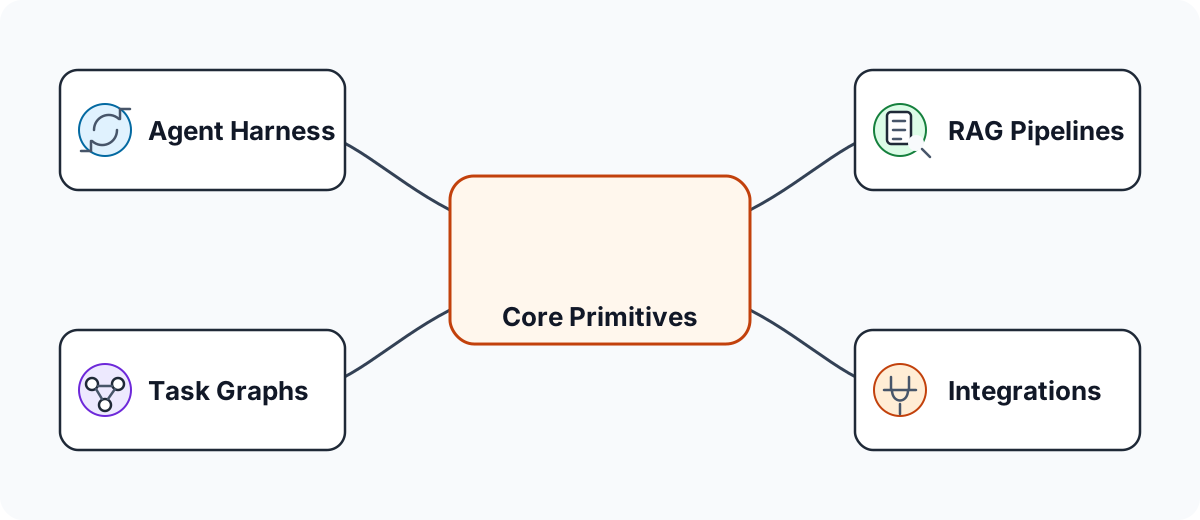
Table of Contents
§Why Swiftide
- Build agents that loop over LLM calls, tool calls, lifecycle hooks, and stop conditions.
- Compose prompt steps, agents, command executors, and domain-specific Rust code in typed task graphs.
- Fan out work into parallel branches and join typed results back into one task output.
- Pause and resume agents or tasks for human approval, external callbacks, or persisted state.
- Bring tools from local Rust functions, custom
Toolimplementations, or MCP servers. - Stream large indexing and retrieval workloads through loaders, transformers, embedders, caches, and storage backends.
- Trace agent, task, and pipeline execution with
tracing, metrics, and Langfuse support.
The core primitives provide the shared interaction model. Around them, use pipelines for data flows, agents for tool loops, and tasks for graphs of typed hand-offs.
§Quick Start
Swiftide keeps default dependencies light. Start with the agent harness and add the integrations your application needs.
cargo add swiftide --features swiftide-agents,openai
cargo add anyhow
cargo add tokio --features macros,rt-multi-thread
If using OpenAI, set the API key expected by the OpenAI-compatible integration:
export OPENAI_API_KEY=...§Agent Harness
Swiftide provides a harnass for building (semi) autonomous agents. The harnass owns message history, call an LLM, invoke tools, run hooks, and stopping. Tools are pure functions and easy to add. The AgentContext abstracts over message history (in memory by default) and provides tools access to the outside world via a ToolExecutor (local by default, see also the docker executor).
use anyhow::Result;
use swiftide::{
    agents,
    chat_completion::{ToolOutput, errors::ToolError},
    traits::AgentContext,
};

#[swiftide::tool(
    description = "Looks up a Swiftide concept",
    param(name = "concept", description = "Concept to explain")
)]
async fn explain_concept(
    _context: &dyn AgentContext,
    concept: &str,
) -> Result<ToolOutput, ToolError> {
    let explanation = match concept {
        "tasks" => "Tasks compose typed nodes into explicit workflows.",
        "agents" => "Agents run LLM completions, tools, hooks, and stop conditions.",
        "pipelines" => "Pipelines stream data through indexing and retrieval steps.",
        _ => "Swiftide composes agents, task graphs, tools, and RAG pipelines.",
    };

    Ok(explanation.into())
}

#[tokio::main]
async fn main() -> Result<()> {
    let openai = swiftide::integrations::openai::OpenAI::builder()
        .default_prompt_model("gpt-4o-mini")
        .build()?;

    agents::Agent::builder()
        .llm(&openai)
        .tools([explain_concept()])
        .on_new_message(|_, message| {
            println!("{message}");
            Box::pin(async { Ok(()) })
        })
        .limit(8)
        .build()?
        .query("Explain Swiftide tasks and agents in one paragraph.")
        .await?;

    Ok(())
}
The agent calls the model, exposes explain_concept as a tool, prints new messages, and stops
within the configured turn limit. By default all agents have a tool to stop the loop. This can be customized.
Agent capabilities include:
- function tools through
#[swiftide::tool], derived tools, or manualToolimplementations - lifecycle hooks before and after completions, tools, messages, streaming chunks, start, and stop
- local or custom
ToolExecutorimplementations for command/file access - human-in-the-loop approval via
ApprovalRequiredand feedback-aware contexts - structured stop and failure payloads with custom JSON schemas
- MCP toolboxes that load tools at runtime
- streaming responses and reasoning-item handling for providers that support them
Start with examples/hello_agents.rs,
then look at the human approval, MCP, streaming, resume, and structured-output examples.
§Typed Task Graphs
Tasks are Swiftide’s orchestration layer. A task is a typed graph of TaskNode steps. Each node has
an input type, output type, and error type; transitions decide where the output goes next.
Tasks are strongly typed at build time. It allows you to compose agents, other swiftide components, and functions to create complex automations.
From examples/tasks.rs.
use swiftide::{
    prompt::Prompt,
    tasks::{Task, TaskRunOutcome, Transition},
    traits::SimplePrompt,
};
use std::sync::Arc;

let prompt_model: Arc<dyn SimplePrompt> = Arc::new(openai.clone());
let briefing_agent = BriefingAgent::new(agent);
let mut task: Task<Prompt, String> = Task::new();

let brief = task.register_node(prompt_model.clone());
let decide = task.register_node(briefing_agent);
let render = task.register_node(prompt_model);

task.starts_with(brief);
task.register_transition(brief, move |short_brief| {
    decide.transitions_with(short_brief)
})?;
task.register_transition(decide, move |decision: BriefingDecision| {
    Transition::next(
        &render,
        Prompt::from("Write a hand-off note for {{audience}}: {{summary}}")
            .with_context_value("audience", decision.audience)
            .with_context_value("summary", decision.summary),
    )
})?;
task.register_transition(render, task.transitions_to_finish())?;

match task.run(Prompt::from("Summarize the rollout plan")).await? {
    TaskRunOutcome::Completed(note) => println!("{note}"),
    TaskRunOutcome::Paused => println!("Task paused"),
}
Task capabilities include:
- closure nodes for small glue steps and
TaskNodeimplementations for domain logic - typed
NodeIdhandles, transitions, and join payloads - static fan-out with explicit joins
- sequential or parallel branch execution
- pause, resume, and reset support
- adapters for prompt-like Swiftide primitives, chat completions, and tool executors
TaskAgentfor the simple case where an agent should run as a task node
See examples/tasks.rs for a
prompt plus custom agent workflow, and
examples/tasks_fanout.rs
for fan-out and join.
§RAG Pipelines
Swiftide includes first-class indexing and querying pipelines for retrieval-augmented generation. Pipelines are streaming and composable: load data, transform it, embed it, cache it, store it, then retrieve and answer with a typed query flow.
use swiftide::{
    indexing::{self, loaders::FileLoader, transformers::{ChunkCode, Embed, MetadataQACode}},
    integrations::qdrant::Qdrant,
};

async fn index(openai: swiftide::integrations::openai::OpenAI) -> anyhow::Result<()> {
    let qdrant = Qdrant::builder()
        .collection_name("swiftide-code")
        .vector_size(1536)
        .batch_size(50)
        .build()?;

    indexing::Pipeline::from_loader(FileLoader::new(".").with_extensions(&["rs"]))
        .with_default_llm_client(openai.clone())
        .then_chunk(ChunkCode::try_for_language_and_chunk_size("rust", 10..2048)?)
        .then(MetadataQACode::default())
        .then_in_batch(Embed::new(openai))
        .then_store_with(qdrant)
        .run()
        .await?;

    Ok(())
}
Indexing supports loaders, caches, chunkers, transformers, batch transformers, embedders, and storage backends. Query pipelines support query transformation, retrieval, response transformation, answer generation, hybrid search, reranking patterns, and evaluation.
§Integrations
Swiftide integrations are feature-gated so application builds stay intentional.
| Area | Supported integrations |
|---|---|
| LLM providers | OpenAI and Azure OpenAI, Anthropic, Gemini, OpenRouter, AWS Bedrock Converse API, Groq, Ollama, Dashscope |
| Tooling | MCP toolboxes, local command execution, custom tool executors |
| Storage and retrieval | Qdrant, Redis, LanceDB, PgVector, DuckDB, Redb |
| Loading data | Files, scraping, Fluvio, Kafka, Parquet, executor-backed file streams |
| Code and text processing | Markdown, text splitting, tree-sitter code chunking and metadata |
| Observability | tracing, metrics, Langfuse |
§Examples
The examples has a variety of examples.
- Agents:
hello_agents.rs,streaming_agents.rs,agents_with_human_in_the_loop.rs,agents_mcp_tools.rs - Structured outputs and control tools:
stop_with_args_custom_schema.rs,agent_can_fail_custom_schema.rs - Tasks:
tasks.rs,tasks_fanout.rs - RAG and retrieval:
index_codebase.rs,query_pipeline.rs,hybrid_search.rs - Provider and observability examples:
responses_api.rs,responses_api_reasoning.rs,aws_bedrock_agent.rs,langfuse.rs
More background is available on the Bosun blog, including posts about tasks, streaming agents, human-in-the-loop flows, and Rust performance for AI tools.
§Project Status
Swiftide is pre-1.0. APIs can change while the agent harness and task graph APIs settle around production use. The current API docs and examples are the most reliable source of exact signatures.
Swiftide is part of the bosun.ai project.
§Contributing
Contributions are welcome. Read CONTRIBUTING.md, open an issue for design discussion, file a bug report, or propose a feature. Join the Discord for a faster feedback loop.
Before opening a pull request:
- Run the focused checks for the crates you changed.
- Run
cargo +nightly fmt --all -- --check. - Run
cargo clippy --workspace --all-targets --all-features -- -D warningswhen touching shared behavior. - Add or update examples, tests, or rustdoc when behavior changes.
AI-generated code is welcome and should be reviewed like any other code. Keep abstractions small, keep domain logic separate from plumbing, and pay attention to allocations in indexing, querying, and task execution paths.
AI agents can refer to AGENTS.md for workspace layout, commands, and expectations.
§Core Team Members

timonv |

tinco |
§License
Distributed under the MIT License. See LICENSE for more information.
§Cargo Features
default— By default only macros are enabled
§Integrations
qdrant— Enables Qdrant for storage and retrievalpgvector— Enables PgVector for storage and retrievalredis— Enables Redis as an indexing cache and storagetree-sitter— Tree-sitter for various code transformersopenai— OpenAIgroq— Groqgemini— Google Geminidashscope— Dashscope promptingopen-router— OpenRouter promptingollama— Ollama promptingfastembed— FastEmbed (by qdrant) for fast, local, sparse and dense embeddingsscraping— Scraping via spider as loader and a html to markdown transformeraws-bedrock— AWS Bedrock for promptinglancedb— Lancdb for persistance and queryingfluvio— Fluvio loaderkafka— Kafka loaderparquet— Parquet loaderredb— Redb embeddable nodecacheduckdb— Duckdb; sqlite fork, support Persist, Retrieve and NodeCache
§Other
mcp— MCP tool support for agents (tools only)metrics— Metrics for usage, pipeline and agent performancetest-utils— Various mocking and testing utilitiesjson-schema— Json schema for various typestiktoken— Estimate token counts using tiktoken
§Agent and task orchestration
swiftide-tasks— Typed task graphsswiftide-agents— GenAI agents and toolslangfuse— Langfuse tracing and observability
Modules§
- agents
swiftide-agents - Swiftide agents are a flexible way to build fast and reliable AI agents.
- chat_
completion - Abstractions for chat completions and LLM interactions. This module enables the implementation of chat completion on LLM providers
- indexing
- This module serves as the main entry point for indexing in Swiftide.
- integrations
- Integrations with various platforms and external services.
- langfuse
langfuse - Provides a Langfuse integration for Swiftide
- prompt
- Prompts templating and management
- query
- Querying pipelines
- tasks
swiftide-tasks - Build and run typed task graphs.
- traits
- Common traits for common behaviour, re-exported from indexing and query
Structs§
- Char
Estimator - A rough estimator when speed matters more than accuracy.
- Sparse
Embedding
Type Aliases§
Attribute Macros§
- indexing_
transformer macros - Generates boilerplate for an indexing transformer.
- tool
macros - Creates a
Toolfrom an async function.
Derive Macros§
- Tool
macros - Derive
Toolon a struct.