pub struct StateChange {
    pub state: Option<SerializedComponentBatch>,
}
Expand description
Archetype: A state change, representing a transition of an entity into a new state.
Useful for representing discrete state machines, mode transitions, or
state changes over time. Each logged archetypes::StateChange marks a new state
at the given time. A null state resets the state, showing a gap in the state timeline view.
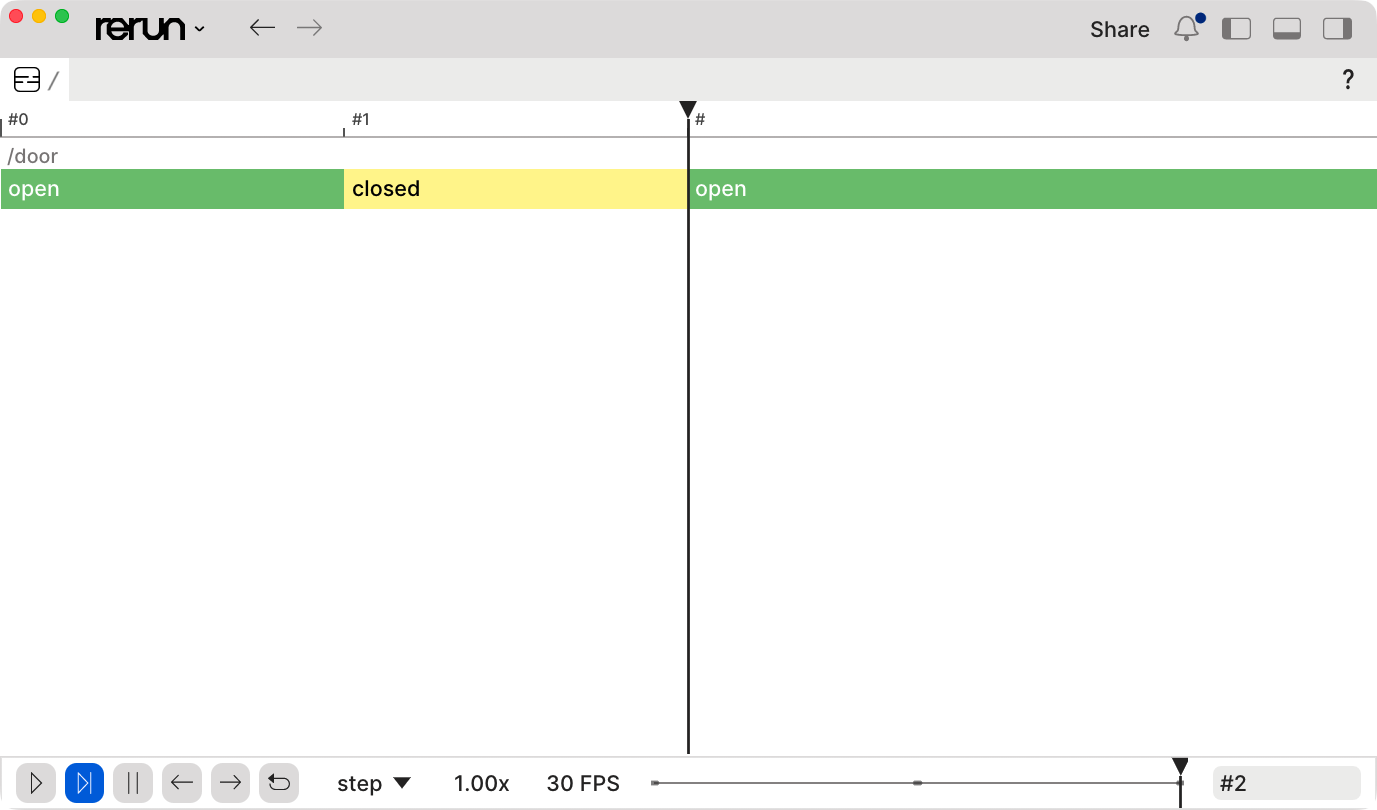
The state timeline view displays these as horizontal colored lanes over time.
§Example
§State changes over time
fn main() -> Result<(), Box<dyn std::error::Error>> {
    let rec = rerun::RecordingStreamBuilder::new("rerun_example_state_change")
        .spawn()?;

    rec.set_time_sequence("step", 0);
    rec.log("door", &rerun::StateChange::single("open"))?;

    rec.set_time_sequence("step", 1);
    rec.log("door", &rerun::StateChange::single("closed"))?;

    rec.set_time_sequence("step", 2);
    rec.log("door", &rerun::StateChange::single("open"))?;

    Ok(())
}
Fields§
§state: Option<SerializedComponentBatch>The new state values; each instance gets its own lane in the state timeline view.
A reset ends the previous state and shows a gap in the state timeline view until the next state. An empty string, a null array entry, and an empty state array (e.g. from clearing the field) all act as resets.
The length of the state array should not change over time.
Implementations§
Source§impl StateChange
impl StateChange
Sourcepub fn descriptor_state() -> ComponentDescriptor
pub fn descriptor_state() -> ComponentDescriptor
Returns the ComponentDescriptor for Self::state.
The corresponding component is crate::components::Text.
Source§impl StateChange
impl StateChange
Sourcepub const NUM_COMPONENTS: usize = 1usize
pub const NUM_COMPONENTS: usize = 1usize
The total number of components in the archetype: 1 required, 0 recommended, 0 optional
Source§impl StateChange
impl StateChange
Sourcepub fn new() -> StateChange
pub fn new() -> StateChange
Create a new StateChange.
Sourcepub fn update_fields() -> StateChange
pub fn update_fields() -> StateChange
Update only some specific fields of a StateChange.
Sourcepub fn clear_fields() -> StateChange
pub fn clear_fields() -> StateChange
Clear all the fields of a StateChange.
Sourcepub fn columns<I>(
self,
_lengths: I,
) -> Result<impl Iterator<Item = SerializedComponentColumn>, SerializationError>
pub fn columns<I>( self, _lengths: I, ) -> Result<impl Iterator<Item = SerializedComponentColumn>, SerializationError>
Partitions the component data into multiple sub-batches.
Specifically, this transforms the existing SerializedComponentBatches data into SerializedComponentColumns
instead, via SerializedComponentBatch::partitioned.
This makes it possible to use RecordingStream::send_columns to send columnar data directly into Rerun.
The specified lengths must sum to the total length of the component batch.
Sourcepub fn columns_of_unit_batches(
self,
) -> Result<impl Iterator<Item = SerializedComponentColumn>, SerializationError>
pub fn columns_of_unit_batches( self, ) -> Result<impl Iterator<Item = SerializedComponentColumn>, SerializationError>
Helper to partition the component data into unit-length sub-batches.
This is semantically similar to calling Self::columns with std::iter::take(1).repeat(n),
where n is automatically guessed.
Sourcepub fn with_state(
self,
state: impl IntoIterator<Item = impl Into<Text>>,
) -> StateChange
pub fn with_state( self, state: impl IntoIterator<Item = impl Into<Text>>, ) -> StateChange
The new state values; each instance gets its own lane in the state timeline view.
A reset ends the previous state and shows a gap in the state timeline view until the next state. An empty string, a null array entry, and an empty state array (e.g. from clearing the field) all act as resets.
The length of the state array should not change over time.
Source§impl StateChange
impl StateChange
Sourcepub fn single(state: impl Into<Text>) -> StateChange
pub fn single(state: impl Into<Text>) -> StateChange
Constructor for a single state value (one lane).
Sourcepub fn with_state_opt(
self,
state: impl IntoIterator<Item = Option<impl Into<Text>>>,
) -> StateChange
pub fn with_state_opt( self, state: impl IntoIterator<Item = Option<impl Into<Text>>>, ) -> StateChange
Set the state array from optional values.
A None entry resets that instance’s state, showing a gap in its lane — something
Self::with_state can’t express, since it only takes present values.
Trait Implementations§
Source§impl Archetype for StateChange
impl Archetype for StateChange
Source§fn name() -> ArchetypeName
fn name() -> ArchetypeName
rerun.archetypes.Points2D.Source§fn display_name() -> &'static str
fn display_name() -> &'static str
Source§fn required_components() -> Cow<'static, [ComponentDescriptor]>
fn required_components() -> Cow<'static, [ComponentDescriptor]>
Source§fn recommended_components() -> Cow<'static, [ComponentDescriptor]>
fn recommended_components() -> Cow<'static, [ComponentDescriptor]>
Source§fn optional_components() -> Cow<'static, [ComponentDescriptor]>
fn optional_components() -> Cow<'static, [ComponentDescriptor]>
Source§fn all_components() -> Cow<'static, [ComponentDescriptor]>
fn all_components() -> Cow<'static, [ComponentDescriptor]>
Source§fn from_arrow_components(
arrow_data: impl IntoIterator<Item = (ComponentDescriptor, Arc<dyn Array>)>,
) -> Result<StateChange, DeserializationError>
fn from_arrow_components( arrow_data: impl IntoIterator<Item = (ComponentDescriptor, Arc<dyn Array>)>, ) -> Result<StateChange, DeserializationError>
ComponentDescriptors, deserializes them
into this archetype. Read moreSource§fn all_component_identifiers() -> impl Iterator<Item = ComponentIdentifier>
fn all_component_identifiers() -> impl Iterator<Item = ComponentIdentifier>
Self::all_components to return all component identifiers.Source§fn from_arrow(
data: impl IntoIterator<Item = (Field, Arc<dyn Array>)>,
) -> Result<Self, DeserializationError>where
Self: Sized,
fn from_arrow(
data: impl IntoIterator<Item = (Field, Arc<dyn Array>)>,
) -> Result<Self, DeserializationError>where
Self: Sized,
impl ArchetypeReflectionMarker for StateChange
Source§impl AsComponents for StateChange
impl AsComponents for StateChange
Source§fn as_serialized_batches(&self) -> Vec<SerializedComponentBatch>
fn as_serialized_batches(&self) -> Vec<SerializedComponentBatch>
SerializedComponentBatches. Read moreSource§impl Clone for StateChange
impl Clone for StateChange
Source§fn clone(&self) -> StateChange
fn clone(&self) -> StateChange
1.0.0 (const: unstable) · Source§fn clone_from(&mut self, source: &Self)
fn clone_from(&mut self, source: &Self)
source. Read moreSource§impl Debug for StateChange
impl Debug for StateChange
Source§impl Default for StateChange
impl Default for StateChange
Source§fn default() -> StateChange
fn default() -> StateChange
Source§impl PartialEq for StateChange
impl PartialEq for StateChange
Source§impl SizeBytes for StateChange
impl SizeBytes for StateChange
const IS_POD: bool = <Option<SerializedComponentBatch> as ::re_byte_size::SizeBytes>::IS_POD
Source§fn heap_size_bytes(&self) -> u64
fn heap_size_bytes(&self) -> u64
self uses on the heap. Read moreSource§fn total_size_bytes(&self) -> u64
fn total_size_bytes(&self) -> u64
self in bytes, accounting for both stack and heap space.Source§fn stack_size_bytes(&self) -> u64
fn stack_size_bytes(&self) -> u64
self on the stack, in bytes. Read moreimpl StructuralPartialEq for StateChange
Source§impl VisualizableArchetype for StateChange
impl VisualizableArchetype for StateChange
Source§fn visualizer(&self) -> Visualizer
fn visualizer(&self) -> Visualizer
Auto Trait Implementations§
impl !RefUnwindSafe for StateChange
impl !UnwindSafe for StateChange
impl Freeze for StateChange
impl Send for StateChange
impl Sync for StateChange
impl Unpin for StateChange
impl UnsafeUnpin for StateChange
Blanket Implementations§
Source§impl<T> BorrowMut<T> for Twhere
T: ?Sized,
impl<T> BorrowMut<T> for Twhere
T: ?Sized,
Source§fn borrow_mut(&mut self) -> &mut T
fn borrow_mut(&mut self) -> &mut T
impl<ST, DT> CastableFrom<ST, Initialized, Initialized> for DT
impl<ST, DT> CastableFrom<ST, Uninit, Uninit> for DT
Source§impl<T> CheckedAs for T
impl<T> CheckedAs for T
Source§fn checked_as<Dst>(self) -> Option<Dst>where
T: CheckedCast<Dst>,
fn checked_as<Dst>(self) -> Option<Dst>where
T: CheckedCast<Dst>,
Source§impl<Src, Dst> CheckedCastFrom<Src> for Dstwhere
Src: CheckedCast<Dst>,
impl<Src, Dst> CheckedCastFrom<Src> for Dstwhere
Src: CheckedCast<Dst>,
Source§fn checked_cast_from(src: Src) -> Option<Dst>
fn checked_cast_from(src: Src) -> Option<Dst>
Source§impl<T> CloneToUninit for Twhere
T: Clone,
impl<T> CloneToUninit for Twhere
T: Clone,
Source§impl<T> Downcast for Twhere
T: Any,
impl<T> Downcast for Twhere
T: Any,
Source§fn into_any(self: Box<T>) -> Box<dyn Any>
fn into_any(self: Box<T>) -> Box<dyn Any>
Box<dyn Trait> (where Trait: Downcast) to Box<dyn Any>. Box<dyn Any> can
then be further downcast into Box<ConcreteType> where ConcreteType implements Trait.Source§fn into_any_rc(self: Rc<T>) -> Rc<dyn Any>
fn into_any_rc(self: Rc<T>) -> Rc<dyn Any>
Rc<Trait> (where Trait: Downcast) to Rc<Any>. Rc<Any> can then be
further downcast into Rc<ConcreteType> where ConcreteType implements Trait.Source§fn as_any(&self) -> &(dyn Any + 'static)
fn as_any(&self) -> &(dyn Any + 'static)
&Trait (where Trait: Downcast) to &Any. This is needed since Rust cannot
generate &Any’s vtable from &Trait’s.Source§fn as_any_mut(&mut self) -> &mut (dyn Any + 'static)
fn as_any_mut(&mut self) -> &mut (dyn Any + 'static)
&mut Trait (where Trait: Downcast) to &Any. This is needed since Rust cannot
generate &mut Any’s vtable from &mut Trait’s.Source§impl<T> DowncastSync for T
impl<T> DowncastSync for T
Source§impl<T> FutureExt for T
impl<T> FutureExt for T
Source§fn with_context(self, otel_cx: Context) -> WithContext<Self> ⓘ
fn with_context(self, otel_cx: Context) -> WithContext<Self> ⓘ
Source§fn with_current_context(self) -> WithContext<Self> ⓘ
fn with_current_context(self) -> WithContext<Self> ⓘ
Source§impl<T> Instrument for T
impl<T> Instrument for T
Source§fn instrument(self, span: Span) -> Instrumented<Self> ⓘ
fn instrument(self, span: Span) -> Instrumented<Self> ⓘ
Source§fn in_current_span(self) -> Instrumented<Self> ⓘ
fn in_current_span(self) -> Instrumented<Self> ⓘ
Source§impl<T> IntoEither for T
impl<T> IntoEither for T
Source§fn into_either(self, into_left: bool) -> Either<Self, Self> ⓘ
fn into_either(self, into_left: bool) -> Either<Self, Self> ⓘ
self into a Left variant of Either<Self, Self>
if into_left is true.
Converts self into a Right variant of Either<Self, Self>
otherwise. Read moreSource§fn into_either_with<F>(self, into_left: F) -> Either<Self, Self> ⓘ
fn into_either_with<F>(self, into_left: F) -> Either<Self, Self> ⓘ
self into a Left variant of Either<Self, Self>
if into_left(&self) returns true.
Converts self into a Right variant of Either<Self, Self>
otherwise. Read moreSource§impl<T> IntoMaybeUndefined<T> for T
impl<T> IntoMaybeUndefined<T> for T
Source§fn into_maybe_undefined(self) -> MaybeUndefined<T>
fn into_maybe_undefined(self) -> MaybeUndefined<T>
Source§impl<T> IntoOption<T> for T
impl<T> IntoOption<T> for T
Source§fn into_option(self) -> Option<T>
fn into_option(self) -> Option<T>
Source§impl<T> IntoRequest<T> for T
impl<T> IntoRequest<T> for T
Source§fn into_request(self) -> Request<T>
fn into_request(self) -> Request<T>
T in a tonic::RequestSource§impl<Src, Dst> LosslessTryInto<Dst> for Srcwhere
Dst: LosslessTryFrom<Src>,
impl<Src, Dst> LosslessTryInto<Dst> for Srcwhere
Dst: LosslessTryFrom<Src>,
Source§fn lossless_try_into(self) -> Option<Dst>
fn lossless_try_into(self) -> Option<Dst>
Source§impl<Src, Dst> LossyInto<Dst> for Srcwhere
Dst: LossyFrom<Src>,
impl<Src, Dst> LossyInto<Dst> for Srcwhere
Dst: LossyFrom<Src>,
Source§fn lossy_into(self) -> Dst
fn lossy_into(self) -> Dst
Source§impl<T> OverflowingAs for T
impl<T> OverflowingAs for T
Source§fn overflowing_as<Dst>(self) -> (Dst, bool)where
T: OverflowingCast<Dst>,
fn overflowing_as<Dst>(self) -> (Dst, bool)where
T: OverflowingCast<Dst>,
Source§impl<Src, Dst> OverflowingCastFrom<Src> for Dstwhere
Src: OverflowingCast<Dst>,
impl<Src, Dst> OverflowingCastFrom<Src> for Dstwhere
Src: OverflowingCast<Dst>,
Source§fn overflowing_cast_from(src: Src) -> (Dst, bool)
fn overflowing_cast_from(src: Src) -> (Dst, bool)
Source§impl<T> Pipe for Twhere
T: ?Sized,
impl<T> Pipe for Twhere
T: ?Sized,
Source§fn pipe<R>(self, func: impl FnOnce(Self) -> R) -> Rwhere
Self: Sized,
fn pipe<R>(self, func: impl FnOnce(Self) -> R) -> Rwhere
Self: Sized,
Source§fn pipe_ref<'a, R>(&'a self, func: impl FnOnce(&'a Self) -> R) -> Rwhere
R: 'a,
fn pipe_ref<'a, R>(&'a self, func: impl FnOnce(&'a Self) -> R) -> Rwhere
R: 'a,
self and passes that borrow into the pipe function. Read moreSource§fn pipe_ref_mut<'a, R>(&'a mut self, func: impl FnOnce(&'a mut Self) -> R) -> Rwhere
R: 'a,
fn pipe_ref_mut<'a, R>(&'a mut self, func: impl FnOnce(&'a mut Self) -> R) -> Rwhere
R: 'a,
self and passes that borrow into the pipe function. Read moreSource§fn pipe_borrow<'a, B, R>(&'a self, func: impl FnOnce(&'a B) -> R) -> R
fn pipe_borrow<'a, B, R>(&'a self, func: impl FnOnce(&'a B) -> R) -> R
Source§fn pipe_borrow_mut<'a, B, R>(
&'a mut self,
func: impl FnOnce(&'a mut B) -> R,
) -> R
fn pipe_borrow_mut<'a, B, R>( &'a mut self, func: impl FnOnce(&'a mut B) -> R, ) -> R
Source§fn pipe_as_ref<'a, U, R>(&'a self, func: impl FnOnce(&'a U) -> R) -> R
fn pipe_as_ref<'a, U, R>(&'a self, func: impl FnOnce(&'a U) -> R) -> R
self, then passes self.as_ref() into the pipe function.Source§fn pipe_as_mut<'a, U, R>(&'a mut self, func: impl FnOnce(&'a mut U) -> R) -> R
fn pipe_as_mut<'a, U, R>(&'a mut self, func: impl FnOnce(&'a mut U) -> R) -> R
self, then passes self.as_mut() into the pipe
function.Source§fn pipe_deref<'a, T, R>(&'a self, func: impl FnOnce(&'a T) -> R) -> R
fn pipe_deref<'a, T, R>(&'a self, func: impl FnOnce(&'a T) -> R) -> R
self, then passes self.deref() into the pipe function.Source§impl<T> Pointable for T
impl<T> Pointable for T
Source§impl<T> PolicyExt for Twhere
T: ?Sized,
impl<T> PolicyExt for Twhere
T: ?Sized,
impl<T> Read<Exclusive, BecauseExclusive> for Twhere
T: ?Sized,
Source§impl<T> SaturatingAs for T
impl<T> SaturatingAs for T
Source§fn saturating_as<Dst>(self) -> Dstwhere
T: SaturatingCast<Dst>,
fn saturating_as<Dst>(self) -> Dstwhere
T: SaturatingCast<Dst>,
Source§impl<Src, Dst> SaturatingCastFrom<Src> for Dstwhere
Src: SaturatingCast<Dst>,
impl<Src, Dst> SaturatingCastFrom<Src> for Dstwhere
Src: SaturatingCast<Dst>,
Source§fn saturating_cast_from(src: Src) -> Dst
fn saturating_cast_from(src: Src) -> Dst
Source§impl<T> StrictAs for T
impl<T> StrictAs for T
Source§fn strict_as<Dst>(self) -> Dstwhere
T: StrictCast<Dst>,
fn strict_as<Dst>(self) -> Dstwhere
T: StrictCast<Dst>,
Source§impl<Src, Dst> StrictCastFrom<Src> for Dstwhere
Src: StrictCast<Dst>,
impl<Src, Dst> StrictCastFrom<Src> for Dstwhere
Src: StrictCast<Dst>,
Source§fn strict_cast_from(src: Src) -> Dst
fn strict_cast_from(src: Src) -> Dst
Source§impl<T> Tap for T
impl<T> Tap for T
Source§fn tap_borrow<B>(self, func: impl FnOnce(&B)) -> Self
fn tap_borrow<B>(self, func: impl FnOnce(&B)) -> Self
Borrow<B> of a value. Read moreSource§fn tap_borrow_mut<B>(self, func: impl FnOnce(&mut B)) -> Self
fn tap_borrow_mut<B>(self, func: impl FnOnce(&mut B)) -> Self
BorrowMut<B> of a value. Read moreSource§fn tap_ref<R>(self, func: impl FnOnce(&R)) -> Self
fn tap_ref<R>(self, func: impl FnOnce(&R)) -> Self
AsRef<R> view of a value. Read moreSource§fn tap_ref_mut<R>(self, func: impl FnOnce(&mut R)) -> Self
fn tap_ref_mut<R>(self, func: impl FnOnce(&mut R)) -> Self
AsMut<R> view of a value. Read moreSource§fn tap_deref<T>(self, func: impl FnOnce(&T)) -> Self
fn tap_deref<T>(self, func: impl FnOnce(&T)) -> Self
Deref::Target of a value. Read moreSource§fn tap_deref_mut<T>(self, func: impl FnOnce(&mut T)) -> Self
fn tap_deref_mut<T>(self, func: impl FnOnce(&mut T)) -> Self
Deref::Target of a value. Read moreSource§fn tap_dbg(self, func: impl FnOnce(&Self)) -> Self
fn tap_dbg(self, func: impl FnOnce(&Self)) -> Self
.tap() only in debug builds, and is erased in release builds.Source§fn tap_mut_dbg(self, func: impl FnOnce(&mut Self)) -> Self
fn tap_mut_dbg(self, func: impl FnOnce(&mut Self)) -> Self
.tap_mut() only in debug builds, and is erased in release
builds.Source§fn tap_borrow_dbg<B>(self, func: impl FnOnce(&B)) -> Self
fn tap_borrow_dbg<B>(self, func: impl FnOnce(&B)) -> Self
.tap_borrow() only in debug builds, and is erased in release
builds.Source§fn tap_borrow_mut_dbg<B>(self, func: impl FnOnce(&mut B)) -> Self
fn tap_borrow_mut_dbg<B>(self, func: impl FnOnce(&mut B)) -> Self
.tap_borrow_mut() only in debug builds, and is erased in release
builds.Source§fn tap_ref_dbg<R>(self, func: impl FnOnce(&R)) -> Self
fn tap_ref_dbg<R>(self, func: impl FnOnce(&R)) -> Self
.tap_ref() only in debug builds, and is erased in release
builds.Source§fn tap_ref_mut_dbg<R>(self, func: impl FnOnce(&mut R)) -> Self
fn tap_ref_mut_dbg<R>(self, func: impl FnOnce(&mut R)) -> Self
.tap_ref_mut() only in debug builds, and is erased in release
builds.Source§fn tap_deref_dbg<T>(self, func: impl FnOnce(&T)) -> Self
fn tap_deref_dbg<T>(self, func: impl FnOnce(&T)) -> Self
.tap_deref() only in debug builds, and is erased in release
builds.