pub struct Weibull<F>{ /* private fields */ }Expand description
The Weibull distribution Weibull(λ, k).
This is a family of continuous probability distributions with
scale parameter λ (lambda) and shape parameter k. It is used
to model reliability data, life data, and accelerated life testing data.
§Density function
f(x; λ, k) = (k / λ) * (x / λ)^(k - 1) * exp(-(x / λ)^k) for x >= 0.
§Plot
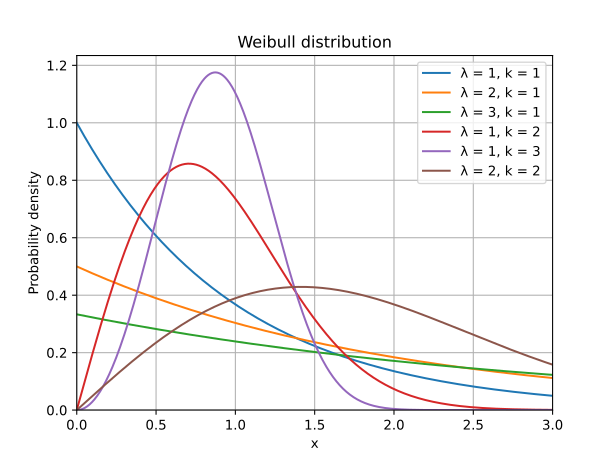
The following plot shows the Weibull distribution with various values of λ and k.
§Example
use rand::prelude::*;
use rand_distr::Weibull;

let val: f64 = rand::rng().sample(Weibull::new(1., 10.).unwrap());
println!("{}", val);§Numerics
For small k like < 0.005, even with f64 a significant number of samples will be so small that they underflow to 0.0
or so big they overflow to inf. This is a limitation of the floating point representation and not specific to this implementation.
Implementations§
Trait Implementations§
Source§impl<F> Distribution<F> for Weibull<F>
impl<F> Distribution<F> for Weibull<F>
impl<F> Copy for Weibull<F>
impl<F> StructuralPartialEq for Weibull<F>
Auto Trait Implementations§
impl<F> Freeze for Weibull<F>where
F: Freeze,
impl<F> RefUnwindSafe for Weibull<F>where
F: RefUnwindSafe,
impl<F> Send for Weibull<F>where
F: Send,
impl<F> Sync for Weibull<F>where
F: Sync,
impl<F> Unpin for Weibull<F>where
F: Unpin,
impl<F> UnwindSafe for Weibull<F>where
F: UnwindSafe,
Blanket Implementations§
Source§impl<T> BorrowMut<T> for Twhere
T: ?Sized,
impl<T> BorrowMut<T> for Twhere
T: ?Sized,
Source§fn borrow_mut(&mut self) -> &mut T
fn borrow_mut(&mut self) -> &mut T
Mutably borrows from an owned value. Read more
Source§impl<T> CloneToUninit for Twhere
T: Clone,
impl<T> CloneToUninit for Twhere
T: Clone,
Source§impl<D, T> DistributionExt<T> for Dwhere
D: Distribution<T>,
impl<D, T> DistributionExt<T> for Dwhere
D: Distribution<T>,
Source§impl<T> Instrument for T
impl<T> Instrument for T
Source§fn instrument(self, span: Span) -> Instrumented<Self>
fn instrument(self, span: Span) -> Instrumented<Self>
Source§fn in_current_span(self) -> Instrumented<Self>
fn in_current_span(self) -> Instrumented<Self>
Source§impl<T> IntoEither for T
impl<T> IntoEither for T
Source§fn into_either(self, into_left: bool) -> Either<Self, Self>
fn into_either(self, into_left: bool) -> Either<Self, Self>
Converts
self into a Left variant of Either<Self, Self>
if into_left is true.
Converts self into a Right variant of Either<Self, Self>
otherwise. Read moreSource§fn into_either_with<F>(self, into_left: F) -> Either<Self, Self>
fn into_either_with<F>(self, into_left: F) -> Either<Self, Self>
Converts
self into a Left variant of Either<Self, Self>
if into_left(&self) returns true.
Converts self into a Right variant of Either<Self, Self>
otherwise. Read moreSource§impl<T> Pointable for T
impl<T> Pointable for T
Source§impl<T> PolicyExt for Twhere
T: ?Sized,
impl<T> PolicyExt for Twhere
T: ?Sized,
Source§impl<SS, SP> SupersetOf<SS> for SPwhere
SS: SubsetOf<SP>,
impl<SS, SP> SupersetOf<SS> for SPwhere
SS: SubsetOf<SP>,
Source§fn to_subset(&self) -> Option<SS>
fn to_subset(&self) -> Option<SS>
The inverse inclusion map: attempts to construct
self from the equivalent element of its
superset. Read moreSource§fn is_in_subset(&self) -> bool
fn is_in_subset(&self) -> bool
Checks if
self is actually part of its subset T (and can be converted to it).Source§fn to_subset_unchecked(&self) -> SS
fn to_subset_unchecked(&self) -> SS
Use with care! Same as
self.to_subset but without any property checks. Always succeeds.Source§fn from_subset(element: &SS) -> SP
fn from_subset(element: &SS) -> SP
The inclusion map: converts
self to the equivalent element of its superset.