pub struct Plot { /* private fields */ }Expand description
Driver structure that calls Python
Example
use plotpy::{Curve, Plot, StrError};
use russell_lab::Vector;

fn main() -> Result<(), StrError> {
    // generate (x,y) points
    let n = 11;
    let x = Vector::linspace(-1.0, 1.0, n)?;
    let y1 = x.clone();
    let y2 = x.get_mapped(|v| f64::abs(v));
    let y3 = x.get_mapped(|v| f64::exp(1.0 + v) - 1.0);
    let y4 = x.get_mapped(|v| f64::sqrt(1.0 + v));

    // configure and draw curves
    let mut curve1 = Curve::new();
    let mut curve2 = Curve::new();
    let mut curve3 = Curve::new();
    let mut curve4 = Curve::new();
    curve1.set_label("y = x");
    curve2.set_label("y = |x|").set_line_color("#cd0000");
    curve3.set_label("y = exp(1+x)-1").set_line_color("#e79955");
    curve4.set_label("y = sqrt(1+x)").set_line_color("#b566ab");
    curve1.draw(&x, &y1);
    curve2.draw(&x, &y2);
    curve3.draw(&x, &y3);
    curve4.draw(&x, &y4);

    // configure plot
    let mut plot = Plot::new();
    plot.set_super_title("FOUR CURVES").set_gaps(0.35, 0.5);

    // add curve to subplot
    plot.set_subplot(2, 2, 1)
        .set_title("first")
        .add(&curve1)
        .grid_labels_legend("x", "y")
        .set_equal_axes(true);

    // add curve to subplot
    plot.set_subplot(2, 2, 2)
        .set_title("second")
        .add(&curve2)
        .grid_labels_legend("x", "y");

    // add curve to subplot
    plot.set_subplot(2, 2, 3)
        .set_title("third")
        .add(&curve3)
        .set_range(-1.0, 1.0, 0.0, 6.0)
        .grid_labels_legend("x", "y");

    // add curve to subplot
    plot.set_subplot(2, 2, 4)
        .set_title("fourth")
        .add(&curve4)
        .grid_labels_legend("x", "y");

    // save figure
    plot.save("/tmp/plotpy/doc_tests/doc_plot.svg")?;
    Ok(())
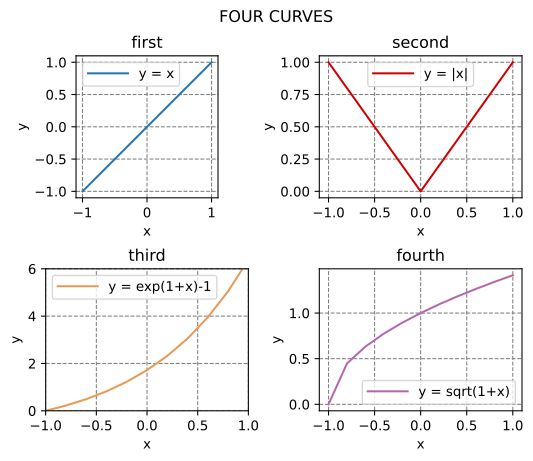
}
See also integration tests in the tests directory
Implementations§
source§impl Plot
impl Plot
sourcepub fn add(&mut self, graph: &dyn GraphMaker) -> &mut Self
pub fn add(&mut self, graph: &dyn GraphMaker) -> &mut Self
Adds new graph entity
sourcepub fn save_and_show<S>(&self, figure_path: &S) -> Result<(), StrError>where
S: AsRef<OsStr> + ?Sized,
pub fn save_and_show<S>(&self, figure_path: &S) -> Result<(), StrError>where S: AsRef<OsStr> + ?Sized,
sourcepub fn clear_current_figure(&mut self) -> &mut Self
pub fn clear_current_figure(&mut self) -> &mut Self
Clears current figure
sourcepub fn grid_and_labels(&mut self, xlabel: &str, ylabel: &str) -> &mut Self
pub fn grid_and_labels(&mut self, xlabel: &str, ylabel: &str) -> &mut Self
Adds grid and labels
sourcepub fn grid_labels_legend(&mut self, xlabel: &str, ylabel: &str) -> &mut Self
pub fn grid_labels_legend(&mut self, xlabel: &str, ylabel: &str) -> &mut Self
Adds grid, labels, and legend
sourcepub fn set_show_errors(&mut self, option: bool) -> &mut Self
pub fn set_show_errors(&mut self, option: bool) -> &mut Self
Sets flag to print python errors (if any) when calling save
sourcepub fn set_subplot(&mut self, row: usize, col: usize, index: usize) -> &mut Self
pub fn set_subplot(&mut self, row: usize, col: usize, index: usize) -> &mut Self
Configures subplots
Arguments
row- number of rows in the subplot gridcol- number of columns in the subplot gridindex- activate current subplot; indices start at one (1-based)
sourcepub fn set_super_title(&mut self, title: &str) -> &mut Self
pub fn set_super_title(&mut self, title: &str) -> &mut Self
Adds a title to all sub-plots
sourcepub fn set_horizontal_gap(&mut self, value: f64) -> &mut Self
pub fn set_horizontal_gap(&mut self, value: f64) -> &mut Self
Sets the horizontal gap between subplots
sourcepub fn set_vertical_gap(&mut self, value: f64) -> &mut Self
pub fn set_vertical_gap(&mut self, value: f64) -> &mut Self
Sets the vertical gap between subplots
sourcepub fn set_gaps(&mut self, horizontal: f64, vertical: f64) -> &mut Self
pub fn set_gaps(&mut self, horizontal: f64, vertical: f64) -> &mut Self
Sets the horizontal and vertical gap between subplots
sourcepub fn set_equal_axes(&mut self, equal: bool) -> &mut Self
pub fn set_equal_axes(&mut self, equal: bool) -> &mut Self
Sets same scale for both axes
sourcepub fn set_figure_size_inches(&mut self, width: f64, height: f64) -> &mut Self
pub fn set_figure_size_inches(&mut self, width: f64, height: f64) -> &mut Self
Sets the figure size in inches
sourcepub fn set_figure_size_points(&mut self, width: f64, height: f64) -> &mut Self
pub fn set_figure_size_points(&mut self, width: f64, height: f64) -> &mut Self
Sets the figure size in points
sourcepub fn set_hide_axes(&mut self, hide: bool) -> &mut Self
pub fn set_hide_axes(&mut self, hide: bool) -> &mut Self
Set option to hide axes
sourcepub fn set_range_3d(
&mut self,
xmin: f64,
xmax: f64,
ymin: f64,
ymax: f64,
zmin: f64,
zmax: f64
) -> &mut Self
pub fn set_range_3d( &mut self, xmin: f64, xmax: f64, ymin: f64, ymax: f64, zmin: f64, zmax: f64 ) -> &mut Self
Sets axes limits
sourcepub fn set_range(
&mut self,
xmin: f64,
xmax: f64,
ymin: f64,
ymax: f64
) -> &mut Self
pub fn set_range( &mut self, xmin: f64, xmax: f64, ymin: f64, ymax: f64 ) -> &mut Self
Sets axes limits
sourcepub fn set_range_from_vec(&mut self, limits: &[f64]) -> &mut Self
pub fn set_range_from_vec(&mut self, limits: &[f64]) -> &mut Self
Sets axes limits from vector
sourcepub fn set_xrange(&mut self, xmin: f64, xmax: f64) -> &mut Self
pub fn set_xrange(&mut self, xmin: f64, xmax: f64) -> &mut Self
Sets x-range (i.e. limits)
sourcepub fn set_yrange(&mut self, ymin: f64, ymax: f64) -> &mut Self
pub fn set_yrange(&mut self, ymin: f64, ymax: f64) -> &mut Self
Sets y-range (i.e. limits)
sourcepub fn set_num_ticks_x(&mut self, num: usize) -> &mut Self
pub fn set_num_ticks_x(&mut self, num: usize) -> &mut Self
Sets number of ticks along x
sourcepub fn set_num_ticks_y(&mut self, num: usize) -> &mut Self
pub fn set_num_ticks_y(&mut self, num: usize) -> &mut Self
Sets number of ticks along y
sourcepub fn set_ticks_x(
&mut self,
major_every: f64,
minor_every: f64,
major_number_format: &str
) -> &mut Self
pub fn set_ticks_x( &mut self, major_every: f64, minor_every: f64, major_number_format: &str ) -> &mut Self
Sets the number and format of x-ticks
Input
major_every– step for major ticks (ignored if ≤ 0.0)minor_every– step for major ticks (ignored if ≤ 0.0)major_number_format– C-style number format for major ticks; e.g. “%.2f” (ignored if empty “”) See matplotlib FormatStrFormatter
sourcepub fn set_ticks_y(
&mut self,
major_every: f64,
minor_every: f64,
major_number_format: &str
) -> &mut Self
pub fn set_ticks_y( &mut self, major_every: f64, minor_every: f64, major_number_format: &str ) -> &mut Self
Sets the number and format of y-ticks
Input
major_every– step for major ticks (ignored if ≤ 0.0)minor_every– step for major ticks (ignored if ≤ 0.0)major_number_format– C-style number format for major ticks; e.g. “%.2f” (ignored if empty “”) See matplotlib FormatStrFormatter
sourcepub fn set_ticks_x_multiple_of_pi(&mut self, minor_every: f64) -> &mut Self
pub fn set_ticks_x_multiple_of_pi(&mut self, minor_every: f64) -> &mut Self
Sets the x-ticks to multiples of pi
Input
minor_every– step for major ticks (ignored if ≤ 0.0). ExamplePI / 12.0
Note: This function sets the major ticks as PI / 2.0.
sourcepub fn set_ticks_y_multiple_of_pi(&mut self, minor_every: f64) -> &mut Self
pub fn set_ticks_y_multiple_of_pi(&mut self, minor_every: f64) -> &mut Self
Sets the y-ticks to multiples of pi
Input
minor_every– step for major ticks (ignored if ≤ 0.0). ExamplePI / 12.0
Note: This function sets the major ticks as PI / 2.0.
sourcepub fn set_label_x(&mut self, label: &str) -> &mut Self
pub fn set_label_x(&mut self, label: &str) -> &mut Self
Sets the label for the x-axis
sourcepub fn set_label_y(&mut self, label: &str) -> &mut Self
pub fn set_label_y(&mut self, label: &str) -> &mut Self
Sets the label for the y-axis
sourcepub fn set_labels(&mut self, xlabel: &str, ylabel: &str) -> &mut Self
pub fn set_labels(&mut self, xlabel: &str, ylabel: &str) -> &mut Self
Sets the labels of x and y axis
sourcepub fn set_camera(&mut self, elev: f64, azimuth: f64) -> &mut Self
pub fn set_camera(&mut self, elev: f64, azimuth: f64) -> &mut Self
Sets camera in 3d graph. Sets the elevation and azimuth of the axes.
Input
elev– is the elevation angle in the z planeazimuth– is the azimuth angle in the x,y plane
sourcepub fn set_frame_border(
&mut self,
left: bool,
right: bool,
bottom: bool,
top: bool
) -> &mut Self
pub fn set_frame_border( &mut self, left: bool, right: bool, bottom: bool, top: bool ) -> &mut Self
Sets option to hide (or show) frame borders
sourcepub fn set_frame_borders(&mut self, show_all: bool) -> &mut Self
pub fn set_frame_borders(&mut self, show_all: bool) -> &mut Self
Sets visibility of all frame borders