Expand description
§Oxana



Oxana is a Redis-backed job processing library for Rust. It powers the background job infrastructure behind Player.gg and Firstlook.gg, serving hundreds of studios and millions of players.
Oxana focuses on simplicity and depth over breadth - one backend, done well.
§Key Features
- Isolated Queues - separate queues with independent concurrency and configuration
- Retries - automatic retry with configurable backoff
- Scheduled Jobs - run jobs at specific times or after delays
- Cron Jobs - periodic jobs using cron expressions
- Batch Processing - process jobs together with size and timeout based batching
- Dynamic Queues - create and manage queues at runtime
- Runtime Queue Controls - pause queues and adjust dynamic concurrency without restarting workers
- Throttling - rate-limit job processing per queue
- Unique Jobs - deduplicate jobs so only one instance runs at a time
- Resumable Jobs - resume from where a job left off on retry
- Resilient Jobs - survive worker crashes and restarts
- Graceful Shutdown - clean shutdown with in-progress job handling
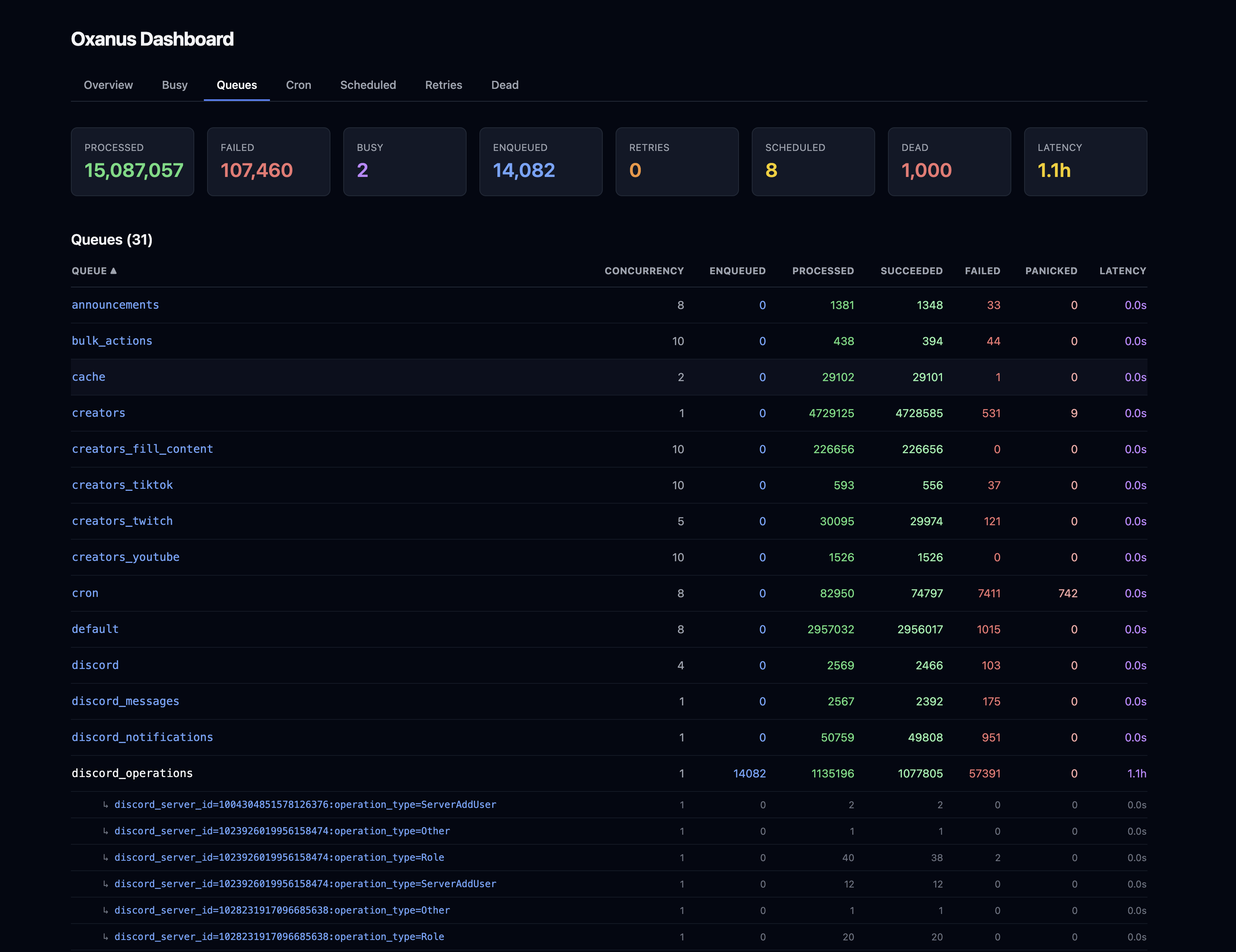
- Web Dashboard - built-in UI for monitoring jobs, queues, metrics, and cron - pure Rust, no JS toolchain
- Prometheus Metrics - export queue and job metrics for monitoring
- MCP Server - bearer-authenticated, read-only monitoring for coding agents via the separate
oxana-mcpcrate - Well Tested - comprehensive integration test suite
§Quick Start
cargo add oxana@2.1.6 --features registryThe registry feature (not enabled by default) powers #[derive(oxana::Registry)] and runtime.register::<...>() used below; without it, register queues and workers explicitly with runtime.queue::<...>() and runtime.worker::<...>().
use oxana::Storage;
use serde::{Serialize, Deserialize};

#[derive(oxana::Registry)]
struct ComponentRegistry(oxana::ComponentRegistry<MyContext>);

#[derive(Debug, thiserror::Error)]
enum MyError {}

#[derive(Debug, Clone)]
struct MyContext {}

#[derive(Debug, Serialize, Deserialize, oxana::Job)]
struct MyJob {
    data: String,
}

#[derive(oxana::Worker)]
#[oxana(context = MyContext)]
struct MyWorker;

impl MyWorker {
    async fn process(&self, job: MyJob, _ctx: &oxana::JobContext) -> Result<(), MyError> {
        println!("Processing: {}", job.data);
        Ok(())
    }
}

#[derive(oxana::Queue)]
#[oxana(key = "my_queue", concurrency = 2)]
struct MyQueue;

#[tokio::main]
async fn main() -> Result<(), oxana::OxanaError> {
    let storage = Storage::from_env()?;
    let runtime = storage
        .runtime(MyContext {})
        .register::<ComponentRegistry>();

    storage.enqueue(MyQueue, MyJob { data: "hello".into() }).await?;
    runtime.run().await?;
    Ok(())
}
For more detailed usage examples, check out the examples directory.
§Web Dashboard
The oxana-web crate provides a built-in dashboard for monitoring jobs, queues, worker metrics, and cron schedules. It integrates as a nested axum router.
use oxana_web::OxanaWebState;

let runtime = storage
    .runtime(MyContext {})
    .register::<ComponentRegistry>();
let catalog = runtime.catalog();

let oxana_router = oxana_web::router(OxanaWebState::new(
    storage.clone(),
    catalog,
    "/oxana".to_string(),
));

let app = your_app_router().nest("/oxana", oxana_router);
The dashboard exposes these pages:
/- Overview with job stats/busy- Currently processing jobs/queues- All queues with stats/queues/{queue_key}- Jobs in a specific queue/jobs/{job_id}- Details for a specific job/metrics- Worker execution metrics/metrics/job?worker=...- Metrics for a specific worker/cron- Cron job schedules/on-demand- Manually enqueue registered on-demand jobs/scheduled- Scheduled jobs/retries- Jobs pending retry/dead- Dead letter queue
It also provides management actions for pausing and unpausing queues, changing dynamic queue concurrency from queue detail pages, wiping queues, and deleting individual jobs.
§Core Concepts
§Jobs and Workers
Jobs carry the data that gets enqueued and define enqueue-time metadata. Workers define the processing logic for jobs. Use the #[derive(oxana::Job)] and #[derive(oxana::Worker)] macros or implement the traits manually.
Job attributes (enqueue-time) | Worker attributes (execution-time) |
|---|---|
#[oxana(unique_id = "worker_{id}")] - define unique job identifiers | #[oxana(job = MyJob)] - override inferred FooWorker -> FooJob binding |
#[oxana(on_conflict = Skip)] - handle unique job conflicts (Skip or Replace) | #[oxana(context = MyContext)] - set worker context type |
#[oxana(resurrect = false)] - disable crash resurrection for this job type | #[oxana(error = MyError)] - set worker error type |
#[oxana(resume = false)] - reset prior-attempt job state on retry | #[oxana(registry = MyRegistry)] - choose component registry |
#[oxana(throttle_cost = 2)] - set per-job throttle cost | #[oxana(max_retries = 3)] - set maximum retry attempts |
#[oxana(on_demand)] - expose the job in the web dashboard for manual enqueueing | #[oxana(retry_delay = 5)] - set retry delay in seconds |
#[oxana(cron(schedule = "*/5 * * * * *", queue = MyQueue))] - schedule periodic jobs | |
#[oxana(batch_size = 100, batch_timeout_ms = 500)] - process jobs in batches |
Cron jobs may define a unique_id to prevent overlapping occurrences. Their conflict strategy
must be Skip; on_conflict = Replace is rejected because replacing an in-flight occurrence can
corrupt the following occurrence.
For job hooks, Self::... resolves to the job type. For worker hooks, Self::... resolves to the worker type.
On-demand argument templates infer editable placeholders from field types. Numeric primitives and common numeric ID newtypes named *Id or *ID are prefilled with 0.
Batch workers use all-or-nothing result semantics: if process_batch returns Ok(()), every job in the batch is marked successful; if it returns an error or panics, every job in that batch follows the normal retry or failure path. Batch handlers should therefore be idempotent, or should only commit external side effects after the whole batch is ready to succeed.
§Queues
Queues are the channels through which jobs flow. Use the #[derive(oxana::Queue)] macro or implement the Queue trait manually. Static queues do not need Serialize; dynamic queues need serializable fields so Oxana can derive each runtime queue key.
Queues can be:
- Static: Defined at compile time with a fixed key
- Dynamic: Created at runtime with each instance being a separate queue (requires struct fields)
Queue attributes:
#[oxana(key = "my_queue")]- Set static queue key#[oxana(prefix = "dynamic")]- Set prefix for dynamic queues#[oxana(concurrency = 2)]- Set a fixed concurrency limit#[oxana(concurrency = Dynamic(2))]- Set a runtime-adjustable concurrency limit with default2#[oxana(throttle(window_ms = 2000, limit = 5))]- Configure throttling#[oxana(discovery_interval_ms = 250)]- Set how often new dynamic queues are discovered (dynamic queues only)
§Component Registry
The component registry automatically discovers and registers all workers and queues in your application. Use #[derive(oxana::Registry)] to create a registry and storage.runtime(ctx).register::<ComponentRegistry>() to register them on a typed runtime.
§Storage
Storage provides the interface for job persistence - enqueueing, scheduling, state management, and queue monitoring.
Build it with Storage::from_env() or Storage::builder().build_from_env(), which read the REDIS_URL environment variable.
Set REDIS_STATS_URL to store counters and metrics in a separate Redis instance; when it is not set, stats use REDIS_URL.
Call storage.runtime(ctx) to create a typed worker runtime, register queues and workers on that runtime, then call runtime.run().await.
§Context
The context provides shared state and utilities to workers. It can include:
- Database connections
- Configuration
- Shared resources
- Job state (for resumable jobs)
Workers can persist job state with ctx.state.update(...) and read the state from
the current attempt with ctx.state.get::<T>(). This is useful for resumable jobs
that need to continue from the last completed item after a retry. Jobs resume
state by default; use #[oxana(resume = false)] to clear prior-attempt state
before each retry.
For long-running jobs, use ctx.state.update_progress(...) to store progress in a
structured format. The web dashboard renders a progress bar when total is set:
ctx.state
    .update_progress((cursor, total, Some("importing users".to_string())))
    .await?;
update_progress accepts a cursor value, (cursor, total), or
(cursor, total, note). Cursor-only state remains useful for resumable jobs and is
shown as normal state in the dashboard. ctx.state.progress().await? reloads the
latest stored progress for the current job.
§Runtime Configuration
Runtime configuration is done on the typed runtime builder, which allows you to:
- Automatically register queues and workers via the component registry
- Set up graceful shutdown
- Configure exit conditions and runtime timing/backoff knobs
- Customize how worker errors are stored on retry and dead jobs
To run only selected queues while keeping every queue and worker registered,
call only_queue once for each queue to process:
let runtime = storage
    .runtime(ctx)
    .register::<Components>()
    .only_queue::<PriorityQueue>()
    .only_queue::<EmailQueue>();

runtime.run().await?;
Selecting a dynamic queue processes all of its discovered subqueues. Cron jobs
for unselected queues are not scheduled. Without any only_queue calls, all
registered queues run as usual.
To run every registered queue except specific ones, call except_queue once
for each queue to exclude:
let runtime = storage
    .runtime(ctx)
    .register::<Components>()
    .except_queue::<LowPriorityQueue>()
    .except_queue::<MaintenanceQueue>();

runtime.run().await?;
Excluding a dynamic queue excludes all of its discovered subqueues. Cron jobs for excluded queues are not scheduled.
Storage remains the enqueueing and monitoring handle; RuntimeBuilder<C> is the worker setup and execution handle for app context type C.
Worker errors use their Debug representation by default so error types that capture backtraces
can include them in the dashboard. Applications can override the stored representation when needed:
let runtime = storage
    .runtime(ctx)
    .error_formatter(|error| error.to_string());
Breaking default behavior change in 2.3.0: built-in worker panic
reporting now requires the opt-in sentry-panic feature. Defaults include sentry but exclude sentry-panic. Panic catching,
failure storage, retries, batch handling, worker survival, and custom failure_reporter
callbacks remain enabled in every feature configuration.
Keep sentry enabled and omit sentry-panic for returned-error reporting only.
To restore built-in panic reporting from 2.2.0 and earlier, add "sentry-panic" to the Oxana dependency’s
features list after upgrading to 2.3.0.
With the sentry feature enabled, returned worker errors are reported once by default with isolated
oxana.* tags and an oxana context containing job IDs, queue/job/worker names, batch size, and
per-job arguments and retry state. To customize events for returned errors while retaining this
metadata and worker scope, use sentry_error_event_builder:
let runtime = storage.runtime(ctx).sentry_error_event_builder(|error| {
    match error.downcast_ref::<ApplicationError>() {
        Some(error) => error.sentry_event(),
        None => sentry_core::event_from_error(error),
    }
});
Return an event without capturing it; Oxana submits it once. The default builder uses
sentry_core::event_from_error, which formats errors with Debug. Applications avoiding native
backtrace resolution should build events from safe messages and recorded locations, and also use
safe Debug output or an error_formatter for the dashboard. The event builder runs only for
returned errors when a Sentry client is active.
Applications that need to replace all reporting, including panic reporting, can instead use
failure_reporter. It takes precedence over sentry_error_event_builder:
let runtime = storage.runtime(ctx).failure_reporter(|report| {
    match report.failure {
        oxana::WorkerFailure::Error(error) => {
            // Downcast to your application's worker error and call a richer
            // integration, such as sentry_anyhow::capture_anyhow(...).
            report_application_error(error, report.metadata);
        }
        oxana::WorkerFailure::Panic { message } => {
            report_application_panic(message, report.metadata);
        }
        _ => {}
    }
});
The callback receives panic failures exactly once per execution (including an entire failed
batch), regardless of Sentry features. sentry_error_event_builder never runs for panics.
Applications own their global Sentry panic hook. Oxana neither installs one nor enables the
application’s Sentry panic integration. With sentry, Oxana suppresses automatic hook events
and other events emitted during unwinding on its isolated worker hub. Without sentry-panic,
these events are discarded without retaining a panic-event buffer. With sentry-panic, Oxana
retains the first hook event and reports it after the catch, preserving its stacktrace and
breadcrumbs and attaching job/retry metadata with the handled oxana.worker_panic mechanism.
If there is no hook event, Oxana builds a fallback event. A custom reporter always replaces
built-in reporting and discards any retained event. Panics outside the worker scope are unaffected.
Cargo features are additive: check cargo tree -e features -i oxana in the application to ensure
no dependency enables oxana/sentry-panic. oxana-web and oxana-mcp use Oxana’s defaults,
which do not enable panic reporting.
Serialized job arguments are included in failure metadata and default Sentry events. Arguments can contain sensitive application data; custom reporters receive the metadata without Oxana attaching it automatically, allowing them to redact or omit arguments before capture.
Backtraces must be enabled before the process starts (for example with RUST_BACKTRACE=1) and
captured by the application’s error type. Diagnostic output may contain sensitive details, so only
enable backtraces where access to stored job errors is appropriately restricted.
§Error Handling
Oxana uses a custom OxanaError type that covers all library error cases. Workers can define their own error type that implements std::error::Error.
§Prometheus Metrics
Enable the prometheus feature to expose metrics:
let metrics = storage.metrics().await?;
let output = metrics.encode_to_string()?;
// Serve `output` on your metrics endpoint§Comparison with Similar Libraries
| Feature | Oxana | Apalis | rusty-sidekiq | Fang |
|---|---|---|---|---|
| Backend | Redis | Redis, Postgres, SQLite, MySQL, AMQP, NATS | Redis | Postgres, SQLite, MySQL |
| Retries | Yes | Yes (tower layer) | Yes | Yes |
| Scheduled Jobs | Yes | Yes | Yes | Yes |
| Cron | Yes | Yes | Yes | Yes |
| Unique Jobs | Yes | No | Yes | Yes |
| Throttling | Yes | No | No | No |
| Dynamic Queues | Yes | No | No | No |
| Resumable Jobs | Yes | No | No | No |
| Graceful Shutdown | Yes | Yes | Partial | No |
| Web UI | Yes | Yes (apalis-board) | No (uses Ruby Sidekiq UI) | No |
| License | MIT | MIT | MIT | MIT |
Oxana focuses on depth with a single Redis backend rather than breadth across multiple backends. It is the only Rust job library offering resumable jobs and combines unique jobs, throttling, and a built-in web dashboard in one package.
Apalis offers the most backend options and integrates with the tower middleware ecosystem, making it highly extensible. It suits projects that need backend flexibility or already use tower layers. However, its breadth of abstraction can come at the cost of reliability and debuggability in production.
rusty-sidekiq is wire-compatible with Ruby Sidekiq, making it ideal for teams migrating from or coexisting with Ruby services. It can share queues with Ruby Sidekiq workers and use the existing Sidekiq web UI.
Fang is SQL-database-backed (no Redis dependency) with both async and threaded execution modes. A good fit for projects that prefer Postgres/SQLite over Redis.
§License
Oxana is licensed under the MIT License.
Structs§
- Batch
Item - BoxError
- Type-erased worker error, used as the default
Worker::Errortype. - Catalog
- Catalog of all registered workers and queues.
- Cron
Worker Info - Information about a registered cron worker.
- Drain
Stats - Dynamic
Queue Stats - Statistics for a dynamic sub-queue.
- Failed
JobMetadata - Retry metadata for one job in a failed worker execution.
- JobContext
- JobData
- JobEnvelope
- JobMeta
- JobMetrics
Detail - JobMetrics
Histogram Bucket - JobMetrics
Point - JobMetrics
Query - JobMetrics
Snapshot - JobMetrics
Totals - JobProgress
- JobProgress
Iterator - JobState
- Metric
Identity - OnDemand
JobInfo - Information about an on-demand job exposed in the web dashboard.
- OnDemand
JobRegistration - Process
- Information about an Oxana worker process.
- Queue
Config - Queue
Info - Information about a registered queue.
- Queue
Length Metrics Point - Queue
Length Metrics Series - Queue
Length Metrics Snapshot - Queue
List Opts - Options for listing jobs in a queue.
- Queue
Rate Stats - Historical per-queue rate estimates.
- Queue
Runtime Config - Queue
Stats - Statistics for a specific queue.
- Queue
Throttle - Queue
Throttle Info - Throttle configuration for a queue.
- RunStats
- Runtime
Builder - Stats
- Overall statistics for the Oxana job queue system.
- Stats
Global - Global aggregate statistics.
- Stats
Processing - Information about a job currently being processed.
- Storage
- Storage provides the main interface for job management in Oxana.
- Storage
Builder - Storage
Builder Timeouts - Worker
Batch Config - Worker
Config - Worker
Failure Metadata - Execution metadata attached to a worker failure report.
- Worker
Failure Report - A worker failure and its execution metadata.
- Worker
Info - Information about a registered worker.
- Worker
Metrics Summary
Enums§
- JobConflict
Strategy - Oxana
Error - Queue
Concurrency - Queue
Kind - Queue
State - Worker
Config Kind - Worker
Failure - The cause of a failed worker execution.
Constants§
- HISTOGRAM_
BUCKET_ INTERVALS_ MS - Maximum execution time represented by each histogram bucket.
- HISTOGRAM_
BUCKET_ LABELS - Display labels for
HISTOGRAM_BUCKET_INTERVALS_MS.
Traits§
- From
Context - Into
Worker Error - Job
- Queue
- Unique
JobId - Resolves the deterministic ID used by a unique job.
- Worker