Expand description
§




Painless peer-to-peer WebRTC networking for rust’s native and wasm applications.
The goal of the Matchbox project is to enable udp-like, unordered, unreliable p2p connections in web browsers or native to facilitate low-latency multiplayer games.
Matchbox supports both unreliable and reliable data channels, with configurable ordering guarantees and variable packet retransmits.
The Matchbox project contains:
-
matchbox_socket: A socket abstraction for Wasm or Native, with:
ggrs: A feature providing a ggrs compatible socket.
-
matchbox_signaling: A signaling server library, with ready to use examples
-
matchbox_server: A ready to use full-mesh signalling server
-
bevy_matchbox: A
matchbox_socketintegration for the Bevy game enginebevy bevy_matchbox 0.18 0.14, main 0.17 0.13 0.16 0.12 0.15 0.11 0.14 0.10 0.13 0.9 0.12 0.8 0.11 0.7 0.10 0.6 < 0.9 Unsupported
§Examples
- simple: A simple communication loop using matchbox_socket
- bevy_ggrs: An example browser game, using
bevyandbevy_ggrs- Live 2-player demo: https://helsing.studio/box_game/
- Live 4-player demo: https://helsing.studio/box_game/?players=4
§How it works
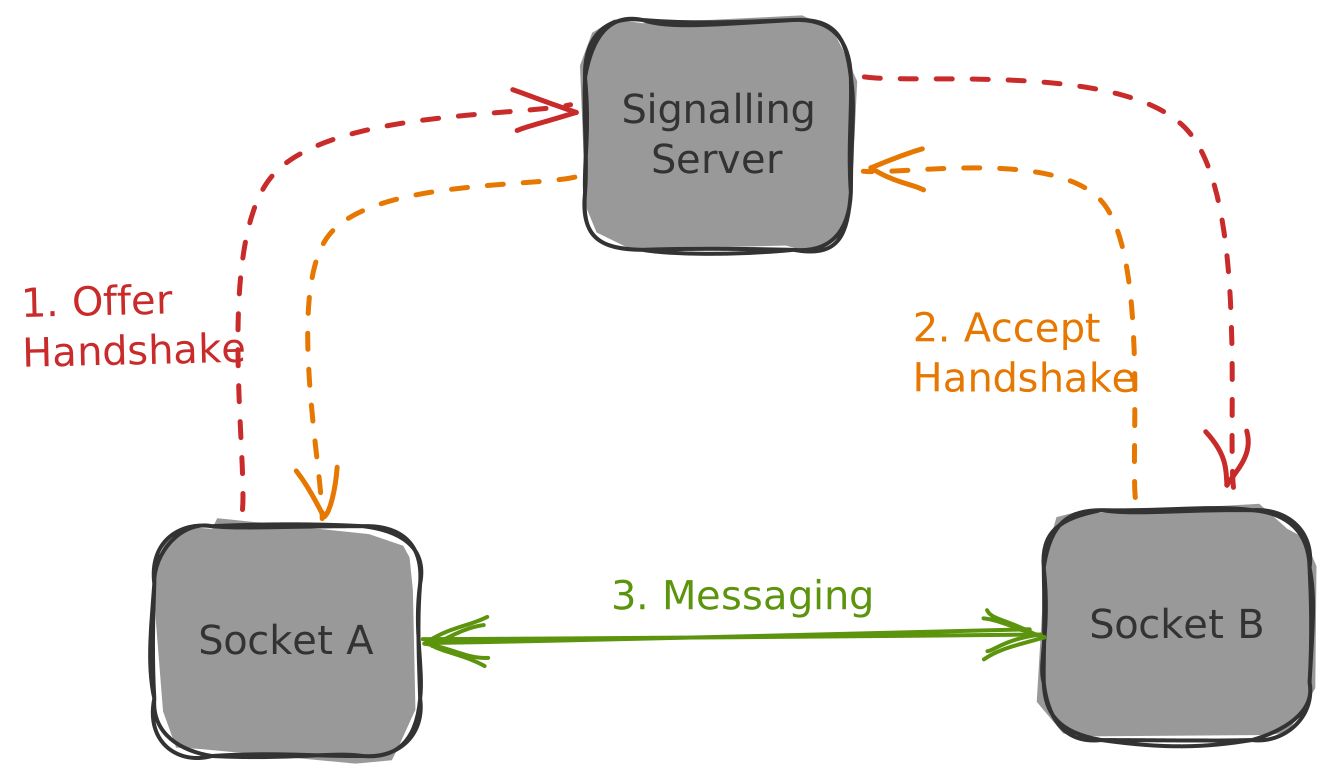
WebRTC allows direct connections between peers, but in order to establish those connections, some kind of signaling service is needed. matchbox_server is such a service. Once the connections are established, however, data will flow directly between peers, and no traffic will go through the signaling server.
The signaling service needs to run somewhere all clients can reach it over http or https connections. In production, this usually means the public internet.
When a client wants to join a p2p (mesh) network, it connects to the signaling service. The signaling server then notifies the peers that have already connected about the new peer (sends a NewPeer event).
Peers then negotiate a connection through the signaling server. The initiator sends an “offer” and the recipient responds with an “answer.” Once peers have enough information relayed, a RTCPeerConnection is established for each peer, which comes with one or more data channels.
All of this, however, is hidden from rust application code. All you will need to do on the client side, is:
- Create a new socket, and give it a signaling server url
.awaitthe message loop future that processes new messages.
You can hook into the lifecycle of your socket through the socket’s API, such as connection state changes. Similarly, you can send packets to peers using the socket through a simple, non-blocking method.
§Showcase
Projects using Matchbox:
- NES Bundler - Transform your NES game into a single executable targeting your favorite OS!
- Cargo Space (in development) - A coop 2D space game about building and flying a ship together
- Extreme Bevy - Simple 2-player arcade shooter
- Matchbox demo
- A Janitors Nightmare - 2-player jam game
- Lavagna - collaborative blackboard for online meetings
§Contributing
PRs welcome!
If you have questions or suggestions, feel free to make an issue. There’s also a Discord channel if you want to get in touch.
§Thanks
- A huge thanks to Ernest Wong for his Dango Tribute experiment!
matchbox_socketis heavily inspired its wasm-bindgen server_socket and Matchbox would probably not exist without it.
§License
All code in this repository dual-licensed under either:
- MIT License or http://opensource.org/licenses/MIT
- Apache License, Version 2.0 or http://www.apache.org/licenses/LICENSE-2.0
Unless you explicitly state otherwise, any contribution intentionally submitted for inclusion in the work by you, as defined in the Apache-2.0 license, shall be dual licensed as above, without any additional terms or conditions.
Re-exports§
pub use async_trait;
Structs§
- Channel
Config - Configuration options for a data channel See also: https://developer.mozilla.org/en-US/docs/Web/API/RTCDataChannel
- PeerId
- The format for a peer signature given by the signaling server
- RtcIce
Server Config - Configuration options for an ICE server connection. See also: https://developer.mozilla.org/en-US/docs/Web/API/RTCIceServer#example
- WebRtc
Channel - Used to send and receive packets on a given WebRTC channel. Must be created as part of a
WebRtcSocket. - WebRtc
Socket - Contains a set of
WebRtcChannels and connection metadata. - WebRtc
Socket Builder - Builder for
WebRtcSockets.
Enums§
- Channel
Error - An error that can occur when getting a socket’s channel through
get_channel,take_channelortry_update_peers. - Error
- Errors that can happen when using Matchbox sockets.
- Peer
Signal - Signals go from peer to peer via the signaling server
- Peer
State - The state of a connection to a peer
- Signaling
Error - An error that can occur with WebRTC messaging. See [Signaller].
Traits§
- Signaller
- A signalling implementation.
- Signaller
Builder - A builder that constructs a new Signaller from a room URL.
Type Aliases§
- Message
Loop Future - A future which runs the message loop for the socket and completes when the socket closes or disconnects
- Packet
- The raw format of data being sent and received.
- Peer
Event - Events go from signaling server to peer
- Peer
Request - Requests go from peer to signaling server