Expand description
§marser
marser is a parser-combinator library for writing PEG-style grammars in Rust with a focus on useful errors, error recovery and good performance.
Why build yet another parser-combinator library? You can read about it here.
It supports:
- Zero-copy parsing for faster parsers
- Multiple input formats - use
&strand&[u8]/&[T]or implement theInputtrait yourself. - Packrat-style caching - just wrap your parsers in
.memoized()to cache results at each position. - Simple debugging of your parsers using a custom TUI
- no_std
§Quickstart
To add this library to your Rust project run:
cargo add marserThis library has a couple of optional features. You can find them below.
§Example
This example parses dice notation like 2d6 into a struct:
use marser::capture;
use marser::matcher::one_or_more;
use marser::parser::Parser;

// the struct we want to parse into
#[derive(Debug, PartialEq)]
struct Roll {
    count: u32,
    sides: u32,
}

// A parser that can parse a number
fn number<'src>() -> impl Parser<'src, &'src str, Output = u32> + Clone {
    // capture defines a parser. It consists of a matcher (the part before `=>`)
    // and a Rust expression that builds the output value (the part after `=>`).
    capture!(
        bind_slice!( // bind_slice! stores the matched part of the input inside a variable
            one_or_more('0'..='9'), // matches any sequence of digits
            number_slice as &'src str // the matched digits are available as `number_slice` of type `&'src str`
        )
        => // we can then define how to build the output value from the bound variables
            number_slice // we use the captured slice of digits
                .parse() // and parse it into a u32
                .expect("matched only digits")
    )
}

// A parser that can parse a roll like `2d6`
fn roll<'src>() -> impl Parser<'src, &'src str, Output = Roll> + Clone {
    // we again define a parser with capture!, this time for the whole roll
    capture!(
        ( // we define a sequence by putting multiple matchers in a tuple
          // they are matched one after another
            bind!(number(), count), // first we expect a number. We use bind! to store its value in `count`
            'd', // then we expect the literal character 'd'
            bind!(number(), sides) // then we expect another number, which we store in `sides`
        )
        => // finally we define how to build the output value from the bound variables
            Roll { count, sides }
    )
}

fn main() {
    // we can then use this parser we defined to parse a string
    let (roll, _errors) = roll().parse_str("2d6").unwrap();
    assert_eq!(roll, Roll { count: 2, sides: 6 });
}
Runnable examples live under examples/ (see also below).
§Learn more
- Guide on docs.rs
- API documentation
- crates.io
- Design rationale: A Grammar-First Approach to Parser Combinators in Rust
§Cargo features
| Feature | When you need it |
|---|---|
std (default) | Standard-library integration: ParserError::eprint / write, trace-to-file helpers, and other I/O. Disable with default-features = false for embedded or other no_std + alloc targets. |
annotate-snippets | Rich terminal diagnostics via annotate-snippets. Works on no_std builds for string rendering; eprint / write still need std. |
parser-trace | Experimental: record parser traces to replay them in the trace viewer TUI (requires std). See the tracing guide and marser-trace-viewer/. |
§Requirements
- Rust 1.88 or later
§Examples in this repository
Examples need the annotate-snippets feature for rendering of errors
| Example | What it shows |
|---|---|
examples/json/ | A JSON parser with error recovery and custom error messages. |
examples/mini_language.rs | Small language: statements, operator precedence, functions etc. with error recovery and custom error messages. |
Run JSON from a git clone:
cargo run --example json --features annotate-snippets -- tests/data/json1.json§Error output sample
Input:
{
    "foo": 123,
    "bar": [1, ,2 ,3
}
Example diagnostic, rendered using annotate-snippets:
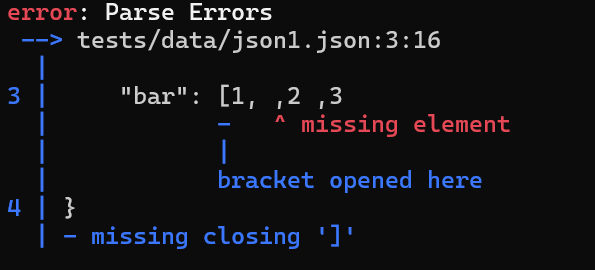
This parser can also still produce a recovered output:
{
    "foo": 123,
    "bar": [
        1,
        2,
        3
    ]
}
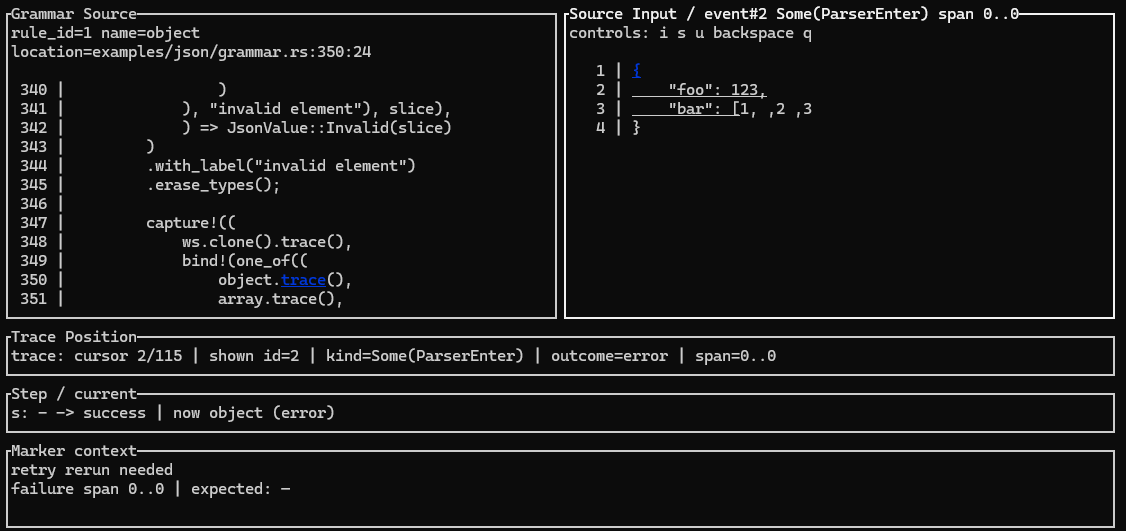
The json example also has tracing support, so parsing can be stepped through in the trace viewer. See screenshot below. Left side is the rust source code for the parser, right side is the file being parsed.
§Performance compared to other libraries:
Below is a comparison of the speed of different libraries for parsing json, including marser. I used json because there are already parsers using different libraries written for it
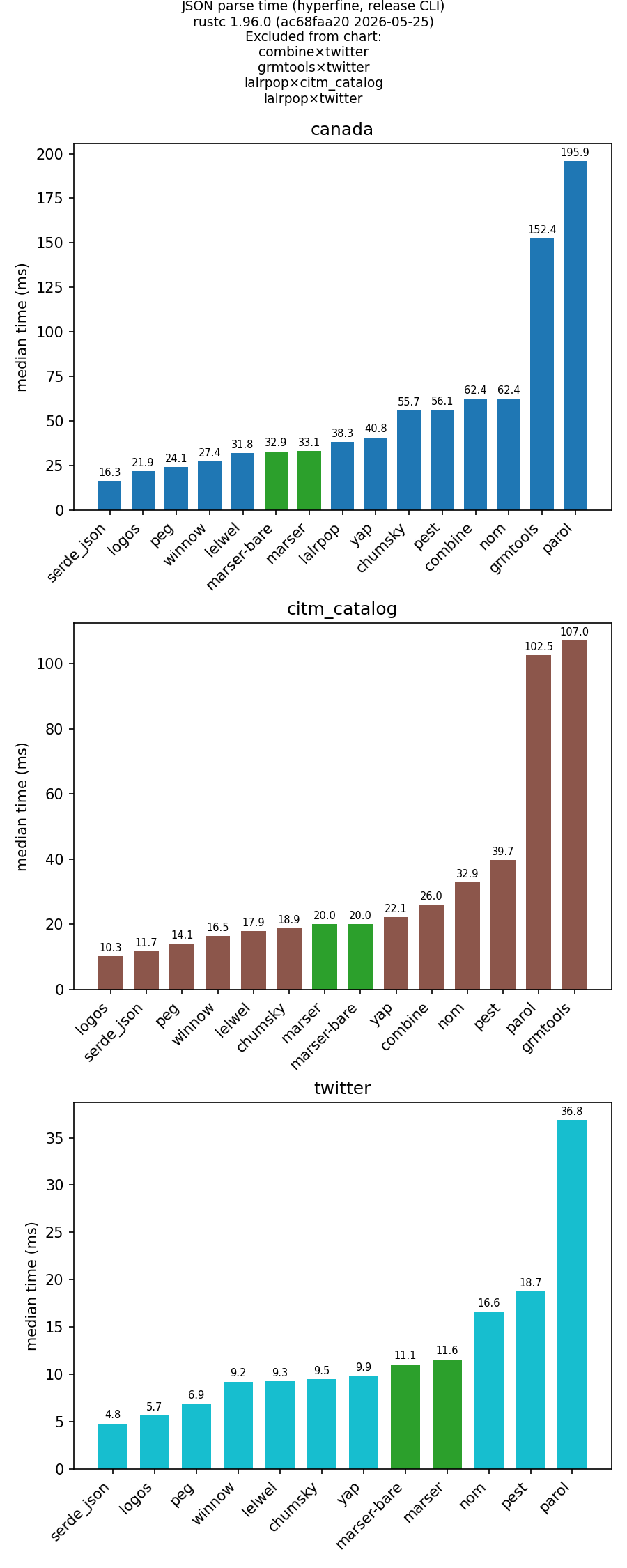
Code for other libraries taken from parse-rosetta. Read more here.
The difference in speed between the marser implementation with error recovery and diagnostics (“marser”) and the implementation without error recovery and diagnostics (“marser-bare”) is quite small because marser works in two modes. First the parser is run without error recovery logic. If the parser encounters an error, it is restarted with error recovery included. This makes it so that the performance cost of including error recovery and diagnostics is only very little.
§Early release
Early release: marser is my first published Rust library. Feedback on the API, error messages, and docs is welcome — open an issue
§License
This project is licensed under the MIT License.
§AI assistance
Parts of this repository were drafted or expanded with AI tools (guide, library docs, tests, macros, trace crates, examples, and parts of this README). The maintainer reviewed this material. If you spot a mistake, please open an issue.
Modules§
- error
- Parse errors and diagnostics.
- guide
embed-guide - Book-style guide to
marserfor newcomers and for evaluating fit. - input
- Input abstractions for parsers and matchers.
- label
- Attach a displayable label to a
crate::matcher::Matcherorcrate::parser::Parserfor richer errors. - matcher
- Matchers: grammar fragments used inside
crate::parser::capture::Capture(viacrate::capture) and related runners. - one_of
- Ordered choice: try each alternative until one succeeds.
- parser
- Parsers: typed values produced from input.
- trace
- Tracing helpers and (with the
parser-tracefeature) re-exports frommarser_trace_schema.
Macros§
- capture
- Build a parser from grammar + result expressions (via
Capture, returned asimpl Parserto limit type size).
Enums§
- Parse
With Trace ToFile Error parser-traceandstd - Error returned by
parse_with_trace_to_file.
Functions§
- parse
- Parse all of
srcwith the same driver asParser::parse_str/Parser::parse_whole_input. - parse_
with_ trace parser-trace - Parse
srcand return the trace session alongside the normal parse result. - parse_
with_ trace_ session parser-trace - Like
parse_with_trace, but reuses an existingTraceSession. - parse_
with_ trace_ to_ file parser-traceandstd - Parse
src, write the trace totrace_path, and return the normal parse result.