Expand description
§fusion-nav





Embedded-first inertial navigation: attitude, velocity and position from an IMU, GNSS, a barometer and a magnetometer.
fusion-nav is a 15-state error-state Kalman filter (ESKF) written in Rust. It is no_std and
allocation-free, and aimed at flight controllers, UAVs and other embedded navigation. New to the
vocabulary? GLOSSARY.md defines it.
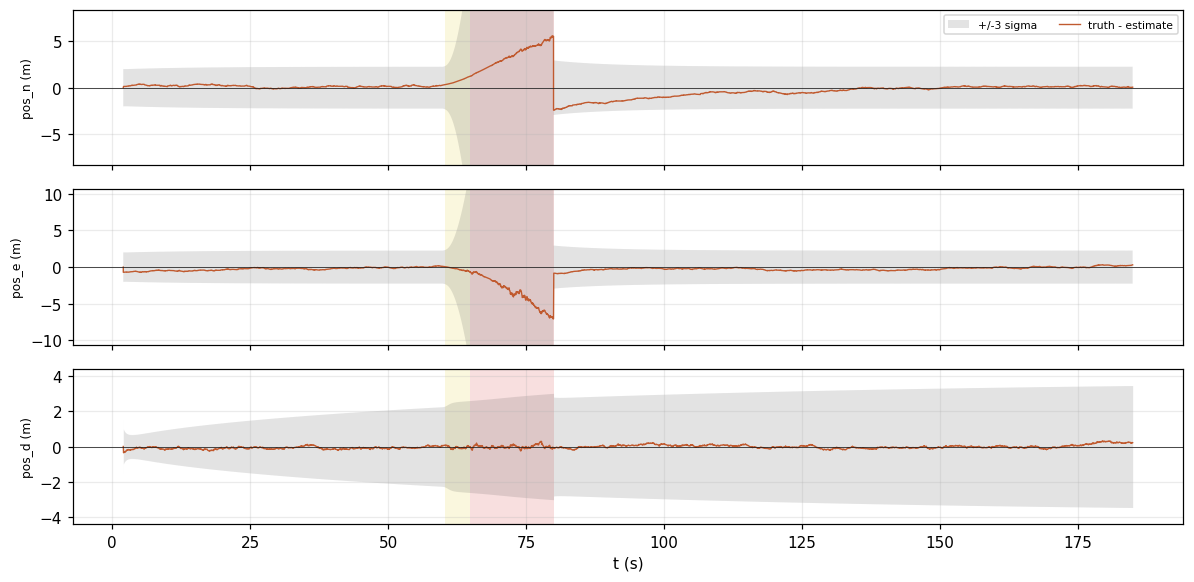
A simulated flight that loses GNSS for 20 s. The line is the position error against truth. The gray band is ±3σ, the range the filter expects its own error to stay within: it widens while GNSS is gone, and the first fix brings the error back inside it. VALIDATION.md has the rest, against simulated truth, real UAV flights and PX4’s EKF2.
§Is it for you?
- 3D position or velocity from an IMU and GNSS:
fusion-nav. - Attitude only:
fusion-ahrs, substantially simpler and cheaper. - Attitude, altitude and vertical velocity (stabilization, altitude hold):
fusion-ahrswithfusion-altitude.
fusion-nav owns its attitude rather than consuming one from fusion-ahrs, because attitude
uncertainty is coupled to velocity and position uncertainty.
Coming from PX4 or ArduPilot? A tuned EKF2 or EKF3 does not carry across by renaming:
MIGRATING.md maps each parameter
onto what this crate takes. GOALS.md
compares fusion-nav against other Rust crates and both autopilots.
§Why this crate
- Readable mathematics. The code cites a numbered equation for every step it takes, in EQUATIONS.md, and a table maps each equation to the function implementing it. No generated code.
- Frames in the types. Passing an ENU vector where NED is expected is a compile error, and a PX4 or ArduPilot attitude seeds with no conversion. See conventions.
- Health travels with the estimate.
state()returns the solution with itsStatusand a validity flag per quantity, and every call returns a typed outcome: accepted, rejected, reset to the measurement, or refused with a reason. - Pure Rust, one dependency (
nalgebra).no_std, allocation-free, no C++ toolchain, and no reachable panic, which CI’s panic check proves by linking the whole API for two Cortex-M targets. - Validation you can rerun. CI scores seeded simulations against truth, and tests on 50 seeds whether the filter’s error bars hold, with no hardware. Real PX4 logs replay beside EKF2, and one script regenerates every published figure.
- Configuration derived, not demanded. The
replayexample’s--deriveprints aConfigfrom your own flight log. The accuracy your mission needs is the one thing you must supply.
GOALS.md says what each claim rests on and what would falsify it.
§How it fits together
  every IMU sample                          every measurement, at its own time
  ────────────────                          ──────────────────────────────────
  predict(imu) ──► Propagation              fuse_*(time, z, noise)
       │           Propagated · Coasted ·        │ refused ──► Fusion::NotFinite, …
       │           refused                       ▼
       ▼                                    gate: does z agree with the estimate then?
  nominal state + covariance  ◄── correct ─ accept ──► Fusion::Accepted
       │                                    reject ──► Fusion::Rejected
       │                      ◄── adopt ─── └─ locked out too long ──► Fusion::Reset
       ▼
  state() ──► position, velocity, attitude, biases
              + Status + validity per quantity
Two paths. Every IMU sample is integrated forward by predict. Every other measurement is first
checked against the estimate, the gate: one that agrees corrects it, one that does not is rejected,
and a source rejected for too long is reset to its next measurement (adopted). Every call returns an
outcome, and every output carries its health.
DESIGN.md draws the same
two paths with the module that owns each step.
§Quick start
[dependencies]
fusion-nav = "0.1"
The default feature magnetic-model links a magnetic declination table (about 2.6 KB of flash).
defmt adds defmt::Format for logging on a microcontroller.
The filter starts from about two seconds of IMU samples with the vehicle at rest, which levels it
and measures the gyroscope bias. It then predicts on every IMU sample and fuses each measurement as
it arrives. The read_* and poll_* functions stand for your drivers.
use fusion_nav::prelude::*;

let mut filter = Eskf::default();

// Start from samples taken while the vehicle sits still.
let mut window = StaticWindow::new();
while !window.is_long_enough(filter.config()) {
    if let Err(_refusal) = window.push(read_still_sample()) { /* dropped; log it */ }
}
if let Alignment::Coarse(_) = filter.initialize(&window)? {
    /* it moved, or the window was short: running, `Status::Aligning` until attitude converges */
}

// Where the GNSS antenna sits relative to the IMU: forward, right, down, in meters.
let antenna = Position::body(0.05, 0.0, -0.12);
// The receiver's latency, from its documentation or your logs.
let latency = Seconds::from_secs(0.110);

loop {
    // Every IMU sample.
    if !filter.predict(read_imu()).is_propagated() { /* log the gap */ }

    // Each GNSS fix, when one arrives. Fuse only a real fix: the first places the origin.
    if let Some(pvt) = poll_gnss() {
        let fix = Geodetic::from_degrees_e7(pvt.lat_e7, pvt.lon_e7, pvt.height_mm);
        // Bound the receiver's own accuracy figures, as PX4 and ArduPilot do.
        let (eph, epv) = (pvt.h_acc_mm as f32 * 1e-3, pvt.v_acc_mm as f32 * 1e-3);
        let (horizontal, vertical) = (SigmaBounds::new(0.5, 100.0), SigmaBounds::new(0.75, 100.0));
        let noise = PositionNoise::clamped(eph, epv, horizontal, vertical);
        let taken = pvt.arrived.before(latency);
        if !filter.fuse_gnss_geodetic(taken, fix, noise, antenna).is_accepted() {
            /* diagnostics() has the detail */
        }
    }

    // The estimate carries its own health.
    let s = filter.state();
    if s.validity.horizontal_position { /* use s.position */ }
}
GUIDE.md covers each step in full: initialization and its other entry points, every measurement and its noise, and what every outcome means.
Four examples run the whole integration surface, fusion_nav::prelude. basic is the loop above as
a program to copy, and embedded is the no_std one, with no println!.
$ cargo run --example basic         # the integration loop on its own
$ cargo run --example degradation   # dropouts, diagnostics, an application-driven reset
$ cargo build --example embedded --target thumbv7em-none-eabihf   # the loop on a microcontroller
$ cargo run --example replay        # a recorded flight in, the estimate out, as CSV
replay also runs real PX4 logs, and cargo run --example simulate generates seeded flights with
known ground truth. Hand replay that truth as a third argument and it scores itself: the error,
whether the filter’s error bars held, and how often it called an estimate usable while the error
said otherwise.
$ cargo run --example replay -- data/flight.csv target/replay.csv data/flight.truth.csvThe replay harness and log corpus explains the formats.
§Health at a glance
A filter that is itself wrong rejects correct measurements and drifts on the IMU alone while looking confident. So every estimate carries its health, and three questions have three answers:
| question | answer | read it |
|---|---|---|
| how bad is the worst thing? | state().status | for a mode change, a failsafe, a log line |
| which outputs can I use now? | state().validity, one flag per quantity | before using a quantity in control |
| will they still be good if I take off now? | predicted_validity() | in an arming check |
Status is, most severe first:
Status | meaning |
|---|---|
DeadReckoning | no GNSS position or velocity accepted for a while; horizontal position is unusable |
Aligning | attitude has not converged yet |
Degraded | a source has timed out |
Healthy | everything fused is still accepted |
A source rejected for too long is reset to its next measurement, per source and on by default. See health reporting and recovery.
§Why an ESKF?
No single sensor gives you navigation. An IMU is fast and self-contained, but integrating it drifts without bound. GNSS is absolute but slow, noisy, and sometimes absent. A barometer gives height only; a magnetometer gives heading only and is easily disturbed.
The errors are also coupled. A small gyroscope bias tilts the attitude, the tilt puts gravity into the wrong axis, and position error grows with the cube of time. A Kalman filter that carries all of these together lets a GNSS fix correct the attitude and biases that caused the drift, not only the position. The error-state form keeps attitude as a quaternion and estimates only a small correction to it. DESIGN.md draws the chain.
§Limitations
The main ones, stated up front. GUIDE.md lists all of them, says what each costs, and links the issue that would remove it.
- You supply each measurement’s latency; the filter cannot measure it.
- Calibrate the magnetometer for hard and soft iron first. The filter cannot detect an uncalibrated one.
- Without a magnetometer or a second GNSS antenna, heading waits for the vehicle to accelerate, and a wrong magnetometer heading is believed until it does.
- A start while moving gives a rough attitude at first.
- The barometer’s reference is allowed to drift at PX4’s rate, so over the long term height follows GNSS, even when the barometer is steadier.
- Without GNSS the filter assumes the vehicle stays put. A car or a fixed-wing sets
Config::hold = None. - Position is on a flat plane about the starting point, so far from it the reported height parts from the true one: 8 cm at 1 km, 7.8 m at 10 km.
Features out of scope (wind, terrain, optical flow, airspeed, …) are listed in GOALS.md.
§Documents
| question | document |
|---|---|
| how do I use it, step by step? | GUIDE.md: conventions, initialization, measurements, health, recovery, limitations |
| how do my PX4 or ArduPilot parameters map? | MIGRATING.md: what is not a rename, and what is left out |
| why does this crate exist, and what did it decide? | GOALS.md: positioning, differentiators, decisions, non-goals |
| how is it built, and where do its numbers come from? | DESIGN.md: architecture, modules, defaults and their evidence, measured cost |
| what does it compute? | EQUATIONS.md: the mathematics, numbered, with an equation-to-code map |
| what does a word mean here? | GLOSSARY.md: innovation, NEES, bias, specific force, and what PX4 and ArduPilot call the same things |
| how good is it? | VALIDATION.md: accuracy, honesty, robustness and cost, regenerated from the runs |
| how is it tested on logs? | data/README.md: the replay harness and the PX4 log corpus |
| what changed, and what does a version promise? | CHANGELOG.md, and versioning in the guide |
§License
Licensed under the MIT License.
Modules§
Structs§
- Acceleration
- Specific force, an accelerometer bias, or a navigation-frame acceleration, in meters per second squared.
- Accuracy
- How good an estimate has to be before the filter calls it valid.
- Altitude
- Barometric altitude above the barometer’s own reference, positive up.
- Altitude
Noise - Noise on a barometric altitude,
Rof equation (30). - Angular
Rate - Angular rate, or a gyroscope bias, in radians per second.
- Attitude
- Vehicle attitude: the rotation from
BodytoNed. - Attitude
Variance - How uncertain the attitude is about each navigation axis, in radians squared: tilt about north and east, heading about down.
- Body
- Vehicle body frame: x forward, y right, z down.
- Coast
- What the filter assumes across an IMU gap it coasts over. Equation (22′).
- Config
- Everything the filter is tuned by.
- Config
Error - Why
Config::validaterefused a configuration: the first field outside its bound. - Correlation
- How long each source’s measurement error persists: the time constant
τof equation (24′), per source.Nonefuses that source as white, which is (24) as written. - Covariance
- The error covariance, with named access to its components.
- Delta
Angle - A rotation increment: angular rate integrated over an interval, in radians.
- Delta
Velocity - A velocity increment: specific force integrated over an interval, in meters per second.
- Diagnostics
- Per-source health and what propagation refused, off the hot path.
- Enu
- Local tangent frame: East, North, Up.
- Eskf
- A 15-state error-state Kalman filter.
- Gate
- Innovation gate threshold
γof equation (37), for an observation ofDOFdimensions. - Gates
- Innovation gate thresholds
γ, one per observation, from equation (37). - Geodetic
- A position on the WGS84 ellipsoid: latitude, longitude, and height.
- Gnss
Fusion - What one GNSS position fix did: its horizontal and vertical halves, each gated and reported on its own.
- Heading
Noise - Noise on a heading,
Rof equations (36), (35′) and (35″): a magnetic heading, a dual-antenna GNSS heading, or the sideslip a course constraint allows. On the heading, not on the field components a magnetometer reports. - Hold
- The position hold an unaided filter fuses to keep its tilt. Equation (28″).
- ImuNoise
- IMU noise, as the continuous-time densities of equations (16)–(21).
- ImuSample
- One IMU measurement, uncorrected: the rotation and the velocity increments over the intervals each was integrated across, and when they end. The filter subtracts its own bias estimates, equations (9) and (10).
- Initialization
- Quasi-static initialization, equations (5)–(8).
- Innovation
- The innovation of one update and its variance:
νof equation (23) and the diagonal ofSof equation (24), one entry per component of the observation. - Local
Origin - The origin of the navigation frame, and the local tangent plane about it. Equation (43).
- MagField
- A magnetic field measurement.
- Meters
- A length, such as a position standard deviation.
- Meters
PerSecond - A speed, such as a velocity standard deviation.
- Meters
PerSecond2 - A scalar acceleration, such as a specific-force tolerance or an accelerometer bias standard deviation.
- Ned
- Local tangent navigation frame: North, East, Down.
- Position
- Position relative to the navigation origin, in meters; or, in
Bodyaxes, where a sensor sits relative to the IMU, which is what the GNSSfuse_*take asantenna. - Position
Noise - Noise on a position measurement,
Rof equation (28), on the axes ofF. - Propagation
Health - What propagation refused or coasted across, and the longest gap.
- Quaternion
- The four components of a rotation quaternion, Hamilton convention, by name.
- Radians
- An angle.
- Radians
PerSecond - A scalar angular rate, such as a gyroscope tolerance or a gyroscope bias standard deviation.
- Recovery
- How long each source may be rejected before the filter adopts it again: automatic recovery from
gate lockout, one
switch per source.
Noneturns that source’s recovery off. - Seconds
- A time interval. The filter never reads a clock; intervals are always supplied,
or differenced from supplied
Timestamps. - Sigma
Bounds - Where a reported standard deviation is allowed to lie, for the
clampedconstructors ofPositionNoiseandVelocityNoise: a floor, a cap, or both. - Source
Health - Health of one observation source.
- State
- The navigation estimate, returned by
Eskf::state. - Static
Sample - One sample from the quasi-static initialization window.
- Static
Window - The initialization window, accumulated one sample at a time.
- Timeouts
- How long the filter may go without horizontal aiding before the status reports it dead-reckoning.
- Timestamp
- A moment on the caller’s clock, in whole microseconds.
- Validity
- Which parts of the estimate are good enough to use.
- Velocity
- Velocity, in meters per second.
- Velocity
Noise - Noise on a velocity measurement,
Rof equation (29), on the axes ofF. - Window
Noise - The white noise a still window measured on each sensor, as
StaticWindow::noisereports it: a floor under the noise the filter should be told, never the noise itself.
Enums§
- Alignment
- What
Eskf::initializeachieved. - Coarse
- Why alignment was coarse rather than static.
- Config
Bound - The bound a
Configvalue must meet. Each refuses NaN and ±∞. - Error
State - Index of an error-state component within the covariance.
- Fusion
- The outcome of one measurement update.
- Init
Error - Why initialization could not run at all.
- Percentile
- How often a gate rejects a measurement that was fine: the percentile of the chi-square distribution its threshold sits at.
- Propagation
- The outcome of one propagation step.
- Refusal
- Why a measurement was turned away before the gate ran.
- Sample
Refusal - Why
StaticWindow::pushrefused a sample. - Status
- How far the estimate can be trusted: whether attitude has converged, and how well aided it is.
Constants§
- ALIGNED_
HEADING - Heading uncertainty at which a start counts as resolved, once a heading has been
established at all: the yaw half of
ALIGNED_TILT’s test. - ALIGNED_
TILT - Tilt uncertainty, per axis, at which a start counts as resolved: the bar behind
Eskf::is_alignedand soStatus::Aligning. - GRAVITY
- Standard gravity, m s⁻²:
Config::gravity’s default. - LATENCY_
HORIZON - How old a measurement may be and still be fused: the span of the past the filter can place
a measurement in. Older than this, a
fuse_*refuses it asFusion::OutOfHorizon. - STATES
- Dimension of the error state: three each of position, velocity, attitude, accelerometer bias, and gyroscope bias.
Traits§
- Frame
- A reference frame a quantity can be expressed in.