Expand description
Core library behind the epicenter CLI — the state layer for Cargo builds.
§epicenter — the state layer for Cargo builds
Requires Cargo with build.build-dir support — Rust 1.91+.
Rust has two main problems: slow compilation times and big target directories.
This usually means that every Cargo project compiles its dependencies into its own target/ directory:
ten projects = ten copies of the same rlibs, consuming gigabytes of storage.
So epicenter tries to solve this problem with a simple idea:
why not keep one shared version of compiled dependencies?
It manages that state as three tiers, one tool:
- store — a durable vault of unit groups addressed by Cargo’s own
fingerprint hashes (
…/epicenter/store/…); survivescargo clean, feeds cold starts and parallel jobs. - build — the shared cache every project compiles into
(
…/epicenter/build/…): dependency rlibs, incremental state, build-script outputs — the heavy 95% — compiled once and reused everywhere. - work — disposable per-job build dirs seeded from the vault
(
…/epicenter/work/<id>/), where CI jobs and agents run fully parallel: nothing shared but the read-only vault.
Around those tiers epicenter owns the lifecycle: configure (setup,
doctor — cross-OS config truth), observe (status, who, why, vault,
verify), reclaim (prune for age-based housekeeping, tiered evict for
deliberate removals with honest freed-vs-released accounting), persist
(harvest, restore) and execute (exec). Cargo stays Cargo — no shim,
no daemon — and a rustc-wrapper (kache or sccache) remains an optional tier.
One configuration for Linux, WSL, macOS and native Windows: the platform code is std-only and cfg-gated, and the canonical template line is identical everywhere. (Linux/WSL and Windows are verified live; Apple and BSD targets are compile-verified — see Cross-OS notes for the first-run checklist.)
epicenter isn’t a Cargo wrapper — it leans on Cargo’s own fingerprint engine,
which decides freshness and therefore recompilation. A unit restored from the
vault is Fresh to Cargo in milliseconds, with zero rustc processes
spawned.
§Benchmarks
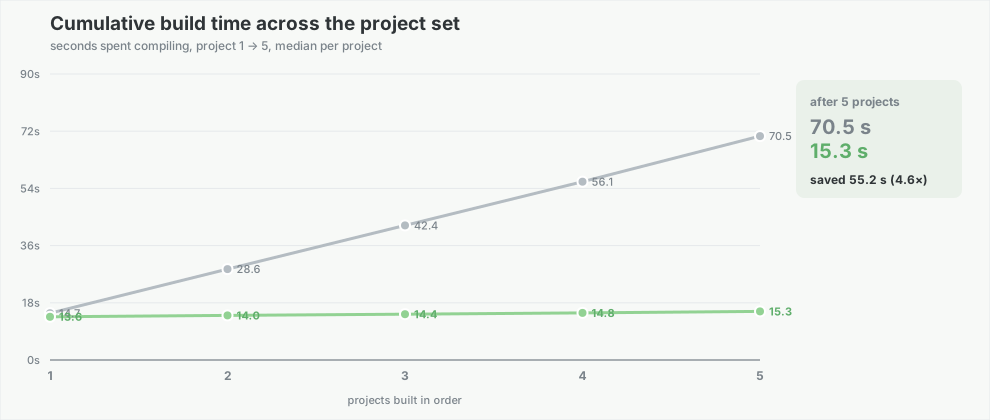
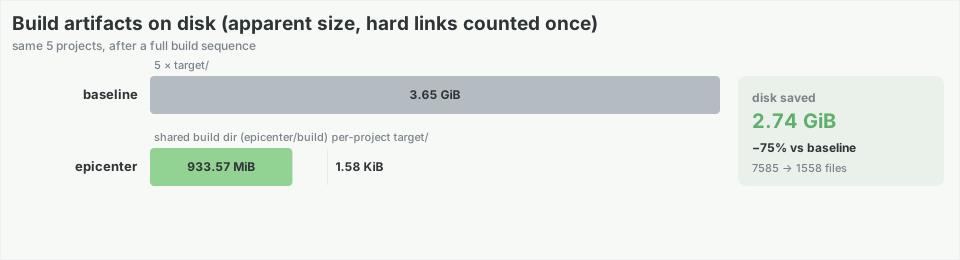
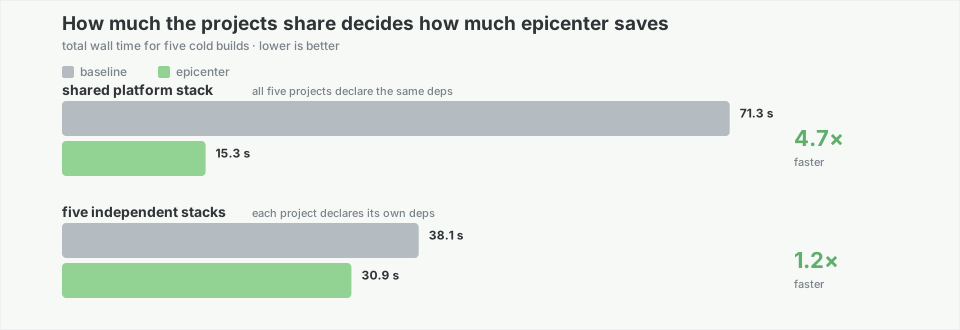
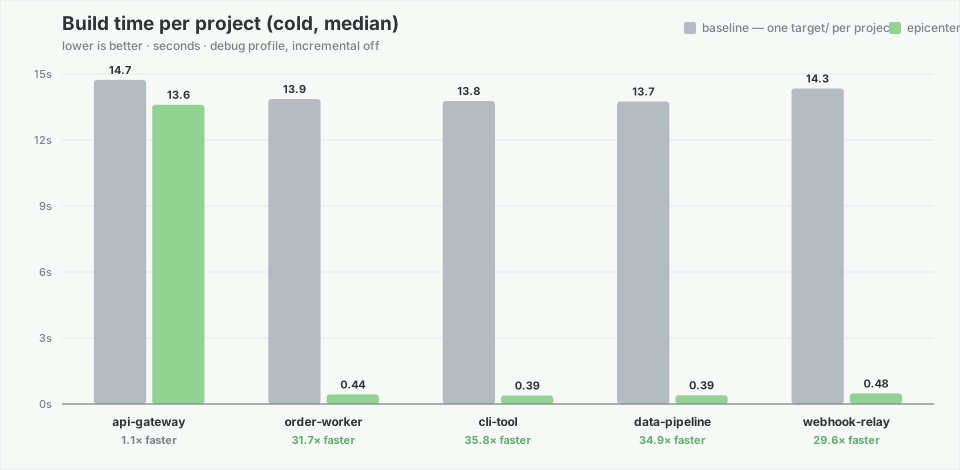
These benchmarks are done against 5 projects with 37 identical dependencies each.
Five cold builds: 71.3 s → 15.3 s (4.7× faster). Disk: 3.65 GiB → 0.91 GiB
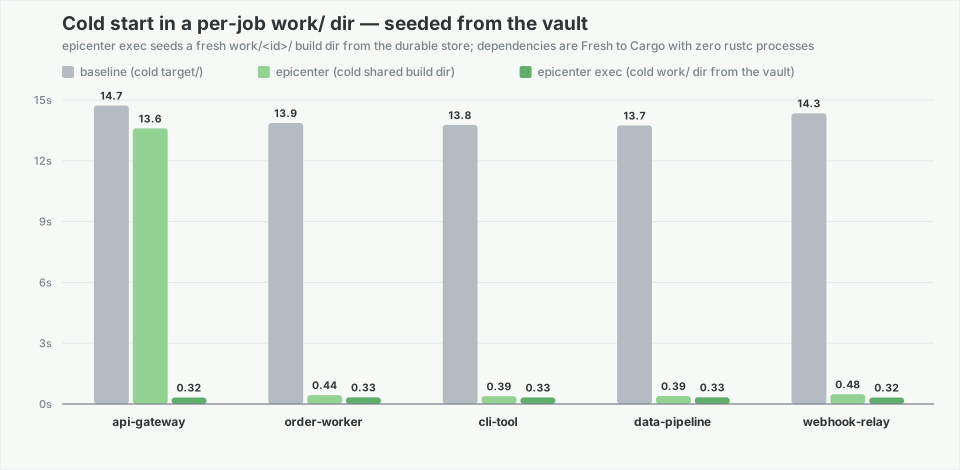
(−75%). A cold per-job work/ dir seeded from the vault: 0.33 s.
All five projects declare the same platform stack. This is the monorepo / “one platform crate” case. Every non-local Cargo unit is byte-for-byte identical across projects, so epicenter can compile it once and the other projects reuse it.
§What is measured
| baseline | epicenter | |
|---|---|---|
| config | no build-dir key | epicenter setup → [build] build-dir = '{cargo-cache-home}/epicenter/build' |
| where dependencies compile | <project>/target/ (one copy each) | one shared build dir |
| measurement | wall clock around cargo build --locked --offline | same |
| reset before every run | rm -rf every target/ | rm -rf every target/ + the whole epicenter/ cache |
In addition it measures the vault tier (epicenter harvest + epicenter exec),
where a cold per-job build dir is seeded from the durable store instead of recompiling.
§Quickstart
cargo install epicenter-cli
epicenter setup                  # write the shared-cache config (backs up files it touches)
cargo build                      # any project of yours — intermediates now land in the shared cache
epicenter status                 # watch it fill up
epicenter doctor # verify everything is healthy§Three workflows, one tool
- Daily development (zero extra steps) — run
epicenter setuponce. Every project on the machine immediately shares compiled dependencies. - Survive
cargo cleanand cold starts (the vault) —epicenter harvestsnapshots built units into the read-only vault;epicenter restorelinks them back so Cargo skips compilation completely. - Parallel agents & CI jobs (zero lock waits) —
epicenter exec --id agent-1 --target-dir -- cargo testseeds a private per-job build dir from the vault in milliseconds. Ten agents can build the same repo at the same time without waiting on Cargo’s build-dir lock or duplicating rlibs on disk.
§Commands
| command | what it does |
|---|---|
epicenter setup | write the shared-cache config; backups any file it modifies (*.epicenter-bak) |
epicenter setup --cache-root <path> | use a different cache directory instead of the default |
epicenter setup --use-default | remove a custom root, back to the canonical default |
epicenter setup --with-wrapper kache | also configure kache (or sccache) as rustc-wrapper |
epicenter setup --without-wrapper | remove a previously configured wrapper |
epicenter status | sizes, per-directory breakdown, largest build units |
epicenter who [--unit <q>] | unit forensics: per-package blocks, toolchain generations, stale flags |
epicenter why <unit> | one unit in depth: hashes, features, deps, artifact inventory, FRESH/DIRTY verdict |
epicenter evict --unit <q> | remove units deliberately (store + views): dry run by default, --yes to delete |
epicenter evict --unit <q> --tier store | trim the vault only — no --force needed, the vault is yours to trim |
epicenter evict --unit <q> --tier view | unlink the working copies only (build dir + job dirs); vault untouched |
epicenter evict --work <job|build> --crate <name> | surgical cache-bust: unlink one crate from ONE view; the vault is never touched |
epicenter evict --stale / --husks / --older-than 90d / --rustc-key <h> | bulk selectors, by default across the store and every known view |
epicenter evict --work-dir <job> | remove ONE job dir now — explicit choices bypass the GC window (dry run default; a live build’s dir is refused) |
epicenter evict --work-dirs [--older-than 7d] | collect stale per-job working dirs; a dir a live build has locked is never touched |
epicenter prune [--older-than 30d] | age-based housekeeping of the shared build dir (policy GC, default 30d). Dry run by default — pass --yes to delete |
epicenter doctor | health check with plain-language verdicts: config, wrapper, filesystem, toolchain, mtime ordering |
epicenter vault | show the vault: generations (toolchain + flags), sizes, links into the build view |
epicenter harvest [--unit <q>] [--dry-run] | store built unit groups from the shared build dir into the vault |
epicenter restore [--into <dir>] [--unit <q>] [--dry-run] | seed a working dir from the vault (default: the shared build dir) — deps/ rlibs and .so hard-linked; .rmeta + fingerprint state copied |
epicenter verify | audit the vault: file sizes, canonical stamps, hash contents, dependency ordering — and name the job dirs under work/ |
epicenter exec [--harvest] [--rm] [--reuse] [--target-dir [DIR]] [--id <id>] [--cwd <dir>] -- <cmd> | run a command in a fresh per-job build dir seeded from the vault (CI/agents) |
§prune vs evict — housekeeping vs deliberate removal
Both delete things, both show a dry run first, and neither ever runs on its own. The difference is why and where they act:
epicenter prune | epicenter evict | |
|---|---|---|
| criterion | age — a policy (--older-than, default 30d) | identity — a selector (--unit, --stale, --rustc-key, --husks) or an explicit target (a job dir) |
| scope | the shared build dir only (one view) | the vault and every known view by default (--tier all); one tier on request |
| space | frees bytes no other link holds; vault copies keep theirs | with --tier all, removes every link it knows — the report separates actually freed from links released |
| typical use | scheduled housekeeping: “keep the cache bounded” | “get rid of this”: a package, a stale toolchain generation, husk units, a finished job dir |
| never does | touch the vault or job dirs; take a selector | sweep purely by age (except --work-dirs, the job-dir GC); remove the shared build dir itself |
Rules of thumb:
- the cache grew over months and you just want it smaller →
prune - a specific crate misbehaves, a toolchain generation went stale, an agent’s
job dir is done →
evict - you want the space back, not just an unlink from the working view →
evict --tier all(or--tier storeto trim the vault alone)
Both report what they would do first; nothing is deleted without --yes.
(What “tiers” mean in practice — and how the numbers stay honest — is in
Tiers, and honest numbers below.)
§Configuration — one file owns the decision
The shared-cache decision lives in $CARGO_HOME/config.toml
(~/.cargo/config.toml) as the [build] build-dir key:
[build]
build-dir = '{cargo-cache-home}/epicenter/build'
epicenter setup writes/manages that key for you (and keeps a
*.epicenter-bak backup of the file before touching it). Custom roots go to
the same place: epicenter setup --cache-root ~/bigdisk/rust-cache replaces
the key’s value with your path. There is no separate epicenter state file —
nothing can drift out of sync, and epicenter doctor verifies the whole
arrangement. (Older versions used ~/.epicenter/config.toml; it is no longer
read and is safe to delete — doctor reminds you if it is still around.)
{cargo-cache-home} is expanded by cargo at every build — one line is
correct on Linux, WSL and native Windows; nothing is path-resolved-and-stored.
§Changing the build dir
epicenter setup --cache-root /mnt/big/cache        # literal path
epicenter setup --cache-root '~/rust-cache'        # home-relative
epicenter setup --cache-root '{cargo-cache-home}/n1' # template power-users
epicenter setup --use-default                      # back to default
Priority is explicit: CLI flag > the value already in ~/.cargo/config.toml >
the canonical default template. After every change, epicenter doctor
re-verifies that the cargo config and the cache directory agree.
§How resolution works (and why it is safe)
- configs always contain the template, never an expanded path —
cargo re-expands
{cargo-cache-home}on the platform it builds for, so one file serves WSL and Windows; - commands that touch the filesystem (
status/prune) ask cargo itself (cargo metadata→build_directory) for the effective directory, then normalize separators locally; the expansion is never written back into any config; - paths with backslash separators are the one known hazard in a shared-cross-OS setup — the canonical form therefore uses forward slashes, which are valid separators on Windows too.
§The vault — surviving cargo clean and cold starts
Cargo’s own fingerprints make the shared build dir fast while it is warm — but a
wipe (cargo clean, a fresh checkout, a new container) throws that state away.
The vault makes the state durable:
{cargo-cache-home}/epicenter/
  store/<parity-key>/          the vault: one generation per toolchain + flag set
    manifest.json              file list, sizes, canonical stamps
    units/<pkg>-<hash>/        one unit group: fingerprint files + artifacts
  build/…                      the shared build dir — a disposable view of the store
epicenter harvest # after a build: store every unit group in the vault
epicenter vault # what the store holds, per generation
epicenter verify # audit: sizes, stamps, hash contents
cargo clean # the view is gone — the store is not
epicenter restore # (or --into <dir>): seed the view from the vault
cargo build # Cargo sees fresh fingerprints: zero recompilesMeasured under WSL on ext4: wiping one unit and restoring it takes milliseconds,
after which cargo build -v reports Fresh … in 0.01s with zero rustc
processes. Restore hard-links deps/ link outputs — a thousand jobs share
one copy of every rlib — and copies .rmeta plus the fingerprint state and
build-script trees, because rustc and cargo rewrite those in place (a shared
inode would either break a rebuild or corrupt the store). Each unit group
carries one canonical timestamp: the moment its .rmeta landed, so nothing
is ever older than what it compiled against — epicenter verify audits that
order. Everything is fail-open: a partial vault just means Cargo recompiles
what is missing, never a broken build.
Generations are keyed by <rustc-release>-<commit>-<host>-<flag-digest>: a
toolchain upgrade opens a new generation instead of invalidating one, and
epicenter vault marks which generation is active. (Cross-arch sharing is not
supported — one vault per platform.)
§One line for CI jobs and agents
exec mints a fresh build dir per job, seeds it from the vault, and runs your
command in it — no shim, no daemon, no config change:
epicenter exec -- cargo test                    # warm start, nothing kept
epicenter exec --harvest -- cargo build         # …and store the units this job produced
epicenter exec --rm --id nightly -- cargo test  # delete the job dir after the run
For long-lived agents, a job dir is a home:
epicenter exec --id agent-7 --target-dir -- cargo build           # per-job finals dir
epicenter exec --id agent-7 --reuse --target-dir -- cargo test    # continue in it
--reuse continues in an existing job dir instead of refusing (restore is
idempotent; a dir a live build holds is still refused). --target-dir pins the
child’s CARGO_TARGET_DIR — bare it is <work dir>/target, so finals live and
die with the job; with a value it selects that path instead. With both pinned
per job, two builds of the same project share nothing but the read-only vault:
no lock contention anywhere — the fully parallel case.
The command’s exit code becomes epicenter’s exit code; its stdout and stderr
pass through untouched (epicenter’s own frame lines go to stderr). Every job
owns its build dir, so parallel jobs never wait on Cargo’s per-build-dir lock,
and job dirs are disposable — they live under
{cargo-cache-home}/epicenter/work/<id>/.
Job dirs accumulate by design (one per job). epicenter evict --work-dirs
collects the ones untouched for a week (customizable with --older-than,
dry-run by default, --yes to delete) and reports what was actually freed —
bytes still hard-linked from the vault or a wrapper’s store are released, not
freed, and are reported separately. A dir a live build has locked is never
touched. And a dir you no longer need goes right now: epicenter evict --work-dir <job> --yes — the age window is a GC policy for bulk collection,
not a gate on explicit choices.
§Tiers, and honest numbers
The vault is the user’s storage: trimming it never breaks a build — the
only cost is the next compile. evict therefore treats the tiers explicitly:
- default
--tier all— the store and every known view (build dir + job dirs). Use it to actually reclaim space; the dry run already tells you the truth: nominal bytes, actually freed (the last hard link goes with it), and links released (the vault or a wrapper store still holds those bytes). --tier store— the vault alone; no--forceneeded for the current generation, because views keep working from their own links.--tier view/evict --work <job> --crate <name>— cache-bust a chosen crate in one view (a patched dependency in an agent job, a flaky crate in CI). A freshness operation, never a space claim; the vault is untouched and a view a live build has locked refuses to be touched.
§Cross-OS notes
- macOS / BSD: nothing platform-specific to configure — same template, same
commands. First-run checks worth doing on real hardware: the Cargo lock guard
(
exec --reusemust refuse while a build runs in the job dir, andevict --work-dirsmust skip it), hard links plus the copy+stamp fallback across APFS volumes, andepicenter doctor. Stamps are whole-second, so HFS+’ 1-second mtime granularity is safe. - WSL users: projects on
/mnt/care fine, but keep the cache on the Linux side (the default does) — 10–30× faster I/O.doctorwarns if the cache ever drifts onto a Windows-mounted drive. - Never put an expanded Windows path (
C:\…) into~/.cargo/config.toml: WSL cargo reads that same file as an ancestor config and breaks.doctorcatches this.
§With kache or sccache (optional)
One line: epicenter setup --with-wrapper kache. The wrapper tier adds
compile-result caching across machines (CI/remote) and languages beyond Rust.
epicenter stays the cache-state authority either way: config health, pruning,
ownership, diagnostics.
§License
Licensed under the GNU General Public License v3.0 or later
(GPL-3.0-or-later). See the LICENSE file in the repository.
Modules§
- config
- Editing Cargo’s global
config.toml— the single source of truth. - doctor
epicenter doctor: one check per known failure mode of a shared build-dir setup. Each check emits one line with a severity icon; the checks are grouped into sections for printing.- evict
epicenter evict— deliberate, user-invoked removal of units. Eviction is never automatic: the caller must select units explicitly.- exec
epicenter exec— run one command against a fresh per-job build dir seeded from the vault.- fingerprint
- Read-only parser for cargo’s
.fingerprint/state: parses each unit directory into aUnit(kind, hashes, fingerprint JSON, dep-info) and attaches the artifacts that belong to it. - paths
- Where things live:
$HOME,$CARGO_HOME, and the shared cache root. - prune
- Garbage collection for the shared cache.
- status
- Read-only inspection of the shared cache: total size, per-directory buckets, oldest entry, and the largest build units.
- util
- Small formatting/parsing helpers shared by the other modules.
- vault
- The vault: a durable store of Cargo unit groups, addressed by Cargo’s own fingerprint hashes.
- who
epicenter who/epicenter why— unit ownership forensics over the shared build dir. Ground truth source:.fingerprint/unit dirs (via thecrate::fingerprintreader), artifacts attached by suffix, staleness reasoned with the mtime rule.