# zrip
Pure Rust zstd codec. Levels -7 through 4 (Fast and DFast strategies).
Optimized for encode throughput in transfer pipelines that need standard
zstd frames at high speed.
```toml
zrip = "0.1"
```
## Why zrip
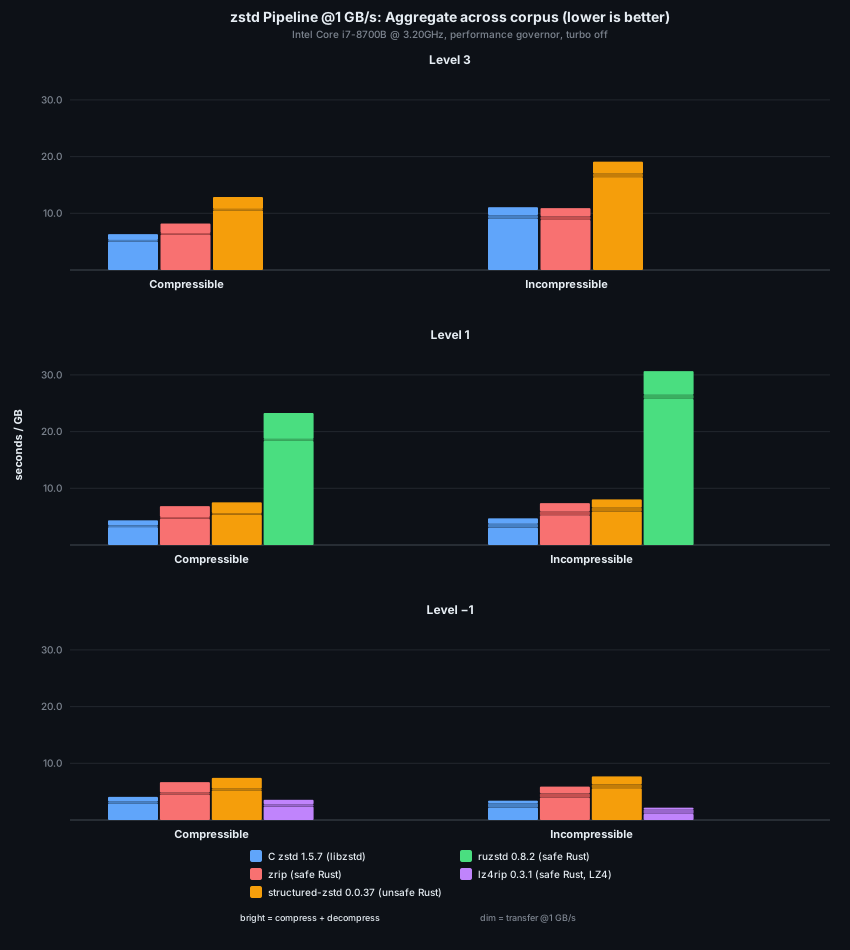
**Fastest pure-Rust zstd encoder available.** 66% faster encode than
structured-zstd at L3, 20% faster at L-1. Faster decode than ruzstd at all
levels and faster decode than structured-zstd at L3 (34%) and L-1 (12%).
**Negative levels (-7..-1) for high-throughput pipelines.** Most zstd
libraries only expose levels 1+.
**`no_std` + `alloc`.** Works in embedded and kernel contexts with the `alloc`
feature; `frame` requires `std`.
**Dictionary compression.** COVER and FastCOVER training built in for
small-message workloads (log lines, JSON records, RPC payloads).
## Performance
Geomean across a 16-file Silesia + misc corpus on Intel i7-8700B (x86_64,
SSE2/AVX2), performance governor, turbo off. Ratio is `original / compressed`;
higher is better.
### zrip vs C zstd
| -7 | Fast | 324 MB/s | 532 | 833 MB/s | 1800 | 2.13x | 2.13x |
| -1 | Fast | 229 MB/s | 383 | 673 MB/s | 1461 | 2.70x | 2.78x |
| 1 | Fast | 193 MB/s | 320 | 566 MB/s | 1047 | 3.13x | 3.33x |
| 2 | Fast | 188 MB/s | 263 | 551 MB/s | 938 | 3.23x | 3.45x |
| 3 | DFast | 155 MB/s | 193 | 689 MB/s | 904 | 3.23x | 3.57x |
| 4 | DFast | 159 MB/s | 183 | 685 MB/s | 872 | 3.23x | 3.70x |
Encode is 40-50% of C zstd at negative levels, closing to ~85% at L3/L4.
Decode is 45-75% of C zstd. Ratio is within 2% at negative levels, widening
to ~13% at L4. The gap is pure Rust vs hand-tuned C with SIMD assembly in its
hot paths.
## API
```rust
// One-shot (allocating)
let compressed = zrip::compress(input, 1)?;
let original = zrip::decompress(&compressed)?;
// One-shot into caller buffer
let n = zrip::compress_into(input, &mut output_buf, 1)?;
zrip::decompress_into(&compressed, &mut output_vec)?;
// Reusable context (amortizes table allocation across calls)
let mut ctx = zrip::CompressContext::new(1)?;
let compressed = ctx.compress(input)?;
let mut dec = zrip::DecompressContext::new();
let original = dec.decompress(&compressed)?;
```
### Streaming
```rust
use std::io::Write;
let mut enc = zrip::FrameEncoder::new(Vec::new(), 1)?;
enc.write_all(b"hello")?;
enc.write_all(b" world")?;
let compressed = enc.finish()?;
use std::io::Read;
let mut dec = zrip::FrameDecoder::new(&compressed[..]);
let mut out = String::new();
dec.read_to_string(&mut out)?;
```
### Dictionary compression
```rust
let dict = zrip::Dictionary::from_bytes(&dict_bytes)?;
let compressed = zrip::compress_with_dict(input, 1, &dict)?;
let original = zrip::decompress_with_dict(&compressed, &dict)?;
```
## Features
| `std` | yes | Enables `CompressContext`, `DecompressContext` |
| `frame` | yes | Frame header parsing and writing; implies `std` |
| `alloc` | yes | `no_std` + heap via `alloc` crate |
| `dict_builder` | no | COVER/FastCOVER dictionary training |
| `nightly` | no | `#[optimize]` attributes on hot functions |
## Safety
All compression and decompression logic is `#![forbid(unsafe_code)]`. Unsafe
is confined to two places:
- `unchecked.rs` modules inside `bitstream/`, `decode/`, `encode/`, `fse/`,
`huffman/`: small `unsafe fn` wrappers (`get_unchecked`, `read_unaligned`)
with `debug_assert!` guards, called only after block-level bounds checks.
- `simd/`: intrinsics and raw pointer arithmetic for wildcopy, copy-match,
and the SIMD sequence decoder. Dispatch happens at block boundaries, not
per-sequence.
## Levels
| -7 | Fast | Fastest; 16 KiB window, aggressive skip |
| -6..-1 | Fast | Progressively larger target lengths |
| 1 | Fast | Standard L1; 512 KiB window |
| 2 | Fast | Larger window, 5-byte min match |
| 3 | DFast | Dual hash table (short + long) |
| 4 | DFast | Larger window; best ratio in this crate |
Level 0 is not valid; use 1 for the standard fast level. All levels match
C zstd's `ZSTD_defaultCParameters` table.