# Yolop
[](https://github.com/everruns/yolop/actions/workflows/ci.yml)
[](LICENSE)
[](https://crates.io/crates/yolop)
[](https://github.com/everruns/homebrew-tap)
[](AGENTS.md)
A terminal coding agent built on
[`everruns-runtime`](https://crates.io/crates/everruns-runtime). One binary
that plans, edits, runs, and verifies code in your repository — autonomous by
default, with persistent sessions, agent skills, MCP servers, and editor
integration over the Agent Client Protocol.
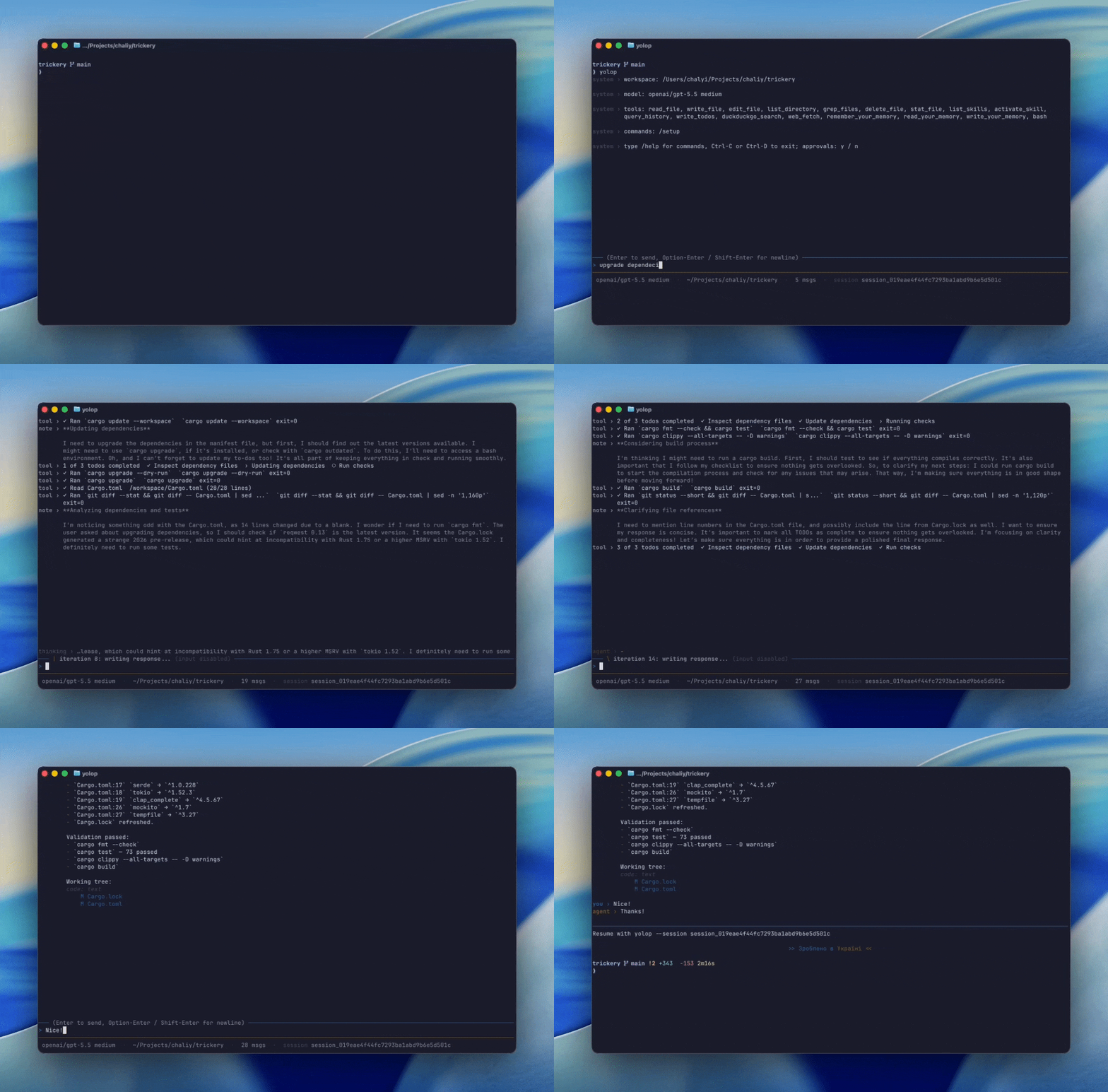
## Origin of the name
`yolop` comes from the Ukrainian `Йолоп`: a dummy, fool, or not-too-bright
person. The name was meant to sound clever and funny in Ukrainian while also
describing the agent's starting point: Yolop avoids per-tool approval pop-ups.
Routine workspace work runs automatically; hard prompts are reserved for the
configured shell boundary, with [soft approval](#soft-approval) for critical
moments that need spoken consent and an audit trail.
## Install
```bash
brew install everruns/tap/yolop
```
Works on macOS (arm64/x86_64) and Linux (x86_64). If your Homebrew enforces
tap trust checks, run `brew trust --tap everruns/tap` once first. Building from
source instead? `cargo install yolop --locked`.
## Quick start
```bash
cd your/repo
yolop
```
First launch with no credentials opens a guided, keyboard-driven setup:
provider → credentials → model. Or set a provider key and go:
```bash
OPENAI_API_KEY=sk-… yolop
yolop -C /path/to/repo # work in a different workspace
yolop -p "summarize the build setup" # one-shot, prints to stdout, no TUI
yolop --provider llmsim -p "hi" # offline demo, no API key required
```
## Features
### Agent core
- **Unrestricted by default** — shell commands get full host access unless you
opt into `workspace-write` containment with `--sandbox` or the `sandbox_mode`
setting. A standing write blocklist always rejects writes into `.git/`,
`node_modules/`, `target/`, and similar build/dependency directories; reads
inside the workspace stay unrestricted.
- **Shell sandboxing** — sandboxed commands run under Seatbelt on macOS or
Landlock + seccomp on Linux. Choose a sandbox mode (`read-only`,
`workspace-write`, or `danger-full-access`, the default) and an approval
policy (`untrusted`, `on-failure`, `on-request` — the default — or `never`)
independently. See
[Shell sandboxing](./docs/features/sandboxing/sandboxing.md).
- **Soft approval** — an optional spoken-consent layer: yolop batches safe work
and pauses, in plain chat, only before destructive or outward-facing steps;
you approve by replying "yes". Set the level with
`/setup approval <protective|normal|off>` or just tell yolop to be more or
less careful. See [Soft approval](#soft-approval) and
[Approvals](./docs/features/approvals.md).
- **TUI chat** (ratatui) — scrolling transcript with tree-sitter syntax
highlighting of fenced code blocks, a multiline composer, a live status bar,
slash commands (`/help`, `/tools`, `/mcp`, `/setup`, `/model`, `/goal`,
`/shell`, `/background`, …), a `Ctrl+B` background-tasks panel, `!<command>`
as a direct shell shortcut, `@`-triggered file-path completion, and shell-style
history recall (`↑`/`↓`, `Ctrl+R`) persisted across sessions.
- **Side questions** — `/btw <question>` answers out-of-band using the current
session context, with no tools and nothing added to conversation history.
- **Goal loops** — `/goal <condition>` keeps working across turns until a
separate evaluator model confirms the condition; `/goal clear` stops early.
Works in `--print` mode too.
- **Planning** — `write_todos` keeps multi-step tasks on track, and loop
detection stops the model from retrying the same failing tool call.
- **One-shot mode** — `--print` runs a single prompt non-interactively, for
scripts and CI.
### Tools
- **Filesystem** — `read_file`, `write_file`, `edit_file`, `list_directory`,
`grep_files`, `delete_file`, `stat_file`, backed by the real workspace disk.
- **Repo map** — `repo_map` and `repo_symbols` build an on-demand multi-language
symbol overview for orientation before targeted grep/read. See
[Repo map](./docs/features/repo-map/repo-map.md).
- **AST grep** — `ast_grep` runs read-only structural pattern search across
Rust, Python, TypeScript/TSX, JavaScript/JSX, C#, Go, CSS, HTML, and Bash.
- **AST edit** *(optional, off by default)* — `ast_edit` applies pattern
rewrites with a preview-first `dry_run` flow. Enable with
`[[capabilities]] ref = "ast_edit"` in `settings.toml`.
- **LSP** *(optional, off by default)* — real language servers (rust-analyzer,
typescript-language-server, pyright, gopls, clangd, or any configured binary)
behind `lsp_diagnostics`, `lsp_definition`, `lsp_references`, `lsp_hover`,
`lsp_rename` (workspace-wide), `lsp_symbols`, and `lsp_code_actions`. Enable
with `[[capabilities]] ref = "lsp"` in `settings.toml`.
- **Shell** — `bash -lc` from the workspace root, with a 120 s timeout and a
1 MiB per-stream output cap (overflow spills to the session folder and stays
readable for tool calls). Run a command directly with `/shell <command>` or
`!<command>`.
- **Background tasks** — `spawn_background` runs a shell command detached from
the current turn (e.g. watching CI): it streams to a log, writes a
`result.json`, and tracks a session task you inspect with `list_tasks`,
`get_task`, and `cancel_task` (or the `/background` command and `Ctrl+B`
panel). Detached commands may run up to 24 hours and their results survive a
restart. `spawn_background` can also schedule one-shot or recurring monitors;
when a schedule fires or a task finishes while the session is idle, yolop
proactively wakes the agent (disable with `proactive_wake`).
- **Web** — `free_web_search`, `web_fetch` (HTTP GET/HEAD with markdown/text
conversion and DNS-pinned SSRF protection), and `duckduckgo_instant_answer`,
all working without an API key. Set `EVERRUNS_SYSTEM_ALLOWLIST_ENABLED=true`
to restrict `web_fetch` to a curated allowlist of well-known public resources.
### Context engineering
- **`AGENTS.md`** — project instructions re-read every turn.
- **Workspace context** — root, shell, local date/timezone, and Git
identity/branch injected automatically.
- **Memory** — a structured `MEMORY.md` of durable, cross-session memories,
managed in natural language ("remember that I prefer terse answers") via the
`remember` / `recall` / `forget` tools. Only titles are injected each turn;
bodies are recalled on demand, so the prompt stays small however much you
remember.
- **Skills** — `SKILL.md` files discovered from workspace (`.agents/skills/`),
global, ephemeral environment, and bundled scopes, exposed via `list_skills`,
`read_skill`, `write_skill`, and `activate_skill`. Skills installed after
startup are available immediately.
- **OKF knowledge** — a bundled `okf` skill for the
[Open Knowledge Format](https://okf.md/spec/): read, author, convert to, and
validate knowledge bundles. See [OKF](./docs/features/okf/okf.md).
- **Herdr-aware sessions** — when launched in a Herdr pane, Yolop reports
`working` / `idle` / `blocked` lifecycle states and exposes read-only Herdr
guidance without installing a global skill.
- **Infinity context** — older history is trimmed out of the live prompt but
stays queryable via `query_history`, so long sessions don't hit the wall.
- **Tool search** — core file/shell tools stay loaded while long-tail tools are
hidden until the model pulls them in, saving input tokens on every provider.
- **Compaction & caching** — at 85% of the model's context window, supported
providers replace old input with a native compact checkpoint plus the new
suffix (raw history stays lossless and searchable), and Anthropic
prompt-caching markers are emitted out of the box.
### Extensibility
- **Extensions** — installable capability packages that add tools, prompt
guidance, MCP servers, and hooks without rebuilding yolop, over the yolop
extension protocol (YEP). Install from crates.io with no Rust toolchain, a git
URL, or a local path; author one with the
[`yolop-yep`](./crates/yolop-yep) SDK. See
[docs/extensions.md](./docs/extensions.md).
- **MCP servers** — extra tools from local (stdio) or remote (HTTP)
[Model Context Protocol](https://modelcontextprotocol.io) servers. See
[MCP servers](#mcp-servers).
- **Hooks** — workspace and global hooks can block, mutate, or audit agent
actions. Configure them by chatting with yolop or by editing `hooks.json`. See
[docs/features/hooks.md](./docs/features/hooks.md).
- **Editor integration** — `--acp` speaks the
[Agent Client Protocol](https://agentclientprotocol.com) over stdio, so
editors such as Zed can drive yolop. See
[Editor integration](#editor-integration-acp).
- **Sessions & rewind** — a durable per-session event log with auto-generated
titles; resume any conversation with `--session <id>`. Every turn gets a
checkpoint, and `/undo`, `/redo`, and `/rewind` restore conversation or
workspace state without touching `HEAD` or the Git index. See
[Session persistence](#session-persistence).
- **Session search** — `search_sessions` finds recent local sessions by a
distinctive phrase, keeping investigations grounded in the saved event log.
### Providers
| OpenAI | `OPENAI_API_KEY` | `gpt-5.6-sol` |
| Codex subscription | browser/device ChatGPT login or `CODEX_ACCESS_TOKEN` | `gpt-5.6-sol` |
| Anthropic | `ANTHROPIC_API_KEY` | `claude-opus-4-8` |
| OpenRouter | `OPENROUTER_API_KEY` | `openai/gpt-5.6-sol` |
| Google | `GEMINI_API_KEY` / `GOOGLE_API_KEY` | `gemini-2.5-flash` |
| Ollama | `OLLAMA_BASE_URL` / `OLLAMA_API_KEY` | `llama3.2` |
| Custom | `CUSTOM_BASE_URL` (+ optional `CUSTOM_API_KEY`) | — (set via `/setup`) |
| llmsim | none (offline simulator) | — |
Pick explicitly with `--provider`, override the model with `-m/--model`. **Codex
subscription** signs in through ChatGPT and uses the Codex backend directly.
**Custom** is any OpenAI-compatible Chat Completions endpoint (vLLM, llama.cpp,
LM Studio, hosted gateways, …).
### Git attribution
On by default. When yolop creates commits it keeps your git identity and appends
`Co-Authored-By: yolop <yolop@everruns.com>` once; PR descriptions created through
`gh` get a `Produced by [yolop](https://everruns.com/yolop)` footer. Disable with
`/setup attribution off`.
### Soft approval
Soft approval is prompt-engineering, not a hard gate: yolop is told to batch
safe work and pause for **spoken** consent only at critical moments. The model
decides what is critical; you approve in plain language ("yes", "approved"); each
grant is recorded to the session event log for audit. There is no separate
approval UI — consent lives in the conversation.
A single `approval_mode` level tunes how cautious yolop is:
| `protective` | any state-changing action (writes, commits, pushes, installs) |
| `normal` | only destructive/irreversible or outward-facing actions (the default) |
| `off` | nothing — fully autonomous, no soft-approval prompt |
The current level shows in the status bar. Change it with
`/setup approval <level>`, or just ask yolop to be more or less careful ("yolo
mode"); the choice persists in `settings.toml`. Soft approval is judgement, not
a guarantee — native shell sandboxing supplies the kernel boundary and hooks can
block specific operations. See
[Shell sandboxing](./docs/features/sandboxing/sandboxing.md) and
[Approvals](./docs/features/approvals.md).
## Editor integration (ACP)
yolop implements the agent side of the [Agent Client
Protocol](https://agentclientprotocol.com). Launch it with `--acp` and it speaks
newline-delimited JSON-RPC 2.0 over stdin/stdout: the editor handshakes, opens a
session, and sends turns; yolop streams back assistant text, reasoning, tool
calls, and plans. Editors can also load an existing session with `session/load`,
replaying the same persisted history used by CLI `--session`.
To set up Zed:
```bash
yolop into zed
```
That adds a custom ACP agent server to `~/.config/zed/settings.json` using the
current yolop executable (preserving any existing `env` on re-run). Then pick
**yolop** in Zed's agent panel.
## MCP servers
Yolop pulls in extra tools from MCP servers — remote (Streamable **HTTP**) and
local (**stdio**) — configured in the standard `.mcp.json` shape. Two scopes are
merged, workspace overriding global by name:
- **workspace**: `<workspace_root>/.mcp.json`
- **global**: `<config_dir>/yolop/mcp.json` (e.g. `~/.config/yolop/mcp.json`)
```json
{
"mcpServers": {
"docs": {
"type": "http",
"url": "https://example.com/mcp",
"headers": { "Authorization": "Bearer ${DOCS_TOKEN}" }
},
"fs": {
"type": "stdio",
"command": "mcp-server-filesystem",
"args": ["${WORKSPACE}"],
"env": { "RUST_LOG": "info" }
}
}
}
```
- `type` defaults to `http`; HTTP servers need a `url`, stdio servers a `command`.
- String values support `${VAR}` expansion from the environment, so secrets stay
out of the file (an unset `${VAR}` is left as-is).
- Discovered tools are exposed as `mcp_<server>__<tool>`.
Manage servers from the CLI with `yolop mcp`, or from a session with `/mcp`:
```bash
yolop mcp list --scope effective
yolop mcp add linear --scope global --type http --url https://mcp.linear.app/mcp --auth-mode oauth --oauth-provider-id linear
yolop mcp enable linear --scope global
yolop mcp remove linear --scope global
```
In a session, `/mcp` lists startup servers and
`/mcp enable|disable|remove <name> [global|workspace]` updates the config;
changes take effect in the next session.
**Trust model:** HTTP requests keep yolop's DNS-pinned SSRF protection; stdio
servers run local processes you listed yourself, so authoring `.mcp.json` is the
act of consent. MCP tools run autonomously like the rest of yolop's tools.
## Reference
### Flags
| `-C, --cwd <PATH>` | Workspace root (default: current dir) |
| `--provider <P>` | Force `anthropic`, `codex`, `openai`, `google`, `openrouter`, `ollama`, `custom`, or `llmsim` |
| `-m, --model <ID>` | Override the model id for the chosen provider |
| `-p, --print <PROMPT>` | Run one prompt non-interactively and print the result |
| `--acp` | Speak the Agent Client Protocol over stdio (for editors like Zed) |
| `--session <ID>` | Resume a previous session by id |
| `--session-dir <PATH>` | Override the parent directory for session folders |
| `--sandbox` | One-run `workspace-write` containment without changing settings |
| `--reasoning-effort <E>` | Reasoning effort override when the model profile supports it |
| `--trajectory-out <PATH>` | Write the session as an [ATIF](https://github.com/harbor-framework/harbor/blob/main/rfcs/0001-trajectory-format.md) v1.7 trajectory JSON at end of run |
### Commands
| `yolop version` | Print yolop, commit, and runtime versions |
| `yolop into zed` | Configure yolop as a custom ACP agent in Zed |
| `yolop mcp …` | Manage MCP servers (see [MCP servers](#mcp-servers)) |
`RUST_LOG` is honored for the underlying tracing layer (writes to stderr).
### Provider env vars
| `OPENAI_API_KEY` | Select OpenAI unless `--provider` overrides |
| `CODEX_ACCESS_TOKEN` | Select Codex subscription auth |
| `ANTHROPIC_API_KEY` | Select Anthropic when OpenAI is not configured |
| `OPENROUTER_API_KEY` | Select OpenRouter when OpenAI/Anthropic are not configured |
| `GEMINI_API_KEY` / `GOOGLE_API_KEY` | Select Google Gemini via its OpenAI-compatible endpoint |
| `OLLAMA_BASE_URL` | Select Ollama, defaults to `http://localhost:11434/v1` |
| `CUSTOM_BASE_URL` | Select the custom OpenAI-compatible endpoint |
| `EVERRUNS_CLI_MODEL` | Override the auto-selected default model |
| `EVERRUNS_CLI_REASONING_EFFORT` | Reasoning effort override when the model profile supports it |
Each provider also accepts an optional base-URL / key override
(`OPENROUTER_BASE_URL`, `GOOGLE_BASE_URL`, `OLLAMA_API_KEY`, `CUSTOM_API_KEY`).
At runtime the per-provider env var always beats a saved token, so a per-run
override is always possible.
### Settings
A TOML file at `<config_dir>/yolop/settings.toml` persists your preferred
provider, per-provider model picks, custom base URLs, the soft-approval level,
sandbox mode and approval policy, Codex login metadata, and (optionally) API
tokens (`~/.config/yolop/settings.toml` on Linux,
`~/Library/Application Support/yolop/settings.toml` on macOS,
`%APPDATA%\yolop\settings.toml` on Windows).
You rarely edit it by hand: the TUI's `/setup`, `/model`, and `/effort` commands
update the active provider, keys, model, and reasoning effort, and yolop can read
and edit the file itself through the `get_config` / `set_config` tools or the
`yolop-config` skill (e.g. "use anthropic by default", "store my OpenAI key").
Unknown keys are ignored, so the format stays forward-compatible.
**Provider resolution at startup:** `--provider` wins, then the saved
`default_provider`, then auto-detect in the order **OpenAI → Codex → Anthropic →
OpenRouter → Google → Ollama → Custom** (first with a matching env var or saved
credential), then a fall back to OpenAI's default with setup opened.
The settings file is written `0o600` on Unix and token values are never echoed,
but it is plain text on disk — treat it like `~/.aws/credentials`.
### Session persistence
Every run writes a durable per-session folder under the platform user-data
directory:
| Linux | `$XDG_DATA_HOME/yolop/sessions/<session_id>/` (typically `~/.local/share/…`) |
| macOS | `~/Library/Application Support/yolop/sessions/<session_id>/` |
| Windows | `%APPDATA%\yolop\sessions\<session_id>\` |
The folder holds the event log (`events.jsonl`), compaction checkpoints, the
saved workspace root, and spilled tool output — everything needed to restore the
transcript and provider continuation state on resume. On Unix the folder is
`0o700` and its files `0o600`. Resume a conversation with:
```bash
yolop --session session_019e3db018a17450aba5407af5777237
```
Resume reuses the workspace root saved for that session unless you pass
`-C <PATH>`; `--session-dir <PATH>` overrides where session folders are stored
(handy for per-workspace histories in `<workspace>/.yolop/sessions/`).
Interactive sessions checkpoint before every turn. `/undo` previews a restore to
before the latest turn, `/rewind` lists and restores earlier checkpoints, and
`/redo` previews the last abandoned branch; each restore returns a token you
confirm with `confirm <token>`. Workspace restore is available only in a
Yolop-owned worktree and never changes the branch, `HEAD`, commits, or index.
> **Treat session logs as you would shell history.** They contain every prompt,
> every string passed to `bash` / `write_file` / `web_fetch`, tool output, and
> reasoning artifacts — deliberately unredacted, with no retention policy. If a
> session should not be persisted, point `--session-dir` at a wipeable path (e.g.
> a `tmpfs`) or delete the JSONL after the run.
## Contributing
Development setup, validation commands, and local smoke tests live in
[`CONTRIBUTING.md`](./CONTRIBUTING.md). Please report vulnerabilities through
[`SECURITY.md`](./SECURITY.md), and follow the
[`CODE_OF_CONDUCT.md`](./CODE_OF_CONDUCT.md) when participating.
## Benchmarking
[`evals/`](./evals/) holds yolop's [Mira](https://github.com/everruns/mira) eval
studies. [`evals/swebench_verified/`](./evals/swebench_verified/) benchmarks
yolop on **SWE-bench Verified** and, behind the same interface, other terminal
agents for head-to-head comparison. See [`evals/README.md`](./evals/README.md).
## Releases
Yolop ships to the `everruns/homebrew-tap` Homebrew tap and to crates.io as the
`yolop` crate. See [`CHANGELOG.md`](./CHANGELOG.md) for what shipped in each
version.
## License
MIT — see [`LICENSE`](./LICENSE).

